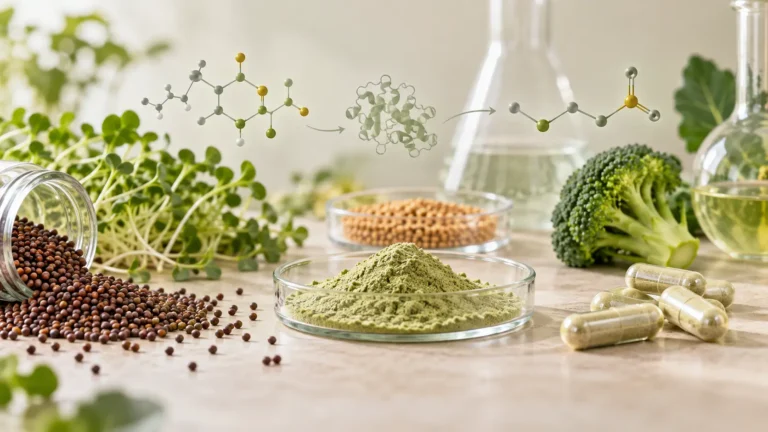
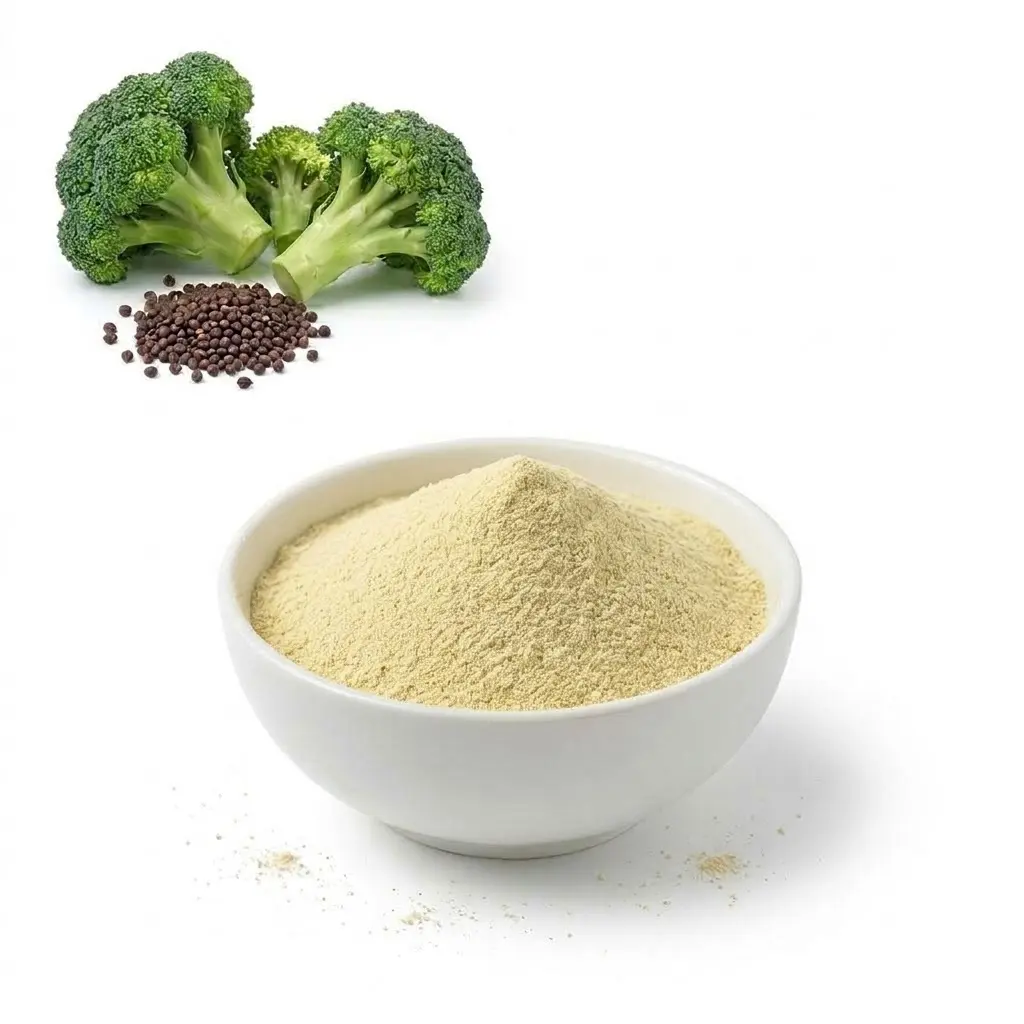
Broccoli Seed Extract
- Source
- Brassica oleracea var. italica · Seeds
- Origin
- China · Broccoli seeds
- Standardization
- Glucoraphanin 1% / 10% / 13% · Sulforaphane 0.1%–13%
- Extract Type
- Aqueous extraction · Standardized GR / Stabilized SF
- Quality
- GMP · ISO 22000 · FSSC 22000 · HACCP · Halal · Kosher
- Key Compounds
- Glucoraphanin · Sulforaphane · Myrosinase
- Applications
- Dietary supplements · Cellular defense formulas · Skin care
MOQ
1 kg
Lead time
7–15 days
Quotation
24 hours
Samples
Free
Bulk Broccoli Seed Extract Supplier — Glucoraphanin 1%, 10%, 13% & Sulforaphane 0.1–13%
Nine ingredient grades for supplement and formulation development
Written by Flora · Updated October 2026
PhytoVale supplies broccoli seed extract (Brassica oleracea var. italica) standardized to glucoraphanin 1%, 10% and 13% or sulforaphane 0.1%, 0.5%, 1%, 5%, 10% and 13%. All grades are produced by aqueous extraction in our own GMP-, ISO 22000-, FSSC 22000-, HACCP-, Halal- and Kosher-certified facility. For preformed sulforaphane formulations, our 5% β-cyclodextrin-stabilized option is offered with ambient-storage instructions, while the concentrated 10% option specifies storage at −4°C. A separate red-cabbage myrosinase preparation (≥220 U/g) supports GR-plus-enzyme development.
The choice depends on whether a formula calls for a stable GR precursor, a measured preformed SF ingredient, or a GR-plus-enzyme delivery system. Not sure which route fits your formula? Read our Glucoraphanin vs Sulforaphane decision guide. The comparisons below connect each approach to capsule loading, carrier selection, manufacturing conditions and the quality records used by professional buyers.
00 · Quick grade comparison
Choose Your Starting Point
All nine grades and the separate myrosinase option side by side. Compare the active compound, typical fill weight at a sample target, storage condition and shelf life in one view, then read the relevant section for formulation detail.
| Grade | Active compound | Assay method | Fill at target | Carrier / stabilization | Storage | Shelf life |
|---|---|---|---|---|---|---|
| GR 1% | Glucoraphanin | HPLC | 5,000 mg @ 50 mg GR | Extract matrix | Cool, dry, sealed | 24 mo |
| GR 10% | Glucoraphanin | HPLC | 500 mg @ 50 mg GR | Extract matrix | Cool, dry, sealed | 24 mo |
| GR 13% | Glucoraphanin | HPLC | 385 mg @ 50 mg GR | Extract matrix | Cool, dry, sealed | 24 mo |
| SF 0.1% | Sulforaphane | HPLC / LC-MS | 5,000 mg @ 5 mg SF | Grade-specific | Per grade sheet | 24 mo |
| SF 0.5% | Sulforaphane | HPLC / LC-MS | 1,000 mg @ 5 mg SF | Grade-specific | Per grade sheet | 24 mo |
| SF 1% | Sulforaphane | HPLC / LC-MS | 500 mg @ 5 mg SF | Grade-specific | Per grade sheet | 24 mo |
| SF 5% | Sulforaphane | Validated assay | 100 mg @ 5 mg SF | β-CD stabilized | Ambient, sealed | 24 mo |
| SF 10% | Sulforaphane | Validated assay | 50 mg @ 5 mg SF | Concentrated SF | −4°C | 24 mo |
| SF 13% | Sulforaphane | Validated assay | 38.5 mg @ 5 mg SF | High-load carrier | Per grade sheet | 24 mo |
| Myrosinase | ≥220 U/g | Sinigrin-substrate | Separate addition | Red cabbage | Dry, avoid heat | 24 mo |
Fill weights are formulation arithmetic at the stated assay, not recommended doses. To compare supplier offers, divide landed cost per kilogram by the measured active fraction to obtain cost per kilogram of target compound.
01 · Commercial grades
Broccoli Seed Extract Grades and Supply Formats
PhytoVale offers three glucoraphanin grades and six sulforaphane grades. Glucoraphanin is a glucosinolate precursor, whereas sulforaphane is the corresponding isothiocyanate. The product families are sold against different active-compound assays; they are not interchangeable percentages.
| PhytoVale grade | Primary standardization | Supply and formulation notes |
|---|---|---|
| Glucoraphanin 1% | GR · HPLC | Lower-strength precursor for flexible-blend development; larger powder input at a fixed GR target |
| Glucoraphanin 10% | GR · HPLC | Standardized precursor grade for capsules, tablets and GR/myrosinase pairing |
| Glucoraphanin 13% | GR · HPLC | Higher-density precursor grade; 13% GR is also the minimum assay threshold in the USP Broccoli Seed Dry Extract definition on the dried basis |
| Sulforaphane 0.1%, 0.5%, 1% | SF · validated HPLC or LC-MS | Lower-load SF options for applications targeting smaller quantities per serving |
| Sulforaphane 5% | SF · validated assay | β-cyclodextrin-stabilized option; supplied with ambient-storage instructions in sealed, dry packaging |
| Sulforaphane 10% | SF · validated assay | Concentrated SF option with −4°C storage instruction; account for controlled-temperature logistics |
| Sulforaphane 13% | SF · validated assay | High-load option; handling, composition and storage described in its own grade documentation |
Separate enzyme option: Myrosinase from red cabbage (Brassica oleracea var. capitata f. rubra), with a stated activity specification of ≥220 U/g. Sinigrin-substrate testing is used to characterize enzyme activity; the activity unit and assay conditions are defined in the relevant technical sheet. Myrosinase is a separate ingredient rather than an implied constituent of every GR or SF powder. For enzyme formulation guidance, see Formulating with Myrosinase.
A formulation specifying GR milligrams per serving is generally best compared among the 1%, 10% and 13% precursor grades; when a label concept specifies preformed SF milligrams, the SF range offers a separate choice with different carrier and storage implications.
The USP Broccoli Seed Dry Extract monograph specifies at least 13% GR on the dried basis for the material defined there. Meeting a GR percentage alone does not establish full USP conformity or constitute USP certification.
02 · Bioactive constituents
Key Compounds and the KEAP1–NRF2 Pathway
The biological literature focuses on sulforaphane's interactions with the KEAP1–NRF2–ARE signaling system, a transcriptional pathway involved in cellular responses to electrophilic and oxidative stress. These mechanistic findings describe studied compounds, not clinical efficacy of any finished formulation.
| Constituent | Role in an ingredient system | Processing consideration |
|---|---|---|
| Glucoraphanin (GR) | Principal assay marker for the 1%, 10% and 13% precursor grades; can be hydrolyzed to SF | Generally more suitable for dry precursor storage; protect from moisture if active enzyme is also present |
| Sulforaphane (SF) | Preformed isothiocyanate studied as a KEAP1–NRF2 modulator | Heat, oxygen and water exposure can reduce retention; stabilization is relevant to concentrated grades |
| Myrosinase | Enzyme catalyzing GR hydrolysis; separate red-cabbage option ≥220 U/g | Protect enzyme activity during processing; sinigrin U/g and SF yield answer different questions |
Glucobrassicin is a minor indole glucosinolate that may occur in less purified Brassica extracts. It is not a standardized marker for PhytoVale's listed GR/SF grades.
03 · Product development
Formulation Applications: Match the Grade to the Product
Liver-Related and Phase II Enzyme Research Formulas
For dry capsules developed around the study of glutathione-related and NRF2-regulated pathways, GR 10% and 13% are practical starting points. At an illustrative 50 mg GR target, the 10% grade requires 500 mg of extract and the 13% grade approximately 385 mg — saving about 115 mg of capsule space. A GR-plus-myrosinase formulation can also be explored using the separate ≥220 U/g red-cabbage enzyme, ideally kept dry until use and assessed for both enzyme activity and actual SF formation.[7]
Antioxidant and Cellular-Defense Supplements
When a formulation specifies a measured amount of preformed SF, the 5% and 10% grades offer a clear manufacturing trade-off. A 5 mg SF target requires approximately 100 mg of a 5% ingredient or 50 mg of a 10% ingredient, calculated from the declared assay before processing losses. The 5% β-cyclodextrin-stabilized option supports ambient-storage supply; the 10% option reduces powder input but specifies −4°C storage. Price comparisons need to account for carrier-related mass, capsule capacity and cold-chain handling, not simply the price per kilogram of powder.
Skin-Health and Cosmetic Research
In a small 2007 human proof-of-concept study, a topical broccoli sprout-derived preparation was associated with reduced UV-induced skin redness at treated sites.[5] It was not a test of PhytoVale's seed extract, an oral beauty supplement or a finished sunscreen. For cosmetics, identify the correct raw material and INCI name, then confirm carrier compatibility and SF retention in the final formula.
Dosage-Form Compatibility
A manufacturing team should connect the intended compound to actual process conditions before pilot scale.
| Dosage form | Grades worth screening | Main pilot check |
|---|---|---|
| Dry capsules / tablets | GR 10%, 13%; stabilized SF 5%, 10% | Fill weight, assay per serving, compression and stability |
| GR + enzyme products | GR 10% or 13% + red-cabbage myrosinase ≥220 U/g | Residual enzyme activity and actual SF generation on activation |
| Powder sticks and blends | GR 1%, 10%; suitable SF grades | Blend uniformity, water activity and carrier interactions |
| Gummies / chewables | Selected grade after heat and pH trials | SF retention through processing and intended shelf life |
| Beverages / liquids | Only grades validated for the liquid system | Dispersion, oxidation, pH and temperature exposure |
| Topical cosmetics | Identity-matched ingredient | Correct INCI, carrier, skin tolerance and final-formula stability |
04 · Carrier and storage
Sulforaphane Stabilization and Storage
PhytoVale's 5% SF β-cyclodextrin-stabilized option is supplied for ambient storage in its sealed, dry packaging. The 10% SF grade specifies −4°C storage. These are grade-specific handling instructions, not a rule that every 5% or 10% sulforaphane material has the same temperature tolerance. The 13% SF option is handled according to its individual grade sheet. All grades carry a 24-month shelf life when stored according to the stated conditions.
The scientific basis for stabilization is well established. Published studies show that inclusion complexes with hydroxypropyl-β-cyclodextrin (HP-β-CD) and maltodextrin-based spray-dried microcapsules can improve SF retention relative to unprotected SF. HP-β-CD and unmodified β-CD are chemically different, so the published result for one material is not an identical performance specification for the other.[3][4]
For a manufacturer comparing 5% and 10% SF, the central question is not whether one powder is simply "stronger." Doubling the stated SF fraction reduces input mass, but chilled shipment and handling may alter the total cost. For a deeper look at where sulforaphane losses actually occur in manufacturing, see Sulforaphane Stability in Manufacturing.
05 · Typical specification
Quality Specification — GR 13% Grade (Reference)
The table below shows the specification range and a representative batch result for the GR 13% grade, produced by aqueous extraction from broccoli seeds. Other grades follow the same quality framework; request a grade-specific COA for exact limits and test methods.
Physical Description
| Item | Specification | Typical result | Method |
|---|---|---|---|
| Appearance | Light brown yellow powder | Conforms | Visual |
| Odor & taste | Characteristic | Conforms | Organoleptic |
| Bulk density (slack / tapped) | — | 0.38 / 0.68 g/ml | USP 616 |
| Particle size | 95% through 80 mesh | Conforms | CP 2020 |
Chemical Tests
| Item | Specification | Typical result | Method |
|---|---|---|---|
| Glucoraphanin | ≥13.0% | 13.74% | HPLC |
| Moisture | ≤5.0% | 1.80% | CP 2020 (40°C, 4 h) |
| Acid-insoluble ash | ≤5.0% | 0.52% | CP 2020 |
Heavy Metals
| Item | Specification | Typical result | Method |
|---|---|---|---|
| Arsenic (As) | ≤0.30 mg/kg | <0.05 mg/kg | GB 5009.11 |
| Lead (Pb) | ≤0.30 mg/kg | <0.05 mg/kg | GB 5009.12 |
| Cadmium (Cd) | ≤0.05 mg/kg | <0.02 mg/kg | GB 5009.15 |
| Mercury (Hg) | ≤0.01 mg/kg | <0.01 mg/kg | GB 5009.17 |
Microbiology
| Item | Specification | Typical result | Method |
|---|---|---|---|
| Aerobic bacterial count | ≤1,000 CFU/g | <10 CFU/g | GB 4789.2 |
| Yeast | ≤100 CFU/g | <10 CFU/g | GB 4789.15 |
| Mold | ≤100 CFU/g | <10 CFU/g | GB 4789.15 |
| Escherichia coli | <3.0 MPN/g | <10 CFU/g | GB 4789.38 |
| Salmonella | Not detected / 25 g | Not detected | GB 4789.4 |
| Staphylococcus aureus | Not detected | Not detected | GB 4789.10 |
Heavy-metal limits shown use the stricter GB national standard. Actual batch results are typically well below stated limits. All grades are non-irradiated. Request a current batch COA for the specific grade and lot number.
06 · Analytical methods
Glucoraphanin, Sulforaphane and Myrosinase: Analytical Testing
PhytoVale lists HPLC-standardized GR grades, HPLC/LC-MS-compatible SF grades and a separate myrosinase option assessed using a sinigrin-substrate activity method. The selected analytical method must distinguish the compound originally present in the powder from SF formed during a deliberate activation test.
| Analyte | Test approach | Report should identify |
|---|---|---|
| Glucoraphanin 1–13% | Validated HPLC/HILIC or LC-MS | Intact GR, reference standard and dry/as-received basis |
| Preformed sulforaphane 0.1–13% | Validated HPLC or LC-MS | Pre-analysis extraction conditions, specificity and actual free/defined SF fraction |
| Enzymatically generated SF | Controlled GR hydrolysis followed by SF assay | Myrosinase source, time, pH and resulting SF yield |
| Red-cabbage myrosinase ≥220 U/g | Sinigrin-substrate activity assay | Unit definition, substrate, temperature, pH and reporting basis |
Sinigrin-based enzyme methods may quantify substrate disappearance or product formation. A common research definition is the amount of enzyme hydrolyzing 1 μmol of sinigrin per minute under stated conditions; however, U/g should always be interpreted using the method applied to the commercial grade. A 220 U/g value measures catalytic activity under the specified assay and should not be described as 220 mg of SF produced per gram or a fixed conversion percentage.
In a 2026 analytical study, conventional high-temperature GC-MS sample introduction caused over 60% SF degradation under one set of conditions; optimization reduced that degradation to below 1%. The lesson is to use a method validated for SF, rather than treating a technique name alone as a guarantee of accuracy.[6] For more on testing pitfalls, see Sulforaphane Stability in Manufacturing.
Measure the starting GR and myrosinase activity, activate the formula under a defined use-relevant protocol, and quantify newly formed SF and remaining GR. This confirms the actual conversion performance without equating the enzyme's U/g figure to an SF yield. See Formulating with Myrosinase for a step-by-step approach.
07 · Human research
Myrosinase and Human Sulforaphane Bioavailability
A 2026 randomized, double-blind crossover trial studied 16 healthy adults given 50 mg GR from an extract standardized to at least 13% GR. Adding mustard-seed myrosinase raised mean 24-hour urinary recovery of SF and its metabolites from 18.6% to 39.8%. Both tested preparations also contained vitamin C.[1]
Urinary metabolite recovery describes the studied product and endpoint, not clinical efficacy or a fixed conversion rate of the separate red-cabbage enzyme option. A 2025 simulated-digestion experiment likewise showed that capsule delivery and formulation ingredients can materially affect SF formation under laboratory conditions.[2] For practical guidance on building a GR + enzyme formula, see Formulating with Myrosinase.
08 · Safety and responsible use
Safety, Tolerability and Formulation Warnings
Concentrated extracts should not be evaluated as if they were simply a serving of cooked broccoli. Safety assessment needs the actual chemical form, daily proposed intake, concentration, other ingredients and target population. In a 2022 randomized crossover trial of a broccoli seed-and-sprout preparation in 49 smokers, the higher GR-dose period had reports of abdominal pain and diarrhea in 20% of participants each, compared with 2% and 6%, respectively, during the lower-dose period. Reported events were grade 1–2. The figures describe that particular studied preparation, not the adverse-event incidence of each grade offered here.[7]
Thyroid considerations should be evidence-based rather than alarmist. A 12-week randomized study of a broccoli sprout beverage in 45 women found no significant effect on the thyroid hormone or autoimmunity measures examined. That is reassuring for the tested intervention but cannot establish unlimited-dose safety for all concentrated GR or SF products, or for people with pre-existing thyroid disease.[8]
Assess gastrointestinal tolerability at the intended intake, pregnancy and breastfeeding data gaps, pediatric or special-population uses, medication use and the allergen profile of all added components. An external myrosinase sourced from mustard seed is not interchangeable with purified broccoli enzyme in allergen documentation; mustard and mustard products are listed allergens under EU Regulation 1169/2011 Annex II. Finished-product safety and labeling remain the responsibility of the marketer.
No disease-treatment or disease-prevention claim is made for this raw material. Nrf2-related experimental findings and changes in urinary metabolites must not be represented as proof that an untested supplement prevents cancer, treats diabetes or "detoxifies" a person.
09 · Regulatory qualification
US and EU Regulatory Compliance: Check the Exact Grade and Use
"Broccoli" is an ordinary food name; a concentrated, purified or specially stabilized broccoli seed ingredient may present a different regulatory question. There is no responsible single statement that makes all nine grades compliant for every dietary supplement, capsule, gummy or drink in the United States and European Union.
| Purchase decision | United States | European Union |
|---|---|---|
| Supplement ingredient identity | Evaluate dietary-ingredient status, history and whether an NDI notification applies. Where required, the notification is submitted at least 75 days before marketing. | Verify the exact extract's Novel Food status and any member-state requirements; conventional vegetable history is not enough to resolve a highly concentrated extract. |
| Conventional food or drink | Determine an independent lawful food-use basis, including applicable food-additive/GRAS considerations and conditions of use; supplement status alone is insufficient. | Verify ingredient eligibility for the proposed food category, including Novel Food and any applicable food-additive conditions. |
| Stabilization carrier | Assess the specific carrier and intended use. FDA GRAS notice GRN 000074 concerns β-cyclodextrin, not a universal approval for every formula. | β-Cyclodextrin (E459) has category-specific permissions and restrictions; its presence does not automatically permit every capsule, gummy or beverage. |
| Claims and allergen declaration | Substantiate relevant structure/function claims and follow required labeling/notification rules; avoid unapproved disease claims. | Review authorized health claims under Regulation 1924/2006 and declare any mustard-derived enzyme ingredients as applicable under Regulation 1169/2011. |
The relevant official starting points are FDA's NDI guidance, FDA's structure/function claims guidance, the EU Novel Food status procedure, the EU food-additive regulation, and the EU health claims framework.
USP's GR monograph, an FDA facility registration, an FDA GRAS notice for an excipient or a published study on cyclodextrin encapsulation does not authorize a finished product by itself. A destination-market review must consider the specific extract, carrier identity and quantity, manufacturer dossier, finished product format, proposed intake and labeling.
10 · Supply capability and quality systems
PhytoVale Manufacturing and Quality Infrastructure
PhytoVale operates its own extraction, blending and packaging lines in Henan, China, with an annual production capacity of 1,200 metric tons across botanical extract product lines. All broccoli seed extract grades are produced under the same quality management framework and use water as the extraction solvent.
Certifications
| Certification | Scope |
|---|---|
| GMP | Manufacturing facility and production processes |
| ISO 22000 | Food safety management system |
| FSSC 22000 | Food safety system certification |
| HACCP | Hazard analysis and critical control points |
| Halal | Halal-certified production |
| Kosher | Kosher-certified production |
Supply and Packaging
| Item | Detail |
|---|---|
| Annual capacity | 1,200 metric tons (across botanical extract lines) |
| Standard packaging | 1 kg / 5 kg / 25 kg — aluminum foil bag (inner), fiber drum or carton (outer) |
| MOQ | 1 kg |
| Lead time | 7–15 business days |
| Custom specifications | Available — contact for target assay, carrier or blend requirements |
| Cold-chain shipping | Controlled-temperature packaging available for −4°C grades; details confirmed at quotation |
11 · PhytoVale technical support
Grade Selection and Documentation for Bulk Buyers
PhytoVale is a factory with its own extraction, blending and packaging capability — not a trading intermediary. Nine standardized grades plus a separate enzyme option cover the three main broccoli-extract development routes (GR precursor, preformed SF, GR + myrosinase) in a single supplier relationship. A 1 kg MOQ allows pilot-scale evaluation before committing to production volumes, and a full certification stack (GMP, ISO 22000, FSSC 22000, HACCP, Halal, Kosher) supports qualification for regulated supplement and food markets worldwide.
We help match the declared compound and concentration to the customer's capsule load, processing conditions, target market and shipping plan. A 5% SF formulation with ambient handling and a 10% grade requiring −4°C can have different total procurement costs even when both deliver the same calculated SF amount.
For technical evaluation, request the current grade-specific COA and assay method, plus the applicable carrier declaration, storage instruction and available quality documentation. Enzyme enquiries can specify the red-cabbage myrosinase ≥220 U/g option and the required sinigrin assay details.
12 · Frequently asked questions
Broccoli Seed Extract FAQs
Which ingredient saves more space in a capsule: GR 10% or GR 13%?
At a 50 mg GR target, 10% GR requires 500 mg of powder and 13% GR requires approximately 385 mg, before other ingredients are added. The compactness advantage may matter in a small vegetarian capsule or a multi-ingredient tablet.
What is the difference between PhytoVale's 5% and 10% SF options?
For a 5 mg SF target, the ingredient amounts are 100 mg and 50 mg respectively. The 5% β-CD-stabilized grade has ambient-storage instructions; the concentrated 10% grade specifies −4°C storage. These differences matter in packaging, storage and delivered-ingredient cost.
Is myrosinase already present in every GR powder?
No. The GR assay does not establish retained enzyme activity. PhytoVale also describes a separate red-cabbage-derived myrosinase option specified at ≥220 U/g for GR-plus-enzyme formulation projects.
Does 220 U/g mean a specified amount of sulforaphane will form?
No. The result describes myrosinase activity in a sinigrin-substrate test under defined conditions. Actual SF yield from GR depends on the blend, activation conditions and competing hydrolysis pathways. See Formulating with Myrosinase for a practical breakdown.
Does β-cyclodextrin count as an added ingredient?
Yes. It is a carrier/stabilization component, not an SF molecule. Include the actual carrier system in raw-material qualification and check the permission for its specific use in the importing market.
Does a USP reference make the 13% GR grade USP certified?
No. USP defines a broccoli seed dry extract with not less than 13% GR on a dried basis, along with other monograph criteria. The numeric percentage alone is not USP verification or a full monograph-conformity claim.
Can these grades be used in gummies, beverages or cosmetics?
Use the grade suited to the process and the destination-market rules. Wet and heated formats need finished-formula stability tests; topical applications additionally require the appropriate cosmetic ingredient identity, safety review and permitted use.
What extraction solvent is used?
Water. All PhytoVale broccoli seed extract grades are produced by aqueous extraction and are non-irradiated.
What certifications does PhytoVale hold?
The production facility is certified under GMP, ISO 22000, FSSC 22000, HACCP, Halal and Kosher. See the Supply Capability section or request the full certification package.
How do I compare cost across different grades?
Divide landed cost per kilogram of ingredient by the actual measured active fraction to obtain cost per kilogram of stated target compound. The final decision also depends on manufacturing loss, added matrix materials, packaging and any refrigerated logistics for −4°C grades.
13 · Selected science
Eight References Supporting the Technical Discussion
These publications support the scientific discussion. Commercial grade details and handling instructions are supplied as PhytoVale product information; the cited studies do not constitute batch-specific COAs or stability certificates. Official USP and regulatory sources are linked in the relevant sections.
[1] Mastaloudis A, et al. (2026). Exogenous myrosinase from mustard seed increases bioavailability of sulforaphane from a glucoraphanin-rich broccoli seed extract in a randomized clinical study. Scientific Reports. DOI: 10.1038/s41598-026-39389-4.
[2] Zhu et al. (2025). Optimization of sulforaphane bioavailability from a glucoraphanin-rich broccoli seed extract in a model of dynamic gastric digestion and absorption by Caco-2 cell monolayers. Food & Function. DOI: 10.1039/D4FO04561K.
[3] Wu H, et al. (2010). Preparation and stability investigation of the inclusion complex of sulforaphane with hydroxypropyl-β-cyclodextrin. Carbohydrate Polymers. DOI: 10.1016/j.carbpol.2010.05.020.
[4] Wu Y, et al. (2014). Stability and encapsulation efficiency of sulforaphane microencapsulated by spray drying. Carbohydrate Polymers. DOI: 10.1039/D4FO04561K.
[5] Talalay P, et al. (2007). Sulforaphane mobilizes cellular defenses that protect skin against damage by UV radiation. Proceedings of the National Academy of Sciences 104(44):17500–17505. DOI: 10.1073/pnas.0708710104.
[6] Melini V, et al. (2026). Sulforaphane Determination by GC-MS Analysis: Mitigation of Thermal Degradation and Quality Evaluation of Two Broccoli-Based Supplements. Molecules 31(15):2598. DOI: 10.3390/molecules31152598.
[7] Bauman JE, et al. (2022). Randomized Crossover Trial Evaluating Detoxification of Tobacco Carcinogens by Broccoli Seed and Sprout Extract in Current Smokers. Cancers 14(9):2129. DOI: 10.3390/cancers14092129.
[8] Chartoumpekis DV, et al. (2019). Broccoli sprout beverage is safe for thyroid hormonal and autoimmune status: Results of a 12-week randomized trial. Food and Chemical Toxicology. PubMed study record.
PhytoVale · Botanical ingredients
Source a Broccoli Seed Extract Grade for Your Formula
Tell us whether your specification is based on glucoraphanin or sulforaphane, your intended formula and destination market. We can review the matching grade designation and the technical information available for qualification before a bulk order.
Request COA & bulk quotation → Explore other ingredients →For professional B2B ingredient evaluation only. Published results relate to the formulations actually studied. The nine listed commercial grades are subject to batch qualification; this page does not assert product-specific carrier composition, enzyme activity, storage life or regulatory approval without supporting documents. Finished-product marketers and importers are responsible for their own formulation, safety, claims and destination-market compliance. © 2026 PhytoVale.
Related Botanical Ingredients
 Ube PowderKey specification: Anthocyanins
CAS N/A
100% purple yam powder
 Apple Cider Vinegar PowderKey specification: Acetic acid
CAS 64-19-7
5%, 10% total acid
 Astragalus Root ExtractKey specification: Astragaloside IV, Polysaccharides
CAS 84687-43-4
AS-IV 0.1–10%; APS 40–90%
 Black Ginger ExtractKey specification: 5,7-Dimethoxyflavone
CAS 21392-57-4
1%, 2%, 5%, 8%, 10% DMF (HPLC)
 How to Formulate a GR + Myrosinase Capsule That Actually Generates Sulforaphane→How to Formulate a GR + Myrosinase Capsule That Actually Generates Sulforaphane WRITTEN BY Flora / OCTOBER 27,…
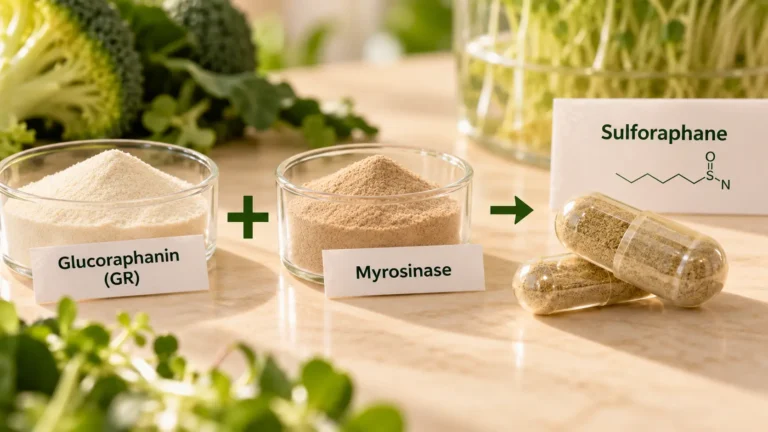 Glucoraphanin vs Sulforaphane: Which Form Does Your Supplement Formula Actually Need?→Glucoraphanin vs Sulforaphane: Which Form Does Your Supplement Formula Actually Need? WRITTEN BY Flora / OCTOBER 26, 2026…