

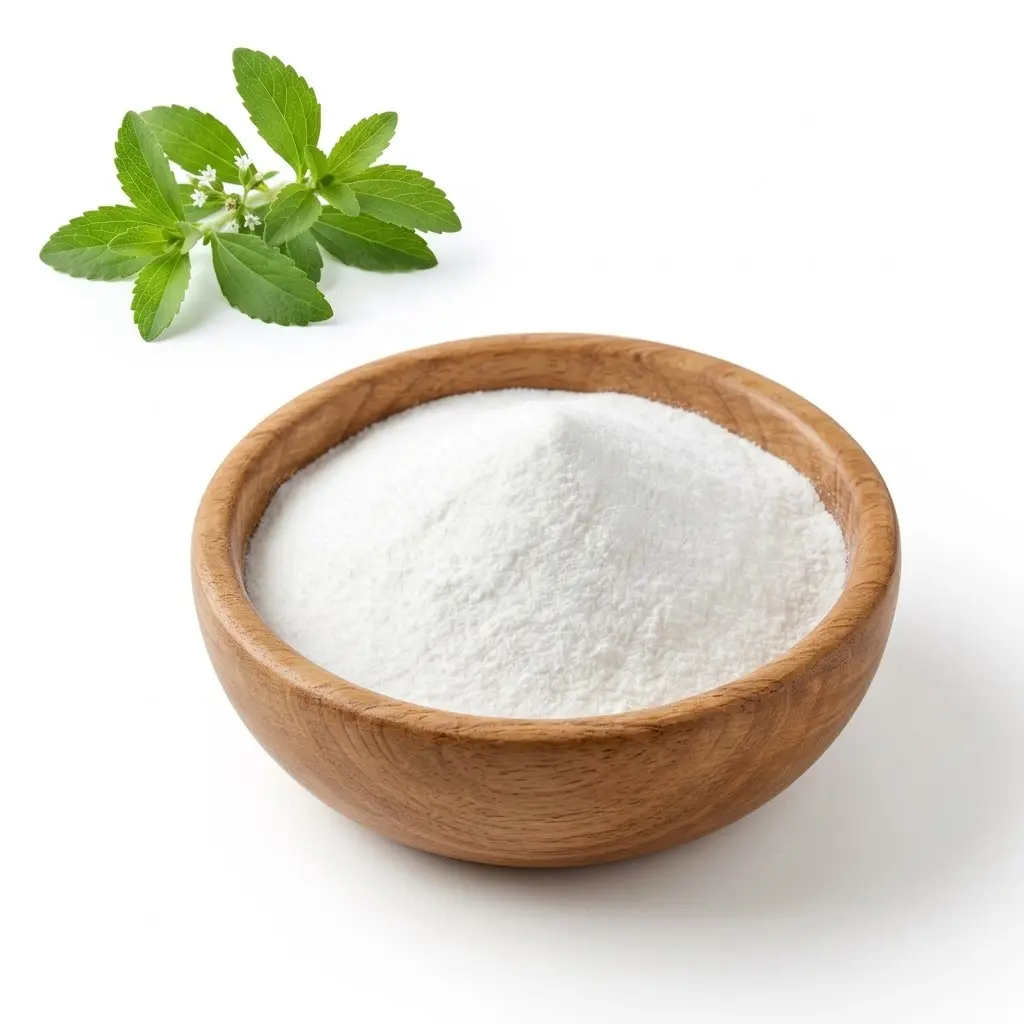
Stevia rebaudiana Bertoni
Rebaudioside D
- CAS number
- 63279-13-0
- Grades
- RD95 · RD98
- EU additive
- E 960c(iii), not E 960a
- Certification
- EU 2018/848 · USDA NOP
- Batch testing
- Recombinant DNA · Residual protein · HPLC, every batch
- Typical use
- 10% to 30% of glycoside in a Reb A base
MOQ
1 kg
Lead time
7–15 days
Quotation
Within 24 hours
Samples
Free · freight credited
Rebaudioside D Supplier — RD95 and RD98 for Blended Sweetener Systems, Conventional and Organic
Written by Flora · Reviewed by Xinjuan Xu, Associate Professor · Updated September 2026
PhytoVale manufactures RD95 and RD98 by enzymatic conversion from our own high-purity Rebaudioside A, using UDP-glucosyltransferase and sucrose synthase produced in house. Both grades come conventional or certified organic under Regulation (EU) 2018/848 and USDA NOP, and every batch is tested for residual recombinant DNA and residual protein. MOQ 1 kg, free samples with freight credited to your first order, quotation within 24 hours.
Reb D is rarely the whole answer to a sweetener brief, and it is not sold here as one. It earns its place inside a blend, where it lifts the temporal profile of a Reb A base without the cost of going fully to Reb M, and where its own low solubility is carried by the rest of the system. This page is built around that role: how much to use, what to pair it with, and the one specification parameter that has already sunk an enzymatic Reb D dossier at EFSA.
01 · Role
What Rebaudioside D Is Actually For
Most enquiries for Reb D arrive framed the wrong way, as though it were a cheaper Reb M. Within our stevia extract range it plays a different part from either neighbour. It is better understood as a different tool. Reb D has a better sugar character and taste profile than Rebaudioside A, but is less water soluble than Reb A, and that combination is exactly what makes it a component rather than a sole sweetener.
In a blend, both halves of that trade work in your favour. The improved temporal profile is contributed at a small inclusion rate, where the solubility penalty is still comfortably absorbed by the rest of the system. Used alone at full sweetness, the same two properties fight each other.
Like Rebaudioside M, Reb D occurs in stevia leaf in quantities too small for direct extraction to be commercially viable, at roughly 0.4% to 0.5% of dry leaf weight for the two glycosides combined. Enzymatic conversion from purified Rebaudioside A is the practical route, and it is the route we use.
02 · Product data
Rebaudioside D Quick Reference
| Property | Value | What it means in practice |
|---|---|---|
| Grades | RD95, not less than 95% Reb D. RD98, not less than 98% Reb D | RD95 covers most blending work; RD98 where the balance fraction would interfere |
| CAS number | 63279-13-0 | Use alongside the E number on customs and QA paperwork |
| Molecular formula and weight | C50H80O28, approx. 1129 g/mol | Five glucose units, between Reb A at four and Reb M at six |
| Appearance | White to off-white crystalline powder | Both grades |
| Sweetness potency | Approx. 200 to 350 times sucrose | The same band as Reb M. Potency is not what distinguishes these glycosides |
| Water solubility | Lower than Rebaudioside A | The main reason to use Reb D at partial inclusion rather than as the sole sweetener. See section 04 |
| Taste profile | Faster onset of sweetness, quicker decay of aftertaste, nearly devoid of bitterness | This is what the inclusion buys you in a Reb A base |
| Packaging | 25 kg fibre drum with double PE liner | Smaller trial packs supplied with samples |
| Shelf life and storage | 24 months, cool and dry, sealed, protected from light | Powder is stable; the handling questions arise in solution |
03 · Selection
When Rebaudioside D Is the Right Call, and When It Is Not
Three questions settle it, and none of them is about purity.
Is a Reb A base already close?
If your formula works on Reb A but the finish lingers or the sweetness arrives late, a Reb D inclusion is the cheapest intervention available. You keep the Reb A economics, the solubility behaviour of the bulk of your sweetener system, and the E 960a documentation on most of the load, while lifting the temporal profile where it matters.
Does the format have solubility headroom?
Reb D is the least soluble of the three glycosides we supply. In a dilute RTD or a dairy application this is invisible. In a concentrate, syrup or high-solids premix it is the governing constraint, and Reb D should be a small fraction of the system or absent from it. This is the same limit that makes Reb D the awkward part of a 95% Reb M grade, which is why we also offer RM98.
Would Reb M simply be better?
Sometimes, and we will say so. If you are replacing sugar close to 100% and the sweetener is exposed, Reb M gives you more headroom and there is no blend ratio of Reb D that closes the gap. Reb D wins on cost per unit of sensory improvement, not on ceiling. Buying Reb D to avoid Reb M pricing on a formula that genuinely needs Reb M is a false economy, and it usually shows up at consumer testing rather than at bench. Our Reb A, Reb D or Reb M guide sets the three side by side.
04 · Blending
Rebaudioside D Blending: Ratios, Partners and What Each One Fixes
These are starting points for screening, not specifications. The right ratio depends on your base, your acid level and how far you are pushing sugar replacement, and it moves once any of those change.
| Blend | Reb D share of total glycoside | What it fixes | Watch |
|---|---|---|---|
| Reb A base plus Reb D | 10% to 30% | Late sweetness onset and lingering finish on an otherwise working Reb A formula | Diminishing returns above roughly 30%; past that, price out Reb M instead |
| Reb M base plus Reb D | 10% to 25% | Cost per kilo, with a small sensory concession | Total solubility falls as Reb D rises. Check dissolution, not just taste |
| Reb D with erythritol | Set by sweetness target | Body and mouthfeel, which no high-intensity sweetener provides | Erythritol at 1% to 3.5% markedly improves glycoside sweetness quality and contributes sweetness additively |
| Reb D with mogroside V | Screen from 20% to 50% | Rounding the profile in clean-label systems where two botanical sweeteners are acceptable | Two premium ingredients; confirm the cost case before the sensory case |
| Reb D retained alongside sucrose | Partial replacement, 30% to 50% of sugar | The easiest brief of all | Sucrose suppresses glycoside bitterness by a mechanism independent of its sweetness, so retained sugar does two jobs |
Four rules that hold across all of them
- Convert on a Reb D basis, not extract weight. For RD98 the two are close. For RD95 multiply your target Reb D level by about 1.05. Carrying a ratio across grades unchanged is the most common blending error.
- Dissolve the Reb D fraction first, hot, then bring it into the base. Adding it last to a cold batch is how a blend that worked at bench arrives cloudy at pilot.
- Hold the trial a week before you accept it. Apparent solubility on day one is not equilibrium solubility for any of these glycosides. Check the sample again after seven days at your real storage temperature.
- Screen two ratios, not one. The sensory gain is not linear in inclusion rate, and the useful ratio is usually lower than teams expect. Starting at 30% and working down finds it faster than starting at 10% and working up.
How to read these ratios
The erythritol and sucrose observations are from published sensory work. The ratio bands themselves are starting points drawn from commercial practice, not validated formulations, and they are the part most likely to move in your matrix. Tell us your base, your replacement target and your format, and we will suggest two ratios to trial rather than one.
05 · The specification that matters
Recombinant DNA: The Parameter That Has Already Failed an Enzymatic Reb D Dossier
This is not a theoretical concern raised to look diligent. It is the specific point on which an application to add an enzymatic Reb D process to the EU specifications was refused.
In 2022 EFSA assessed Rebaudioside D produced by enzymatic bioconversion using UDP-glucosyltransferase and sucrose synthase from a genetically modified K. phaffii strain. The Panel found no toxicological concern for the glycoside itself. It nonetheless could not conclude, because on the available data it could not exclude that some residual DNA coding for the kanamycin resistance gene remained in the final product. The submitted PCR analyses returned detections including in the water blanks and were therefore judged invalid; a second set of experiments hit the same problem. The dossier failed on the analytics, not on the chemistry.
The lesson for a buyer is direct. When you qualify any enzymatically produced Reb D, the recombinant DNA and residual protein data are not paperwork. They are the part of the file that regulators have actually rejected.
What we test, and how often
| Parameter | Requirement | Our frequency |
|---|---|---|
| Residual recombinant DNA | Absence demonstrated by a method with a limit of detection not higher than 10 ng DNA per gram of product | Every batch |
| Residual protein | Absence demonstrated by a method with a limit of detection not higher than 5 mg/kg | Every batch |
| Rebaudioside D assay and glycoside profile | Per grade, full profile reported | Every batch |
How the material is made
Leaf from our own 400 hectare cultivation base is extracted, decolourised, desalted and crystallised to high-purity Rebaudioside A in our own facility. That Reb A is then converted enzymatically, with UDP-glucosyltransferase transferring glucose onto the steviol backbone and sucrose synthase regenerating UDP-glucose from sucrose. The converted product is heat treated, carbon treated, resin purified, crystallised and filtered to remove the enzyme system. Both enzymes are produced in house.
Why we do not write "Non-GMO"
Because it would not be accurate. The enzymes are produced by a genetically modified microorganism. They act as processing aids, they are removed during purification, and their absence in the finished product is demonstrated batch by batch against the two limits above. Given what the 2022 dossier failed on, a supplier writing a bare non-GMO claim across an enzymatic Reb D is telling you they have not read the file.
06 · Compliance
Rebaudioside D Regulatory Status
European Union
Steviol glycosides are authorised in Annex II to Regulation (EC) No 1333/2008 as the group E 960a to E 960d. In October 2022 Regulation (EU) No 231/2012 was amended to insert, among others, the entry E 960c(iii), rebaudioside D produced via enzymatic conversion of highly purified rebaudioside A stevia leaf extracts. That is the entry our material is made against.
Two things follow, and both are worth confirming rather than assuming with any supplier. Enzymatic Reb D is not E 960a and must not be labelled as such. And the EU specification defines the additive by its manufacturing process, including the production organism, so adding a new strain requires an amendment that EFSA assesses case by case. Ask which entry and which process definition a supplier is working to. We will provide ours on request.
The wider group is still moving. A separate entry, E 960b(i), covering rebaudioside M from fermentation produced by Yarrowia lipolytica, was added by Commission Regulation (EU) 2025/652 in April 2025, and EFSA has continued to assess further enzymatic bioconversion routes since. Check the consolidated Annex rather than a summary when a launch depends on it.
United States
Enzymatically produced steviol glycosides including Reb D have been the subject of GRAS notices to which FDA has responded with no-questions letters, and are used as general-purpose sweeteners on that basis. Our RD95 and RD98 are made to the specifications and by the production route described in that body of notified material.
PhytoVale does not hold its own GRN number. US customers relying on GRAS self-affirmation should confirm the basis with their own regulatory counsel, and we supply the full specification, process description and analytical package for that assessment. "FDA approved" and "GRAS certified" do not exist for any steviol glycoside from any supplier, and a page claiming either is describing its own standards rather than the product.
China
China treats these as three separate additive categories. GB 1886.355-2022 covers glycosides obtained from stevia leaf by extraction and refining, which is our Reb A. Enzymatically converted glycosides sit outside that standard and are approved as a separate new food additive variety, as are fermentation-derived glycosides. All three may be used alone or together under GB 2760, calculated as steviol equivalents. Confirm the applicable route with your importer, and see our regulation guide for the four-market comparison.
Organic, intake and claims
RD95 and RD98 are both available certified under Regulation (EU) 2018/848 and USDA NOP, run from our own 400 hectare cultivation base because certification has to cover the chain from field through processing. Organic Reb D is chemically identical to conventional Reb D and performs identically; certification governs the agricultural and processing inputs and is an access requirement rather than a performance upgrade. The ADI, the conversion factors, the combined maximum levels across the group and the sugar replacer claim rules are set out with a worked intake calculation in our steviol glycoside regulation and claim guide.
07 · Packaging and logistics
Bulk Packaging, Lead Time and Shipping
Standard packing is a 25 kg fibre drum with a double food-grade PE liner, palletised for container and air freight. Trial quantities from 1 kg are supplied in sealed foil bags inside a fibre drum or carton. Shelf life is 24 months from production when stored cool, dry, sealed and away from light.
Lead time is 7 to 15 days depending on grade and quantity, with organic grades sometimes at the longer end because certified lots run in scheduled campaigns. Air, sea and courier shipping are supported, and the documentation set is confirmed against the specific grade at quotation.
08 · Questions
Rebaudioside D FAQ for Buyers and Formulators
Is Reb D just a cheaper Reb M?
No, and buying it that way is where projects go wrong. Reb D improves the temporal profile of a Reb A base at a small inclusion rate and at a fraction of the cost, but there is no Reb D ratio that reaches what Reb M does at full sugar replacement. Reb D wins on cost per unit of sensory improvement; Reb M wins on ceiling. If the sweetener is exposed and you are replacing close to 100% of the sugar, price out Reb M properly before settling for a blend.
How much Reb D should I put in a Reb A formula?
Screen between 10% and 30% of total glycoside, and screen downward rather than upward. The sensory gain is not linear in inclusion rate and the useful ratio is usually lower than teams expect, so starting at 30% and reducing finds it faster. Above roughly 30% the returns flatten and the cost case for going to Reb M instead becomes worth running. Section 04 has the other partner combinations and what each one fixes.
Why is Reb D harder to dissolve than Reb A?
Reb D has a better sugar character than Reb A but lower water solubility, and that pairing is intrinsic rather than a processing artefact. In a dilute RTD or dairy application it is invisible. In a concentrate, syrup or high-solids premix it becomes the governing constraint. Dissolve the Reb D fraction hot and separately before bringing it into the base, and hold the trial a week before accepting it, because apparent solubility on day one is not equilibrium solubility.
Why do you make so much of the recombinant DNA test?
Because it is the parameter that has already failed a dossier. In 2022 EFSA assessed an enzymatic Reb D process, found no toxicological concern with the glycoside, and still could not conclude, because the submitted PCR work returned detections in the water blanks and could not demonstrate the absence of residual kanamycin resistance gene DNA. A second set of experiments hit the same problem. We test every batch against a limit of detection no higher than 10 ng DNA per gram, and every batch for residual protein at no higher than 5 mg/kg, and both reports ship with the sample.
Can I label your Reb D as E 960a?
No. Enzymatically converted Reb D falls under E 960c(iii), the entry inserted into Regulation (EU) No 231/2012 in October 2022 for rebaudioside D produced via enzymatic conversion of highly purified rebaudioside A stevia leaf extracts. E 960a is reserved for glycosides obtained from stevia leaf by extraction. Moving between our Reb A and our Reb D therefore changes the regulatory section of your specification and your label. Worth asking any supplier which entry and which process definition they work to, since the specification names the production organism.
Should I choose RD95 or RD98?
RD95 covers most blending work, because at a 10% to 30% inclusion rate the balance fraction is a small share of a small share and rarely reaches a level where it matters. Move to RD98 in two situations: when the blend sits close to its dissolution limit and every poorly soluble component counts, or when you need a clean glycoside profile in the finished product for specification reasons. Tell us the base and the target inclusion and we will send both, with the full profile on each COA so you can see what you are actually comparing.
Do you also supply Reb A and Reb M?
Yes. Rebaudioside A in RA60, RA80 and RA97, and Rebaudioside M in RM95 and RM98, alongside stevioside, total steviol glycosides and glucosylated steviol glycosides across the full stevia extract range. Our RA97 is the substrate for both the Reb D and the Reb M, so a customer building a blend across two or three of these stays with one supplier and one substrate history, and the glycoside profiles on the COAs are directly comparable rather than measured against different references. Our Reb A, Reb D or Reb M guide works through the choice.
Can I get a sample before committing to a bulk order?
Yes. Samples are free and the freight is credited against your first order, orders start at 1 kg MOQ, quotations return within 24 hours and lead time is 7 to 15 days. For Reb D the useful sample request is different from a single-ingredient trial: tell us your base glycoside, your sugar replacement target and your format, and we will send Reb D with two suggested inclusion ratios rather than a jar and a specification sheet. Recombinant DNA and residual protein reports ship with every sample.
09 · Evidence base
References
[1] EFSA Panel on Food Additives and Flavourings. Safety of the proposed amendment of the specifications for enzymatically produced steviol glycosides (E 960c): Rebaudioside D produced via enzymatic bioconversion of purified stevia leaf extract. EFSA Journal. 2022;20(5):7291. DOI: 10.2903/j.efsa.2022.7291 →
[2] EFSA Panel on Food Additives and Flavourings. Safety of the proposed amendment of the specifications of the food additive E 960c(i) or E 960c(ii). EFSA Journal. 2025;23:e9396. DOI: 10.2903/j.efsa.2025.9396 →
[3] EFSA Panel on Food Additives and Flavourings. Safety evaluation of the modification of the food additive enzymatically produced steviol glycosides (E 960c). EFSA Journal. 2026. DOI: 10.2903/j.efsa.2026.9779 →
[4] European Union. Commission Regulation (EU) 2025/652 of 2 April 2025, introducing specifications for steviol glycosides from fermentation. EUR-Lex official text →
[5] Okonkwo CE, et al. A review on rebaudioside M: The next generation steviol glycoside and noncaloric sweetener. Journal of Food Science. 2024. DOI: 10.1111/1750-3841.17401 →
[6] Compositions and methods for improving taste of non-nutritive sweeteners. United States Patent 11102995. USPTO full text →
[7] EFSA Panel on Food Additives and Flavourings. Scientific opinion on the extension of the authorisation of use of the food additive steviol glycosides (E 960a–d) and the modification of the acceptable daily intake (ADI) for steviol. EFSA Journal. 2024;22:e9045. DOI: 10.2903/j.efsa.2024.9045 →
[8] FAO/WHO JECFA. Steviol Glycosides: Chemical and Technical Assessment, 63rd JECFA. FAO/JECFA official document →
Reviewed by
Xinjuan XuScientific Advisor, PhytoVale · Associate Professor, Stevia Agronomy & Crop Physiology Expert. Research focus: stevia cultivation, crop physiology, glycoside accumulation and raw material quality.
Written by
FloraContent Editor, PhytoVale · Product Content & Editorial Specialist. Focuses on botanical ingredient specifications, sourcing information and B2B technical content.
B2B supply
Tell us your base, not just the grade
Reb D is bought to fix something in a formula that already exists. Send us your base glycoside, your sugar replacement target and your format, and we will suggest two inclusion ratios to trial and send RD95 and RD98 with the full glycoside profile, recombinant DNA and residual protein reports for each. From 1 kg MOQ, free samples with freight credited to your first order, quotation within 24 hours.
Request a sample →Browse all products →Related Botanical Ingredients
 Monk Fruit ExtractKey specification: Mogroside V
CAS 88901-36-4
Mogroside V 25–60%
 Rebaudioside AKey specification: Reb A
CAS 58543-16-1
Reb A 60% / 80% / 97%
 Rebaudioside MKey specification: Rebaudioside M (Reb M)
CAS 1220616-44-3
Reb M 95% / 98%
Stevia ExtractKey specification: Steviol GlycosidesCAS 57817-89-7
Reb A 80–98% ,Reb M 95–98% ,Reb D 95%
 Custom Sweetener Blend OEM: The Buyer’s Process Guide→Custom Sweetener Blend OEM: The Buyer’s Process Guide WRITTEN BY Flora / OCTOBER 19, 2026 Written by Flora,…
 Types of Curcumin Extract: 7 Grades by Process, Assay and Use→Types of Curcumin Extract: 7 Grades by Process, Assay and Use WRITTEN BY Flora / OCTOBER 17, 2026…
