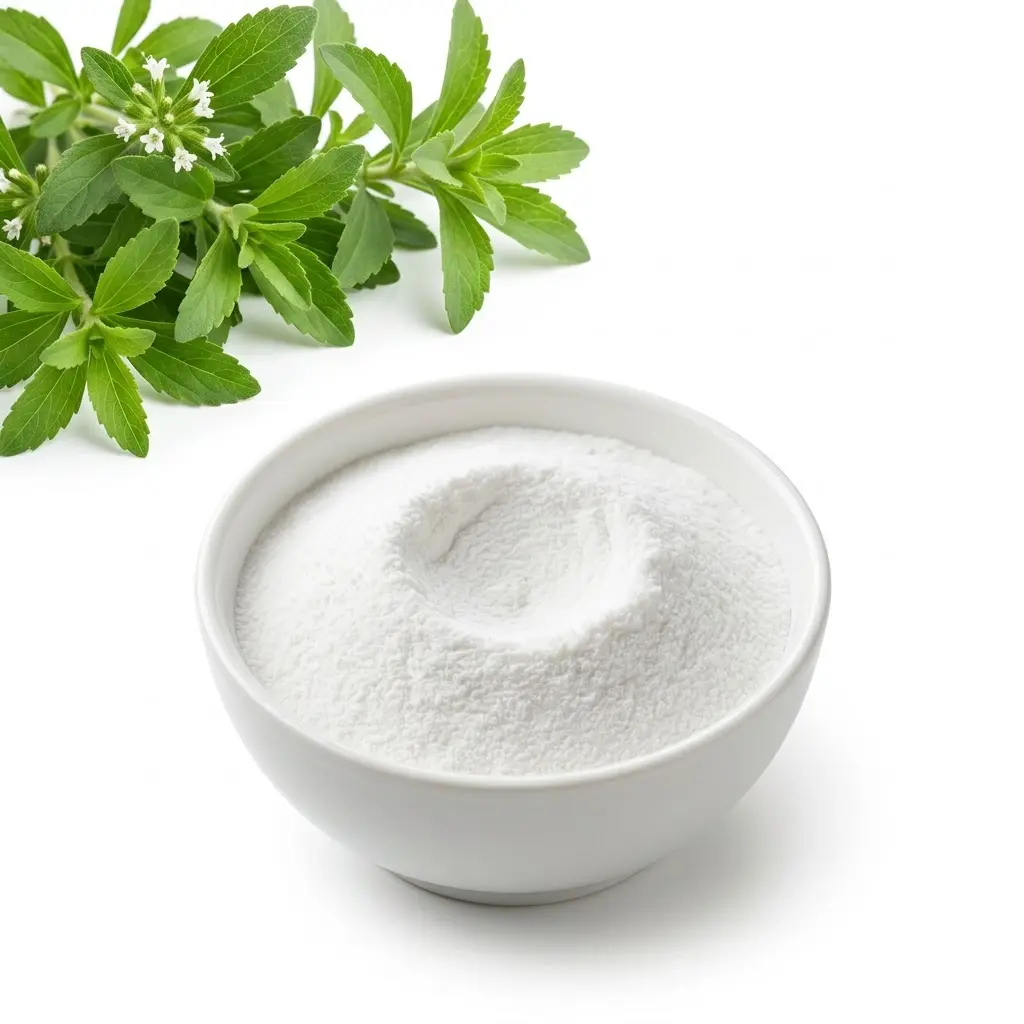
Stevia rebaudiana Bertoni
Rebaudioside A
- CAS number
- 58543-16-1
- Grades
- RA60 · RA80 · RA97
- EU additive
- E 960a
- Certification
- EU 2018/848 · USDA NOP
- Composition
- Full glycoside profile on every COA
- Applications
- Beverages · Dairy · Bakery · Table-top · Blends
MOQ
1 kg
Lead time
7–15 days
Quotation
Within 24 hours
Samples
Free · freight credited
Bulk Rebaudioside A Supplier — Stevia Extract in RA60, RA80 and RA97, Conventional and Organic
Written by Flora · Reviewed by Xinjuan Xu, Associate Professor · Updated September 2026
PhytoVale manufactures Rebaudioside A at our own facility in China and supplies RA60, RA80 and RA97 grades, each available as conventional or certified organic material under Regulation (EU) 2018/848 and USDA NOP, for beverage and dairy sugar reduction, bakery, table-top sweeteners, blended sweetener systems and nutraceutical premixes. Every grade ships with a batch COA, MSDS and TDS. MOQ 1 kg, free samples with freight credited to your first order, quotation within 24 hours.
Rebaudioside A is the workhorse steviol glycoside of the sugar-reduction industry, and the one most often bought on a single number. For a formulator the number is rarely the whole story. The glycoside profile sitting behind the headline assay, an unusual solubility curve, light and iron sensitivity during shelf life, the arithmetic that converts a sweetness target into a dose, and what your finished product may legally say all shape how the material performs. This page covers all five, and states plainly where the limits are.
01 · Product identity
What Is Rebaudioside A? RA60, RA80 and RA97 Explained
Rebaudioside A, commonly shortened to Reb A, is one of the major steviol glycosides found in the leaves of Stevia rebaudiana Bertoni, and the most widely used member of our stevia extract range. It carries most of the sweetness in mainstream stevia ingredients and is the glycoside that commercial stevia extracts are usually standardized against.
The grade names cause more procurement confusion than any other part of this product, so it is worth being exact. RA60 and RA80 are not 60% or 80% pure single-compound material in the way the names suggest. They are steviol glycoside preparations in which Reb A accounts for that share of the product, while the total steviol glycoside content still meets the international purity requirement of not less than 95% on the dried basis. Only RA97 and above approaches an isolated single glycoside.
Commercially, the Reb A share of total steviol glycosides in stevia preparations ranges from around 20% up to more than 90%, which is exactly why a grade name alone is not a specification. The remaining glycoside fraction is mostly stevioside, along with smaller amounts of Reb C, Reb B and other minor glycosides, and that fraction is where most of the bitter and licorice character comes from. Section 03 sets out what sits behind each grade and what each component does to the taste.
02 · Product data
Rebaudioside A Quick Reference: Solubility, Sweetness, Storage and Shipping
| Property | Value | What it means in practice |
|---|---|---|
| Appearance | White to off-white crystalline powder | Higher grades run whiter; lower grades can carry a faint cream tone from the residual matrix |
| CAS number | 58543-16-1 | Use alongside the E number on customs and QA paperwork |
| Molecular formula | C44H70O23 | Diterpene glycoside; steviol backbone with four glucose units |
| Sweetness potency | Approx. 250 to 300 times sucrose | Potency per unit falls as concentration rises, so this is a screening input rather than a fixed conversion. Section 05 gives the measured anchor |
| Solubility in water at room temperature | Approx. 0.8% at true equilibrium | Lower than most buyers expect; see section 06 before designing a dosing step |
| Solubility above about 60 °C | Rises sharply to roughly 30% to 50% and is stable there | Dissolve hot, then cool into the batch |
| Hygroscopicity | Markedly hygroscopic | Reseal immediately; do not leave open in a humid room |
| Heat processing | Withstands retort, UHT and HTST pasteurisation | Thermal process is rarely the limiting factor; light and shelf life usually are |
| Packaging | 25 kg fibre drum with double PE liner | Smaller trial packs available with samples |
| Shelf life and storage | 24 months, cool and dry, sealed, protected from light | Light protection matters in storage as well as in the finished product |
| HS code | 2938.90 | Confirm the exact subheading with your broker for the destination market |
Full physical, chemical and microbiological release data sit on the batch COA rather than on this page, so that what you receive is the actual lot result rather than a specification range. Section 07 lists every parameter we test, the limit applied and how often. Request the COA for the grade you are evaluating and we will send the most recent production batch.
03 · Grade selection
What Sits Behind RA60, RA80 and RA97: The Full Glycoside Profile
A grade name gives you one number. What decides how the material tastes, how much you have to dose and whether your panel will agree on the result is the whole glycoside profile, and most suppliers will not print it. Here is ours.
Typical glycoside composition by grade
| Component | RA60 | RA80 | RA97 |
|---|---|---|---|
| Rebaudioside A | Not less than 60% | Not less than 80% | Not less than 97% |
| Stevioside | Typically 20% to 30% | Typically 8% to 14% | Below 1% |
| Rebaudioside C | Typically 3% to 7% | Typically 1% to 3% | Below 0.5% |
| Rebaudioside B | Typically 1% to 2% | Typically 1% to 2% | Below 0.5% |
| Rebaudioside D, F and other minor glycosides | Balance | Balance | Trace |
| Total steviol glycosides | Not less than 95% | Not less than 95% | Not less than 95% |
These are typical ranges for our production rather than a specification. The batch COA carries the actual figures, and we send it with every sample rather than only with commercial orders.
What each companion glycoside does to the taste
| Glycoside | Sweetness behaviour over time | Bitterness | What it means for your formula |
|---|---|---|---|
| Rebaudioside A | Sweetness persists longer than sucrose at a comparable peak; the first taste is noticeably sweeter than the tastes that follow it | Activates the bitter receptors TAS2R4 and TAS2R14, with half-maximal responses at roughly 925 and 1394 µM respectively | The reference point. Manageable at ordinary beverage doses, more audible as you approach full sugar replacement |
| Stevioside | Slower to arrive, then lingers | Immediate, distinct bitterness with a lingering aftertaste | The dominant off-taste contributor in RA60 and RA80. If your sample tastes harsher than expected, this fraction is usually why |
| Rebaudioside C and other leaf glycosides | Contributes to the overall temporal profile rather than to peak sweetness | Part of the residual off-note fraction | Falls sharply with purification, which is most of what you are paying for when you move from RA60 to RA97 |
| Rebaudioside D and Rebaudioside M | Faster onset of sweetness and quicker decay of aftertaste | Nearly devoid of bitterness | Present only in traces in Reb A grades. If this profile is what you are chasing, buy them directly rather than paying up through the Reb A range |
The trade is measurable rather than theoretical. In published sensory work on a peach juice matrix comparing stevia extracts at 40% and 95% Reb A, the higher the Reb A share, the lower the bitterness and stevia aftertaste of the finished juice. That is what a grade upgrade actually buys.
If your tasting panel disagrees, they may both be right
Bitterness perception for these compounds is under genetic control. Variation in the bitter receptor genes TAS2R4 and TAS2R14 is associated with differences in how strongly individuals perceive the bitterness of steviol glycosides. Two people tasting the same beaker can honestly report different results, which is why a two-person internal check is not enough to qualify a grade. Use a panel of at least eight, and repeat the comparison at your real use level rather than at a screening dose.
Choosing between the grades
Match the grade to the job rather than to a purity ranking. RA60 suits blended sweetener systems, table-top products and beverages where a bulk sweetener carries part of the profile. RA80 suits general beverage, bakery and dairy work that needs a cleaner finish than RA60 without RA97 economics. RA97 suits high-purity applications: premium zero-sugar beverages and dairy, precision blends, and use as the substrate for enzymatically converted Reb D and Reb M. For projects that extend beyond Reb A purity alone, our guide to choosing the right stevia grade compares the main commercial glycosides by application, sensory profile and formulation constraints.
Higher purity is not automatically the right grade. If you are weighing Reb A against the next-generation glycosides rather than between grades, our Reb A vs Reb D vs Reb M formulation guide works through that choice. The useful comparison between Reb A grades is at equal Reb A loading in your own matrix, not at equal extract weight, and if erythritol or retained sucrose is doing part of the work, RA60 or RA80 will often reach the same finished result at a materially lower cost in use.
Organic grades
All three grades are available as certified organic material under both Regulation (EU) 2018/848 and USDA NOP. Organic certification has to cover the whole chain from field through processing, which is why we run it from our own 400 hectare cultivation base rather than through a trading layer. Organic Reb A is chemically the same molecule as conventional Reb A and behaves identically in solubility, stability and taste. The difference is in the agricultural and processing inputs, not in performance. Organic material is an access requirement rather than an upgrade: if your finished product carries an organic claim, organic raw material is the only route, and no conventional grade can substitute for it. For certificate scope, sourcing and qualification requirements, see our guide to organic stevia certification and sourcing.
How the grades are made
All three come off the same line at our facility: authenticated Stevia rebaudiana leaf from our own 400 hectare cultivation base, through water and ethanol extraction, clarification, macroporous resin decolourisation, membrane and ion exchange desalting, then crystallisation from alcoholic solution. RA97 takes an additional recrystallisation, which is the step that separates a high-purity single glycoside from an enriched preparation, and that same RA97 stream is the substrate for our own Rebaudioside D and Rebaudioside M.
04 · Label and claims
What Your Finished Product Can Say
Most ingredient pages list health benefits. That is the wrong information for this ingredient, because the claim risk sits with the finished-product manufacturer rather than with the raw material supplier. The boundary in short:
Sugar reduction, no added sugar and reduced calorie positioning are compositional routes and remain fully available. Two health claims for sugar replacers are authorised in the EU, one for tooth mineralisation and one for post-prandial blood glucose, both carrying conditions that the finished food must meet. Weight management and disease risk positioning are not available for this ingredient class in the EU and sit against current WHO guidance.
Where the detail sits
The authorised wording, the conditions attached to each claim, the EFSA assessment that left the body weight claim out, the ADI arithmetic with a worked example, and the metabolic reason the limit is expressed in steviol are all set out in our steviol glycoside regulation and claim guide. Confirm the wording and the functional category for your destination market before artwork is locked.
05 · Formulation
Rebaudioside A Dosing: From Sweetness Target to Use Level
Step one, convert on a Reb A basis rather than extract weight
Every level on this page is quoted on a Reb A basis. Because the glycoside is what delivers the sweetness, carrying a use level across grades unchanged is the most common formulation error with this ingredient, and it under-doses by a third or more.
| Grade | Multiply your target Reb A level by | Extract needed for a 300 ppm Reb A target |
|---|---|---|
| RA97 | 1.03 | Approx. 309 ppm |
| RA80 | 1.25 | Approx. 375 ppm |
| RA60 | 1.67 | Approx. 500 ppm |
Step two, start from a measured anchor rather than from a potency multiple
The familiar figure of 250 to 300 times sucrose is a screening input, not a conversion factor, because potency per unit falls as concentration rises. Published paired-comparison work in plain water gives a usable anchor and shows that decline directly.
| Reb A in plain water | Isosweet to | Implied potency at that level |
|---|---|---|
| 20 ppm | Approx. 0.75% sucrose, by interpolation | Approx. 375 times |
| 30 ppm | Approx. 1.0% sucrose | Approx. 333 times |
Read the two rows together and the pattern is clear. Extrapolating linearly from a low-concentration anchor will under-dose a full sugar replacement, because each additional increment of Reb A buys less sweetness than the one before it. A linear projection from 30 ppm to a 10% sucrose target gives 300 ppm; in practice a full replacement in a real matrix lands above that, which is why the ranges below start rather than end at 300 ppm.
Step three, screen inside these ranges
| Application | Sugar typically replaced | Starting Reb A range | Usual partner | What to check |
|---|---|---|---|---|
| Carbonated soft drink | Up to 100% | 300 to 500 ppm | Erythritol or allulose for mouthfeel | Aged flavour at four weeks and again at end of shelf life |
| Flavoured water and RTD tea | 50% to 100% | 120 to 350 ppm | Erythritol | Clarity after the batch has cooled and stood |
| Flavoured milk and drinking yoghurt | 30% to 50% | 100 to 250 ppm | Retained sucrose | Taste after fermentation and after the full cold chain, not at mixing |
| Set yoghurt and chilled dessert | 30% to 50% | 100 to 200 ppm | Retained sucrose | Bulk and mouthfeel, which the sweetener cannot restore |
| Bakery | 30% to 50% | 100 to 300 ppm on flour weight | Bulking agent, required rather than optional | Volume, browning and crumb structure |
| Table-top sweetener | 100% | Set by spoon or sachet equivalence | Erythritol as carrier | Flow, dosing consistency and dissolution in a hot drink |
Step four, use the partner sweetener properly
- Erythritol is the highest-return blend to screen first. In practice, stevia and erythritol play different roles in a reduced-sugar system: Reb A supplies high-intensity sweetness while erythritol contributes bulk and helps round the sensory profile. It is qualitatively synergistic with Reb A, and at only 1% to 3.5% it markedly improves the sweetness quality of the glycoside while contributing its own sweetness additively. It lowers total sweetener cost at the same time, which is unusual for a quality fix.
- Partial replacement is easier than the dose difference alone suggests. Sensory work under sweetness-blocked conditions found that sucrose suppresses Reb A bitterness by a mechanism independent of its sweetness. Sugar you retain in the formula is therefore doing two jobs, and a 50% replacement is disproportionately easier to get right than a 100% one.
- If bitterness is the blocker rather than cost, change the molecule rather than the dose. Glucosylated steviol glycosides show reduced bitterness, aftertaste and astringency compared with Reb A, at the cost of relative sweetness falling to around 155. Reb D and Reb M take a different route to the same goal. Moving up the Reb A grade range only takes you so far.
When the formulation brief is still open on the sweetener system itself, our stevia vs monk fruit vs erythritol comparison looks at how the three differ in sweetness delivery, bulk, mouthfeel and beverage formulation.
How to read these levels
The two-row anchor table is measured data. The application ranges are formulation starting points drawn from commercial practice, not validated or recommended doses, and they will move with your flavour system, acid level and target. Confirm in your own matrix under your actual process, and taste again at four weeks and at end of shelf life rather than only at mixing. Section 06 explains why that second check matters more for this ingredient than for most.
06 · Handling
Rebaudioside A Solubility and Stability: Five Things That Change a Formula
Dissolve hot, not cold
The true equilibrium solubility of Reb A in water at room temperature is only about 0.8%. Above roughly 60 °C it becomes abruptly and stably soluble at around 30% to 50%. The reliable method is to dissolve in hot water and then cool into the batch, rather than to fight the powder at ambient temperature.
Do not trust the first hour
Reb A purified by crystallisation from alcoholic solution can show temporary solubility above 20% at room temperature, which looks encouraging in a beaker. The system is metastable: the glycoside forms a hydrate that can crystallise out at any point. If you design a dosing step from what you observe on day one, you may find sediment or haze in the tank on day five.
Light is the main shelf-life variable
In stability work on acidic model beverages, solutions held at pH 3 in darkness at 30 °C for two months showed no observable loss of Reb A, while UV exposure significantly increased degradation rate constants. UV-blocking packaging is worth more to this ingredient than tighter temperature control.
Watch iron and citrate together
Increasing iron concentration raises the rate of photodegradation, and iron in combination with citrate increases Reb A degradation further. If your product is citrate-buffered, iron in the water supply or in a minor ingredient becomes a real shelf-life risk rather than a theoretical one.
Flavour can drift without anything looking wrong
Studies on mock beverages across pH 2.8 to 4.2 stored for 26 weeks identified six minor degradation compounds from Reb A. Three of these are known to matter sensorially, and in an aged acidic beverage held six weeks at 35 °C they were present at 8.9, 1.4 and 2.9 mg/L. The product will not look different. Taste the aged sample, do not only inspect it.
07 · Compliance
Rebaudioside A Regulatory Status, Testing Programme and Documentation
Below is what applies to Reb A specifically. The group-level material that covers every steviol glycoside, including the JECFA specification, the ADI of 4 mg/kg body weight per day as steviol equivalents, the conversion factors and the fact that maximum levels are combined across E 960a to E 960d, is in our regulation and claim guide.
| Framework | Status | Note for buyers |
|---|---|---|
| United States | FDA completed its first stevia-related GRAS notice in 2008, and that notice was for rebaudioside A. The agency has since issued no-questions letters covering many steviol glycoside preparations | GRAS status attaches to high-purity glycoside preparations, not to stevia leaf or crude leaf extracts. State which you are buying |
| European Union | E 960a, steviol glycosides from stevia. Regulation (EU) 2021/1156 renamed E 960 to E 960a with an 18-month transition that ended on 2 February 2023 | Products should no longer be labelled E 960. Enzymatically produced glycosides fall under E 960c and glucosylated steviol glycosides under E 960d |
| China | GB 1886.355-2022, which replaced GB 8270-2014, covers glycosides obtained from stevia leaf by extraction and refining. That is Reb A | Use levels follow GB 2760. Enzymatically converted and fermentation-derived glycosides sit outside this standard as separate additive varieties |
| Organic | Regulation (EU) 2018/848 and USDA NOP, across RA60, RA80 and RA97 | Certificates are issued in the name of the certifying body and are supplied with the quotation |
What we test, against what limit, and how often
| Parameter | Limit applied | Method | Frequency |
|---|---|---|---|
| Total steviol glycosides | Not less than 95% on the dried basis | HPLC | Every batch |
| Rebaudioside A and glycoside profile | Per grade; full profile reported | HPLC | Every batch |
| Loss on drying | Not more than 6% | Gravimetric | Every batch |
| Total ash | Not more than 1% | Gravimetric | Every batch |
| Lead | Not more than 1 mg/kg | ICP-MS | Every batch |
| Arsenic | Not more than 1 mg/kg | ICP-MS | Every batch |
| Methanol | Not more than 200 mg/kg, equal to 0.02% | GC | Every batch |
| Ethanol | Not more than 5000 mg/kg, equal to 0.5% | GC | Every batch |
| Total plate count | Not more than 1000 CFU/g | Plate count | Every batch |
| Yeast and mould | Not more than 100 CFU/g each | Plate count | Every batch |
| Pesticide residues, glyphosate included | EU MRLs under Regulation (EC) No 396/2005, with the default 0.01 mg/kg applied where no specific MRL exists | LC-MS/MS and GC-MS/MS multi-residue | Every raw material campaign |
| Pyrrolizidine alkaloids | Sum of the 21 regulated alkaloids plus the 14 potentially interfering isomers, benchmarked against the 400 µg/kg level set in Regulation (EU) 2023/915 for food supplements containing plant-based extracts | LC-MS/MS | Every raw material campaign |
| Polycyclic aromatic hydrocarbons | Benzo(a)pyrene and the PAH4 sum, against the relevant category level in Regulation (EU) 2023/915 | GC-MS/MS | Annual verification and on request |
The last three rows are agricultural and processing risks rather than assay risks, and they never appear in a glycoside profile. Growing our own leaf on a 400 hectare cultivation base is what makes the agricultural half of that controllable rather than merely testable. No PA or PAH limit is written specifically for steviol glycosides as a food additive, so we benchmark against the strictest category level that plausibly applies to a plant extract, which is the conservative reading rather than the convenient one. Why these three contaminants matter.
Documentation supplied with every order
Batch COA, MSDS, TDS, organic certificates where the organic grade is ordered, Halal and Kosher certificates, ISO documentation, a non-GMO statement and an allergen statement. Pesticide, PA and PAH reports, residual solvent data and an HPLC chromatogram are available on request for qualification lots.
08 · Packaging and logistics
Bulk Packaging, Lead Time and Shipping
Standard packing is a 25 kg fibre drum with a double food-grade PE liner, palletised for container and air freight. Trial quantities from 1 kg are supplied in sealed foil bags inside a fibre drum or carton. Shelf life is 24 months from production when stored cool, dry, sealed and away from light.
Lead time is 7 to 15 days depending on grade and quantity, with organic grades sometimes at the longer end because certified lots are produced in scheduled campaigns rather than continuously. Air, sea and courier shipping are all supported, and the documentation set is confirmed against the specific grade at quotation.
09 · Questions
Rebaudioside A FAQ for Buyers and Formulators
Is RA60 the same as 60% pure Rebaudioside A?
Not in the way the name suggests. RA60 is a steviol glycoside preparation in which Reb A accounts for at least 60% of the product, while the total steviol glycoside content still meets the requirement of not less than 95%. The balance is not inert filler, it is mostly stevioside plus minor glycosides, and stevioside is the strongest bitterness contributor of the common glycosides. This is why two suppliers can both sell RA60 and deliver noticeably different taste at the same dose. The composition table in section 03 shows what sits behind each of our grades, and the batch COA gives the actual figures.
How do I convert my sugar target into a Reb A dose?
Do not start from the potency multiple. Start from a measured anchor: 30 ppm Reb A in plain water is isosweet to about 1% sucrose, and 20 ppm to about 0.75%. Those two points also show that potency falls as concentration rises, so a linear projection to a full sugar replacement will under-dose you. Then convert from a Reb A basis to extract weight using your grade: multiply by 1.03 for RA97, 1.25 for RA80 and 1.67 for RA60. Section 05 works through both steps and gives starting ranges by application.
My Reb A solution dissolved easily and then went cloudy a few days later. What happened?
You almost certainly met the metastable state. Reb A purified by crystallisation from alcoholic solution can dissolve to above 20% at room temperature, well beyond its true equilibrium solubility of about 0.8%, but the system is unstable and a hydrate can crystallise out at any point without warning. The fix is procedural rather than chemical: dissolve above 60 °C where solubility rises to roughly 30% to 50% and is stable, cool into the batch, and validate your dosing step against a sample held for at least a week rather than against what you see on the first day.
Our two tasters disagree about whether the sample is bitter. Which one is right?
Possibly both. Perception of steviol glycoside bitterness is under genetic control, and variation in the bitter receptor genes TAS2R4 and TAS2R14 is associated with real differences in how strongly individuals taste it. A disagreement between two people is data about the panel, not about the material. Use at least eight tasters, compare at your actual use level rather than a screening dose, and include a full-sugar control rather than benchmarking against your current stevia formula, which carries its own bias.
Does organic Rebaudioside A taste or perform differently from conventional?
No. It is the same molecule, and solubility, stability, sweetness potency and sensory profile are identical at the same grade and loading. The difference sits entirely in the agricultural and processing inputs that the certification governs. We say this plainly because the honest reason to buy organic is different and stronger: if your finished product carries an organic claim, organic raw material is a requirement with no conventional substitute. Treat it as an access question for your label, not as a performance upgrade.
Can a product sweetened with Reb A claim to help with weight management?
Not in the European Union, and not in line with current WHO guidance. EFSA assessed intense sweeteners in relation to body weight, and only the tooth mineralisation and post-prandial glycaemic claims entered the authorised list under Regulation (EU) No 432/2012. WHO issued a guideline in 2023 recommending against the use of non-sugar sweeteners for weight control or noncommunicable disease risk reduction, naming stevia derivatives among those covered. Sugar reduction, no added sugar and reduced calorie positioning remain fully available, and for most products they are the stronger commercial message anyway. Section 04 sets out the boundary in more detail.
Is Reb A stable through the shelf life of an acidic beverage?
It is stable to the thermal process, including retort, UHT and HTST pasteurisation. Shelf life is a different question, and the variables that matter most are light and iron rather than temperature. Model beverages at pH 3 held in darkness at 30 °C for two months showed no observable loss, while UV exposure significantly raised degradation rates, and iron with citrate raised them further. Across 26 weeks at pH 2.8 to 4.2, six minor degradation compounds were identified, three of which are sensorially relevant. The practical answer is to use UV-blocking packaging, control iron, and taste the aged sample rather than only inspecting it.
Do you also supply Rebaudioside D and Rebaudioside M?
Yes, in RD95, RD98, RM95 and RM98. Both are produced by enzymatic conversion from our own high-purity Reb A, which is the commercially viable route for these glycosides because they occur in stevia leaf at levels too low for direct extraction. Note that they carry a different EU classification from Reb A and are not labelled E 960a, so the regulatory section of your specification will need to change if you move between them. See the Reb D and Reb M pages, or the full stevia extract range, and be aware that Reb M is less soluble in water than Reb A rather than more.
Can I get a sample before committing to a bulk order?
Yes. Samples are free of charge and the freight is credited against your first order, bulk orders start at 1 kg MOQ, quotations are returned within 24 hours and lead time is 7 to 15 days depending on grade and quantity. Both conventional and organic samples are available. Send us the finished-product format, the sweetness you need to replace and the destination market, and we will send two grades with the batch COA and full glycoside profile for each rather than a single sample and a specification sheet.
10 · Evidence base
References
[1] FAO/WHO JECFA. Steviol Glycosides: Chemical and Technical Assessment, 63rd JECFA. FAO/JECFA official document →
[2] FAO/WHO JECFA. (Framework for) Steviol Glycosides. Combined Compendium of Food Additive Specifications. FAO official specification →
[3] Maki KC, Curry LL, Reeves MS, et al. Chronic consumption of rebaudioside A, a steviol glycoside, in men and women with type 2 diabetes mellitus. Food and Chemical Toxicology. 2008;46(Suppl 7):S47–S53. DOI: 10.1016/j.fct.2008.05.007 →
[4] Maki KC, Curry LL, Carakostas MC, et al. The hemodynamic effects of rebaudioside A in healthy adults with normal and low-normal blood pressure. Food and Chemical Toxicology. 2008;46(Suppl 7):S40–S46. DOI: 10.1016/j.fct.2008.04.040 →
[5] EFSA Panel on Food Additives and Flavourings. Scientific opinion on the extension of the authorisation of use of the food additive steviol glycosides (E 960a–d) and the modification of the acceptable daily intake (ADI) for steviol. EFSA Journal. 2024;22:e9045. DOI: 10.2903/j.efsa.2024.9045 →
[6] European Union. Commission Regulation (EU) No 432/2012 establishing a list of permitted health claims made on foods, other than those referring to the reduction of disease risk and to children's development and health. EUR-Lex official text →
[7] World Health Organization. WHO advises not to use non-sugar sweeteners for weight control in newly released guideline. 15 May 2023. WHO official statement →
[8] European Union. Commission Regulation (EU) 2023/915 on maximum levels for certain contaminants in food, repealing Regulation (EC) No 1881/2006. EUR-Lex official text →
[9] Stability of rebaudioside A under acidic conditions and its degradation products. Food Research International. 2012. ScienceDirect record →
[10] Mechanisms of Rebaudioside A Degradation and Ingredient-Sweetener Interactions in Beverages during Storage. Molecules. 2022;27(4):1385. DOI: 10.3390/molecules27041385 →
[11] Manoharan et al. Steviol Glycosides (E960) from Stevia rebaudiana: Technological Innovations, Safety Assessment, Regulatory Aspects and their Role in Sustainable Food Systems. Food Science & Nutrition. 2026. DOI: 10.1002/fsn3.71891 →
[12] FDA regulatory approach to steviol glycosides. Regulatory Toxicology and Pharmacology. 2018. ScienceDirect record →
Reviewed by
Xinjuan XuScientific Advisor, PhytoVale · Associate Professor, Stevia Agronomy & Crop Physiology Expert. Research focus: stevia cultivation, crop physiology, glycoside accumulation and raw material quality.
Written by
FloraContent Editor, PhytoVale · Product Content & Editorial Specialist. Focuses on botanical ingredient specifications, sourcing information and B2B technical content.
B2B supply
Tell us the grade and finished-product format
Send us the format, the sweetness you need to replace, whether you need conventional or organic material, and the destination market. We will suggest which two grades to trial and at what starting loading. Bulk Rebaudioside A from 1 kg MOQ, free samples with freight credited to your first order, quotation within 24 hours.
Request a sample →Browse all products →Related Botanical Ingredients
 Monk Fruit ExtractKey specification: Mogroside V
CAS 88901-36-4
Mogroside V 25–60%
 Rebaudioside DKey specification: Rebaudioside D (Reb D)
CAS 63279-13-0
Reb D 95%/98%
 Rebaudioside MKey specification: Rebaudioside M (Reb M)
CAS 1220616-44-3
Reb M 95% / 98%
 Stevia ExtractKey specification: Steviol Glycosides
CAS 57817-89-7
Reb A 80–98% ,Reb M 95–98% ,Reb D 95%
 Custom Sweetener Blend OEM: The Buyer’s Process Guide→Custom Sweetener Blend OEM: The Buyer’s Process Guide WRITTEN BY Flora / OCTOBER 19, 2026 Written by Flora,…
 Types of Curcumin Extract: 7 Grades by Process, Assay and Use→Types of Curcumin Extract: 7 Grades by Process, Assay and Use WRITTEN BY Flora / OCTOBER 17, 2026…