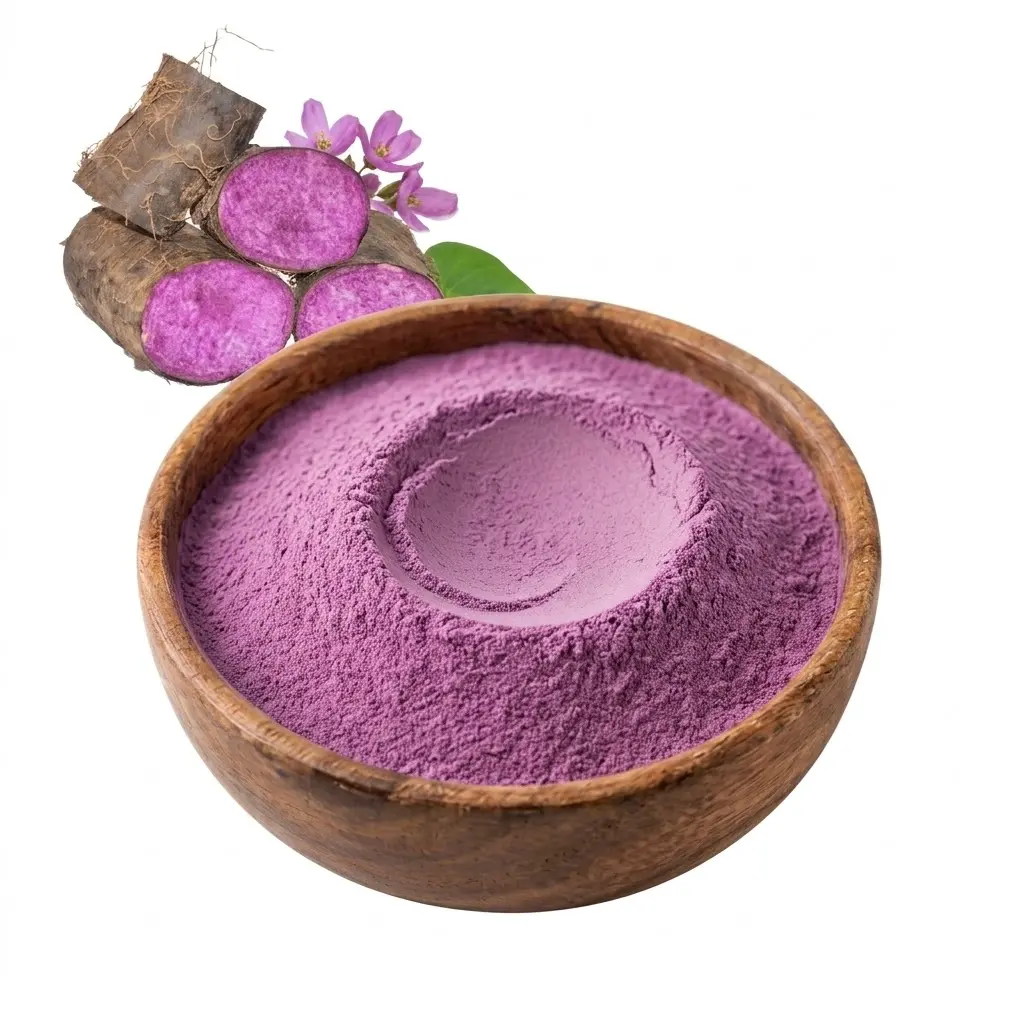
Ube Powder
- Source
- Dioscorea alata L. · Philippine ube tuber
- Origin
- Philippines · imported ube powder
- Process
- Steam-cooked at 105 °C · drum-dried · pre-cooked powder
- Composition
- 100% purple yam · no carrier
- Free from
- Sulphites · added colors · added flavors
- Applications
- Beverages · bakery · frozen desserts · fillings · snacks
- Documentation
- COA · nutrition panel · HPLC anthocyanin result
MOQ
1 kg
Lead time
7–15 days
Quotation
Within 24 hours
Samples
Free of charge
Bulk Ube Powder (purple yam powder) Supplier
Written by Flora · Reviewed by Prof. Bingji Ma · Updated September 2026
PhytoVale supplies bulk Ube Powder (purple yam powder), sold in the US mostly as ube powder, made from the peeled tuber flesh of Dioscorea alata L. sourced from the Philippines. The flesh is steam-cooked at 105 °C and drum-dried, then milled. The finished powder is 100% purple yam: no carrier, no sulphites, no added color and no added flavor.
This page is written for food and beverage manufacturers, bakeries, café and bubble-tea chains, and private-label brands in the EU and US. It covers what ube is and what it gets confused with, how the powder is made, what is in it, how pH and heat change the shade, where it works, how to tell real ube from purple sweet potato, and the regulatory points buyers ask about.
01 · Product identity
What Is Purple Yam Powder (Ube Powder)?
Purple yam powder is the cooked, dried and milled flesh of Dioscorea alata L. The plant goes by many names: ube in the Philippines and in most US recipes, greater yam, water yam or winged yam in the agricultural literature, and 紫山药, 参薯 or 大薯 in China. It is the most widely distributed of the cultivated yam species,[1] grown as a staple across Asia, Africa and the Caribbean.
Often confused with taro and other purple-colored ingredients, ube is a distinct yam species with its own flavor, color and formulation characteristics. Learn more in our guide: Ube vs Taro: Are They the Same? .
The color is in the flesh itself, so a well-made powder needs nothing added to look purple, and the flavor is mild and gently sweet. Several other ingredients are sold, searched for or substituted as "ube", so check the botanical name on any specification before comparing prices.
| Ingredient | Botanical source | How it differs from purple yam |
|---|---|---|
| Purple yam (ube) powder: this page | Dioscorea alata L., yam family | The reference point. Purple flesh colored by its own acylated anthocyanins, the alatanins (§03) |
| Purple sweet potato powder | Ipomoea batatas, morning glory family | A different plant family. Sweeter, with a sweet-potato flavor, and colored by a different group of anthocyanins (§06) |
| Taro powder | Colocasia esculenta, arum family | Pale flesh with purple flecks; it does not give a solid purple on its own. In Chinese, 香芋 is used for both taro and purple yam, so check what a "taro" or "ube" powder from an Asian supplier actually contains |
| Wild yam | Dioscorea villosa | A North American species sold as a supplement for its diosgenin content, not as a food ingredient or color source |
| Chinese yam (Shan Yao, Huai Shan) | Dioscorea polystachya (syn. D. opposita) | A different yam species with white flesh; the yam of the Chinese Pharmacopoeia. Same genus, different product |
PhytoVale's powder is made from D. alata only, from purple-fleshed ube sourced from the Philippines. The species is stated on the COA.
02 · Sourcing & processing
How Our Purple Yam Powder Is Made: Philippine Ube, Steam-Cooked and Drum-Dried
Philippine sourcing
Our purple yam raw material is sourced from the Philippines. D. alata is a warm-climate crop widely cultivated in tropical and subtropical regions. The tubers are selected for their purple flesh before processing.
It takes about 5 kg of fresh tuber to make 1 kg of powder. The raw material is sourced from the Philippines, and each lot is documented for origin and batch traceability.
From tuber to powder
- Washing and peeling. The skin, and the soil that clings to it, is removed completely. Only the purple flesh goes forward, so pale applications stay free of dark specks.
- Slicing and steam cooking at 105 °C. Steam cooks the starch through and stops the tuber's own browning enzymes.
- Drum drying. The cooked yam is spread as a thin layer on heated rotating drums, dried in a short contact time and scraped off as flakes.
- Milling, sieving and packing. The flakes are milled to a fine powder. Nothing is added at any stage.
Why steam, and why before drying
Raw purple yam browns quickly once it is cut, because the tuber carries polyphenol oxidase. In a Thai study, flour milled from raw, uncooked purple yam lost its intense purple color.[2] Cooking first prevents that. A follow-up study from the same group found that steam cooking did not significantly change the total phenolic, flavonoid or anthocyanin content of purple yam, although it converted part of the largest pigment, alatanin B, into smaller alatanins.[3] We use steam rather than boiling water because anthocyanins are water-soluble, and a boiling bath draws color out of the slices.
Why drum drying
A drum dryer finishes the cooking and removes the water in one short pass. The starch leaves the drums already gelatinized, so the powder swells in cold liquids and builds body without a cooking step (§04). Drum drying is the same long-established route used to make pregelatinized starches and instant flours.
No sulphites at any stage
Commercial fresh-cut yam processing has used sulphite dips to stop browning.[1] We rely on steam instead. That keeps sulphites off your allergen declaration in both the EU and the US, and it protects the color too, because sulphite is one of the factors known to degrade anthocyanins.[2]
03 · Composition
Purple Yam Powder Composition and Nutrition
Nutritional Information (Typical Values per 100g)
The following nutritional values are based on third-party laboratory analysis of our Purple Yam Powder. Testing was conducted by Eurofins, an independent testing laboratory. Full analytical reports are available upon request.
| Nutritional Parameter | Typical Value |
|---|---|
| Energy | 366 kcal / 1554 kJ |
| Protein | 7.58 g / 100g |
| Total Carbohydrate | 83.8 g / 100g |
| Total Sugars | 2.4 g / 100g |
| Total Fat | 0.42 g / 100g |
| Moisture | 4.84 g / 100g |
| Ash | 3.4 g / 100g |
| Sodium | 12.2 mg / 100g |
Quality documentation: COA, product specification, and nutritional analysis report are available for food manufacturers and formulation teams upon request.
The figures below are published values for raw Dioscorea alata tubers, on a dry-weight basis, not our specification. A per-100 g nutrition panel for our powder (energy, protein, fat, carbohydrate, fiber, sugars, sodium and potassium) comes with the COA. The widely quoted USDA "yam, raw" entry covers Dioscorea yams in general, so it is not a label value for ube.
Starch, fiber and protein
Starch makes up 75.6–84.3% of the dry matter across seven D. alata cultivars,[4] with 25–30 g of amylose per 100 g dry weight in Thai purple accessions.[2] Crude protein averaged 7.4%.[4] Much of it is the storage protein dioscorin; fat is very low and fiber content useful.[1] In our powder the starch is already gelatinized, so resistant-starch figures for raw purple yam flour do not apply.
Minerals and other constituents
A survey of 25 yam landraces grown in China found magnesium at 326.8–544.7 mg/kg, allantoin at 0.62–1.49% and dioscin at 0.032–0.092% of dry weight.[5] Raw D. alata also contains oxalate (486–781 mg per 100 g dry matter, largely water-soluble) and little phytic acid.[4]
Anthocyanins and phenolics
The purple comes from the alatanins, cyanidin- and peonidin-based anthocyanins acylated with sinapic or ferulic acid; alatanin C is the main one.[2] Content depends on the cultivar: about 10–90 mg per 100 g dry weight (as cyanidin-3-glucoside), with total phenolics of 100–385 mg gallic acid equivalent.[2] The acylation makes them more heat-stable than the pigments of purple sweet potato and purple potato.[6] We measure anthocyanins in our powder by HPLC and report the result on the COA.
What the research does and does not show
Most studies on D. alata compounds are laboratory or animal work, and a 2022 systematic review of yam and blood-glucose control found only rodent studies.[7] We sell this powder as a food ingredient and make no health claims for it.
04 · Formulation
Formulating With Purple Yam Powder: pH, Heat and Hydration
Three things commonly go wrong with purple yam in a formula: the batter is too alkaline, the powder goes into the liquid all at once, or the finished product sits in clear packaging under shop lights. All three are easy to design around.
pH sets the shade
Like every anthocyanin, the alatanins change color with pH. In a 2026 study of a D. alata extract, the absorption peak moved from 520 nm at pH 1 to 600 nm at pH 9, taking the color from red through purple to blue, and by pH 12 the extract had turned a dark mustard.[8] Those measurements were made on an acidified methanol extract, so a food matrix will soften the shades, but the direction of travel is the same.
| System pH | Shade to expect | Where you will meet it |
|---|---|---|
| Strongly acidic | Red to pinkish red | Lemonades, fruit-acid drinks, kombucha, fruit fillings |
| Mildly acidic to near neutral | Purple to violet, the classic ube shade | Milk drinks and lattes, yeast doughs, ice cream and custard bases |
| Mildly alkaline | Blue-violet to blue | Cakes and cookies leavened mainly with baking soda |
| Strongly alkaline | Dull green-yellow to mustard | Alkaline noodles, heavily over-leavened batters |
Baking soda is the usual culprit
An ube cake or crinkle cookie that comes out grey, blue-green or khaki usually has an alkaline batter: the blue that anthocyanins take on above neutral mixes with the yellow of the crumb. Cut the baking soda, lean on baking powder, or add a small acid component such as buttermilk or cream of tartar. Watch other alkaline ingredients too, such as Dutch-process cocoa or a high share of egg white, and check the shade at the pH of the finished batter, not in a glass of powder and water.
Heat and baking
Purple yam pigments hold up to heat better than those of purple sweet potato or purple potato,[6] which is why ube works in baked goods at all. In bread, a higher inclusion gives a darker crumb and a smaller rise. A pre-cooked powder also takes up more water than an uncooked flour, so expect to raise dough hydration when you switch from one to the other. If a baked ube product comes out more brown than purple, or a new lot looks paler than the last, our guide ube powder not purple? explains how to tell a normal result from a bad lot.
Hydration and dispersion
Because the starch is already gelatinized, the powder swells and thickens in cold milk or water. That makes it useful in no-bake fillings, frozen dessert bases and cold drinks, where a raw flour would stay chalky. Pre-cooked powders hydrate fast, though, and tipped straight into a liquid they can form lumps with dry powder trapped inside. Blend the powder first with sugar or the other dry ingredients, or add it gradually under stirring; in a café, whisk it into a little warm milk before topping up. For bottled, chilled and ready-to-drink formats, where settling and color over shelf life are the harder problems, see our guide to ube powder for beverages.
Light, oxygen and storage
Anthocyanins are sensitive to pH, temperature, oxygen, light, enzymes, ascorbic acid, sugars and sulphite.[2] For finished products that need to hold their color on shelf, opaque or light-blocking packaging and low headspace oxygen do more than any formulation trick. Keep the powder itself sealed, cool and dry between uses.
05 · Applications
Purple Yam Powder Applications in Food and Beverage
The powder does three jobs at once: it colors, it flavors and it adds body. Which of the three matters most decides how you use it.
| Application | Why the powder works here | Formulation notes |
|---|---|---|
| Ube lattes, milk tea and café drinks | Near-neutral milk keeps the violet shade, and the cooked starch gives a rounder mouthfeel than a syrup | Pre-blend with sugar or whisk into a little warm milk first. Pairs with espresso, matcha and coconut milk |
| Smoothies and powdered drink mixes | No raw-starch taste, and it builds body in cold blends | In acidic fruit bases the shade shifts toward magenta. Blend with the other dry ingredients before filling sachets |
| Bread, buns and enriched doughs | Color that survives the bake | Higher inclusion means a smaller rise; raise dough water. Ube cheese pandesal is a well-known example |
| Cakes, cookies, crinkles and pastries | The ube look from a single real ingredient | Check leavening (§04). Recipes raised with yeast or baking powder are easier to keep purple |
| Ice cream, gelato and frozen desserts | Cooked starch adds body to the base, and dairy keeps the shade violet | Protect finished tubs from light |
| Fillings, spreads and ube halaya | The yam is already cooked, so the powder rehydrates into a smooth paste | Reconstitute with milk or coconut milk, then cook down with sugar and butter for texture and set |
| Mochi, noodles, crackers and snacks | Color plus a starch that behaves well in doughs | Avoid alkaline noodle formulas if you want purple. Trial the shade at your process pH and temperature |
| Private-label retail ube powder | A one-ingredient declaration that shoppers can read at a glance | Repack from bulk into consumer packs. Usage tips on pH and dispersion help home bakers get the color right |
For more formulation guidance, explore our application guides: Ube Powder for Ice Cream , Ube Powder for Baking , and Ube vs Taro: Key Differences .
Flavor partners
Ube's mild, nutty-sweet flavor is carried best by dairy and fat. The classic Filipino pairings are coconut milk, condensed or evaporated milk, butter, cheese and vanilla, with pandan and toasted coconut as common accents. In drinks it sits comfortably next to espresso, matcha and brown-sugar syrups. If you want more aroma than the powder alone provides, a flavoring can be layered on top; check that flavoring's label, because many carry synthetic colors (§06).
06 · Buying guide
Ube Powder vs Ube Extract vs Purple Sweet Potato Powder
These three products sit next to each other in search results and on distributor price lists, and they are not interchangeable. We read the ingredient statements of widely distributed ube flavorings, and compared the US and EU labeling rules that separate them, in ube powder vs ube extract.
| Purple yam (ube) powder | Ube extract or flavoring | Purple sweet potato powder | |
|---|---|---|---|
| Raw material | Dioscorea alata tuber flesh | A flavor concentrate; how much real ube it contains varies by brand | Ipomoea batatas root |
| Where the purple comes from | The yam's own alatanins | In many commercial products, added red and blue colors | The sweet potato's own anthocyanins |
| Starch and fiber | Yes, the whole flesh | Typically none | Yes |
| Flavor | Mild, nutty-sweet | Concentrated aroma, natural or artificial depending on brand | Sweet-potato flavor, noticeably sweeter |
| How it is used | As a bulk ingredient | By the drop or teaspoon | As a bulk ingredient |
| Heat stability of the color | Acylated alatanins; the most heat-stable of three purple tubers compared in 2022[6] | Depends on the colors used | Also acylated, but less heat-stable than purple yam in the same comparison[6] |
| Ingredient declaration | One ingredient: purple yam powder | Several ingredients, commonly including glucose syrup, alcohol, flavoring and colors | One ingredient: purple sweet potato powder |
How to tell real ube powder from purple sweet potato powder
The two can look alike in the bag, but their pigments are built differently. Purple yam's alatanins are cyanidin and peonidin gentiobiosides acylated mainly with sinapic acid.[2] Purple sweet potato's anthocyanins are 3-sophoroside-5-glucosides of the same two pigment cores, acylated mainly with caffeic, ferulic or p-hydroxybenzoic acid. An LC-MS anthocyanin profile separates the two clearly, and for a buyer qualifying a new ube supplier, a profile from an independent lab is the most direct check available.
Without a lab, three quick checks catch most substitutions: the Latin name on the COA, a flavor that tastes distinctly of sweet potato, and a price that sits well below the rest of the market.
07 · Compliance
Purple Yam Powder Regulatory Notes for EU and US Buyers
European Union
In 2013, the EU's Standing Committee on the Food Chain and Animal Health endorsed guidance notes that separate colouring foods from food colours (additives). The dividing line is selective extraction, judged with an enrichment factor, and a threshold of 6 is proposed. Purple yam powder involves no extraction at all: the whole flesh is cooked, dried and milled. Used for its color, it follows the colouring-food logic and is normally declared as an ingredient by name rather than as the additive E163 (anthocyanins). The classification decision for a finished product remains with the buyer.
- Novel food status. The Commission's Novel Food catalogue is not exhaustive. Establishing that an ingredient was consumed in the EU before 15 May 1997 is the food business operator's responsibility, so confirm the position for your use with your regulatory team.
- Pesticide residues. Yams are listed under tropical root and tuber vegetables, product code 0212030, in Annex I of Regulation (EC) No 396/2005. For a dried powder, the MRL is applied with a processing (drying) factor.
- Cadmium and lead. Regulation (EU) 2023/915 sets a cadmium maximum level of 0.050 mg/kg for tropical roots and tubers, on a wet-weight basis, and a separate lead limit for root and tuber vegetables. Drying concentrates any contaminant several-fold, so powder results need to be compared using a drying factor. Ask us for it alongside the heavy-metal data.
- Allergens. Yam is not one of the 14 allergens listed in Regulation (EU) No 1169/2011, and with no sulphites used, the powder adds no sulphite declaration.
- Claims. There are no authorised EU health claims specific to purple yam. Keep product messaging to color, flavor and texture.
United States
Under 21 CFR 70.3, food ingredients such as cherries, chocolate and orange juice that contribute their own natural color are not treated as color additives, while a food deliberately used to color something else, such as beet juice in pink lemonade, is. FDA's vegetable juice listing (21 CFR 73.260) is defined around expressed juice or a water infusion of a dried vegetable, and a whole-tuber powder does not sit neatly inside that wording. The practical route is to use purple yam powder as an ingredient that contributes its own color and flavor, declare it by name, and not describe it as a dye. If color is the powder's only job in your formula, take regulatory advice first.
- "No artificial colors." Since February 2026, FDA policy allows this statement on products colored only from natural sources. It follows the April 2025 plan to move petroleum-based dyes out of the food supply, which FDA is pursuing through voluntary industry commitments rather than a ban.
- Allergens. Yam is not one of the nine major food allergens. Sulphites at 10 ppm or more must be declared; none are used in our process.
- California Proposition 65. The safe-harbor level for lead is 0.5 µg per day. Ask us for lead results and run the calculation at your serving size.
- Gluten. Purple yam is not a gluten-containing grain. A "gluten-free" label claim must meet FDA's threshold of less than 20 ppm gluten, so confirm test data before making one.
Classification is the buyer's call
PhytoVale supplies documentation and technical data. Ingredient classification, label wording and claims for a finished product are the responsibility of the company placing it on the market, under the law of the destination country.
08 · B2B qualification
Sourcing Purple Yam Powder: What to Ask Any Supplier
| Criterion | Why it matters | PhytoVale |
|---|---|---|
| Species | Purple sweet potato and flavored blends are sold as "ube" | Dioscorea alata L., stated on the COA |
| Origin | Tubers pooled from many farms make shade and residues harder to trace | Philippines · imported ube raw material |
| Plant part | Skin adds dark specks and soil load | Peeled flesh only |
| Heat treatment | Raw-dried yam browns and loses its purple; boiling leaches color | Steam-cooked at 105 °C |
| Drying method | Decides whether the powder is instant or needs cooking | Drum-dried, pre-cooked |
| Carrier | Maltodextrin or starch dilutes color and changes the declaration | None: 100% purple yam |
| Sulphites | Allergen labeling in the EU and US, and a known anthocyanin degrader | None used |
| Anthocyanin data | The only objective handle on color strength; compare like-for-like methods only | Measured by HPLC, reported on the COA |
| Nutrition panel | Needed for your own label; generic yam data does not fit ube | Per-100 g panel supplied with the COA |
| Contaminants and microbiology | Cadmium and lead limits apply after a drying factor; microbiology decides how the powder can be used | Request current results with your inquiry |
A COA covering the points above is provided with every inquiry. Tell us your application and destination market when you write, and we will send it together with a free sample so you can check the shade in your own base. Physical specifications are listed in the specification section of this page.
09 · Evidence base
References
[1] Lebot V, Lawac F, Legendre L. The greater yam (Dioscorea alata L.): a review of its phytochemical content and potential for processed products and biofortification. Journal of Food Composition and Analysis. 2023;115:104987. DOI
[2] Srivichai S, Hongsprabhas P. Profiling anthocyanins in Thai purple yams (Dioscorea alata L.). International Journal of Food Science. 2020;2020:1594291. DOI
[3] Cakrawati D, Srivichai S, Hongsprabhas P. Effect of steam-cooking on (poly)phenolic compounds in purple yam and purple sweet potato tubers. Food Research. 2021;5(1):330–336. Kasetsart University repository
[4] Wanasundera JPD, Ravindran G. Nutritional assessment of yam (Dioscorea alata) tubers. Plant Foods for Human Nutrition. 1994;46(1):33–39. DOI
[5] Wu ZG, Jiang W, Mantri N, Bao XQ, Chen SL, Tao ZM. Characterizing diversity based on nutritional and bioactive compositions of yam germplasm (Dioscorea spp.) commonly cultivated in China. Journal of Food and Drug Analysis. 2016;24(2):367–375. DOI
[6] Miyata R, Sano H, Hoshino S, Kumazawa S. Thermostability and catechol-O-methyltransferase inhibitory activity of acylated anthocyanins from purple yam. Bioscience, Biotechnology, and Biochemistry. 2022;86(7):916–921. DOI
[7] Alharazi WZ, McGowen A, Rose P, Jethwa PH. Could consumption of yam (Dioscorea) or its extract be beneficial in controlling glycaemia: a systematic review. British Journal of Nutrition. 2022;128(4):613–624. DOI
[8] Karunathilaka N, Wickramarachchi S. Sustainable pH sensing: repurposing the anthocyanin-rich extract from Dioscorea alata for green analytical chemistry. RSC Advances. 2026;16(37):40211–40218. DOI
Reviewed by
Prof. Bingji MaScientific Advisor, PhytoVale · Professor & Medicinal Plant Science Expert. Research focus: Chinese medicinal materials, phytochemistry, natural products and medicinal plant quality.
Written by
FloraContent Editor, PhytoVale · Product Content & Editorial Specialist. Focuses on botanical ingredient specifications, sourcing information and B2B technical content.
10 · Questions
Frequently Asked Questions
Is purple yam powder the same as ube powder?
Yes, when both are made from Dioscorea alata. "Ube" is the Tagalog name and the one most US shoppers search for; "purple yam" is the English name used more often in trade documents. The catch is that "ube" is not a protected term, and products sold as ube powder can turn out to be purple sweet potato, a flavored blend or a mix cut with starch. On a supplier specification, the Latin name and the ingredient list settle the question. On your own pack, many brands declare "purple yam" in the ingredient list and use "ube" in the product name; confirm the wording with your labeling team.
What are the nutrition facts for ube powder?
Ube powder is mostly carbohydrate, almost all of it starch, with some fiber and protein and very little fat, but exact label values depend on the crop and the process, so use the per-100 g panel on our COA rather than a figure from a website. Two cautions. First, the "yam, raw" numbers quoted on many sites come from a generic Dioscorea entry, not from D. alata. Second, the drying step concentrates everything, so a gram of powder carries the solids of several grams of fresh tuber. We make no blood-sugar or glycemic-index claim for this powder: the published glycemic research on yams is animal work, and our starch is pre-cooked.
How much fresh ube equals ube powder?
It takes about 5 kg of whole fresh tuber to make 1 kg of our powder, once peeling, trimming and water loss are counted. For recipe work, peeled fresh purple yam is roughly 70–75% water, so about 25–30 g of powder plus 70–75 ml of water stands in for 100 g of peeled fresh ube. Treat that as a starting point: adjust the water for your texture, because the pre-cooked starch in the powder absorbs more readily than raw flesh.
Ube powder or ube extract: which should I use?
Use the powder when you want real yam in the product: it brings body, a natural shade and a one-ingredient declaration. Use an extract when you need strong aroma at a tiny dose, for example in frostings or thin batters where extra solids would change the texture. Many bakers use both, powder for substance and color and a few drops of extract for aroma. If your customers want to avoid synthetic dyes, read the extract label closely, because many commercial ube extracts take most of their color from added reds and blues.
Does this purple yam powder need to be cooked before use?
No. The yam was steam-cooked and drum-dried, so the powder can go straight into cold drinks, smoothies, no-bake fillings and ice cream mixes. It is still a raw material rather than a finished food, so handle it under your own food-safety plan and check the microbiology results on the COA against your specification. For halaya-style spreads you will still cook the mix, but for texture and set rather than to cook the yam.
Will the purple color fade after opening or on the shelf?
It can, if the powder picks up moisture or sits in light and warmth. Reseal the bag after each use, keep it cool and dry, and don't store it next to an oven or a window. In finished products the bigger risks are clear packaging, headspace oxygen and a pH that drifts over shelf life, so run your stability test in the real pack, under shop-style lighting, before launch. Shelf life for the unopened powder is given in the specification section of this page.
Does purple yam contain progesterone like wild yam?
No. The idea comes from wild yam (Dioscorea villosa), whose diosgenin has been used as a starting material for making progesterone in a laboratory. Memorial Sloan Kettering Cancer Center's herb database notes there is no evidence that the human body can make that conversion, so eating yam is not a way to take in progesterone. Purple yam powder is a food ingredient for color, flavor and texture, and we do not sell it for hormonal support.
B2B supply
Tell us the application and the market
Send us the product format, the pH of your base, the shade you are aiming for and where the product will be sold. We will reply within 24 hours with a quote, a free sample and a COA with the nutrition panel and HPLC anthocyanin result.
Request a sample →Browse all products →Disclaimer: this page is intended for ingredient evaluation, formulation and B2B purchasing. PhytoVale supplies purple yam powder as a food ingredient and makes no health claims for it. Composition figures are published values for raw tubers, not our product specification. Research is summarized as technical background, not as claim substantiation. Output and fresh-to-powder figures are typical values and vary by season. Regulatory positions and contaminant limits change; figures above are current as of the update date and should be re-verified against the legislation in force at launch. Finished-product manufacturers are responsible for ingredient classification, labeling, claims and compliance in their target markets. © 2026 PhytoVale.
Related Botanical Ingredients
 Blue Lotus ExtractKey specification: None
CAS N/A
10:1 · 30:1 · 50:1 · 100:1 · 200:1 (fresh flower basis)
 Butterbur ExtractKey specification: Total Petasins
CAS N/A
Total Petasins 10%, 15%, 20%, 30%
 Cinnamon Bark ExtractKey specification: Polyphenols
CAS 84649-98-9
total polyphenols 10%, 20%, 30%
 Citrus aurantium extractKey specification: Synephrine/Total Flavonoids
CAS 94-07-5
Synephrine 6%, 30%, 50%, 98% Total Flavonoids 30%, 60%, 98%
 Custom Sweetener Blend OEM: The Buyer’s Process Guide→Custom Sweetener Blend OEM: The Buyer’s Process Guide WRITTEN BY Flora / OCTOBER 19, 2026 Written by Flora,…
 Types of Curcumin Extract: 7 Grades by Process, Assay and Use→Types of Curcumin Extract: 7 Grades by Process, Assay and Use WRITTEN BY Flora / OCTOBER 17, 2026…