Ube powder not purple? It is one of the most common complaints in this category, and often the powder is fine. Real Dioscorea alata powder is a pale lilac in the bag, a noticeably deeper violet once it is wet, and frequently not purple at all once it has been baked.
Before you reject a lot, check whether you are judging it dry, wet or baked. Those are three different colours, and only one of them tells you much about the powder.
One disclosure. We sell purple yam powder, drum-dried from tuber sourced in the Philippines. That makes us the supplier you would be complaining to, so read section 03 as a checklist you can use against us as easily as for us.
This guide covers the short answer in order of likelihood, what real ube colour looks like dry, wet and baked, including measured values for a baked product, five checks that separate a bad lot from normal ube, why "low and slow" drying is not the colour-safe route it is sold as, what in your own process turns ube grey or brown, how to deepen the colour without synthetic dye under US and EU rules that treat the same ingredient differently, and how to write colour into a purchase specification.
01 Short answer
Why Is My Ube Powder Not Purple? The Short Answer
If your ube powder is not as purple as you expected, the cause is usually one of these. They are listed in the order we would check them, not ranked by any survey of complaints.
- You are looking at it dry. Finely milled powder scatters light and reads paler than the material it was made from. Wet it and much of the depth comes back. Section 02 explains why and gives a simple test.
- Your application is pulling it out of purple. Baking, alkaline leaveners and neutral dairy all move ube's colour. One published measurement of bread made with purple yam flour put it in the red-brown range, not the violet one.[3]
- The purple you are comparing against was never ube. The saturated violet of most commercial ube desserts comes from synthetic dye, as we showed by reading the labels in our comparison of ube powder vs ube extract.
- The lot genuinely carries less pigment. Anthocyanin content varies severalfold with cultivar, harvest timing and processing. That is a real difference, and the fix is in the specification, not the complaint.
- It is not ube, or not a purple cultivar of it. Less common, and the one that matters most when it happens. Dioscorea alata is not automatically purple.[4]
Most ube that "isn't purple" is being judged dry, judged baked, or judged against a dye. The first three causes are not faults in the powder. The last two are, and section 03 tells you which one you have.
02 Real colour
Three Colours of the Same Powder: Dry, Wet and Baked
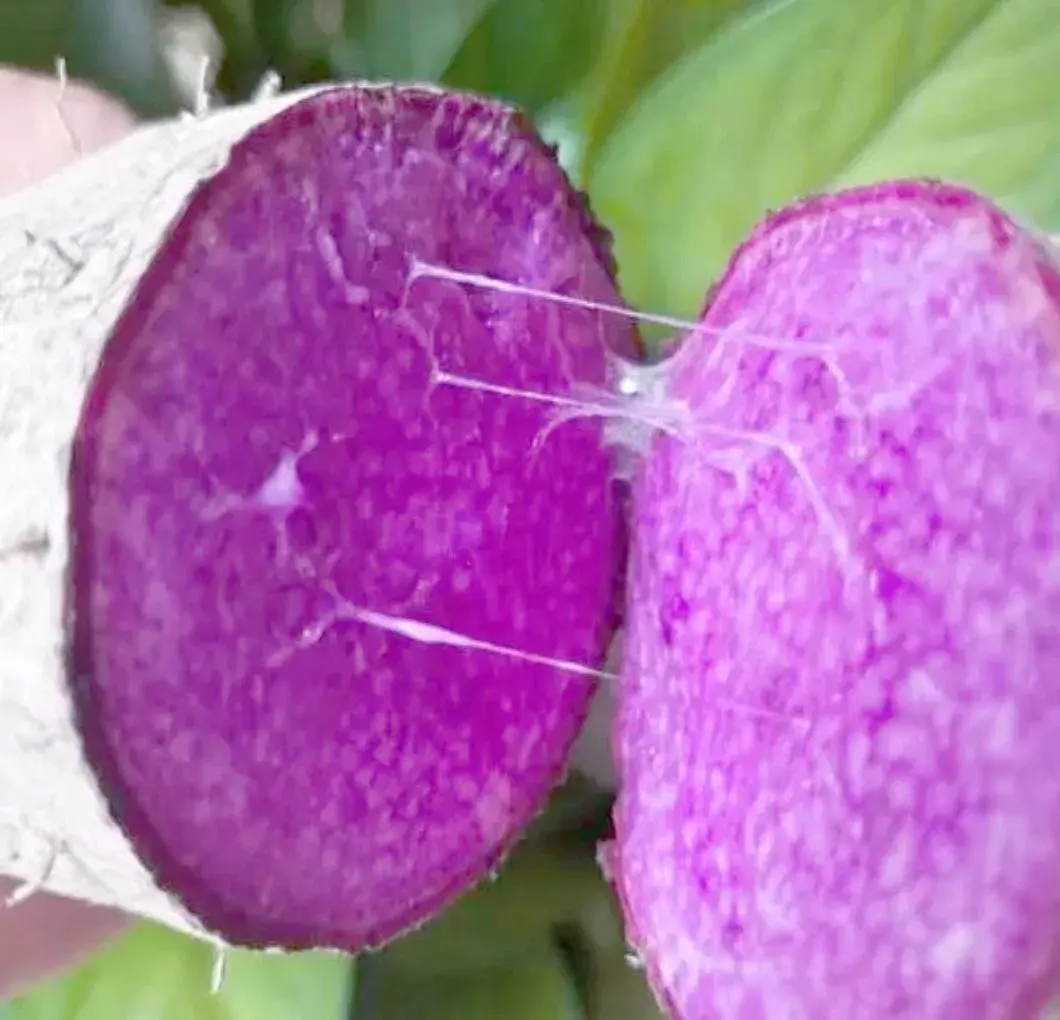
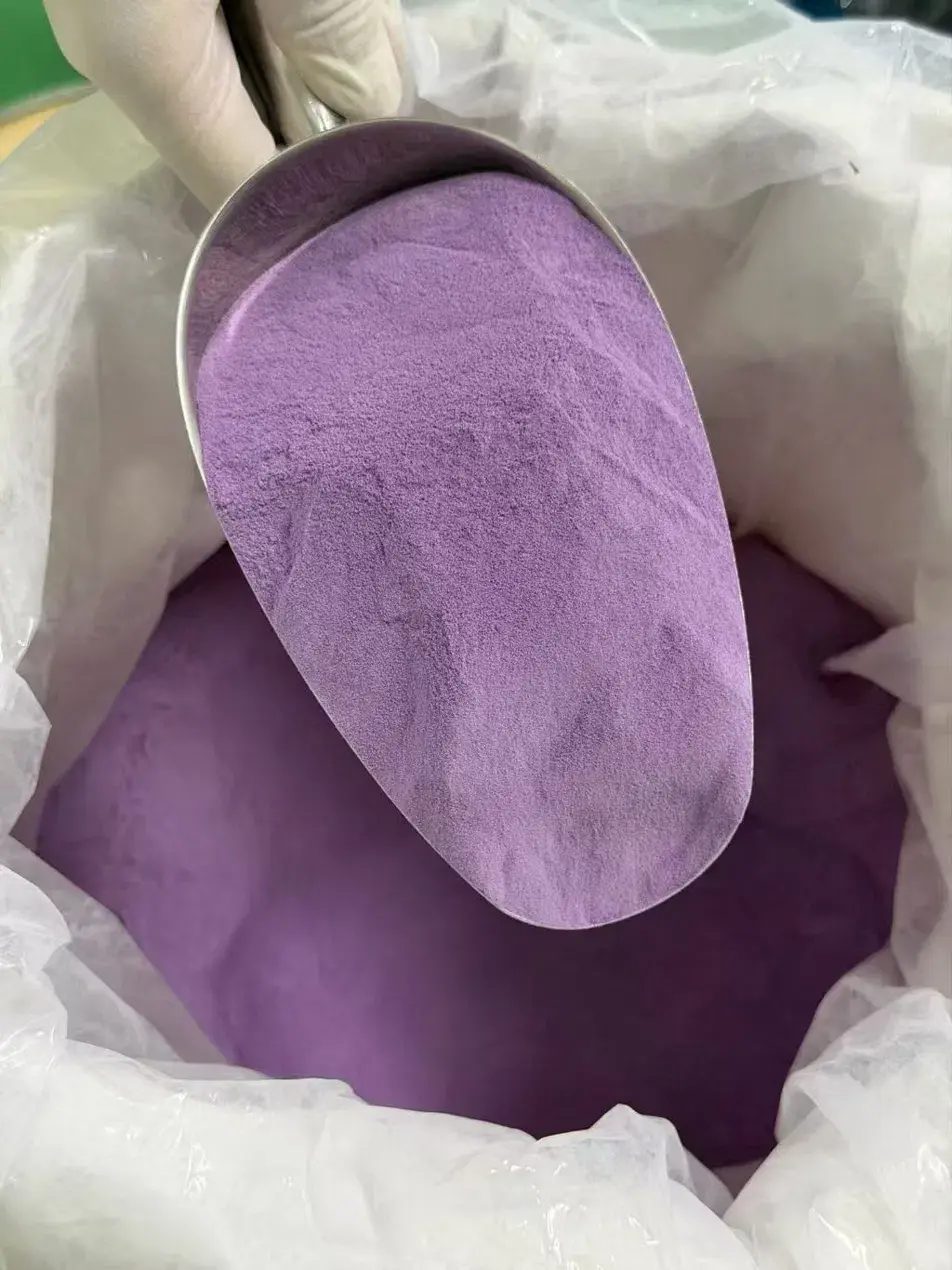
Left: a cut purple yam tuber. The fine sticky threads are mucilage, typical of Dioscorea yams; a cut purple sweet potato tends instead to bleed a milky white latex, though practitioners caution that its absence proves little.[10] Right: our drum-dried powder. The surface in the scoop, lit directly, reads lilac. The same powder deeper in the bag reads distinctly darker. Nothing about the powder changed between the two; only the light and the depth did.
Why dry powder looks paler than the tuber
The drop from the magenta tuber to the lilac powder is partly real pigment loss and partly optics, and the two are worth separating before anyone blames the supplier. The wet test below shows how much of the gap is optics.
Some pigment is lost in any drying process. In purple sweet potato flour, drum drying reduced anthocyanin by 35 and 75 percent across two varieties, against 90 and 86 percent for sun drying.[7] Those are sweet potato figures, not yam, but they show the scale: a real loss, not the whole story.
The larger effect is scattering. In food colour work, the degree of light scattering from a powder is governed mainly by particle size and by the difference in refractive index between the solid and whatever surrounds it. Scattering rises as particles get smaller, so reducing particle size depresses colour intensity: a solid of any colour turns whiter as it is ground finer, for as long as its particles stay above roughly a micron.[1][2] Colourless particles mixed in with the pigment make it worse: they add reflectance without adding colour, and the product surface looks whiter.[1]
Ube powder is exactly that system. The anthocyanin is carried in a matrix that is mostly white starch, milled fine, with air between every particle. The tuber is the same material with water filling those gaps.
Dry ube powder looks pale for the same reason dry sand looks lighter than wet sand. Add water and the colour you paid for comes back into view.
Water has a refractive index much closer to the starch than air does, so wetting the powder cuts the scattering and lets the pigment show. That is why the practical rule in section 03 is to judge ube wet.
There is a trade-off here worth knowing. Finer milling makes a dry powder look paler, and it also settles more slowly in drinks. Coarser milling looks richer in the bag and sediments faster. We set out the settling side of that trade in our guide to ube powder for beverages. A supplier choosing mesh size is choosing between those two, whether or not they say so.
A simple wet-colour test
Our suggested practice, not a standard method
Whisk 3 g of powder into 100 mL of room-temperature water, roughly a drink-level dose, and leave for ten minutes. Pre-gelatinised powder hydrates cold; much above this concentration it thickens into a lumpy paste that colours unevenly. Compare against a reference sample prepared the same way, side by side, against a white background in daylight or under a D65 lamp.
For a second reading, acidify a duplicate cup to about pH 3 with citric acid or lemon juice, checking with a pH strip. Anthocyanins are most intensely coloured in acid. A lot with normal pigment turns a brighter red-violet. A lot that stays pale even acidified is either genuinely low in pigment or has been sulfite-treated, which bleaches the pigment; ask for the residual SO₂ figure before deciding which.
If you have a colorimeter, record L*, a* and b* on the hydrated sample, not the dry powder. That is the number worth putting in a specification.
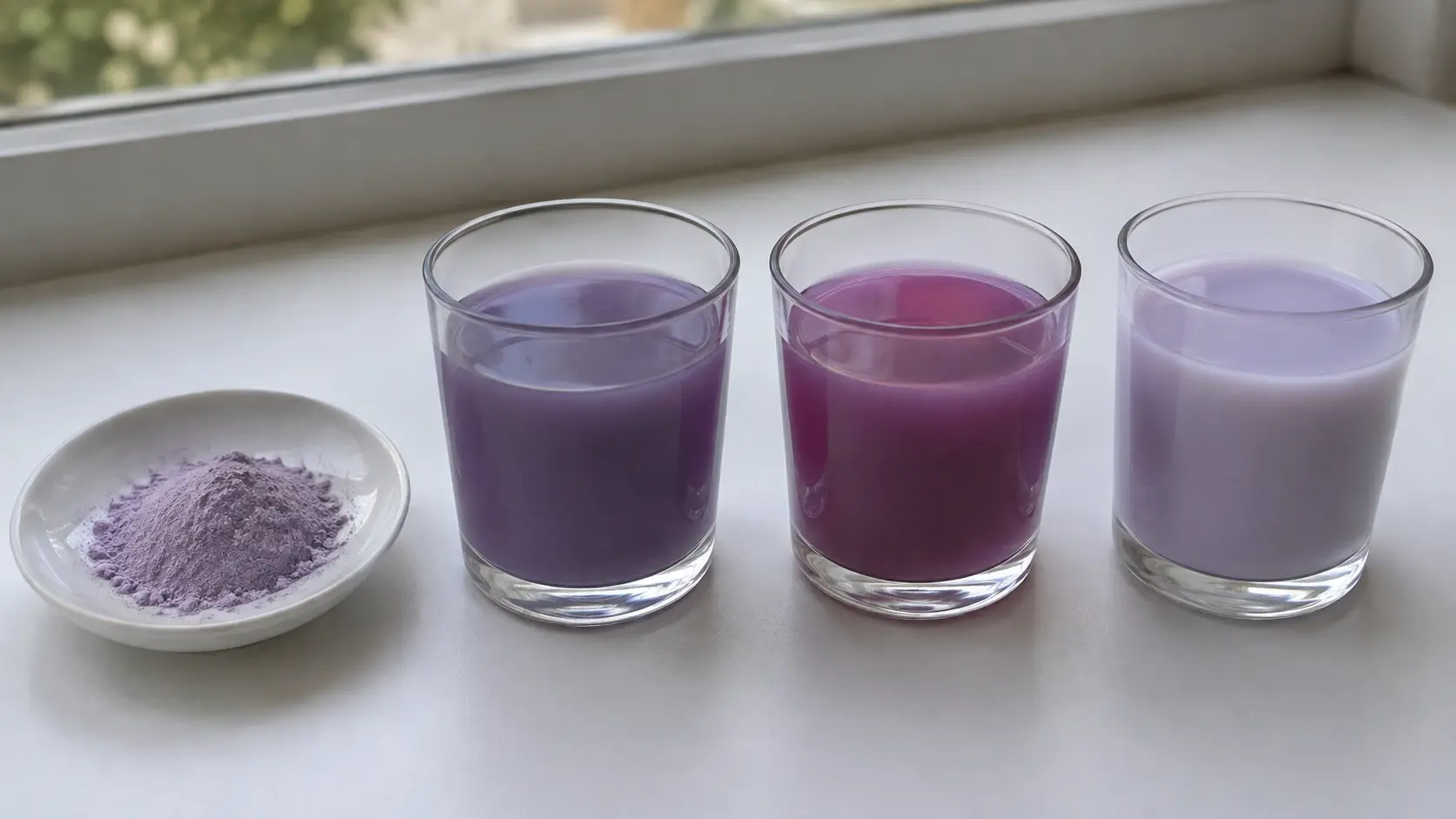
Illustration, not a photograph of our powder. Left to right: dry powder, in water, in water with lemon juice, in milk. It shows the typical direction of change only. Your lot, water and milk will differ, so run the test above on your own sample.
What happens when it is baked
This is the only published measurement of a baked ube product we have found, and it goes a long way to explaining disappointed bakers.
Bread made with 30 percent purple yam flour, carrying 54.62 mg of anthocyanin per 100 g on a dry basis, measured L* 53.06, a* 6.52, b* 13.32, chroma 14.87 and hue angle 64.06°.[3]
A hue angle of 64° sits between red and yellow. Positive a* is red; positive b* is yellow. Violet needs a positive a* with a negative b*, which puts it on the other side of the colour wheel entirely. This is a real ube product with real pigment in it, and instrumentally it is a reddish brown, not a purple.
It is one study, of one Indonesian material at 30 percent substitution, and the published abstract does not say whether crust or crumb was measured. Treat it as evidence of the direction, not as a benchmark for your product.
The same study found that baking at 170 °C or 180 °C made no significant difference to bread colour.[3] Turning the oven down is not the fix. The study did not test why the colour shifts; the most likely causes are the dough's pH, browning reactions and the dilution of pigment in a large volume of wheat, rather than the peak temperature.
| State | What to Expect | Why |
|---|---|---|
| Dry powder | Pale lilac to soft violet, lighter at the surface than in the bulk | Light scattering from fine particles and white starch |
| Hydrated in water | Noticeably deeper violet | Water reduces scattering |
| In milk or neutral dairy | Blue-violet, slightly muted | Neutral pH shifts the pigment toward blue |
| In an acidic drink | Redder violet, brighter | Acid favours the most intensely coloured form |
| Baked | Mauve to reddish brown; measured at hue 64° in one bread study | Browning, pH and dilution in the dough[3] |
Only the baked row is a published measurement. The others are qualitative expectations from the chemistry, and your matrix will move them.
03 Five checks
Is It the Lot or the Ube? Five Checks Before You Reject
Run these in order. The first two cost nothing and take fifteen minutes. Most complaints end there.
| Check | How | Normal Ube | Points to a Real Problem |
|---|---|---|---|
| 1. Judge it wet | Hydrate at a fixed ratio beside a reference sample | Deepens clearly on wetting; comparable to the reference | Stays chalky or grey even when wet |
| 2. Acid test | Acidify a duplicate cup to about pH 3 | Shifts to a brighter red-violet | Barely changes: pigment is genuinely low, or the lot was sulfite-treated. Ask for residual SO₂ |
| 3. Pigment number | Compare the lot's anthocyanin result, method named, with your specification | Inside the agreed range | Below the agreed floor |
| 4. Direction of the shift | Look at which way the colour has moved, not just how much | Violet or blue-violet, just lighter | Brown cast (browning in processing) or flat grey with a respectable assay (possible sulfite bleaching) |
| 5. Species and cultivar | Ask for both; confirm with an HPLC profile or DNA barcoding on a first shipment | D. alata, a purple-fleshed cultivar, cyanidin-dominant profile | Wrong species, or a non-purple cultivar of the right one |
Check 4 in more detail
A brown cast in the dry powder is not the same fault as paleness. It usually means the browning enzymes in the tuber were still active during processing, which is a thermal processing problem at the supplier. A flat grey powder whose anthocyanin assay looks fine is a different signal: sulfite pretreatment bleaches anthocyanins reversibly, so the standard assay can read normal while the powder looks washed out. We covered both mechanisms, with the data, in our beverage formulation guide.
Check 5: the species is not enough
Buying guides commonly tell you to look for Dioscorea alata on the label. That is necessary and not sufficient. D. alata is a species with many cultivars, and not all of them are purple. In a study of browning in dried yam, no anthocyanidins could be detected by HPLC at 520 nm in the unprocessed yam examined, which included a D. alata cultivar.[4]
So a correctly identified D. alata powder can still be pale because it was made from a pale cultivar. Ask for the cultivar, not only the species.
The opposite warning sign
Natural ube varies. Published work on Philippine accessions grown side by side found flesh colour differing not only between tubers but between the head, middle and tail of a single tuber.[9] A powder that is identically saturated violet in every lot, and brighter than the tubers it supposedly came from, deserves a question about added colour rather than praise for consistency.
What you can reasonably reject, and what you cannot
- Reasonable grounds: anthocyanin below the agreed floor; a brown or grey cast in the dry powder against the retained reference; wrong species or cultivar; an undeclared carrier or colour additive.
- Not reasonable grounds: a lot that looks paler dry than a marketing photo; a baked product that is not violet; a lot that differs from the last one but sits inside the agreed tolerance.
The second list is why the specification matters more than the complaint. Section 08 covers what to write into it.
04 Drying myth
"Low and Slow" Drying Is Not the Colour-Safe Route
One widely read buying guide advises that slow, low-temperature drying preserves more flavour and nutrients than spray drying or flash drying.[12] The intuition is understandable. Heat damages anthocyanins, so less heat must mean more colour.
For yam, the evidence points the other way, because the main threat to colour in a freshly cut tuber is not heat. It is enzymes.
Polyphenol oxidase activity was 50 percent higher in a D. alata cultivar than in D. rotundata, and 45 percent of that activity survived 50 minutes of blanching at 60 or 65 °C.[4] Gentle heat leaves the browning enzymes working while the tuber is still wet, and brown pigments forming on top of the purple are what turn a powder muddy.
Drying temperature data points the same way. In purple yam powders made by reflectance window drying, higher drying temperatures lowered L* and raised chroma — a darker, more saturated powder — and the 70 °C and 80 °C treatments gave the best retention of bioactive compounds.[5] And in purple sweet potato flour, high-temperature, short-time drum drying retained substantially more anthocyanin than slow sun drying.[7]
The honest qualification
The literature is not unanimous. One study recommended drying purple yam at 45 °C for overall quality. But in that study the slices were first blanched in water at 80 °C for eight to ten minutes before drying.[6] Low-temperature drying after a proper enzyme-killing step can work. Low-temperature drying of raw slices is the risk. The variable that matters is whether the enzymes were inactivated first, not the temperature of the dryer.
That is the reasoning behind the process used for our powder: peeled tuber flesh is steam-cooked at 105 °C before it reaches the drum dryer, so the enzyme step comes first and the drying step is short.
05 Your process
What Turns Ube Grey or Brown in Your Own Process
If the powder passes the checks in section 03 and the finished product still disappoints, look here. Each of these has a fuller treatment, with the data, in our beverage formulation guide.
- Baking soda and other alkaline leaveners. They push anthocyanins toward blue, grey and eventually green-brown. Rebalance toward an acidic leavening system or add a little acid.
- Browning in the bake. The measured bread in section 02 sat at a strongly positive b*, the direction browning moves colour.[3] In that study a cooler oven made no significant difference, so reducing alkaline leavening and shortening the bake are the levers worth testing.
- Neutral dairy. Milk sits near pH 6.7, which shifts ube toward blue-violet and costs some intensity. Ube tolerates this better than most natural purples, but it does not ignore it.
- Ascorbic acid. Vitamin C degrades anthocyanins irreversibly. An ube product with a vitamin C claim needs a protected form or a separate SKU.
- Iron. From a mineral premix, process water or equipment. It shifts cyanidin-based pigments toward slate.
- Long hot holds. Total heat load matters more than peak temperature.
06 Natural options
Making It More Purple Without Synthetic Dye: US and EU Compared
There are two ways to get more purple into a product without synthetic dye. Use more ube, which adds starch, cost and body, with the texture ceiling set out in our beverage guide. Or add a natural colour alongside the ube. The second route is where the regulations get interesting, because the US and the EU treat the same ingredients in almost opposite ways.
United States: approved colour by approved food category
In the US a natural colour used to colour food is a colour additive, and each one is permitted only for the uses its regulation lists. A fruit or vegetable juice deliberately used as a colour — the regulation's own example is beet juice in pink lemonade — is a colour additive even though it is a food.[25]
- Fruit juice and vegetable juice colours may both be used to colour foods generally, in amounts consistent with good manufacturing practice, except foods with a standard of identity unless that standard authorises added colour.[13][14] The FDA has given the opinion that sources including purple sweet potato, purple and black carrot, purple corn, red cabbage, aronia and elderberry are suitable.[15] They are declared as, for example, "colored with ___" or "___ color".[16] These are the most flexible options for an ube product, and the only ones on this list with general permission today.
- Butterfly pea flower extract is listed at 21 CFR 73.69.[17] Its permitted uses are specific categories — sports and juice drinks, dairy-based beverages, ready-to-drink teas, confectionery, ice cream and yogurt among them — expanded in 2025 to ready-to-eat cereals, crackers, snack mixes, pretzels and chips.[18][19] Cakes and general bakery are not on the published list.
- Galdieria extract blue is approved for a list that includes beverages, flavoured milks, frostings, ice cream and puddings.[20]
- Gardenia blue is approved for sports drinks, flavoured waters, fruit drinks, ready-to-drink teas and candy.[21]
- Spirulina extract, a blue, is listed for specific categories that include confections, frostings, ice cream, puddings and non-alcoholic beverages.[22] In February 2026 the FDA issued an order extending it to foods generally,[23] but after objections and a hearing request were filed, the effective date of that order was delayed indefinitely from 20 March 2026.[24] As of the latest notice we found, the category list still applies, so cakes are not covered. This is precisely the kind of position that changes; check it before you formulate.
If you make an ube cake in the US and want it more purple without synthetic dye, fruit and vegetable juice colours are your realistic options today. Some natural blues are approved for the frosting. None is currently approved for the cake.
European Union: colouring food or colour additive
The EU draws its line somewhere else entirely. Fruit and vegetable concentrates used for their colouring properties are classed as colouring foods and fall outside the food additives regulation; extracts in which the pigments have been selectively enriched are colours, meaning additives.[27] The test, set out in guidance endorsed in 2013, is whether the extraction was selective, judged by an enrichment factor comparing pigment to nutritive and aromatic constituents.[26]
The practical effect is that a non-selective purple sweet potato or black carrot concentrate can appear in the ingredient list as a food, with no E number. A selectively extracted anthocyanin preparation is E163 and is declared as a colour.
Spirulina extract is typically treated in the EU as a colouring food rather than an additive,[28] which makes a red vegetable concentrate plus spirulina one route to a natural purple that stays on the food side of the line. Its weakness is stability: spirulina is not very heat stable and has limited pH stability,[11] so it suits cold dairy and frostings far better than anything baked.
Butterfly pea is a different matter. Commercial sources describe it as a novel food in the EU, not approved for general food use.[29] That is a secondary source and we would not rely on it either way; check the EU Novel Food Catalogue before planning a formula around it.
The same purple sweet potato concentrate can be a food ingredient on a German label and a colour additive on an American one.
What each option does to ube's shade
A colour that is purple in one product can be blue in another. Butterfly pea is the clearest case: its extract is blue near its natural pH of about 6.5, purple at around pH 4 to 4.5, and green between pH 7.5 and 9.[8] Added to a neutral ube latte, it pushes the colour toward blue, not purple. In an acidic ube drink it adds purple.
| Option | US Position | EU Position | Effect on Ube in a Neutral Product |
|---|---|---|---|
| More ube powder | Food ingredient in an ube product | Food ingredient | More of the same colour; more starch and body |
| Fruit or vegetable concentrate: purple sweet potato, black carrot, purple corn, aronia, elderberry | Fruit or vegetable juice colour; foods generally; declared as a colour | Colouring food if non-selective; E163 if selectively extracted | Adds red-purple |
| Butterfly pea extract | Listed categories only; not cakes | Reported as novel food; check before use | Adds blue at neutral pH, purple in acid |
| Spirulina extract | Listed categories, including frostings; the February 2026 foods-generally order is delayed indefinitely | Typically a colouring food | Adds blue; limited heat and pH stability |
| Galdieria blue | Listed categories, including frostings, ice cream and puddings | Status not established in our research; check before use | Adds blue |
| Gardenia blue | Drinks, teas and candy only | Status not established in our research; check before use | Adds blue |
We have not tested these combinations with our own powder in finished products. The directions above follow from each colour's chemistry; the magnitude in your system is a bench question. And one reminder from our labelling comparison: in the US, ube powder used to colour something that is not an ube product is itself a colour additive, for the same reason beet juice is.
07 Presentation
Selling the Real Colour Instead of Apologising for It
The dye route has trained a whole market to expect neon violet from anything called ube. A brand that switches to real ube can either fight that expectation quietly, and field complaints, or use it.
- Photograph the finished product, wet, in daylight. Never the dry powder alone, which undersells it, and never a dye-level colour the product cannot reach.
- Show the tuber. A cut purple yam next to the product explains the colour better than a paragraph does.
- Name the colour honestly. Lilac, mauve and soft violet are accurate and read as premium. "Vibrant purple" invites comparison with dyed competitors you will lose.
- Make the absence of dye the point. Real ube's colour comes from the plant, while the colour systems behind many dyed ube products now face a US revocation deadline and, in Europe, a mandatory warning statement, as our labelling comparison set out.
There is also a compliance reason to keep pack imagery honest. EU food information rules prohibit information that misleads, and that includes pictorial presentation.[30] A carton showing a violet the product cannot reach, on a product coloured only by ube, is an avoidable exposure.
08 Specification
Writing Colour Into the Purchase Specification
Every dispute about ube colour is easier with a specification that says what "purple enough" means before the goods arrive. These are the lines worth writing in.
- An anthocyanin floor and target, with the method named. Not just a target. A lot below the floor is rejected; a lot above it is accepted even if it looks paler than the last one. Our beverage guide explains how to dose on colour value inside that band.
- A wet-colour target. L*, a* and b* measured on a defined hydration — ratio, water, time and illuminant stated — with a ΔE tolerance. Not a description of the dry powder, and never a photograph.
- A retained reference sample, agreed at the start, that every future lot is compared against using the tests in section 02.
- Species and cultivar, for the reason in section 03.
- A statement that no carrier and no colour additive is present, so that a lot that is suspiciously bright is as clearly out of specification as one that is pale.
We do not yet publish CIELAB values for our own lots. Ask for the certificate of analysis for the specific lot you are sampling, measure it wet against your own reference, and hold us to it.
We supply purple yam powder made from Dioscorea alata sourced from the Philippines, from peeled tuber flesh steam-cooked at 105 °C and drum-dried, with no carrier and no sulfites, and a certificate of analysis carrying an HPLC anthocyanin result. Samples are free of charge, MOQ is 1 kg, lead time is 7 to 15 days and quotations are returned within 24 hours. Tell us your application and what the finished product needs to look like, and we will tell you honestly whether real ube can get you there.
09 Questions
Frequently Asked Questions
Why did my ube cake come out brown instead of purple?
Most likely because baking moves ube out of the violet range. In the one published measurement we found, bread made with 30 percent purple yam flour had a hue angle of 64°, which is reddish brown rather than purple, and baking at 170 °C versus 180 °C made no significant difference.[3] The probable causes are the dough's pH, browning reactions and dilution. Reduce alkaline leavening, shorten the bake and accept that a baked ube product will read mauve. A cooler oven will not fix it.
Does ube powder change colour when you add water?
Yes, it gets noticeably deeper. Fine dry powder scatters light and looks paler than the material it came from; water reduces that scattering and lets the pigment show.[1][2] Always judge ube colour on a hydrated sample.
Is Dioscorea alata always purple?
No. D. alata is a species with many cultivars, and some have white or cream flesh. One study found no detectable anthocyanidins in the unprocessed yam it examined, which included a D. alata cultivar.[4] "Ube" in trade use means a purple-fleshed cultivar. Ask your supplier for the cultivar as well as the species.
Is very bright purple ube powder fake?
Not necessarily. Some cultivars and harvests are richer in pigment than others, and natural colour varies even within a single tuber.[9] But a powder that is neon violet, identical in every lot and priced close to purple sweet potato deserves questions: ask for written confirmation that no colour additive is present, and consider a synthetic dye screen and an HPLC anthocyanin profile on a first order.
Why is my ube powder grey?
If the dry powder itself is grey, suspect the supplier's processing: browning during drying, or sulfite pretreatment, which bleaches the pigment while the assay can still read normal. If the powder is fine and the finished product turns grey, suspect baking soda, iron from a premix or water, or ascorbic acid in your formula. The checks in section 03 separate the two.
Can I make ube powder more purple naturally?
Yes, but what is permitted depends on the market and the product. In the US, fruit and vegetable juice colours such as purple sweet potato, black carrot or aronia can be used in foods generally and declared as colours, while the natural blues are approved only for specific categories that do not currently include cake.[13][14][19][24] In the EU, a non-selective vegetable concentrate can be a colouring food declared as an ingredient.[26] Section 06 has the full comparison.
How do I check ube powder colour without a colorimeter?
Use the wet test in section 02. Whisk 3 g into 100 mL of water beside a retained reference sample prepared the same way, wait ten minutes, and compare them side by side against white card in daylight. Photograph both in the same frame, with a white and a grey card in shot, so the pictures can be compared fairly later. Then acidify duplicates to about pH 3. A lot that brightens is carrying pigment; one that stays pale needs an anthocyanin figure and a residual SO₂ figure before you decide.
10 Evidence base
References
Colour science and processing
[1] US Patent 5,002,789. Food colorant system — light scattering by powdered solids, the effect of particle size and refractive index, and the whitening effect of colourless diluent particles. View source
[2] US Patent 5,069,918. Method of coloring foods — the same optical principles applied to food colorants. View source
[3] Tamaroh, S., Sudrajat, A. (2021). Antioxidative characteristics and sensory acceptability of bread substituted with purple yam (Dioscorea alata L.). International Journal of Food Science. DOI: 10.1155/2021/5586316
[4] Biochemical origin of browning during the processing of fresh yam (Dioscorea spp.) into dried product (2005). Journal of Agricultural and Food Chemistry. PubMed
[5] Exploring novel frontiers of advancements in purple yam (Dioscorea alata L.) starch extraction, modification, characterization and applications (2024), including drying temperature effects on powder colour. ScienceDirect
[6] Investigation of drying kinetics, nutrient profile, physicochemical and functional properties of purple yam (Dioscorea alata) under different drying conditions (2024). Journal of Food Measurement and Characterization. Springer
[7] Influence of drying approaches on the structural, nutritional, and functional characteristics of purple sweet potato flour. CyTA – Journal of Food, 24(1). DOI: 10.1080/19476337.2026.2672215
[8] Ondokuz Mayıs University (2026). Research on pH-dependent colour of butterfly pea flower infusions. View source
[9] Summary of Ferriol (2023) on genetic variation in flesh colour among Philippine yam accessions, including within-tuber variation. Secondary source. View source
[10] Practitioner note on sweet potato latex as a field cue. Secondary source; not a test. View source
[11] Colour manufacturer's regulatory note comparing natural blues, including the limited heat and pH stability of spirulina. Industry source. View source
[12] Retail buying guide recommending slow, low-temperature drying for ube powder. Cited as the claim under discussion. View source
Regulation, United States
[13] US FDA. 21 CFR 73.260 — Vegetable juice, including use for colouring foods generally at good manufacturing practice. eCFR
[14] Fruit juice and vegetable juice colours: US status, including fruit juice (21 CFR 73.250) for colouring foods generally at good manufacturing practice. Industry association profile. View source
[15] FDA opinions on suitable fruit and vegetable juice colour sources, including purple sweet potato, purple and black carrot, purple corn and red cabbage. Industry compilation. View source
[16] NATCOL. Position on fruit and vegetable juice colours in the US, including label declaration forms. View source
[17] US FDA. 21 CFR 73.69 — Butterfly pea flower extract. eCFR
[18] Federal Register, 12 May 2025. Listing of color additives exempt from certification; butterfly pea flower extract — expanded uses. Federal Register
[19] Summary of 2025 FDA colour additive approvals, including the full list of butterfly pea extract categories. Secondary source. View source
[20] FDA approval of galdieria extract blue and its permitted food categories, May 2025. View source
[21] FDA approval of gardenia (genipin) blue and its permitted food categories. View source
[22] US FDA. 21 CFR 73.530 — Spirulina extract, permitted food categories. eCFR
[23] Federal Register, 6 February 2026. Listing of color additives exempt from certification; spirulina extract — final order extending use to human foods generally. Federal Register
[24] Federal Register, 24 March 2026. Spirulina extract; delay of effective date — the February 2026 order's effective date delayed indefinitely as of 20 March 2026. Federal Register
[25] US FDA. 21 CFR 70.3 — Color additive definitions, including food substances deliberately used as a colour. eCFR
Regulation, EU
[26] European Commission. Guidance notes on the classification of food extracts with colouring properties (2013), including the enrichment factor test. View source
[27] Colouring foods versus food colours: guidance notes on the classification of food extracts with colouring properties. Review. View source
[28] Spirulina extract: regulatory profile, including its usual treatment as a colouring food in the EU. Industry association profile. View source
[29] Retail source describing butterfly pea as a novel food in the EU. Secondary source; verify against the EU Novel Food Catalogue. View source
[30] Regulation (EU) No 1169/2011 on the provision of food information to consumers, including the prohibition of misleading information. EUR-Lex
Reviewed by
Prof. Bingji MaScientific Advisor at PhytoVale. Professor and medicinal plant science expert. Research focus covers Chinese medicinal materials, phytochemistry, natural products and medicinal plant quality.
Written by
FloraContent Editor at PhytoVale. Product content and editorial specialist, focused on botanical ingredient specifications, sourcing information and B2B technical content.
This article is written for food and beverage product development, sourcing and marketing professionals. Colour values quoted are from published studies of specific products and will differ in your matrix; the wet-colour and acid tests described are suggested practice rather than standard methods. The summary of US and EU colour regulations reflects our understanding at the date shown and is not legal or regulatory advice; colour additive approvals are category-specific and change, and several entries in section 06 rely on secondary sources that should be verified before a formulation or labelling decision. No health claims are made for any ingredient discussed here.