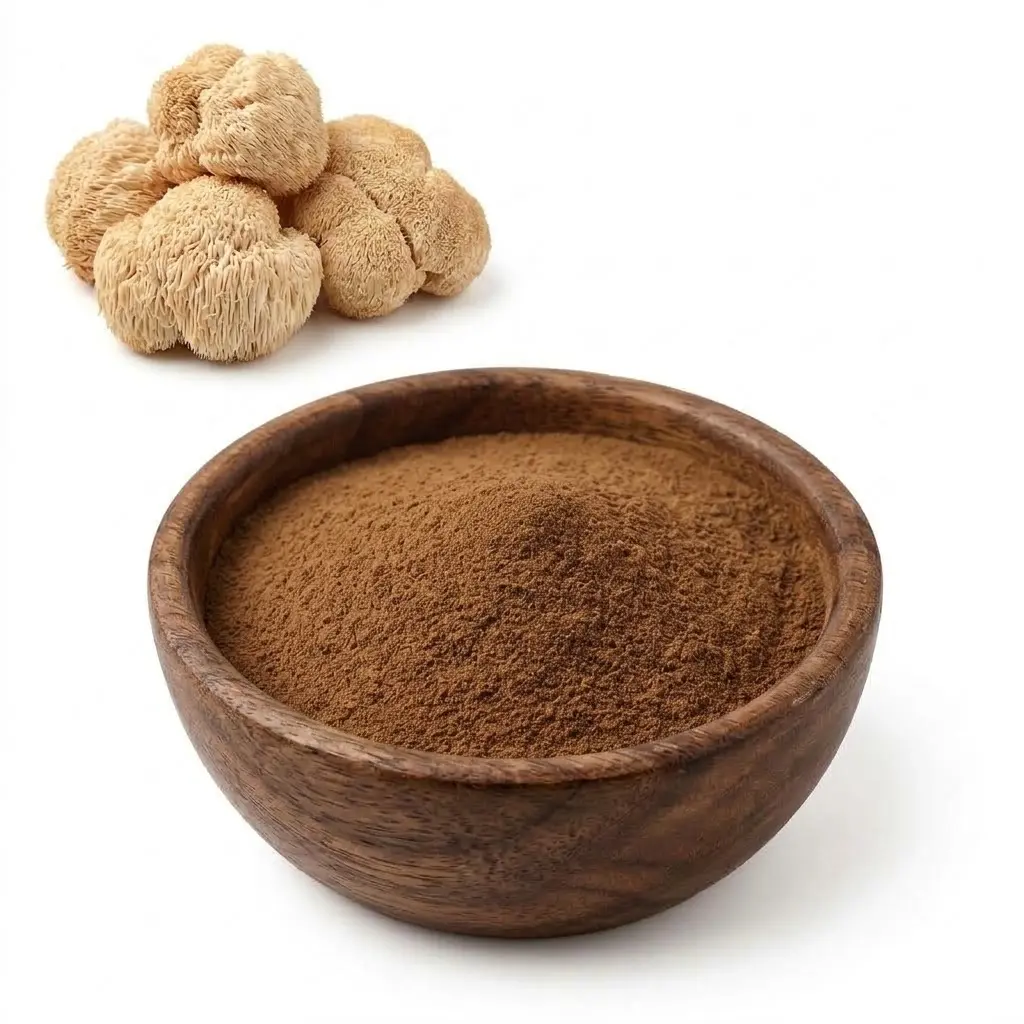
Hericium erinaceus
MOQ
1 kg
Lead time
7–15 days
Quotation
Within 24 hours
Samples
Free of charge
Written by Flora · Reviewed by Prof. Bingji Ma · Updated September 2026
PhytoVale is a bulk supplier of Lion's Mane Extract produced from cultivated Hericium erinaceus fruiting body only, extracted with hot water. Five stock grades: beta-glucan 10% and 30% by enzymatic assay, and total polysaccharide 10%, 30% and 50% by UV, for capsules, tablets, mushroom coffee, functional beverages and powder blends. MOQ 1 kg, free samples, quotation within 24 hours.
Two things separate lion's mane suppliers, and neither is the headline percentage. The first is whether the input material is fruiting body or mycelium grown on grain, which changes both the European regulatory position and how much of the assayed carbohydrate is actually fungal. The second is which assay the specification is written against, because a polysaccharide number and a beta-glucan number are not measuring the same thing. This page answers both before you ask.
Lion's Mane Extract Powder – Real Water Mixing Test
01 · Product identity
Lion's Mane Extract is produced from the fruiting body of Hericium erinaceus. Our raw material is cultivated in Henan Province, China. Dried fruiting body is milled, extracted in hot water, filtered, concentrated and dried to a free-flowing powder. The concentration end point sets the assay level, and the assay level defines the grade.
The commercially important variable is not the species. Almost everyone selling lion's mane is selling Hericium erinaceus. The variable is which part of the fungus went into the extractor, and which method was used to certify what came out. Those two questions decide regulatory eligibility in Europe, actual fungal content, and whether two quotations are comparable at all.
These are different ingredients sold under similar names, and price comparisons between them are meaningless.
Lion's mane powder is dried mushroom milled to a powder, with nothing removed. It carries whatever the mushroom carries, typically a single-digit beta-glucan figure. Lion's mane extract has been through water extraction, so the water-soluble fraction is concentrated and the insoluble residue is discarded. That is why an extract can reach 30% beta-glucan and a powder generally cannot.
A third material is sold under both names and is neither: mycelium grown on a grain substrate, dried and milled with the grain still in it. Section 04 covers why that matters for the numbers on the certificate.
02 · Active compounds
Lion's mane research covers three compound families. They do not come from the same part of the fungus and they do not come out in the same solvent. Getting this wrong is the most common reason a finished product does not match the studies its marketing points at.
| Compound family | Found in | Extracted by | Present in our extract |
|---|---|---|---|
| Beta-glucans and other polysaccharides | Fruiting body and mycelium | Hot water | Yes. This is what our grades are built on |
| Hericenones | Fruiting body | Acetone, chloroform, ethanol, supercritical CO2 | Trace at most. Lipophilic, and hot water does not carry them |
| Erinacines | Mycelium | Organic solvent | No. Our input material contains no mycelium |
Hericenones were originally isolated from fresh fruiting bodies using acetone extraction followed by chloroform and ethyl acetate partition, then silica gel chromatography and HPLC. Current work on hericenones and related lipophilic constituents uses supercritical CO2 with ethanol as co-solvent. None of that describes a hot water process. Erinacines are a separate cyathane diterpenoid family produced by cultured mycelium, and the clinical work on them uses mycelial preparations standardized to erinacine A.
Before you specify
If your product concept rests on a hericenone or erinacine content claim, a hot water fruiting body extract is the wrong raw material and we will say so at enquiry rather than after you have paid for it. Note also that erinacine-bearing material is mycelial, which carries a different European regulatory status. See section 06.
03 · Product data
All five grades come from the same input material and the same hot water process. They differ in how far the extract is concentrated, and in which assay the specification is written against.
| Grade | Specification | Assay method | Typical buyer |
|---|---|---|---|
| LM-BG30 | Beta-glucan ≥ 30% | Enzymatic (Megazyme K-YBGL or equivalent) | Capsule and tablet brands whose label carries a beta-glucan figure |
| LM-BG10 | Beta-glucan ≥ 10% | Enzymatic (Megazyme K-YBGL or equivalent) | Blends and beverages where lion's mane is one of several actives |
| LM-P50 | Total polysaccharide ≥ 50% | Phenol-sulfuric acid, UV | Buyers whose own specification or registration is written in polysaccharide terms |
| LM-P30 | Total polysaccharide ≥ 30% | Phenol-sulfuric acid, UV | General food and beverage use |
| LM-P10 | Total polysaccharide ≥ 10% | Phenol-sulfuric acid, UV | Cost-led blends, instant drink bases, pet products |
These are two different measurements and the numbers are not interchangeable. Reading them as if they were is the single most common mistake we see in enquiries.
The phenol-sulfuric acid method reacts with sugars in general. It counts beta-glucan, alpha-glucan, starch and any other carbohydrate present, and returns one combined figure. The enzymatic method measures total glucan and alpha-glucan separately, then reports beta-glucan as the difference. Only the second one tells you how much of the powder is the fungal cell wall polysaccharide the research literature is about.
In practice a lot of LM-BG30 will also return a high number by UV, because the UV method is capturing everything present. The reverse does not hold. A material reading 50% by UV can carry a low beta-glucan figure if the carbohydrate came from somewhere other than the mushroom cell wall.
How to compare two quotations
Ask every supplier, including us, for a beta-glucan and an alpha-glucan result from the same lot by the same enzymatic method. That comparison is meaningful. Comparing a UV polysaccharide number against an enzymatic beta-glucan number is not, and it is how most buyers end up overpaying for starch.
Start from what goes on your finished label. If the label states a beta-glucan content, specify a BG grade so the pack figure traces back to the same method on the certificate of analysis. If the label states extract weight only, or your registration dossier is written in polysaccharide terms, a P grade usually reaches the same finished product for less.
Where dose per unit is tight, such as a single capsule carrying several actives, BG30 delivers the most beta-glucan per milligram of fill. Where the format has volume to spare, such as a 10 g sachet or a coffee blend, a lower grade at higher inclusion reaches the same delivered amount at lower cost. Higher assay is not automatically the better buy; it is the better buy when space is the constraint.
Not sure which of the five grades fits?
Send us your finished-product format and the beta-glucan or extract weight you need per serving. We will tell you which two grades to trial, and send both as free samples.
04 · Production
| Step | What happens | What it controls |
|---|---|---|
| Cultivation | Fruiting bodies cultivated in Henan Province, China, on a hardwood sawdust-based substrate | Strain, farm, harvest window, cultivation lot number |
| Harvest and drying | Fruiting bodies harvested, cleaned, dried and milled | Fruiting body only. Mycelium and spent substrate are not collected |
| Extraction | Hot water extraction at approximately 80–90 °C, typically in two passes | Water only. No ethanol, no other solvent |
| Filtration and concentration | Solids removed, liquor concentrated under vacuum | Concentration end point, which sets the assay level |
| Drying | Spray dried to a free-flowing powder | Drying conditions and residual moisture are controlled lot by lot |
| Standardization and packing | Assayed, adjusted to grade, sieved, packed | Adjustment is made with lower-assay lion's mane extract from the same process, not with added starch or fibre |
A large share of the lion's mane powder on the world market is made a different way. Mycelium is inoculated onto a grain substrate, usually oats, brown rice or sorghum, grown for several weeks, then the whole mass including the grain is dried and ground. The resulting powder is largely starch.
Independent testing by Nammex using the enzymatic method found mycelium-on-grain samples carrying roughly 10% beta-glucan or less, in some cases around 1%, with starch levels matching the excess grain. Fruiting body material tested in the same programme carried consistently higher beta-glucan and averaged under 3% starch by dry weight.
That starch is alpha-glucan. A UV polysaccharide assay counts it. An enzymatic beta-glucan assay does not. This is how a supplier can honestly certify a high polysaccharide figure on a material whose fungal content is low. For our BG grades, beta-glucan is tested lot by lot by enzymatic assay and alpha-glucan is reported alongside it. For polysaccharide grades, alpha-glucan testing is available when required by the buyer.
An extract ratio describes how much raw material entered the extractor, not how much active left it. Two suppliers can both state 10:1 and ship materials with very different beta-glucan content, because yield depends on the raw material, the extraction conditions and how far the liquor was concentrated.
We state a ratio on request. Treat it as a process description, and buy on the assay. A ratio with no assay attached is not a specification.
Most of the world's lion's mane raw material is grown and extracted in China, including ours. That is a cost and scale advantage rather than a quality question in itself, but it does mean the burden of evidence sits with the supplier. Four things are worth confirming in writing before a first order, from any Chinese supplier:
Standard grades are supplied without added maltodextrin where the process permits. If a carrier or drying aid is required for a specific grade or production lot, its identity and level are declared on the certificate of analysis before shipment. If your formulation or label is carrier-sensitive, say so at enquiry and we will confirm the carrier status of the quoted lot in writing.
05 · Formulation
| Format | Grade usually specified | What decides it |
|---|---|---|
| Capsules | LM-BG30 | Fill volume is the constraint. Calculate from tapped density, not bulk density |
| Tablets | LM-BG30, LM-P50 | Hygroscopicity affects hardness over shelf life. Consider coating if the pack is not foil |
| Mushroom coffee and instant drinks | LM-P30, LM-BG10 | Dispersion below 80 °C, since that is how most consumers actually make them |
| RTD beverages | LM-BG10, LM-P10 | Viscosity and haze. Check clarity in a clear bottle under shelf lighting, not in a beaker |
| Gummies | LM-BG30 | Colour carry-through and dosing accuracy at low inclusion |
| Powder blends and meal replacements | LM-P10, LM-P30 | Segregation risk if particle size differs sharply from the base powder |
| Pet supplements | LM-P10 | Palatability, plus a separate heavy metal limit set in several markets |
Two calculations cover most briefs, and both are worth running before you request a sample rather than after.
Most pilot batches that fail do not fail on assay. They fail on colour, dispersion, caking or taste. Three points are worth knowing before you scale.
Colour and flavour. Hot water mushroom extracts run beige to light brown and will tint a white base. Flavour contribution is mild and slightly savoury, and becomes noticeable in neutral systems before it does in coffee or cocoa. Evaluate both against your target, not against a competitor sample.
Viscosity. Beta-glucan builds viscosity in solution. Irrelevant in a capsule, not irrelevant in an RTD at higher inclusion, where it interacts with gums already in your system. Run a viscosity check at target inclusion before locking the hydrocolloid package.
Moisture. The material is hygroscopic. Control room humidity during filling and keep foil bags closed between runs. Resealing matters more than storage temperature.
Requesting a sample
Lot-specific physicochemical data, including solubility, bulk and tapped density, pH in solution and particle size distribution, is issued with the certificate of analysis rather than published here, because it varies by grade and lot. Ask for 100 g rather than 20 g if you intend to run a real trial. Bench-beaker behaviour rarely predicts a 200 L batch, and a second sample request costs you another two weeks.
06 · Evidence level
The clinical literature on lion's mane is real but thin. Fewer than fifteen controlled human trials exist, most enrolled between twenty and eighty people, several were funded by ingredient producers, and the results are mixed rather than uniform. We set the main ones out below so your regulatory and marketing teams can judge them directly. None of this is a claim for a PhytoVale product.
| Study | Who and how long | Material and dose | Outcome |
|---|---|---|---|
| Mori 2009 [1] | 30 adults aged 50–80 with mild cognitive impairment, 16 weeks, double blind, placebo controlled | Dried fruiting body powder, 3 g/day | Cognitive scale scores higher than placebo at weeks 8, 12 and 16; scores fell significantly 4 weeks after intake stopped |
| Saitsu 2019 [2] | Adults, 12 weeks, double blind, placebo controlled | Fruiting body supplement | Significant on MMSE only; the two other cognitive tests used did not reach significance |
| Li 2020 [3] | Mild Alzheimer's disease, 49 weeks, double blind, placebo controlled | Mycelium standardized to 5 mg/g erinacine A, 3 × 350 mg/day | Placebo declined on one instrument while treatment improved on another; 4 withdrawals for abdominal discomfort, nausea or rash |
| Surendran 2025 [4] | 18 healthy adults aged 18–35, single dose, crossover | 3 g of a 10:1 fruiting body extract | No significant effect on composite cognition or mood; one task improved |
| Grozier 2022 [5] | 24 college-age adults, 4 weeks | 10 g/day | No effect on cognition or metabolic flexibility |
| Gravina 2023 [6] | Review of gastrointestinal evidence | Various | Collects the gastritis and inflammatory bowel evidence; concludes further evidence is needed |
| Martínez-Mármol 2023 [7] | Preclinical, cultured neurons and mice | Solvent-extracted hericene A and crude extract | Promoted neurite outgrowth and enhanced hippocampal memory through ERK1/2 signalling |
| Menon 2025 [8] | PRISMA systematic review, PubMed 2000–2024 | Various | Reports neuroprotective and mood signals; notes that side effects, though often unreported, include stomach discomfort, headache and allergic reactions |
The signal is in older adults, not in healthy young ones. The positive cognitive results come from populations with mild cognitive impairment or self-reported difficulty. In healthy younger adults the picture is weak: a single 3 g extract dose produced no significant composite effect, and 10 g per day for four weeks produced none either. A 2024 review reached the same conclusion. Positioning aimed at a young performance audience is running ahead of the evidence.
Fruiting body and mycelium trials are not interchangeable. The longest and most cited Alzheimer's trial used mycelium standardized to erinacine A, a compound our extract does not contain and which is not permitted as a dehydrated mycelium ingredient in the EU. Citing that trial to support a fruiting body water extract is a mismatch a competent reviewer will catch.
Trial doses do not convert to extract doses. The studies above used whole dried powder, cookies or specific standardized mycelial preparations, each compositionally different from a concentrated water extract. A 3 g daily powder dose does not mean 3 g of LM-BG30. If you need a defensible serving size, work from the beta-glucan or polysaccharide amount the study material actually delivered, and note that most papers do not report it.
Repeat-dose oral toxicity work in rats on erinacine A enriched lion's mane over 28 days at 1, 2 and 3 g/kg body weight per day found no treatment-related changes in clinical signs, urinalysis, haematology, serum biochemistry or histopathology, giving a no observed adverse effect level above 3 g/kg body weight per day. A thirteen-week feeding study at up to 2625 mg/kg found no mortality or noticeable toxicological effect, and a single-dose acute study at 5000 mg/kg produced no death or signs of toxicity. The NIH LiverTox monograph records that lion's mane has not been linked to serum enzyme elevations or to clinically apparent liver injury. Reported side effects are summarized in the systematic review cited above [8].
07 · Compliance
Regulatory status depends on which part of the fungus the material came from, how it was extracted, and where the finished product will be sold. A single global answer does not exist, and any supplier offering one is oversimplifying.
| Material | EU novel food status |
|---|---|
| Fruiting body | Not novel. Consumed to a significant degree in the Union before 15 May 1997 |
| Aqueous extract powder from fruiting body | Not novel. Confirmed through a novel food status consultation assessed by Finland and concluded in 2025 |
| Dehydrated mycelium powder | Unauthorised novel food, including in food supplements |
| Ethanol and dual extracts | Not explicitly classified. The catalogue entry covers aqueous extract powder |
Our material is fruiting body, hot water, no ethanol, and sits in the first two rows. We supply the process description your regulatory consultant needs to confirm that for your own dossier.
Novel food status governs whether an ingredient may be sold. It says nothing about what may be claimed for it, and the two are routinely confused.
There are no authorised EU health claims for Hericium erinaceus. Under Regulation (EC) No 1924/2006 only authorised claims may be used. In Case C-386/23 the Court of Justice of the European Union addressed claims relating to psychological and behavioural functions under Article 13(b) and held that such claims for botanical substances cannot be used where no authorisation application was filed by the 19 January 2008 deadline, even where the claim appears on the so-called on-hold list. The Court also confirmed that the Commission's suspension of botanical claim evaluation does not change the rule that unauthorised claims may not be used.
In practical terms, wording such as supports cognitive function, improves memory, reduces stress or mood support is not available on an EU or UK consumer-facing product. This does not affect your ability to buy or use the ingredient. It shapes the pack copy, and it should be settled with your regulatory adviser before artwork is finalised rather than after.
There is no FDA no questions letter for lion's mane beta-glucan. GRAS Notice GRN 001124, covering beta-glucans from Hericium erinaceus strain BCRC 35669, was filed in May 2023. FDA raised questions on the identity and safety of the production strain, the amendment submitted did not sufficiently characterise it, and at the notifier's request FDA ceased evaluation in September 2023. Suppliers describing lion's mane as FDA GRAS or FDA-notified GRAS on that basis are overstating the record. We do not make that claim, and we would rather you hear it from us than find it during due diligence.
For China, Japan, Korea, Canada, Australia and New Zealand, the regulatory classification can vary with the ingredient format, extraction process, intended use and finished-product category. We can provide botanical identity, process description, specification and lot documentation for your regulatory review. Confirm the current status for your destination market at the time of registration rather than relying on a supplier web page, including this one.
08 · B2B qualification
Nine questions worth putting to any lion's mane supplier, including us. Our answers are in the right column so you can hold us to them.
| Ask any supplier | PhytoVale |
|---|---|
| Fruiting body, mycelium, or mycelium grown on grain? | Fruiting body only. No mycelium, no grain substrate |
| Beta-glucan by which method, and what is the alpha-glucan figure on the same lot? | Enzymatic assay. Beta-glucan is tested lot by lot for BG grades; alpha-glucan is reported alongside it. Alpha-glucan testing is available for P grades when required |
| Is any carrier or drying aid present, and at what level? | Carrier and drying-aid status is declared on the certificate of analysis for the quoted lot |
| Which solvent was used? | Water only |
| Can you supply the EU novel food position for this exact material? | Yes, with the process description behind it |
| Do you claim FDA GRAS status? | No. There is no FDA no questions letter for lion's mane beta-glucan |
| Can a finished lot be traced to a cultivation batch? | Yes |
| Are heavy metals tested by ICP-MS on the shipped lot, or on a historic sample? | Lot-specific heavy metals are tested by ICP-MS. Third-party confirmation can be arranged through SGS, Eurofins, Intertek or another qualified ISO/IEC 17025 laboratory when required |
| Are retained samples held, and for how long? | Yes, for 24 months from the production date; retained material can be released to an agreed third-party laboratory when a quality investigation requires it |
If a supplier will not answer the second and third questions in writing, the price comparison you are running is not a like-for-like comparison.
Lot-specific certificate of analysis with the test method named against each result, full specification sheet, safety data sheet, manufacturing flow chart, signed allergen and GMO statements, and traceability records linking the finished lot to its production batch are available with shipment documentation. Third-party testing for heavy metals, microbiology and pesticide residues can be arranged through a qualified ISO/IEC 17025 laboratory when required by the customer or destination market; beta-glucan and alpha-glucan confirmation can also be arranged where needed. Organic certification is supplied only for lots specifically quoted and documented as certified organic. Standard shelf life is 24 months when the unopened product is stored in a cool, dry place away from direct light. Samples are supplied with the current COA and specification so you can compare your incoming requirements before committing to a bulk order.
Run these nine questions past us in writing
Send your incoming specification or supplier questionnaire and we will answer it line by line, with a current COA attached, before you commit to a trial order.
09 · Questions
Standard commercial terms are 50% T/T deposit and 50% balance before shipment or against a copy of the shipping document, depending on the shipment mode. For small trial orders at or near the 1 kg MOQ, 100% T/T before dispatch is normally the simplest option. Letters of credit can be discussed for larger commercial orders subject to order value and bank review. If your procurement policy requires different terms, raise it at quotation rather than at order confirmation, because payment terms are easier to agree before a price is fixed than after.
Small quantities normally go by DHL or FedEx, typically about 5–8 business days door to door after dispatch, subject to customs clearance. Larger orders move by air freight or sea freight depending on volume, destination and production timing; sea freight is usually evaluated once the shipment reaches several hundred kilograms. We quote EXW, FOB, CIF and DDP, and for first-time buyers we usually recommend confirming who will act as importer of record before choosing DDP. Standard packing is 1 kg aluminium foil bags for samples and small orders, and 25 kg fibre drums with double PE inner liners for bulk supply. Drum dimensions and gross weights can be provided with the quotation for freight calculation.
Every shipment carries a commercial invoice, packing list, certificate of origin, certificate of analysis and the airway bill or bill of lading. On request we add a phytosanitary certificate, a health certificate, a non-GMO and allergen declaration, and the manufacturing flow chart, which several EU customs authorities ask for on botanical extracts. Tell us the destination country and the HS code your broker intends to use before we ship, not after, because the correct commodity classification for a mushroom extract varies between markets and a mismatch is the most common cause of a hold.
Yes. We can discuss custom assay levels, mesh size, blending with other botanical or mushroom extracts, bulk packing and customer-specific incoming specifications. Finished-format projects such as capsules, sachets and bottled powders are also available by quotation, with MOQ determined by the formula, dosage form and packaging format. Custom assay levels normally carry a higher MOQ than the 1 kg stock minimum and a longer lead time, because they are produced against your order rather than drawn from stock. Send the target specification with its test methods stated and we will confirm plainly whether we can meet it, rather than agreeing first and renegotiating later.
LM-BG10, LM-BG30, LM-P10, LM-P30 and LM-P50 are maintained as regular commercial grades, but actual lot availability is confirmed at quotation rather than assumed from the website. Stocked lots normally ship within the published 7 to 15 day window, including release testing and export preparation. Made-to-order grades and customer-specific assays normally require about 15–20 working days, depending on the specification and testing scope. If you are planning a launch, tell us your production date at enquiry and we will confirm against the actual lot position rather than the published lead time. We will also tell you if a grade is about to change lot, since buyers running a validated formula usually prefer to secure the current one.
First we compare methods, because a large share of assay disputes on mushroom extracts come from a beta-glucan result being compared against a polysaccharide result, or from two labs using different enzymatic protocols. We will send our retained sample of the same lot to an agreed third-party laboratory for confirmation, with the cost allocation determined by the investigation outcome. If the material is confirmed to be out of the agreed specification, we will arrange replacement or another mutually agreed remedy. Raise the issue with the lot number and your test report within 90 days of receipt so the complaint can be investigated against the retained sample and shipment records.
10 · Evidence base
[1] Mori K, Inatomi S, Ouchi K, Azumi Y, Tuchida T. Improving effects of the mushroom Yamabushitake (Hericium erinaceus) on mild cognitive impairment: a double-blind placebo-controlled clinical trial. Phytotherapy Research. 2009;23(3):367–372. DOI: 10.1002/ptr.2634 →
[2] Saitsu Y, Nishide A, Kikushima K, Shimizu K, Ohnuki K. Improvement of cognitive functions by oral intake of Hericium erinaceus. Biomedical Research (Tokyo). 2019;40(4):125–131. DOI: 10.2220/biomedres.40.125 →
[3] Li IC, Chang HH, Lin CH, et al. Prevention of early Alzheimer's disease by erinacine A-enriched Hericium erinaceus mycelia pilot double-blind placebo-controlled study. Frontiers in Aging Neuroscience. 2020;12:155. DOI: 10.3389/fnagi.2020.00155 →
[4] Surendran G, Saye J, Binti Mohd Jalil S, et al. Acute effects of a standardised extract of Hericium erinaceus (Lion's Mane mushroom) on cognition and mood in healthy younger adults: a double-blind randomised placebo-controlled study. Frontiers in Nutrition. 2025;12:1405796. DOI: 10.3389/fnut.2025.1405796 →
[5] Grozier CD, Alves VA, Killen LG, Simpson JD, O'Neal EK, Waldman HS. Four weeks of Hericium erinaceus supplementation does not impact markers of metabolic flexibility or cognition. International Journal of Exercise Science. 2022;15(2):1366–1380. PMID: 36582308 →
[6] Gravina AG, Pellegrino R, Auletta S, et al. Hericium erinaceus, a medicinal fungus with a centuries-old history: evidence in gastrointestinal diseases. World Journal of Gastroenterology. 2023;29(20):3048–3065. DOI: 10.3748/wjg.v29.i20.3048 →
[7] Martínez-Mármol R, Chai Y, Conroy JN, et al. Hericerin derivatives activate a pan-neurotrophic pathway in central hippocampal neurons converging to ERK1/2 signaling enhancing spatial memory. Journal of Neurochemistry. 2023. DOI: 10.1111/jnc.15767 →
[8] Menon A, Jalal A, Arshad Z, Nawaz FA, Kashyap R. Benefits, side effects, and uses of Hericium erinaceus as a supplement: a systematic review. Frontiers in Nutrition. 2025;12:1641246. DOI: 10.3389/fnut.2025.1641246 →
Research is cited to describe the published science on Hericium erinaceus. It is not a claim about any PhytoVale product and does not constitute a health claim under Regulation (EC) No 1924/2006 or any equivalent national rule.
Reviewed by
Prof. Bingji MaScientific Advisor, PhytoVale · Professor & Medicinal Plant Science Expert. Research focus: Chinese medicinal materials, phytochemistry, natural products and medicinal plant quality.
Written by
FloraContent Editor, PhytoVale · Product Content & Editorial Specialist. Focuses on botanical ingredient specifications, sourcing information and B2B technical content.
B2B supply
Send us the format, the beta-glucan or extract weight you need per serving, and the destination market. We will tell you which two grades to trial and at what loading. Bulk Lion's Mane Extract from 1 kg MOQ, free samples, quotation within 24 hours.
Request a sample →Browse all products → Blue Lotus ExtractKey specification: None
 Butterbur ExtractKey specification: Total Petasins
 Cinnamon Bark ExtractKey specification: Polyphenols
 Citrus aurantium extractKey specification: Synephrine/Total Flavonoids
 Custom Sweetener Blend OEM: The Buyer’s Process Guide→Custom Sweetener Blend OEM: The Buyer’s Process Guide WRITTEN BY Flora / OCTOBER 19, 2026 Written by Flora,…
 Types of Curcumin Extract: 7 Grades by Process, Assay and Use→Types of Curcumin Extract: 7 Grades by Process, Assay and Use WRITTEN BY Flora / OCTOBER 17, 2026…