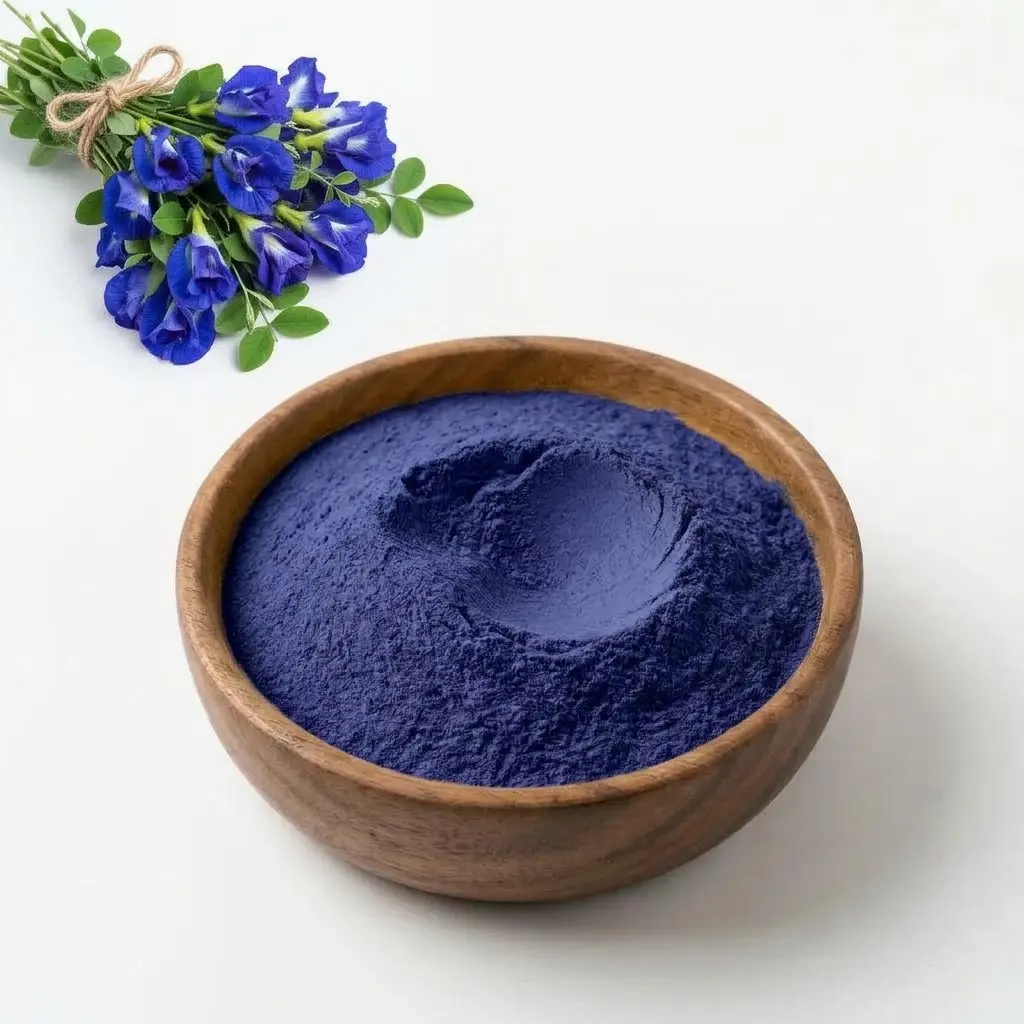
Butterfly Pea Flower Extract
- Source
- Clitoria ternatea L. · Dried flowers
- Origin
- Tropical Asia · Sun-dried butterfly pea flowers
- Standardization
- Total anthocyanins 5% / 10% / 20% / 25% · UV
- Extract Type
- Aqueous extract · Spray-dried
- Certifications
- ISO, HACCP, GMP, Kosher, Halal
- Key Compounds
- Ternatin anthocyanins · Delphinidin glycosides · Flavonol glycosides
- Applications
- Natural food colouring · Colour-changing beverages · Dietary supplements · Personal care
MOQ
1 kg
Lead time
7–15 days
Quotation
24 hours
Samples
Free
Bulk Butterfly Pea Flower Extract — Anthocyanin 5%, 10%, 20% & 25% UV, Natural Blue Colour Additive, B2B Wholesale
Written by Flora · Reviewed by Prof. Bingji Ma · Updated November 2026
PhytoVale supplies bulk butterfly pea flower extract in four grades — 5%, 10%, 20% and 25% total anthocyanins by UV — produced from the dried flowers of Clitoria ternatea L. (Fabaceae) by aqueous extraction and spray-drying. The dominant pigment class is ternatin — a family of polyacylated delphinidin glycosides found only in this species. Polyacylation folds the molecule's side chains back over its chromophore, giving ternatins significantly higher thermal and photostability than the simple anthocyanins in blueberry, grape or elderberry extracts. This structural advantage is why butterfly pea flower extract is the first — and currently only — plant-sourced natural blue to receive FDA colour-additive approval.
This page covers the ternatin chemistry behind the stability advantage, a pH-to-colour reference table for formulators, how butterfly pea extract compares with spirulina blue and FD&C Blue No. 1, the full FDA approval timeline including the 2026 synthetic-dye phase-out context, what "anthocyanin %" on a COA actually measures, and published evidence on antioxidant, glycaemic and skin-protective activity.
01 · Chemistry
Ternatin Anthocyanins — Not Your Ordinary Blue
Most supplier pages list "anthocyanin" as the active compound and stop there. That description is accurate in the way that calling steel and aluminium both "metals" is accurate — it hides the structural difference that determines whether the pigment survives your production line.
Polyacylated structure — why it matters for industrial use
Ordinary anthocyanins — the kind in blueberry, elderberry and grape skin extracts — are simple glycosides of delphinidin, cyanidin or malvidin. They follow the well-documented flavylium equilibrium: intensely coloured below pH 3, nearly colourless between pH 4 and 6, and weakly blue above pH 7. They degrade rapidly above 60 °C and bleach under UV exposure. These limitations rule them out as industrial-scale blue food colours.
Ternatins are structurally different. They are polyacylated derivatives of delphinidin-3,3',5'-triglucoside — the glucose units carry multiple aromatic acyl groups (typically p-coumaroyl and caffeoyl moieties) that fold back over the anthocyanin chromophore through intramolecular copigmentation.[1] This physical shielding protects the chromophore from nucleophilic attack by water and from thermal and photolytic degradation. The practical result: ternatin anthocyanins hold their blue colour through pasteurisation (72 °C / 15 s), UHT processing (135 °C / 2–5 s) and extended shelf storage under conditions that would destroy blueberry or elderberry pigments.[2]
Approximately 15 ternatin variants have been identified. The six major ones — A1, A2, B1, B2, D1 and D2 — differ in the number and type of acyl substituents. LC-MS analysis of methanol flower extracts has detected ternatin C2 at 1.81 mg/g, D2 at 1.45 mg/g, D3 at 0.54 mg/g, A1 at 0.51 mg/g, B3 at 0.50 mg/g and B2 at 0.32 mg/g.[2]
Beyond anthocyanins
The extract carries a secondary fraction of flavonol glycosides — kaempferol, quercetin and myricetin — along with phenolic acids including gallic acid and chlorogenic acid. Total phenolic content runs approximately 30 mg gallic acid equivalents per gram of dry matter; total anthocyanin content approximately 9 mg ternatin B2 equivalents per gram.[2] In 2011, a separate class of compounds — cyclotides (macrocyclic peptides designated cliotide cT1–cT5) — was identified in C. ternatea for the first time, showing antimicrobial and insecticidal activity independent of the anthocyanin fraction.[4]
The flavonoid fraction also contains clitorin and kaempferitrin. Published reviews note nootropic and neuroprotective activity in animal models — consistent with centuries of Ayurvedic use — attributed partly to acetylcholinesterase inhibition by the flavonoid and anthocyanin fractions together.[5][10]
02 · Specifications
Available Grades
| Grade | Anthocyanin content | Test method | Recommended use |
|---|---|---|---|
| 5% | ≥ 5% total anthocyanins | UV | Beverage colouring, RTD tea, flavoured water — where large volumes of powder make a lower concentration practical |
| 10% | ≥ 10% total anthocyanins | UV | Sports drinks, cocktails, dairy products, ice cream — the standard all-purpose grade |
| 20% | ≥ 20% total anthocyanins | UV | Confectionery, baked goods, capsule fill — where space or serving weight is constrained |
| 25% | ≥ 25% total anthocyanins | UV | Nutraceutical tablets, high-potency capsules, concentrated functional formats |
Common parameters across all grades: fine deep-blue powder, fully water-soluble, produced from dried Clitoria ternatea flowers by aqueous extraction and spray-drying. Full analytical data — particle size, loss on drying, ash, heavy metals (Pb, As, Cd, Hg), microbiology (TPC, yeast & mould, E. coli, Salmonella), allergens and shelf life — are provided in the batch-specific Certificate of Analysis.
What "anthocyanin %" on a COA actually measures
UV spectrophotometry at 520–530 nm is the standard method for total anthocyanin quantification in plant extracts. The result is expressed as equivalents of a reference standard — but which standard the laboratory uses varies. Some labs calibrate against delphinidin-3-glucoside (the closest available standard to the ternatin backbone). Others use cyanidin-3-glucoside (the most widely available anthocyanin standard) or malvidin-3-glucoside. Because these compounds have different molar absorptivities, the same physical sample will produce different "% anthocyanin" numbers depending on the reference standard. Our specifications use delphinidin-3-glucoside equivalents. When comparing our COA with another supplier's, check which reference their lab used — a "10% anthocyanin" result calibrated against cyanidin-3-glucoside is not the same measurement as a "10%" calibrated against delphinidin-3-glucoside.
03 · Colour behaviour
pH-Responsive Colour — A Formulator's Reference
The colour of butterfly pea flower extract in solution depends on pH. This is not a defect — it is the single most commercially exploitable property of the extract. Colour-changing beverages (add lemon to a blue drink and watch it turn purple) are a consumer-experience feature that no other approved natural blue can offer.
| pH range | Colour | Typical application | Acidulant |
|---|---|---|---|
| > 7 | Bright blue | Alkaline cocktails, blue smoothie bowls, baking soda-activated visual effects | None / sodium bicarbonate |
| 5–7 | Blue-violet | Sports drinks, flavoured water, neutral-pH dairy | Light citric acid |
| 3–5 | Purple to magenta | Fruit juice, kombucha, wine-colour imitation | Malic acid, tartaric acid |
| < 3 | Pink to red | Lemonade, citrus-based drinks, sour gummy coatings | Lemon juice, citric acid at higher concentration |
Stability in processing
Heat: ternatin anthocyanins survive pasteurisation and UHT without significant colour loss.[3] This is a direct advantage over spirulina blue (phycocyanin), which denatures above 60 °C and loses its blue colour irreversibly. Butterfly pea extract can be added before the heat step rather than post-process, simplifying production workflows.
Light: moderate to good photostability. For products with extended retail shelf life under fluorescent or LED lighting, opaque or amber packaging reduces colour fade over time. Shelf-life trials at intended storage conditions are recommended.
Metal ions: aluminium and iron ions can shift the colour toward grey-green through chelation. Avoid prolonged contact with unlined aluminium cans or iron-containing process equipment. Stainless steel and glass are inert.
Bench-trial starting point
Begin at 0.1–0.3% extract (w/v) at your target pH. Adjust concentration upward until the desired colour intensity is reached. Run the trial at your actual processing temperature — a room-temperature bench sample will not predict colour survival through a heat step, even though ternatins are heat-stable. Small differences in matrix composition (proteins, sugars, metal traces) affect final hue more than concentration alone.
04 · Competitive landscape
Butterfly Pea Extract vs Spirulina Blue vs Synthetic Blue
Three ingredients compete for the blue position in food and beverage formulations. The table compares them on the parameters that drive sourcing decisions.
| Parameter | Butterfly pea extract (ternatins) | Spirulina blue (phycocyanin) | FD&C Blue No. 1 (Brilliant Blue) |
|---|---|---|---|
| Source | Plant flower (C. ternatea) | Cyanobacterium (Arthrospira) | Petroleum-derived synthesis |
| Chromophore class | Polyacylated anthocyanin | Phycobiliprotein | Triphenylmethane |
| Thermal stability | Survives pasteurisation & UHT | Denatures > 60 °C — colour loss is irreversible | Stable |
| pH range | Blue above pH 7; reversible shift to purple–pink below pH 5 | Stable pH 4.5–8; precipitates below pH 4 | Stable pH 3–8 |
| Light stability | Moderate–good (polyacylation protects chromophore) | Poor — rapid fading under light | Good |
| Taste / odour | Neutral — no off-flavour at typical use levels | Algal / fishy off-note, especially at higher dosing | Neutral |
| pH colour change | Yes — exploitable for colour-changing products | No | No |
| Clean label | Yes — "vegetable juice for colour" | Yes — "spirulina extract for colour" | No — synthetic, requires batch certification |
| US FDA status | Colour additive, exempt from certification (2021, expanded 2025) | Colour additive, exempt from certification | Colour additive, requires batch certification |
| Relative cost | Medium | High | Low |
Spirulina blue remains the incumbent natural blue in cold-chain applications (chilled beverages, ice cream) where heat exposure is minimal and the higher price is justified by established supply chains. Synthetic Blue No. 1 still dominates on cost and stability. Butterfly pea flower extract occupies a specific sweet spot: heat-processed products that need a clean-label natural blue at a moderate price point, and any product line that wants to use pH-triggered colour change as a consumer-facing feature. The FDA's initiative to phase out petroleum-based synthetic dyes by the end of 2026 is shifting the cost–benefit calculation further in favour of the two natural options.
05 · Regulatory
FDA and Global Regulatory Status
Butterfly pea flower extract is classified as a colour additive exempt from certification under Section 721(c) of the FD&C Act. It is the first and currently only plant-sourced natural blue to receive this classification.
| Date | Regulatory event |
|---|---|
| September 2021 | FDA publishes final rule (21 CFR 73.40) approving butterfly pea flower extract as a colour additive in beverages (sports drinks, juice drinks, carbonated soft drinks, RTD teas, alcoholic beverages, nutritional drinks), dairy products (ice cream, yoghurt, milk-based beverages), confectionery, chewing gum and coated nuts[6] |
| May 2025 | FDA expands permitted categories to include ready-to-eat cereals, crackers, snack mixes and hard pretzels[7] |
| End of 2026 | FDA targets phase-out of petroleum-based synthetic food dyes — butterfly pea flower extract positioned as the primary plant-sourced alternative for blue |
Labelling
Products using butterfly pea flower extract as a colour additive in the US must declare it in the ingredient list as "butterfly pea flower extract" or "vegetable juice (for colour)". It may not be declared simply as "natural colour" or "natural flavouring". Usage levels are limited to amounts consistent with current Good Manufacturing Practice.
Extraction method matters for US compliance
FDA's colour-additive approval under 21 CFR 73.40 specifies that the extract must be produced by aqueous extraction from dried Clitoria ternatea flowers, followed by filtration and concentration. Ethanol-extracted or solvent-extracted products do not meet this specification when used as a colour additive in the US market — regardless of the anthocyanin content stated on the COA. If your customer intends to use the extract as a dietary-supplement ingredient (regulated under DSHEA) rather than as a colour additive, this extraction-method restriction does not apply.
Other markets
Across Southeast Asia — Thailand, Malaysia, Indonesia, Vietnam — butterfly pea flower is a traditional culinary ingredient with unrestricted food and beverage use. FSANZ (Australia and New Zealand) has approved its use. In Japan, it is used as a natural food colouring agent.
EU market — novel food status unresolved
In 2022, EFSA assessed dried Clitoria ternatea flowers as a traditional food from a third country under Regulation (EU) 2015/2283 and raised safety objections, citing limited data on the digestibility, bioavailability and toxicological profile of cyclotides present in the flower.[11] As of this update, novel food authorisation for dried butterfly pea flowers has not been granted in the EU. Several member states permit their use in beverages under national provisions, but the regulatory position is not harmonised across the bloc. Buyers targeting EU food or beverage markets should verify current authorisation status with regulatory counsel before finalising formulation.
Pregnancy and lactation
Insufficient controlled clinical data exist to establish safety during pregnancy or lactation. Published preclinical studies have reported uterotonic activity in animal models. Until adequate human data are available, precautionary avoidance during pregnancy is the standard industry recommendation. Consumer-facing product labelling should include an appropriate advisory statement where required by the target market's regulations.
06 · Evidence
What the Published Research Supports
The evidence base for Clitoria ternatea spans antioxidant, anti-inflammatory, neuroprotective, antimicrobial, antidiabetic and skin-protective activity. The three areas below are the most commercially relevant — they have the strongest evidence and the most direct path to finished-product positioning.
| Area | Key finding | Evidence level |
|---|---|---|
| Glycaemic response | In a randomised crossover trial, 1 g or 2 g of C. ternatea flower extract co-ingested with 50 g sucrose significantly reduced postprandial plasma glucose and insulin in 15 healthy male subjects compared with sucrose alone.[8] This is the only human RCT on butterfly pea flower extract published to date. | Moderate (single RCT, small sample) |
| Antioxidant activity | Strong free-radical scavenging confirmed across DPPH, ABTS and FRAP assays. In the same human crossover trial, subjects showed significantly increased plasma antioxidant capacity after consuming the extract.[8] Antioxidant capacity correlates with total phenolic and anthocyanin content.[3] | Moderate (human + in vitro) |
| Skin protection | Topical application prevented UV-B-induced collagen loss and epidermal thinning in animal models (2024). A water extract inhibited PM-induced inflammatory and senescence markers in skin cells, with no sensitisation and good safety margins confirmed in a 2025 dermal safety study.[9] | Preclinical (animal + cell) |
Broader pharmacological profile
Published reviews document additional activity including anti-inflammatory effects (TNF-α and NF-κB pathway modulation), neuroprotective properties (acetylcholinesterase inhibition, memory improvement in animal models consistent with centuries of Ayurvedic use), antimicrobial spectrum (MIC as low as 0.3 mg/mL against S. aureus and E. coli), and anti-obesity effects (lipogenesis gene downregulation in cell models).[5][10] These directions currently rely on animal or in vitro data and are not summarised in the table above.
Evidence context
These findings come from published peer-reviewed studies on Clitoria ternatea as an ingredient. They do not constitute health claims for any finished product. Only one human randomised controlled trial exists — the glycaemic-response study. All other evidence is preclinical. Regulatory requirements for functional claims vary by market; structure/function claims in the US require proper notification and substantiation under 21 CFR 101.93.
07 · Applications
Where Butterfly Pea Flower Extract Is Used
Food and beverage colouring
The primary commercial application. Beverages — including sports drinks, RTD teas, juice drinks, flavoured waters, carbonated soft drinks, cocktails and non-alcoholic spirits — are the largest category by volume. The pH-triggered colour change is being used as a consumer-experience feature: brands sell a blue beverage with a citrus shot or garnish that turns the drink purple or pink in front of the consumer. Beyond beverages, the 2025 FDA expansion opened the door to cereals, crackers and snack mixes. Ice cream, yoghurt, confectionery and chewing gum have been permitted since 2021. The 5% and 10% grades serve most colouring applications; the 20% grade works better in high-sugar matrices where the anthocyanin needs to compete with Maillard browning in baked goods.
Dietary supplements and nutraceuticals
Capsule and tablet formats typically use the 20% or 25% grade to maximise the functional dose within a reasonable serving size. The glycaemic-response RCT used 1–2 g of flower extract — a dose deliverable in two to four standard capsules at the 25% grade. Positioning is typically around antioxidant support and metabolic health, backed by the single published human trial. The extract also functions as a natural colourant for the capsule contents, producing a visually distinctive deep-blue fill that differentiates on-shelf.
Personal care and cosmetics
Two roles: natural colourant (lip products, eye shadows, bath products, soap) and active ingredient (skin serums, anti-pollution formulations, UV-protective preparations). The 2025 dermal safety study confirmed that the water extract has no sensitisation potential and a good safety margin for topical use.[9] The anthocyanin fraction provides antioxidant activity, while the phenolic acids contribute to anti-inflammatory and anti-senescence effects in skin cells exposed to particulate matter.
08 · Quality & supply
Sourcing, Quality Control and Supply Terms
Our butterfly pea flower extract is produced from dried Clitoria ternatea flowers sourced from established tropical growers and processed through aqueous extraction, concentration and spray-drying into a fine, free-flowing deep-blue powder. Total anthocyanin content is tested by UV spectrophotometry on every production lot before release. Heavy-metal limits, microbiological parameters and loss on drying are verified on every batch COA.
Quality management follows GMP, ISO 22000, FSSC 22000, HACCP standards with Halal and Kosher certification available on all four grades. Annual production capacity across our botanical extract lines is approximately 1,200 metric tonnes.
Every lot ships with a full documentation package: Certificate of Analysis (total anthocyanins by UV, delphinidin-3-glucoside equivalents), MSDS, TDS, allergen statement and origin statement. Additional panels — HPLC anthocyanin profile, pesticide residues, irradiation declarations — are available on request.
All four grades — 5%, 10%, 20% and 25% — are available from stock. MOQ is 1 kg. Lead time is 7–15 business days. Free samples are available for evaluation — request yours here.
09 · Evidence base
References
[1] Terahara N, Oda M, Matsui T, et al. Five new anthocyanins, ternatins A3, B4, B3, B2, and D2, from Clitoria ternatea flowers. J Nat Prod. 1996;59(2):139–144. Read paper
[2] Vidana Gamage GC, Lim YY, Choo WS. Anthocyanins from Clitoria ternatea flower: biosynthesis, extraction, stability, antioxidant activity, and applications. Front Plant Sci. 2021;12:792303. Read paper
[3] Fu X, Wu Q, Wang J, Chen Y, Zhu G, Zhu Z. Spectral characteristic, storage stability and antioxidant properties of anthocyanin extracts from flowers of butterfly pea (Clitoria ternatea L.). Molecules. 2021;26(22):7000. Read paper
[4] Poth AG, Colgrave ML, Lyons RE, et al. Discovery of an unusual biosynthetic origin for circular proteins in legumes. Proc Natl Acad Sci USA. 2011;108(25):10127–10132. Read paper
[5] Lakshan SAT, Jayanath NY, Abeysekera WPKM, Abeysekera WKSM. A comprehensive review on the phytochemical composition, health benefits, and industrial applications of Clitoria ternatea. Plants. 2025;14(21):3322. Read paper
[6] US FDA. Listing of color additives exempt from certification; butterfly pea flower extract. Fed Reg. 2021;86(168):49063–49069 (21 CFR 73.40). Read notice
[7] US FDA. Listing of color additives exempt from certification; butterfly pea flower extract (expanded uses). Fed Reg. 2025;90(89). Read notice
[8] Chusak C, Thilavech T, Henry CJ, Adisakwattana S. Acute effect of Clitoria ternatea flower beverage on glycemic response and antioxidant capacity in healthy subjects: a randomized crossover trial. BMC Complement Altern Med. 2018;18:6. Read paper
[9] Jeon YS, Kim MJ, Lee JY, et al. Safety evaluation and anti-pollution efficacy of Clitoria ternatea flower water extract for cosmetic application. 2025. Study confirmed no skin sensitisation (DPRA, KeratinoSens, h-CLAT) and significant inhibition of PM2.5-induced inflammatory markers in human keratinocytes.
[10] Mukherjee PK, Kumar V, Kumar NS, Heinrich M. The Ayurvedic medicine Clitoria ternatea — from traditional use to scientific assessment. J Ethnopharmacol. 2008;120(3):291–301. Read paper
[11] EFSA (European Food Safety Authority). Notification of dried flowers of Clitoria ternatea L. as a traditional food from a third country pursuant to Article 14 of Regulation (EU) 2015/2283. EFSA Supporting Publications. 2022;19(2):EN-7084. Read report
Reviewed by
Prof. Bingji MaScientific Advisor, PhytoVale · Professor & Medicinal Plant Science Expert. Research focus: Chinese medicinal materials, phytochemistry, natural products and medicinal plant quality.
Written by
FloraContent Editor, PhytoVale · Product Content & Editorial Specialist. Focuses on botanical ingredient specifications, sourcing information and B2B technical content.
10 · Questions
Frequently Asked Questions
Can butterfly pea flower extract replace FD&C Blue No. 1 in my product?
In many applications, yes — particularly in heat-processed beverages, confectionery and baked goods where the extract's thermal stability matches or exceeds synthetic blue. Two caveats: the colour shifts with pH, so the exact shade depends on your product's acidity (run a bench trial at your target pH); and the cost per unit of colour is higher than synthetic blue, though lower than spirulina. For products positioned as clean-label or natural, the trade-off is straightforward.
Is butterfly pea flower extract water soluble?
Fully water-soluble. The powder dissolves clear in water at room temperature with no sediment, particles or cloudiness. This makes it straightforward to incorporate in beverages, liquid supplements and water-based cosmetic formulations without additional emulsifiers or dispersants.
Does butterfly pea flower extract have a taste or odour?
At typical colouring concentrations (0.1–0.3%), the extract has no perceptible taste or odour. At higher concentrations used in nutraceutical applications, a very mild earthy note may be detectable. It does not carry the algal off-flavour associated with spirulina blue — a practical advantage in flavour-sensitive formulations like flavoured water, cocktails and dairy products.
How much extract do I need to achieve a visible blue colour?
Start at 0.1% (w/v) of the 10% grade in your matrix and adjust upward. The required concentration depends on the target colour intensity, the pH of the product (lower pH shifts toward purple, so more extract may be needed to hold a blue hue) and the optical properties of the matrix (opaque vs clear, presence of other pigments). For a vivid blue in a clear beverage at pH 6–7, 0.15–0.25% of the 10% grade is a typical range.
Is the colour stable in carbonated beverages?
Carbonation itself (dissolved CO₂) has minimal direct effect on ternatin anthocyanins. However, CO₂ lowers pH — a carbonated beverage typically sits at pH 3–4, which will shift the colour from blue toward purple-magenta. If blue is the target colour in a carbonated product, the formulation needs a buffer system or a pH above 5. Alternatively, the purple-pink hue at carbonation pH can be used as the intended product colour.
Does the extract need to be declared as a colour additive on the US label?
Yes, when used for colouring purposes. Under 21 CFR 73.40, it must appear in the ingredient list as "butterfly pea flower extract" or as "vegetable juice (for colour)." It may not be listed generically as "natural colour." If the extract is used as a dietary-supplement ingredient for its functional properties rather than as a colourant, it is regulated under DSHEA and the labelling rules differ.
What is the minimum order quantity?
MOQ is 1 kg for all four grades (5%, 10%, 20%, 25%). Free samples are available for formulation trials. Every lot ships with COA, MSDS, TDS, allergen statement and origin statement. Halal and Kosher documentation is available. Quotation is returned within 24 hours of inquiry.
B2B supply
Tell us the grade and the application
Send us the specification you need — 5%, 10%, 20% or 25% anthocyanins — along with the product format, target pH and intended market. We will reply within 24 hours with a quote, a free sample and a batch-specific COA.
Request a sample →Browse all products →Disclaimer: this page is intended for ingredient evaluation, formulation and B2B purchasing. PhytoVale supplies butterfly pea flower extract as a food-colouring, dietary-supplement and cosmetic ingredient. Statements regarding dietary supplements have not been evaluated by the FDA or any equivalent regulatory authority. Research is summarised as technical background and does not constitute claim substantiation. Regulatory positions change; information above is current as of the update date and should be re-verified against the legislation in force at product launch. Not recommended during pregnancy or lactation due to insufficient controlled human data and published preclinical reports of uterotonic activity; consumer-facing products should include an appropriate advisory statement. Finished-product manufacturers are responsible for ingredient classification, labelling, claims and compliance in their target markets. © 2026 PhytoVale.
Related Botanical Ingredients
 Apple Cider Vinegar PowderKey specification: Acetic acid
CAS 64-19-7
5%, 10% total acid
 Astragalus Root ExtractKey specification: Astragaloside IV, Polysaccharides
CAS 84687-43-4
AS-IV 0.1–10%; APS 40–90%
 Beetroot ExtractKey specification: Nitrate
CAS 89957-89-1
Nitrate 1%, 5%, 10%
 Black Ginger ExtractKey specification: 5,7-Dimethoxyflavone
CAS 21392-57-4
1%, 2%, 5%, 8%, 10% DMF (HPLC)
 Fruit Powder vs Fruit Juice Powder: Processing, Composition, Applications & How to Choose→Fruit Powder vs Fruit Juice Powder: Processing, Composition, Applications & How to Choose WRITTEN BY Flora / NOVEMBER…
 Sulforaphane Stability in Manufacturing: A 7-Step Engineering Guide→Sulforaphane Stability in Manufacturing: A 7-Step Engineering Guide WRITTEN BY Flora / OCTOBER 29, 2026 Written by Flora,…