

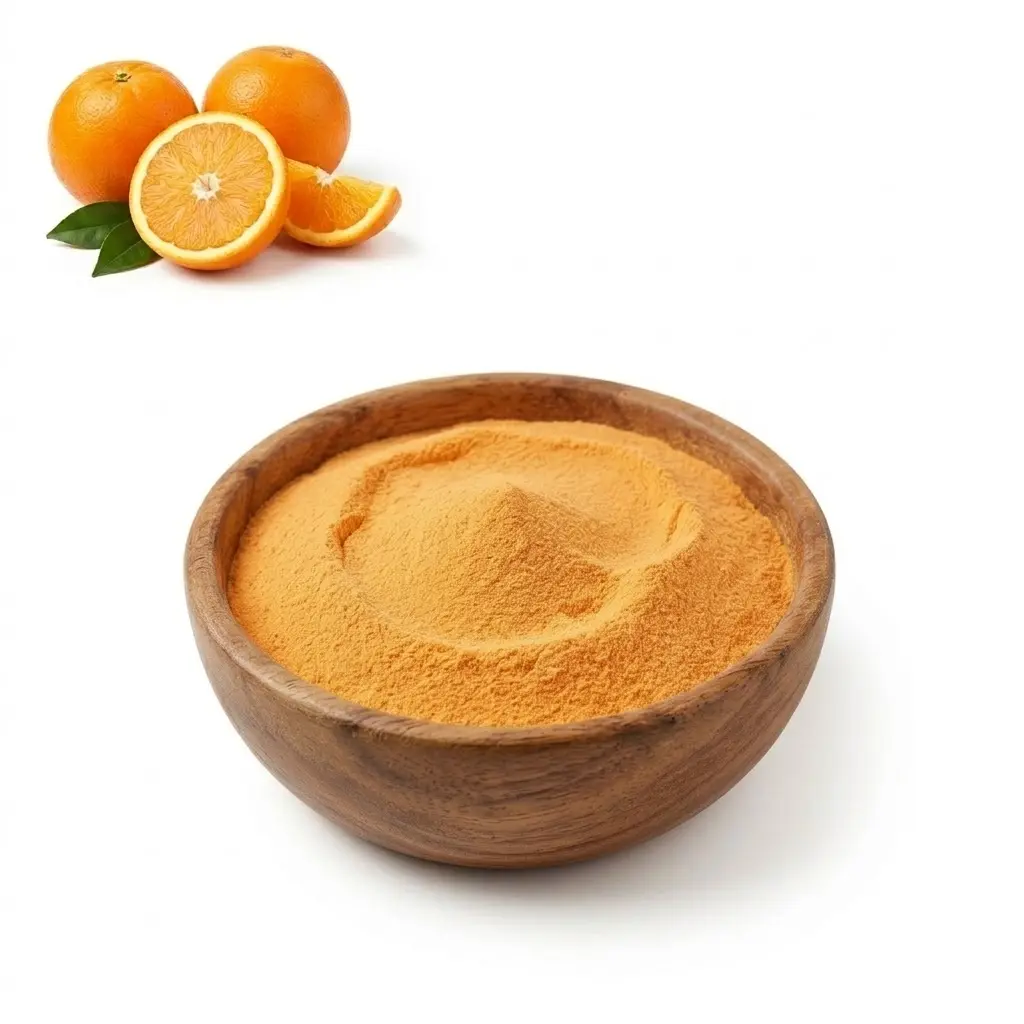
Orange Powder
- Source
- Citrus sinensis · whole ripe sweet orange
- Two grades
- Freeze-dried whole-fruit · Spray-dried juice (with maltodextrin)
- Organic
- USDA & EU Organic — freeze-dried only
- Key compounds
- Hesperidin · β-cryptoxanthin · vitamin C · folate
- Free from
- Sulphites · added colours · added flavours
- Applications
- Beverages · dairy · bakery · supplements
- Documentation
- COA · nutrition panel · HPLC hesperidin assay
MOQ
1 kg
Lead time
7–15 days
Quotation
Within 24 hours
Samples
Free of charge
Bulk Orange Powder — Freeze-Dried Whole-Fruit & Spray-Dried Juice, Citrus sinensis
Written by Flora · Reviewed by Prof. Bingji Ma · Updated October 2026
PhytoVale supplies bulk orange powder in two grades — freeze-dried whole-fruit (100% fruit, no carrier) and spray-dried juice powder (with maltodextrin carrier) — both made from ripe sweet oranges (Citrus sinensis). Orange juice is extremely high in sugar and notoriously sticky; without a glass-forming carrier the spray-dried powder clumps and won't flow. The freeze-dried grade avoids this problem entirely because sublimation drying works without a carrier, keeping it single-ingredient and supporting a cleaner label.
Below: the two grades compared, how to pick the right one by application scenario, what "orange powder" actually means (five products share the search term), the hesperidin advantage of whole-fruit orange, how carotenoid colour works versus berry anthocyanins, and a sourcing checklist.
01 · Two grades
Freeze-Dried Whole-Fruit vs Spray-Dried Juice
The drying method is the main decision. It sets the carrier requirement, the colour intensity, how much vitamin C and carotenoid survive, the hesperidin content, solubility, and the label. Both grades start from real sweet oranges — only the freeze-dried grade is carrier-free.
| Parameter | Freeze-Dried Whole-Fruit | Spray-Dried Juice |
|---|---|---|
| Made from | Whole ripe sweet oranges — flesh, pith, membranes, juice | Pressed orange juice |
| Carrier | None — 100% fruit | Maltodextrin (typically 30–40%) |
| Appearance | Vivid orange; fine powder or coarse pieces | Light orange; fine, free-flowing |
| Flavour | Fullest citrus — sweet-tart, aromatic, limonene top notes retained | Clean, sweet orange; lighter aroma |
| Vitamin C retention | Highest — minimal thermal degradation[1] | Lower — heat exposure during atomisation[2] |
| Carotenoid retention | Best — vivid natural orange colour[2] | Moderate — some oxidative loss, plus diluted by carrier |
| Hesperidin | Highest — pith and membranes included[3] | Lower — most hesperidin removed with pith during juicing |
| Volatile aroma | Good — limonene and terpenes largely preserved | Reduced — heat drives off volatile citrus oils |
| Solubility | Disperses; natural pith fibre visible | Dissolves fast and relatively clear — ideal for drinks |
| Fibre | Retained — whole fruit including pith and membranes | Minimal — removed during juicing |
| Mesh options | Fine powder or coarse granules | Fine powder (80–100 mesh standard) |
| Single-ingredient label | Yes — "orange powder" | No — maltodextrin must be declared |
| Organic | USDA & EU Organic available | Conventional only |
Why spray-dried orange needs a carrier
Orange juice contains roughly 10–13 °Brix sugar (mainly sucrose, glucose, fructose) with a very low glass-transition temperature. During spray-drying, the atomised droplets stay sticky and plaster onto the dryer wall instead of forming free-flowing particles. Maltodextrin raises the glass-transition temperature so the droplets solidify into powder. Without it, the yield crashes and what does come out clumps within hours. This is basic spray-drying physics — the same reason most high-sugar fruit juices (mango, pineapple, orange) require a carrier to spray-dry. If a supplier claims carrier-free spray-dried orange juice powder, ask how they solved the sticking problem and what the shelf-stability looks like at 30 °C and 60% RH.
02 · Grade selection
Which Grade Fits Your Application
Beverages, drink mixes & sachets
This is the primary market for spray-dried juice powder. It dissolves fast in cold water with no sediment or visible fibre, making it the obvious choice for instant orange drinks, flavoured water, stick packs, and effervescent bases. The maltodextrin carrier actually helps here — it improves flowability during sacheting and speeds dispersion. For smoothie blends and freshly-mixed formats where a stronger colour and aroma matter more than instant clarity, freeze-dried powder gives a visibly more intense result, though you'll get some natural fibre sediment.
Bakery, bars & cereals
Freeze-dried is the stronger choice. It delivers the deepest orange colour and fullest citrus aroma. The coarse-granule option gives visible fruit pieces in granola, trail mix, and cereal toppings. Vitamin C and carotenoids degrade in oven temperatures, so if you're baking above 160 °C and the orange is there for flavour and colour rather than nutrition, expect some loss — add it to coatings, fillings, or post-bake toppings to preserve more.
Dairy, ice cream & plant-based
For yoghurt ripples and ice cream, freeze-dried powder gives the best colour intensity (carotenoids hold up well in cold-chain products) and the pith fibre helps suspension. For plant-milk blends that need smooth mouthfeel with no graininess, spray-dried juice dissolves cleaner. Note that orange powder is high in citric acid — at high inclusion rates it can curdle dairy protein or break emulsions. Do a stability trial before locking in your inclusion rate.
Supplements, capsules & vitamin-C blends
Freeze-dried whole-fruit is the logical grade here. It concentrates more vitamin C and hesperidin per gram of actual fruit solids because there's no carrier diluting them, and it supports a single-ingredient label. For effervescent tablets, spray-dried juice powder's fine particle size and fast dissolution may be easier to work with — but remember that the maltodextrin is on your label and the vitamin C per gram of powder is lower because 30–40% of the powder is carrier, not fruit.
Natural colour contribution
Orange powder's carotenoid colour is stable across pH 3–7 (unlike berry anthocyanins which fade above pH 4), making it especially useful in neutral-pH products — bars, coatings, dairy, cereals — where berry powders would lose colour. The freeze-dried grade delivers the most carotenoid per gram. The main degradation pathway is oxidation, not pH shift, so protect with nitrogen flush or oxygen-barrier packaging rather than acidification.
03 · Terminology
What "Orange Powder" Actually Means — Five Different Products
"Orange powder" is one of the most ambiguous terms in fruit ingredients. Five different products share the same search term, and they have almost nothing in common.
| Product | What It Is | We Supply? |
|---|---|---|
| Sweet orange fruit / juice powder | Dried from real Citrus sinensis fruit or juice — a food ingredient | ✓ Yes — this page |
| Orange-flavoured drink mix | Sugar, citric acid, artificial flavour and colour — not real fruit | ✗ No |
| Orange peel / zest powder | Dried skin — different composition, used in baking and cosmetics | ✗ No |
| Bitter orange (Citrus aurantium) | Different species — sold as synephrine extract for weight-loss supplements | Separate product — see Citrus Aurantium Extract |
| Blood orange powder | Red-fleshed variety coloured by anthocyanins, not carotenoids — different pigment chemistry | ✗ No |
For buyers
If you searched "orange powder" and landed here, confirm the product you actually need. If you need a citrus peel ingredient, bitter orange extract, or a blood-orange colour source, this is not the right page. If you need real sweet-orange fruit or juice powder as a food ingredient, you're in the right place.
04 · Hesperidin
Hesperidin — Orange's Signature Flavonoid and Why Grade Matters
Hesperidin is the dominant flavonoid in sweet oranges. It is increasingly used in supplement and functional-food formulas for vascular health (it is the direct precursor to diosmin, a pharmaceutical active). What makes hesperidin relevant to the grade decision is where in the fruit it concentrates.
Distribution within the fruit
Hesperidin is not evenly spread through an orange. Research consistently shows the same pattern: the albedo (white pith) contains the highest concentration, followed by the segment membranes, then the juice itself.[3] The pith can hold 5–10× more hesperidin per gram than the juice. This distribution creates a large gap between the two grades: the freeze-dried whole-fruit powder includes pith and membranes and retains the bulk of the fruit's hesperidin, while the spray-dried juice powder starts from pressed juice that has already left most of the hesperidin behind in the pith.
Hesperidin vs naringin: sweet orange vs grapefruit
Sweet orange (Citrus sinensis) is dominated by hesperidin. Grapefruit is dominated by naringin (responsible for the bitter taste). Lemon and lime contain both in smaller amounts. If a buyer specifically needs hesperidin as a functional ingredient, sweet orange whole-fruit powder is the richest whole-fruit food source — and it doesn't have the bitterness issue that grapefruit brings.
Formulator tip
If hesperidin content matters to your formula — vascular supplements, bioflavonoid blends, or functional drinks with a hesperidin claim — use freeze-dried whole-fruit powder and specify it. The spray-dried juice grade starts from juice that has already lost most of its hesperidin at the press. Hesperidin is relatively heat-stable (unlike vitamin C), so it survives both drying methods well; the difference between grades is about which part of the fruit goes in, not the process temperature.
05 · Carotenoid colour
Orange Powder as a Natural Colour Contribution
The orange colour in sweet-orange powder comes from carotenoids — primarily β-cryptoxanthin, with smaller amounts of lutein, zeaxanthin, and β-carotene.[3] This is fundamentally different from berry-derived colour (anthocyanins) and has different stability characteristics that matter for formulation.
| Factor | Carotenoids (Orange) | Anthocyanins (Berry) |
|---|---|---|
| pH sensitivity | Low — stable across pH 3–7 | High — best below pH 3.5, fades above pH 4 |
| Oxygen sensitivity | High — oxidise in air | Moderate |
| Light sensitivity | High — photo-oxidation | High — photodegradation |
| Heat sensitivity | Moderate — some isomerisation | High — rapid degradation above 60 °C |
| Solubility | Fat-soluble — disperses, doesn't dissolve in water | Water-soluble |
| Best application fit | Neutral-pH products: bars, coatings, dairy, cereals | Acidic products: juice, yoghurt, gummies |
Formulator tip
If you're using orange powder partly for colour, the freeze-dried grade delivers more carotenoid per gram — both because freeze-drying preserves more intact carotenoid and because there's no carrier diluting the pigment. For shelf-life protection, nitrogen-flush the finished product or use oxygen-barrier packaging. Carotenoid oxidation is the main colour-loss pathway, not pH shift, making orange powder a more forgiving natural colour source in neutral-pH products than berry powders.
06 · Handling & storage
Handling & Storage — Orange Powder Is Hygroscopic
Orange powder has one of the highest natural sugar contents of any fruit powder — roughly 40–60% total sugars on a dry basis (sucrose, glucose, fructose). This makes it extremely moisture-sensitive. At ambient humidity above 50–55% RH, carrier-free freeze-dried orange powder will start absorbing moisture, turn sticky, and eventually cake into a solid block within days.
Freeze-dried (no carrier)
This grade is the more moisture-sensitive of the two. With no maltodextrin to raise the glass-transition temperature, the powder's Tg is low and it goes sticky quickly once exposed to humid air. Keep aw below 0.3. Store at ≤25 °C in nitrogen-flushed, moisture-barrier packaging (aluminium-laminate bags or sealed drums with desiccant). Once opened, reseal immediately and use within 2–4 weeks in a climate-controlled room. Do not leave open on a production floor.
Spray-dried (with maltodextrin)
The maltodextrin carrier raises the glass-transition temperature, so this grade is more forgiving — it stays free-flowing longer after opening and tolerates slightly higher humidity. But it's still sugar-heavy fruit powder, not a stable dry extract. Same storage principles apply: sealed, cool, dry, and away from light to protect the carotenoid colour. The carrier does not eliminate hygroscopicity, it just widens the operating window.
Watch out
Orange powder that arrives caked or discoloured (brown rather than orange) has either been stored in high humidity, is oxidised, or is old stock. Carotenoids oxidise to colourless or brownish compounds. If a supplier's sample is dull or brown, reject it — the product has already degraded and no downstream processing will recover the colour or vitamin C.
07 · Naturally occurring composition
What Orange Powder Contains
These are natural constituents of the fruit. Levels vary by cultivar, ripeness, season, and drying method — they are not standardised values. For the spray-dried grade, remember that 30–40% of the powder weight is maltodextrin carrier, so the nutrient content per gram of powder is proportionally lower than the freeze-dried grade.
Vitamin C (ascorbic acid)
Fresh sweet oranges typically contain 45–60 mg vitamin C per 100 g of edible fruit.[5] On a dry-weight basis, freeze-dried orange powder concentrates this roughly 5–6× (the fruit is ~86% water), putting estimated vitamin C content in the range of 200–350 mg per 100 g of powder — though this depends heavily on cultivar, harvest timing, and post-harvest handling before drying. Spray-dried juice powder retains less vitamin C due to heat exposure, and the carrier further dilutes it. If your product carries a vitamin-C claim, request the batch COA — natural variation means each lot differs.
Carotenoids
β-cryptoxanthin is the dominant carotenoid in sweet orange, accompanied by lutein, zeaxanthin, and β-carotene.[3] These are provitamin-A precursors (β-cryptoxanthin and β-carotene). Total carotenoid content in fresh orange is modest compared to mango or papaya, but the β-cryptoxanthin concentration is among the highest of common fruits. Freeze-dried whole-fruit powder retains carotenoids best because it avoids heat and keeps the coloured peel and membrane tissues.
Hesperidin (flavonoid)
The main flavonoid in sweet orange, concentrated in pith and membranes — see section 04 above for the full discussion. Freeze-dried whole-fruit grade retains substantially more than the juice-only spray-dried grade.
Potassium, fibre & sugars
Naturally present in the whole fruit. The fibre (pectin and cellulose from pith and membranes) is retained in the freeze-dried grade and largely removed in the spray-dried grade. Total sugars are high — expect 40–60% on a dry basis in the carrier-free grade — which makes the powder hygroscopic and contributes noticeable sweetness to formulas.
Cultivar differences: Navel vs Valencia
Most commercial sweet oranges fall into two broad groups that affect the powder's character. Valencia is the dominant juice variety — high juice content (up to 50% of fruit weight), balanced sugar-acid ratio, thin pith, available year-round from different hemispheres. Most spray-dried orange juice powder worldwide comes from Valencia juice. Navel is the main fresh-eating variety — seedless, thicker pith, sweeter with lower acidity, and a distinct "orange oil" aroma from limonene in the navel tissue. Freeze-dried whole-fruit powder from Navel oranges has a sweeter, more aromatic profile but slightly lower acidity than Valencia-based powder. If batch-to-batch flavour consistency matters to your product, specify the cultivar group when ordering. If your supplier can't tell you whether the powder is Navel or Valencia, that's a sourcing red flag.
Not a standardised extract
This is a whole-fruit food powder, not a standardised botanical extract. If your product carries a vitamin-C, carotenoid, or hesperidin claim, request the batch COA and confirm the levels meet your label requirements — natural variation means each lot is slightly different.
08 · Applications
Applications by Category
| Category | Recommended Grade | Watch Out For |
|---|---|---|
| Beverages & drink mixes | Spray-dried juice — fast dispersion, clear solution, no sediment | High sugar content adds sweetness — adjust formula sweetener. Freeze-dried leaves visible fibre sediment in clear drinks |
| Supplements & sachets | Freeze-dried — higher vitamin C and hesperidin per gram of fruit solids | Maltodextrin in spray-dried grade must be declared. If vitamin-C claim drives the product, confirm batch COA levels — natural variation is wide |
| Bakery & snacks | Freeze-dried — deepest colour and flavour; coarse pieces for visible fruit | Vitamin C and volatile aroma degrade above 160 °C. Add to coatings, fillings, or post-bake toppings to preserve more. High sugar may accelerate Maillard browning |
| Dairy & frozen | Freeze-dried for colour; spray-dried for smooth blending | Citric acid at high inclusion can curdle dairy protein or break emulsions — run stability trial. Carotenoid colour holds well in cold-chain products |
| Natural colour | Freeze-dried — highest carotenoid per gram, no carrier dilution | Carotenoids oxidise in air — use nitrogen flush or oxygen-barrier packaging. Colour is pH-stable (unlike berry) but light-sensitive |
| Nutrition blends | Either; spray-dried blends more evenly in dry mixes | 40–60% sugars on a dry basis — account for caloric and glycaemic contribution. Freeze-dried is more hygroscopic, may clump if blended with dry powders in humid conditions |
Inclusion rate guidance
Typical usage: 3–10% in beverage mixes, 5–15% in bars and cereals, 2–5% in dairy, 1–3% as a colour and flavour contribution in blends. Orange juice powder is high in natural sugars — account for the sweetness contribution in your formula. For the spray-dried grade, remember that 30–40% of the inclusion is maltodextrin, not fruit.
09 · Sourcing & QC criteria
What to Verify When You Source Orange Powder
| Parameter | What to Check | Why It Matters |
|---|---|---|
| Species & part | Sweet orange (Citrus sinensis), fruit or juice — not peel, not bitter orange (C. aurantium) | These are different products with different composition, use, price, and regulatory status |
| Grade & carrier | Freeze-dried whole-fruit (no carrier) vs spray-dried juice (maltodextrin declared) | Sets label, nutrient density, solubility, and price. Confirm maltodextrin ratio in spray-dried grade |
| Cultivar | Navel or Valencia — ask the supplier | Flavour, acidity, and juice content differ. If they can't answer, sourcing traceability is weak |
| Drying method | Freeze-dried or spray-dried — documented on COA | Directly drives vitamin-C retention, carotenoid content, colour, and price |
| Colour | Visual check — should be natural orange, not brown, grey, or artificially bright | Dull or brown powder indicates aged stock, oxidised carotenoids, or poor process |
| Microbiology | TPC, yeast & mould, E. coli, Salmonella per batch | Standard food-safety requirement |
| Heavy metals | Pb, As, Cd, Hg by ICP-MS | Standard food-safety screen |
| Pesticide residues | Multi-residue screen — citrus is routinely treated | EU and US import requirement; request lot-specific data |
| Sugar content | Typical 40–60% total sugars (dry basis, carrier-free grade) | High sugar = hygroscopic. Verify storage history and packaging condition on arrival |
10 · Evidence base
References
[1] Ratti C. Hot air and freeze-drying of high-value foods: a review. Journal of Food Engineering. 2001;49(4):311–319. Read paper
[2] Barbosa J, Borges S, Amorim M, Pereira MJ, Oliveira A, Pintado ME, Teixeira P. Comparison of spray drying, freeze drying and convective hot air drying for the production of a probiotic orange powder. Journal of Functional Foods. 2015;17:340–351. Read paper
[3] Escobedo-Avellaneda Z, Gutiérrez-Uribe J, Valdez-Fragoso A, Torres JA, Welti-Chanes J. Phytochemicals and antioxidant activity of juice, flavedo, albedo and comminuted orange. Journal of Functional Foods. 2014;6:470–481. Read paper
[4] Rodriguez-Amaya DB. A Guide to Carotenoid Analysis in Foods. ILSI Press, Washington DC. 2001. Link
[5] USDA. FoodData Central — Oranges, raw, all commercial varieties. U.S. Department of Agriculture. Link
[6] Meléndez-Martínez AJ, Vicario IM, Heredia FJ. Provitamin A carotenoids and ascorbic acid contents of the different types of orange juices marketed in Spain. Food Chemistry. 2007;101(1):177–184. Read paper
[7] Garg A, Garg S, Zaneveld LJD, Singla AK. Chemistry and pharmacology of the citrus bioflavonoid hesperidin. Phytotherapy Research. 2001;15(8):655–669. Read paper
[8] Tripoli E, La Guardia M, Giammanco S, Di Majo D, Giammanco M. Citrus flavonoids: molecular structure, biological activity and nutritional properties. Food Chemistry. 2007;104(2):466–479. Read paper
Reviewed by
Prof. Bingji MaScientific Advisor, PhytoVale · Professor & Medicinal Plant Science Expert. Research focus: Chinese medicinal materials, phytochemistry, natural products and medicinal plant quality.
Written by
FloraContent Editor, PhytoVale. Product content and editorial specialist for botanical ingredients.
11 · Questions
Frequently Asked Questions
Is this orange peel powder?
No. This is whole-fruit and juice powder made from the fruit of the sweet orange — not the peel, rind, or zest. Orange peel powder is a different product with different composition and uses.
Is this bitter orange or sweet orange?
Sweet orange (Citrus sinensis). Bitter orange (Citrus aurantium) is a different species sold mainly as a synephrine extract for weight-loss supplements. We supply sweet orange as a food ingredient. We do supply bitter orange extract separately — see our Citrus Aurantium Extract page.
Does the spray-dried grade contain maltodextrin?
Yes. Orange juice is extremely high in sugar and sticky — it cannot be spray-dried into a free-flowing powder without a glass-forming carrier. Our spray-dried grade uses maltodextrin (typically 30–40%) to achieve a stable, free-flowing powder. The freeze-dried whole-fruit grade has no carrier and is 100% orange.
Can I use orange powder as a natural food colour?
It contributes a natural orange hue from carotenoids. Unlike berry-derived anthocyanins, the colour is stable across a wide pH range (pH 3–7) but sensitive to oxidation and light. Use opaque or oxygen-barrier packaging for best shelf-life colour. Whether you can label it as "colour from fruit" depends on your market's regulations.
Orange powder vs orange juice powder — what is the difference?
Whole-fruit powder uses the entire orange (flesh, pith, membranes) and gives the fullest colour, flavour, and highest hesperidin content. Juice powder is made from pressed juice with a maltodextrin carrier — it dissolves faster and cleaner, with no visible fibre. Both are real orange.
Freeze-dried or spray-dried — which one for beverages?
Spray-dried juice dissolves faster with no sediment — better for instant drink mixes, sachets, and RTD bases. Freeze-dried works for smoothie blends where stronger colour and flavour matter more than instant dispersion.
Navel or Valencia — does the cultivar matter?
Yes. Valencia is the main juice variety — higher juice content, balanced sugar-acid ratio, thinner pith. Most spray-dried orange juice powder comes from Valencia. Navel is sweeter, seedless, with thicker pith and a more aromatic profile. The cultivar affects flavour consistency across batches. Specify when ordering if it matters to your formula.
What documents come with an order?
COA (batch-specific), MSDS, TDS, allergen statement, and origin statement. Lot-specific pesticide and heavy-metal data available on request. Free sample included.
Orange powder
Request a Sample & COA
Tell us your target application, preferred grade and quantity. Free sample and batch-specific COA included.
Send inquiry →Browse all products →Disclaimer: this page describes a raw food ingredient, not a finished product. These statements have not been evaluated by the Food and Drug Administration. This product is not intended to diagnose, treat, cure, or prevent any disease. Finished-product claims are the brand's responsibility. © 2026 PhytoVale. All rights reserved.
Related Botanical Ingredients
 Strawberry PowderKey specification: Pelargonidin-3-glucoside
Freeze-dried & spray-dried, 80–100 mesh
 Blue Lotus ExtractKey specification: None
CAS N/A
10:1 · 30:1 · 50:1 · 100:1 · 200:1 (fresh flower basis)
 Butterbur ExtractKey specification: Total Petasins
CAS N/A
Total Petasins 10%, 15%, 20%, 30%
 Cinnamon Bark ExtractKey specification: Polyphenols
CAS 84649-98-9
total polyphenols 10%, 20%, 30%
 Custom Sweetener Blend OEM: The Buyer’s Process Guide→Custom Sweetener Blend OEM: The Buyer’s Process Guide WRITTEN BY Flora / OCTOBER 19, 2026 Written by Flora,…
 Types of Curcumin Extract: 7 Grades by Process, Assay and Use→Types of Curcumin Extract: 7 Grades by Process, Assay and Use WRITTEN BY Flora / OCTOBER 17, 2026…
