

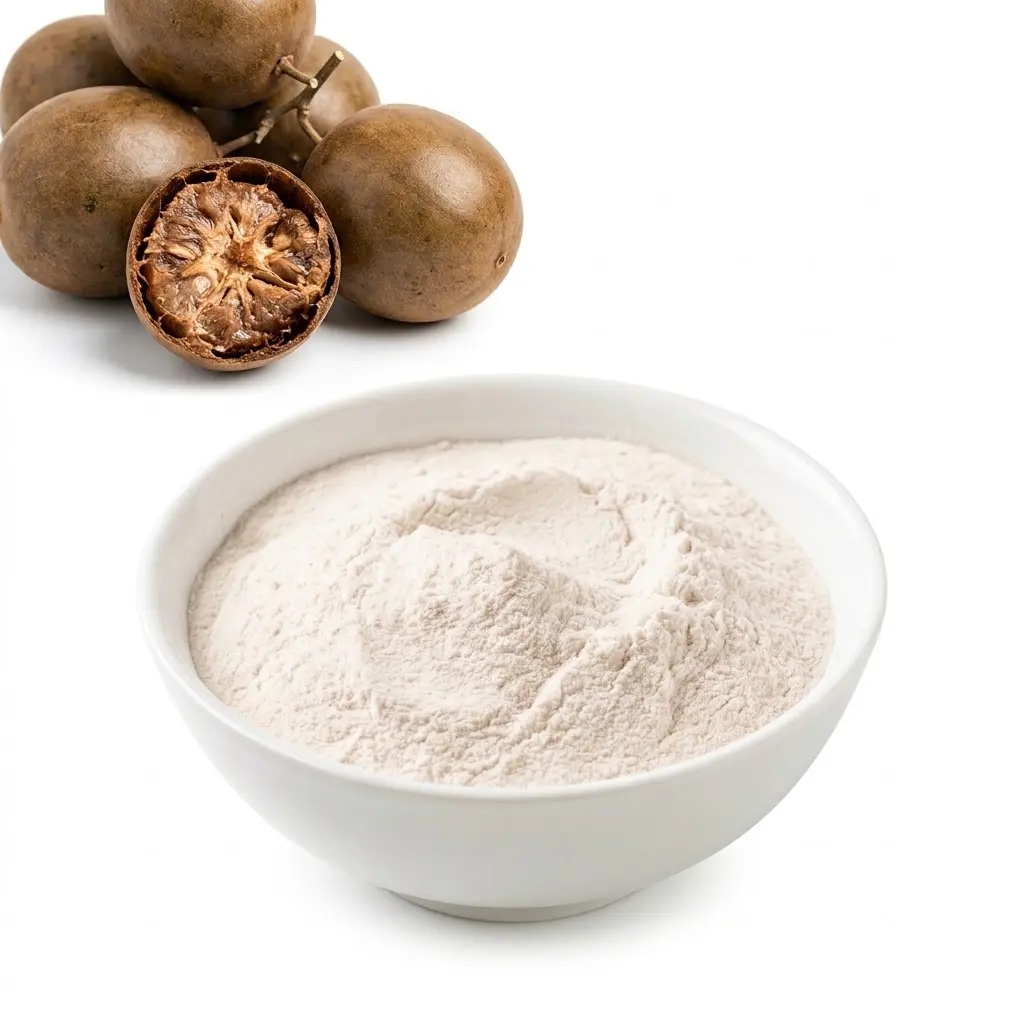
Siraitia grosvenorii
Monk Fruit Extract
- Compounds
- Mogroside V · Mogroside IV · Siamenoside I · Iso-mogroside V
- Grades
- Mogroside V 25–30% · 40–45% · 50–55% · 55–60%
- Method
- HPLC per lot — individual mogroside distribution & chromatogram
- Applications
- Beverages · Bakery · Supplements · Table-top blends · Dairy
- Compliance
- US GRAS-supported · China GB 2760 — destination-market review recommended
- MOQ
- 1 kg — free sample, freight credited to first order
Siraitia grosvenorii
Bulk Monk Fruit Extract Powder Supplier — Mogroside V 25%–60%, B2B Wholesale
Written by Flora · Reviewed by Prof. Bingji Ma · Updated September 2026
PhytoVale manufactures and wholesales monk fruit extract across four standardised grades, from 25–30% up to 55–60% Mogroside V by HPLC. Extracted from the fruit of Stevia rebaudiana's Cucurbitaceae counterpart Siraitia grosvenorii, mogrosides carry FDA GRAS status and approval as a food additive in China under GB 2760. MOQ 1 kg, with US warehouse stock for domestic lead times.
Mogroside V is the marker compound, and on its own it is an incomplete specification. The sweet compounds sitting alongside it range from roughly the sweetness of sucrose to more than five hundred times sucrose. Two lots at the same assay can carry a very different sweet fraction, and the difference is set by fruit maturity at harvest before anything reaches a column.
Every lot is released against the individual mogroside by HPLC, with the full distribution and the chromatogram available.
01 · Core active compounds
Mogroside V, and Why Neither Assay on the Market Describes the Sweetness
Monk fruit contains over seventy identified mogrosides, cucurbitane-type triterpene glycosides built on a mogrol backbone.[4] Mogroside V (CAS 88901-36-4) carries five glucose units and is the compound every commercial specification is written against. Its biosynthetic pathway was mapped in 2016.[1]
The number of glucose units and where they sit decides how sweet a mogroside is, and the spread across the family is very wide. Compounds with more than four glucose moieties run three to five hundred times sucrose. Those with fewer than three are tasteless or bitter.[3] This is the fact that both common ways of buying monk fruit ignore.
| Compound | Reported sweetness vs sucrose | What its presence tells you |
|---|---|---|
| Siamenoside I | 465–563× | The sweetest cucurbitane glycoside isolated from the fruit, and sweeter than Mogroside V.[2] A residual worth paying for, and invisible on a Mogroside V assay |
| Iso-mogroside V | around 500× | Sweet and clean. Also invisible on a Mogroside V assay |
| Mogroside V | 250–425× 378× at 5% sucrose |
The marker compound. The range is one compound measured at different concentrations, not disagreement between labs |
| Mogroside IV | 233–392× | Genuinely sweet, and carries real load in lower-purity grades. A 25% grade is not 25% of the sweetness of a 100% one |
| 11-oxo-mogroside V | 68× | Counts identically toward a total mogroside figure and sweetens at roughly one fifth of Mogroside V. The single largest reason a total assay misleads |
| Mogroside III, IIIE, IIE | tasteless or bitter | Under-converted fruit. These dominate early in maturation and are displaced as glycosylation proceeds.[2] A high level is a harvest signal, not a process one |
| Mogroside I and II | about equal to sucrose | At the inclusion rates monk fruit is used at, effectively inert. They still count toward a total mogroside percentage |
Read the middle column and the problem with a total mogroside figure becomes arithmetic. The compounds aggregated under that heading span from roughly the sweetness of sucrose to over five hundred times sucrose. Adding them into one percentage and presenting it as purity is not a specification, it is an average across compounds that do not do the same job. A 60% total mogroside product carrying a high 11-oxo and Mogroside III fraction can sweeten less than a 45% one that does not.
Mogroside V alone is incomplete for the opposite reason. Siamenoside I is sweeter than Mogroside V and Mogroside IV is in the same band, and neither appears on a Mogroside V assay. Two lots that both release at 50.2% Mogroside V can differ materially in delivered sweetness and in finish, and nothing on a conventional certificate would show it.
Why this page publishes no sweetness multiple
Most supplier pages carry a figure like "50% grade, 250 times sucrose". Two things make that number unusable, and both are visible in the table above.
First, relative sweetness of a high-intensity sweetener falls as concentration rises. The 250 to 425 range for Mogroside V is one compound measured against different sucrose references. A multiple quoted without its reference concentration cannot be compared to anything.
Second, the multiple depends on the whole profile, not the marker. So we do not publish one. We report the individual mogroside distribution per lot, and we measure sweetness equivalence on your own base rather than in water. If a competing quote carries a multiple, ask for the reference concentration and the profile behind it before you compare prices.
Grades we supply
| Grade | Mogroside V (HPLC) | What sits in the remainder | Specify it when |
|---|---|---|---|
| Standard | 25–30% | Mogroside IV and siamenoside I carry a substantial share of the sweetness. Lower glycosides present, so the profile matters most at this grade | Inclusion volume is not constrained and the flavour system has something to hide behind. RTD beverages, bakery, dairy, general sugar reduction |
| Mid purity | 40–45% | Mogroside IV, siamenoside I and iso-mogroside V dominant, lower glycosides substantially reduced | Capsules, stick packs, protein and meal-replacement powders, reduced-sugar snacks. The mainstream supplement grade |
| High purity | 50–55% | Predominantly the high-sweetness mogrosides, with 11-oxo and lower glycosides at low level | Mogroside V content is declared on label, inclusion rate must be minimal, or the blend needs a precisely defined sweet fraction |
| Ultra purity | 55–60% | The cleanest profile we run. Lower glycosides at trace level | Table-top blends, cosmetic actives, and any base with nothing to mask a tail: plain dairy, water, unflavoured protein |
The third column is the one to read. It is why two grades at the same headline number quote and taste differently, and it is why a specification that names only the assay leaves the part you can taste unconstrained. Two lines close that gap on a purchase specification: individual mogroside distribution per lot, and chromatogram supplied with the certificate of analysis. We report both as standard.
Typical specification
| Appearance | Off-white to pale beige free-flowing powder |
| Particle size | REPLACE (mesh) |
| Bulk / tapped density | REPLACE (g/mL) |
| Solubility in water, 25 °C | REPLACE (g/100 mL) · 1% aqueous clarity per lot |
| Loss on drying / ash | REPLACE |
| Heavy metals | ICP-MS, Pb As Cd Hg to USP <232>, per batch |
| Residual solvent | REPLACE · USP <467> or ICH Q3C |
| Microbiology | USP <2021> limits |
| Shelf life / storage | REPLACE months, sealed, cool and dry |
| Packing | REPLACE (kg per drum / carton) |
Full specification sheet and a lot-specific certificate of analysis are sent with every sample.
02 · Evidence
What the Published Research Supports, and What It Does Not
Context for formulators, not claims for any PhytoVale product. Finished-product claims are the marketer's responsibility in each destination market.
Why it is non-glycaemic, mechanistically
Rat pharmacokinetic work places oral systemic bioavailability of Mogroside V near 8.7%, with the compound extensively deglycosylated by digestive enzymes and gut microbiota into mogrol and intermediate mogrosides.[5] Mogrosides are not metabolised as carbohydrate. In a technical dossier this is worth more than a bare assertion of zero glycaemic impact, because it explains the mechanism rather than restating the outcome.
The one registered human trial
In 203 surgical patients, a Luo Han Guo decoction was compared against black tea for throat complications following tracheal intubation. The intervention group showed significantly lower throat soreness scores at 12, 24 and 48 hours, and reduced coughing and expectoration at 48 hours.[6] Registered as ChiCTR-INR-17012203. The intervention was a decoction, not a standardised extract, so it supports the traditional throat and respiratory use rationale rather than any grade of ours.
Antiglycation and antioxidant
In a protein glycation model, mogroside extract at 500 µg/mL reduced fluorescent advanced glycation end-product formation by 58.5%, protein carbonyls by 26.7% and Nε-carboxymethyl lysine by 71.2%, with antiglycative activity comparable to aminoguanidine at equal concentration.[7] This is an in vitro model, and it underpins interest in cosmetic and functional-food positioning rather than any health claim.
03 · Industry use
Formulation Applications and Blending
Monk fruit holds through hot fill, pasteurisation and standard bake profiles, and is stable across the acid range used in most beverages. It carries no bulk, so replacing more than roughly 30% of sucrose by weight requires a bulking system rather than more extract.
On flavour, honestly. Monk fruit is cleaner than most high-intensity sweeteners, and it is not neutral. At high use levels it shows a slight onset delay and a lingering finish, and residual lower glycosides can leave a faint bitter or herbal tail. Both effects are grade dependent and both are manageable through blending and use-level control. Raising the dose to chase sweetness makes the tail worse, not better.
Blending ratios
Ratios below are share of total sweetness contribution, not weight, and they are bench starting points. Acid, flavour and temperature all shift sweetness equivalence.
| Partner | Monk fruit share | Why it works | Watch out for |
|---|---|---|---|
| Erythritol | 3–8% | Erythritol supplies the bulk and mouthfeel monk fruit cannot. Monk fruit lifts the front of the curve and softens erythritol's cooling effect | Solubility ceiling in high-solids systems, and tolerance above roughly 30 to 40 g per serving |
| Stevia (Reb A or Reb M) | 25–40% | Monk fruit fills the opening of the curve where stevia is slow, and masks the liquorice tail. Cheaper than raising stevia purity to solve the same problem | Above roughly 50% monk fruit the blend cost climbs without a proportional sensory gain |
| Allulose | 5–10% | Allulose gives bulk, Maillard browning in bake and a genuinely sugar-like body. Monk fruit tops the sweetness back to parity | Allulose regulatory status differs sharply by market. Confirm the destination before formulating, not after |
| Erythritol + stevia + monk fruit | 15–25% of the high-intensity fraction | The standard commercial table-top and beverage system. Monk fruit rounds the flavour rather than carrying the sweetness load | Needs factorial bench work. Two-way results do not extrapolate to a three-way system |
The fastest way to find the right ratio is not to model it. Send us the base and the reduction target and we will run the ratio series on your matrix, and report sweetness equivalence measured on that base rather than in water.
04 · Sweetener selection
Monk Fruit vs Stevia, Erythritol, Allulose and Sucralose
Comparison tables rank sweeteners by intensity and glycaemic impact. Both are settled facts, and neither decides anything. Three things decide whether a sweetener survives a project: where you are legally permitted to launch it, which part of the sweetness curve it covers, and which of sugar's other jobs it leaves you to fill. The table is built on those.
| Sweetener | Where you can actually launch it | Position on the sweetness curve | What it leaves you to replace | Cost logic |
|---|---|---|---|---|
| Monk fruit | US GRAS, China GB 2760, and a number of Asia-Pacific markets. EU is the constraint: one specific aqueous extract only, via novel food, and purified mogrosides are not authorised as a sweetener additive. The narrowest footprint on this table | Arrives fast and cleanly. Lingers at the back at high use, with a faint herbal note in lower grades | All of it. Bulk, browning, freezing-point depression, water activity | Highest cost per kg here, at a very low inclusion rate. Judge on cost per kg sucrose equivalent, never per kg |
| Stevia | Widest of the naturals. E960 in the EU, US GRAS, JECFA evaluated, approvals in more than sixty markets. Carries a numerical ADI of 4 mg/kg body weight per day as steviol, so portfolio headroom is a real constraint | Slow to arrive and slow to clear. Reb A turns bitter above roughly 4 to 5% sucrose equivalence; Reb M is closest to sucrose | All of it, same as monk fruit | Lowest cost per unit sweetness among the naturals at Reb A grades. Reb M is a step change upward |
| Erythritol | Broad. E968 in the EU with restrictions by food category, US GRAS. Confirm the beverage position for your category | Not on the intensity curve at all. Roughly 0.6 to 0.7 times sucrose, with a cooling sensation that scales with dose | Very little. This is the bulk partner, not the sweetener | Cheapest per kg, used near 1:1 by volume, so it dominates formula cost. Tolerance ceiling per serving |
| Allulose | US and Japan among others, with favourable US sugar-declaration treatment. Not authorised in the EU at the time of writing. Verify before it enters a global brief | Roughly 0.7 times sucrose. Functionally the closest thing to sugar on this table | Almost nothing. It browns, bulks and depresses freezing point | Higher than erythritol per kg, also used at volume. Tolerance ceiling per serving |
| Sucralose | Very broad. E955 in the EU, FDA approved, established almost everywhere | Fast and clean at low use. Off-notes at high use, and it is the least robust here at high bake temperatures | All of it | By far the lowest cost per unit sweetness. Projects leave it for label reasons, not performance ones |
Read the second column first. Regulatory footprint kills more sweetener projects than sensory does, and it kills them later, after the formula is locked and the artwork is drawn. For monk fruit the EU position is the single most common late-stage surprise. A brand that specifies monk fruit for a global launch and discovers at pre-registration that the purified grade has no EU sweetener authorisation is not looking at a reformulation, it is looking at a market split. Section 07 sets out what is and is not authorised.
Nothing on this table replaces sugar on its own. Sucrose does five jobs: it sweetens, it bulks, it browns, it depresses freezing point, and it lowers water activity. Monk fruit does one of them. Any brief that reads "replace the sugar with monk fruit" is under-specified by four functions, and the failures show up as thin mouthfeel, pale bake colour, icy texture and shortened shelf life rather than as a sweetness problem.
Why monk fruit and stevia get blended rather than chosen between. They fail at opposite ends of the same curve. Stevia is slow to arrive and lingers; monk fruit arrives quickly. Their off-notes also differ in kind, liquorice against faint herbal, so they do not stack the way two grades of one sweetener would. Cost usually favours stevia carrying the load, sensory usually favours the blend, and the crossover sits in a different place for a citrus carbonate than for a plain dairy drink. Our stevia grades are on a separate page, and we will run a monk fruit and stevia ratio series on your base if you send it.
05 · Supply
Origin, Maturity and the Seasonal Cycle
Nearly all commercial supply originates in Guilin and the surrounding counties of Guangxi. Suitable cultivation area is limited and the vine requires hand pollination, which is why published reviews identify low Mogroside V yield as the main constraint on the category.[4] There is no meaningful second origin. Model monk fruit as a single-origin ingredient in your supply risk assessment.
Maturity at harvest sets the profile, and the profile is what you taste. An LC-MS-MS study of cultivars from four locations across Guangxi, Guizhou and Hunan tracked the conversion directly: mogroside IIE is the major component early, converts to mogroside III between roughly 15 and 45 days, then glycosylation proceeds rapidly and Mogroside V becomes predominant after about 60 days.[2]
Cross-reference that against the sweetness table in section 01 and the commercial consequence is direct. Fruit picked early to catch a price window carries more of the tasteless and bitter lower glycosides and less of the compounds that actually sweeten. It can still release at an acceptable Mogroside V figure. It will read flatter in the base and finish worse, and no headline assay will show you why.
Seasonality. Harvest runs roughly September into November, with fruit dried or processed straight after. Availability eases in the quarter following harvest and tightens through the second and third quarters as the crop draws down. Buyers with continuous requirements should contract post-harvest or hold safety stock into the pre-harvest window. Our US warehouse inventory exists to buffer that cycle for domestic customers.
06 · Quality
Adulteration Traps and What to Put in Your Specification
Monk fruit is expensive per kilogram, standardised on one marker, and sold to buyers who usually verify only that marker. That is the profile of an ingredient that gets adulterated.
Total mogroside presented as Mogroside V. The most common misrepresentation, and more often ambiguous phrasing than fraud. Section 01 explains why the two are not comparable. Require the marker and the method named explicitly on the certificate.
Spiking with undeclared high-intensity sweeteners. Sucralose, steviol glycosides and neotame are cheap per unit of sweetness and can lift a weak lot to a passing sensory result. HPLC standardised on Mogroside V will not catch any of them. Run an LC-MS screen on incoming lots, particularly on offers priced well below market.
Undeclared carrier, or plant-part substitution. Maltodextrin is legitimate on a spray-dried grade when disclosed and a problem when not: a low total mogroside figure beside a plausible Mogroside V number points at carrier dilution. Leaf, stem and post-extraction residue carry flavonoids such as grosvenorine and kaempferitrin but very little Mogroside V, and blending them in raises yield and darkens the powder. Read moisture, ash, colour and the full fingerprint together.
Reference standard provenance. Two laboratories can return different Mogroside V figures on the same sample using different reference standards or chromatographic conditions. Ask which were used before treating a discrepancy as a quality failure.
| Line on your specification | What to require |
|---|---|
| Marker | Mogroside V by HPLC, named as Mogroside V and not total mogroside, with the method referenced |
| Mogroside distribution | Siamenoside I, iso-mogroside V, Mogroside IV, 11-oxo-mogroside V and the Mogroside II and III fraction, each reported individually per lot |
| Chromatogram | Supplied with each certificate of analysis, not on request |
| Sweetness | Relative sweetness with the sucrose reference concentration stated, or equivalence measured on your finished base |
| Adulteration screen | LC-MS for undeclared sucralose, steviol glycosides and neotame |
| Contaminants | ICP-MS heavy metals to USP <232> and a multi-residue pesticide panel, per batch. Residual solvent to USP <467> or ICH Q3C with the extraction solvent named |
| Documentation | COA, specification sheet, SDS, GRAS reference, non-GMO, allergen, BSE and TSE statements, process flow chart |
07 · Compliance
Regulatory Guidance
Monk fruit extract has been the subject of GRAS notices for sweetener use, with no-questions letters on file. GRAS attaches to a defined material at a defined purity for defined conditions of use, not to monk fruit in general, so confirm that the notice your supplier relies on covers your grade and your production route rather than accepting a general GRAS claim. Our facility is registered under 21 CFR Part 1 Subpart H and operates to dietary supplement cGMP under 21 CFR Part 111. Those are two separate things and are frequently conflated.
Monk fruit extract is not authorised as a sweetener food additive under Regulation (EC) No 1333/2008. It has no E number for that use. As of October 2024, one specific aqueous monk fruit extract was authorised through the novel food route under Commission Implementing Regulation (EU) 2024/2345, for a defined set of food categories.
Highly purified mogrosides and non-aqueous extracts sit outside that authorisation, which published regulatory analysis attributes to gaps in the toxicological dossier and the absence of industry-led applications.[9] Extraction route therefore determines eligibility. Ask us for our process statement before you build monk fruit into an EU launch, and note that the cosmetic pathway is separate: Momordica grosvenorii fruit juice and fruit extract appear in the CosIng inventory with humectant, solvent and antioxidant functions.
Siraitia grosvenorii extract is approved as a food additive sweetener under GB 2760, and the species is recognised as food-medicine homologous by the National Health Commission. Use levels are set by food category and revised periodically, so confirm the current category and limit for your application.
In its 2019 opinion the EFSA panel noted that testicular effects observed in a 90-day study using a 52% Mogroside V extract could not be dismissed, and that the available in vitro work was insufficient to characterise the genotoxic potential of metabolites generated by microbial metabolism, including the aglycone. No maternal or developmental toxicity was observed in a rat reproductive and developmental screening study.[8]
That is a data gap rather than a finding of harm, and it is better heard from your supplier than discovered by your own regulatory team mid-assessment. A 90-day oral gavage study in dogs and comparative in vitro metabolism work on purified mogrosides are the most cited supporting datasets.[10]
Monk fruit extract is a food ingredient and sweetener. Finished products should not carry disease treatment claims, including any relating to blood sugar management, diabetes or metabolic conditions. Non-glycaemic and zero-calorie claims are permissible where substantiated, and supplement structure-function claims require the FDA disclaimer. Permitted categories, maximum use levels and ingredient naming differ by destination market, and nothing on this page is a regulatory opinion. We supply the documentation your assessment needs and will tell you where our file does not reach.
08 · Questions
Frequently Asked Questions
What is the difference between 25%, 45% and 60% mogroside V monk fruit extract?
The figure is Mogroside V content by HPLC. Higher grades sweeten more per gram, so the inclusion rate and the carrier load in your finished product both fall. What the number does not tell you is the rest of the sweet fraction, and at 25 to 30% that fraction is doing a lot of the work. Request the individual mogroside distribution alongside the assay. Broadly: 25–30% for beverages and bakery, 40–45% for supplements, 50–60% where Mogroside V is declared on label or inclusion must be minimal.
How much does monk fruit extract cost per kg, and why do quotes differ so much at the same assay?
Price moves with grade, with the harvest cycle described in section 05, and with order volume, so a live quote is the only honest answer. What we can tell you is how to compare the quotes you receive, because cost per kg is the wrong metric.
Divide price per kg by the measured sweetness multiple to get cost per kg of sucrose equivalent. That is what actually lands in your formula cost. Run it and a 25–30% grade frequently beats a 55–60% one outright in a beverage where inclusion volume is unconstrained.
Two quotes at the same assay differ because the rest of the profile differs, and because a quoted sweetness multiple without its reference concentration is not comparable. A cheap quote with no mogroside distribution behind it is not a cheaper version of the same thing.
Monk fruit or stevia, and can they be used together?
They fail at opposite ends of the same curve, which is why they are usually blended rather than chosen between. Stevia is slow to arrive and lingers; monk fruit arrives quickly and fills that opening. Stevia is more cost-efficient per unit sweetness and far better documented across markets, holding E960 status in the EU where purified monk fruit does not. Cost usually favours stevia, sensory usually favours the blend, and regulatory reach favours stevia decisively for a global launch. See our stevia grades.
Does monk fruit extract contain erythritol?
Not in our material. We supply monk fruit extract standardised on Mogroside V with no bulking agent blended in. Most retail products sold as monk fruit sweetener are predominantly erythritol with a small high-intensity fraction, which is why the two get treated as one ingredient. That matters commercially: if your brief was written from a retail product, the use rate you have in mind is probably out by two orders of magnitude. Pre-blended systems are available and specified separately.
Can monk fruit extract be used in the EU?
Only within a narrow scope, and this is the answer most supplier pages get wrong. Monk fruit is not authorised as a sweetener food additive under Regulation (EC) No 1333/2008 and holds no E number for that use. One specific aqueous extract was authorised through the novel food route in October 2024 under Regulation (EU) 2024/2345 for defined categories. Purified mogrosides and non-aqueous extracts are not covered. Extraction route decides eligibility, so confirm ours and your target category with regulatory counsel before an EU launch. The cosmetic pathway is separate and far less restricted.
How much monk fruit extract replaces a given weight of sugar?
Divide the sugar you are removing by the measured sweetness multiple of the grade on your base. A beverage replacing 80 g of sucrose per litre needs a few hundred parts per million of extract, and the exact figure moves with grade, pH, acid system, temperature and the flavour build.
We deliberately do not publish a use-rate table calculated from a headline multiple, because a multiple measured in water overstates what you will get in a finished matrix. Send the base and the reduction target and we will return a measured figure on it. Remember that above roughly 30% sugar removal by weight you also need a bulking system.
Is monk fruit extract stable in baking and hot-fill beverages, and what is the shelf life?
It holds through hot fill, pasteurisation and standard bake profiles, and is stable across the acid range used in most beverages. Powder shelf life is on the specification sheet, sealed, cool and dry. The caveat is functional rather than chemical: monk fruit contributes no bulk, no browning and no freezing-point depression, so a bake that loses sugar loses colour and structure with it. Confirm clarity at your own use level with a 1% aqueous test on the specific lot before committing to a pack.
What is the minimum order quantity, and can I get a sample first?
1 kg for standard grades. Samples are free and freight is credited against the first order. US warehouse stock is held for domestic lead times. Tell us the base, the reduction target and the destination market and we will send the grade that fits with its specification sheet, rather than the one that is easiest to ship.
What documents come with a shipment?
Certificate of analysis for the lot, specification sheet, safety data sheet, and allergen and non-GMO statements as standard. Mogroside distribution with chromatogram, GRAS reference, process flow chart with the extraction route stated, certificate of origin, BSE and TSE statement and market-specific documentation on request.
09 · Evidence base
References
- [1]Itkin M, Davidovich-Rikanati R, Cohen S, et al. (2016). The biosynthetic pathway of the nonsugar, high-intensity sweetener mogroside V from Siraitia grosvenorii. PNAS, 113(47), E7619–E7628. doi:10.1073/pnas.1604828113 →
- [2]Wang B, Yang Z, Xin Z, Ma G, Qian Y, Xie T, Prakash I (2019). Analysis of mogrosides in Siraitia grosvenorii fruits at different stages of maturity. Natural Product Communications, 14(9). doi:10.1177/1934578X19878621 →
- [3]Glycosyltransferase engineering and multi-glycosylation routes development facilitating synthesis of high-intensity sweetener mogrosides (2022). iScience. PMC9557039 →
- [4]Luo Z, Zang Y, Su J, Tang Q, Pan L, Ma X, Wang C, Mo C (2025). A review of Siraitia grosvenorii: applications, breeding, and biosynthesis of mogrosides. Chinese Herbal Medicines, 18(1), 59–76. doi:10.1016/j.chmed.2025.11.005 →
- [5]Zhang et al. (2025). Mogroside V: a review of its structure, synthesis, pharmacokinetics, and toxicity. Archiv der Pharmazie. doi:10.1002/ardp.70112 →
- [6]Tan HL, Liang YK, Li YM, et al. (2019). Effects of Luo Han Guo on throat complications associated with tracheal intubation: a randomized controlled trial. Journal of International Medical Research, 47(7). doi:10.1177/0300060519853656 →
- [7]Liu H, Wang C, Qi X, et al. (2018). Antiglycation and antioxidant activities of mogroside extract from Siraitia grosvenorii (Swingle) fruits. Journal of Food Science and Technology, 55(5), 1880–1888. doi:10.1007/s13197-018-3105-2 →
- [8]EFSA Panel on Food Additives and Flavourings (2019). Safety of use of monk fruit extract as a food additive in different food categories. EFSA Journal, 17(12), 5921. doi:10.2903/j.efsa.2019.5921 →
- [9]Why does monk fruit extract remain only partially approved in the EU? Regulatory barriers and policy implications for food innovation (2025). PMID 40870722 →
- [10]Bhusari S, Rodriguez C, Tarka SM, et al. (2021). Comparative in vitro metabolism of purified mogrosides derived from monk fruit extracts. Regulatory Toxicology and Pharmacology, 120, 104856. doi:10.1016/j.yrtph.2020.104856 →
Reviewed by
Scientific Advisor, PhytoVale · Professor & Medicinal Plant Science Expert. Research focus: Chinese medicinal materials, phytochemistry, natural products and medicinal plant quality.
Written by
Content Editor, PhytoVale · Product Content & Editorial Specialist. Focuses on botanical ingredient specifications, sourcing information and B2B technical content.
B2B supply
Tell us the base, not just the grade
Send your matrix, your target reduction and the destination market. We come back with a shortlist, samples, the full mogroside distribution, and sweetness equivalence measured on your own base rather than in water. MOQ 1 kg, US warehouse stock, samples free with freight credited against the first order.
Request a sample → Browse all products →Related Botanical Ingredients
 Rebaudioside AKey specification: Reb A
CAS 58543-16-1
Reb A 60% / 80% / 97%
 Rebaudioside DKey specification: Rebaudioside D (Reb D)
CAS 63279-13-0
Reb D 95%/98%
 Rebaudioside MKey specification: Rebaudioside M (Reb M)
CAS 1220616-44-3
Reb M 95% / 98%
Stevia ExtractKey specification: Steviol GlycosidesCAS 57817-89-7
Reb A 80–98% ,Reb M 95–98% ,Reb D 95%
 Custom Sweetener Blend OEM: The Buyer’s Process Guide→Custom Sweetener Blend OEM: The Buyer’s Process Guide WRITTEN BY Flora / OCTOBER 19, 2026 Written by Flora,…
 Types of Curcumin Extract: 7 Grades by Process, Assay and Use→Types of Curcumin Extract: 7 Grades by Process, Assay and Use WRITTEN BY Flora / OCTOBER 17, 2026…
