MOQ
1 kg
Lead time
7–15 days
Quotation
Within 24 hours
Samples
Free of charge
Written by Flora · Reviewed by Prof. Bingji Ma · Updated September 2026
PhytoVale supplies Japanese butterbur extract in bulk — from Petasites japonicus (蜂斗菜, fuki, meowi) grown on our own 33-hectare cultivation base in Henan, in production since 2018 — across two lines with different chemistry, different markers and different applications: root and rhizome extract at 10%, 15%, 20% and 30% Total Petasins, and leaf extract at 7.5%, 10% and 15% Total Bakkenolides. Pyrrolizidine alkaloids are removed by acid-water wash on both lines. No carrier, no excipient.
Both lines are tested on an extended PA panel that adds the two otonecine-type alkaloids specific to this species — petasitenine and neopetasitenine — which the EU list of 21 does not include. On this page: available grades, from base to extract, what each percentage means, the PA problem specific to this species, research background, formulation applications, sourcing criteria and regulatory guidance.
01 · Product grades
Two lines, two markers. They are not grades of the same product: the root and rhizome carry the petasins, the leaf carries the bakkenolides, and each has its own body of research. Specify against the marker that matches the plant part your formulation is built on.
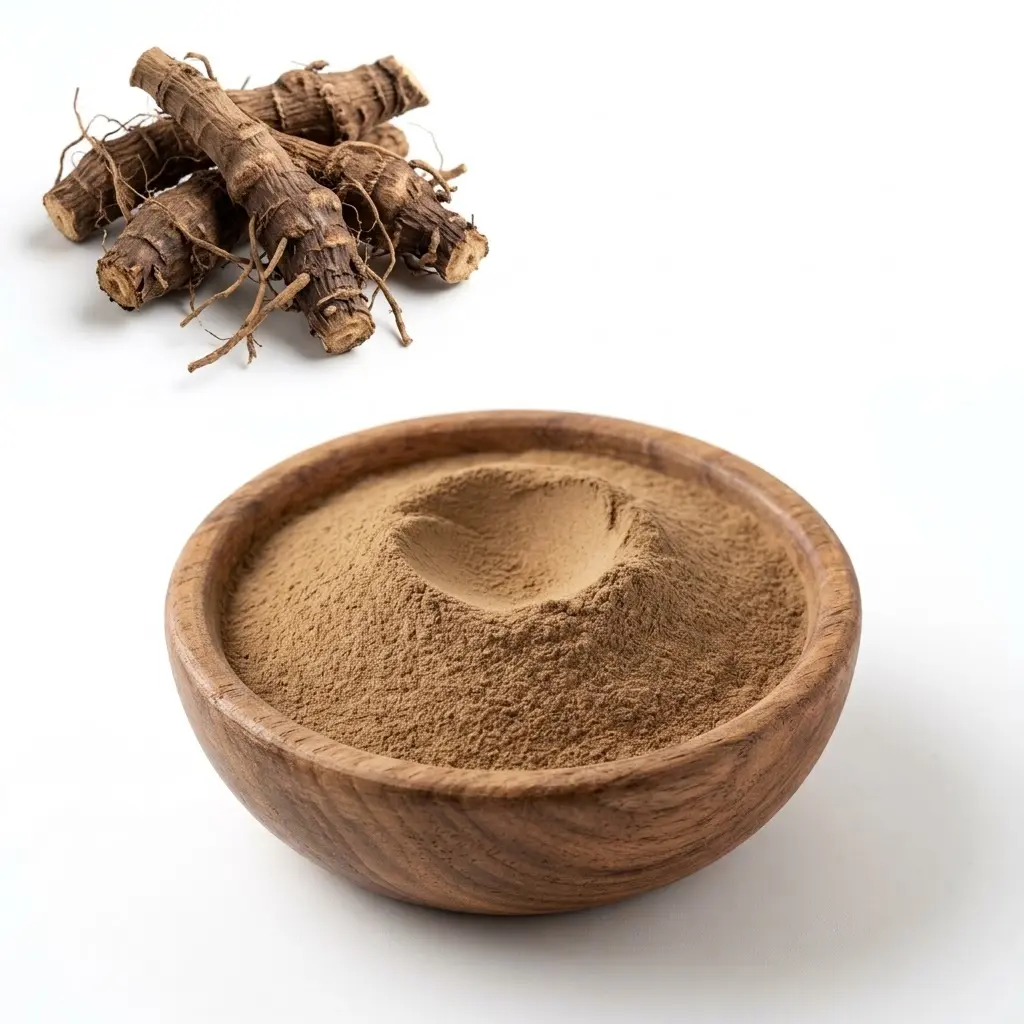
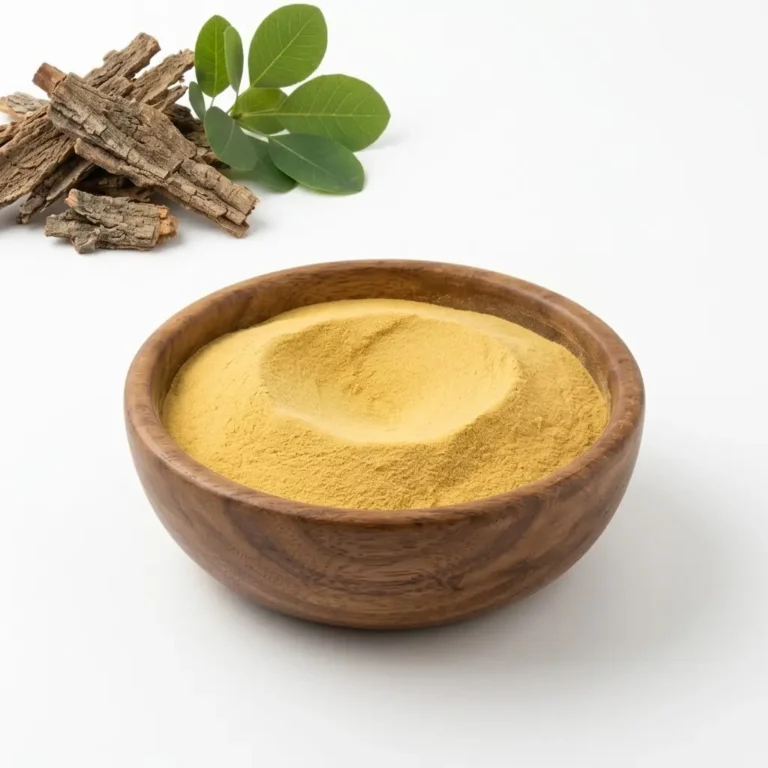
★ Brown-yellow to brown fine powder, characteristic odour, bitter taste. Poorly soluble in water, soluble in ethanol. 80 mesh. No carrier or excipient, so the stated assay refers to the extract itself.
| Grade | Total Petasins (petasin + isopetasin + neopetasin, HPLC) | Extract per 7.5 mg petasins | Best suited for |
|---|---|---|---|
| Butterbur Root Extract 10% | ≥10.0% | 75 mg | Single-ingredient capsules and tablets with fill weight to spare; lowest cost per kilogram |
| Butterbur Root Extract 15% | ≥15.0% | 50 mg | Conventional capsules and softgels; the most widely quoted commercial specification |
| Butterbur Root Extract 20% | ≥20.0% | 37.5 mg | Two- and three-ingredient blends, smaller capsule sizes, metabolic and weight-management stacks |
| Butterbur Root Extract 30% | ≥30.0% | 25 mg | Multi-ingredient softgels, small tablets, concentrated blends where capsule space is contested |
★ Green-brown to brown fine powder, characteristic odour, slightly bitter taste. 80 mesh. No carrier or excipient. Standardized on total bakkenolides by HPLC, with bakkenolide B as the principal constituent; Total Petasins can be reported alongside as a secondary assay on request.
| Grade | Total Bakkenolides (HPLC) | Extract per 10 mg bakkenolides | Best suited for |
|---|---|---|---|
| Butterbur Leaf Extract 7.5% | ≥7.5% | 133 mg | Functional food and beverage systems, East Asian market products, topical bases — formats where inclusion weight is flexible |
| Butterbur Leaf Extract 10% | ≥10.0% | 100 mg | Conventional capsules and tablets; the mid-range working specification for seasonal-comfort products |
| Butterbur Leaf Extract 15% | ≥15.0% | 67 mg | Multi-ingredient seasonal blends and smaller formats where fill weight is contested |
On the arithmetic columns
The third column in each table is arithmetic, not a recommended serving. The 7.5 mg petasin reference reflects a commonly used commercial unit size; there is no established reference serving for bakkenolides, so the 10 mg figure is a round number chosen to make the grades directly comparable. Target loads are for the brand or formulator to set. To compare grades on cost rather than label percentage: price per kg ÷ (1000 × marker fraction) — at $120/kg, a 15% grade works out to $0.80 per gram of marker.
★ Packaging 1 kg foil bag / 25 kg fibre drum with double PE liner. Shelf life 24 months sealed, below 25 °C, away from light and heat. Custom standardization available on both lines. MOQ, lead time and current pricing as listed alongside.
02 · Traceability
Raw material for both lines comes from PhytoVale's own Petasites japonicus cultivation base in Henan: approximately 33 hectares (500 mu), in production since 2018, harvested between March and June. Underground and aerial parts are separated at harvest rather than sorted afterwards, which is what allows the two lines to be run as genuinely different products rather than as fractions of one crude input.
A stand that has been in continuous production since 2018 is established rather than newly planted, and the harvest window has been held constant across those seasons. Both reduce the year-to-year variability that makes botanical specifications difficult to hold — variability that, on this genus, is documented as substantial.
Owning the base matters more for butterbur than for most botanicals, and the reason is specific. Several plants circulate under overlapping Chinese and English common names — P. japonicus, P. hybridus, P. tricholobus, and the superficially similar Tussilago farfara — and they differ in whether they contain petasins at all and in which alkaloids they carry. When material is bought through a dried-goods market, species is something you infer at goods-in from a sample and a supplier's word. When it is grown on your own base, species is fixed in the field before anything is harvested.
The chemical differences between the species, and how identity is checked at goods-in, are set out in Petasites japonicus vs Petasites hybridus: Japanese and European butterbur compared.
Harvest and washing → separation of underground and aerial parts → drying and milling → ★ solvent extraction → acid-water wash → concentration → drying → milling → finished powder. Both lines run the same route from their respective plant parts.
The acid-water wash is the PA-removal step, and it works on a polarity difference. Petasins and bakkenolides are lipophilic sesquiterpenes; pyrrolizidine alkaloids are polar bases that protonate in acidified water and partition into the aqueous phase, where they are carried out of the product. Because the separation is driven by an intrinsic property of the two compound classes rather than by selective adsorption, it is not specific to any one alkaloid — which matters on this species, since its characteristic alkaloids are structurally different from those of European butterbur.
Removal is not the same as verification, so both are done. PA results for the actual production lot — both panels, with the limit of quantification stated — are reported on the batch COA.
03 · Active compounds
| Compound | Identity | Relevance to the specification |
|---|---|---|
| Petasin | CAS 26577-85-5 · C20H28O3 · MW 316.44; the angelate ester of petasol | Root line. The compound most of the published root-line bioactivity is attributed to; converts spontaneously to isopetasin in dried material and stored extract |
| Isopetasin | Geometric isomer of petasin | Root line. Accumulates as petasin isomerizes; counted in the sum |
| Neopetasin | Third isomer routinely quantified alongside the other two | Root line. Counted in the sum |
| S-petasin series | Methylthio derivatives: S-petasin, iso-S-petasin, neo-S-petasin | Present in the extract and reported in the literature; not part of a commercial Total Petasins figure |
| Bakkenolides | Bakkenolide-type sesquiterpene lactones, chiefly bakkenolide B; concentrated in the leaf | Leaf line marker. Also a species-identity marker — P. hybridus does not carry them |
| Phenolics | Fukinolic acid, chlorogenic acid, caffeic acid, caffeoylquinic acids | Leaf line. Characterised in the published leaf work; not standardized in our specification |
Petasin, isopetasin and neopetasin interconvert, so the sum is the only reproducible basis. A specification written as "petasin ≥15%" will fail on re-test against material that has not degraded at all — total sesquiterpene content is unchanged, the ratio has simply shifted.
The isomer distinction is not only analytical. Structure-activity work on P. japonicus found petasin active against adipocyte differentiation while isopetasin and petasol were not, attributing the difference to the C11–C12 double bond and the angeloyl ester.[1] If your positioning rests on that literature, ask for the individual breakdown alongside the total rather than the total alone — we report both.
Reading a Total Petasins figure on a COA, and writing a specification around it, are covered in Total Petasins explained: petasin, isopetasin and how to specify butterbur extract.
Because that is what the leaf research is built on. The published anti-allergic and anti-inflammatory work on P. japonicus leaves identifies bakkenolide B as a major active constituent and the later-described petatewalide B as a second bakkenolide-type compound from the same material.[2][3] A leaf extract specified only on petasins is being bought against the wrong body of evidence, however respectable the number looks.
The leaf line, its chemistry and where it fits in formulation are covered in Bakkenolide B and butterbur leaf extract: the other half of Petasites japonicus.
04 · PA control
Every Petasites species carries pyrrolizidine alkaloids, and the 1,2-unsaturated PAs are hepatotoxic and classified by IARC as possibly carcinogenic to humans (group 2B). But P. japonicus does not carry the same alkaloids as European butterbur, and that difference has a practical consequence most sourcing programmes miss.
The alkaloids isolated from P. japonicus are predominantly otonecine-type: petasitenine (also called fukinotoxin), neopetasitenine, secopetasitenine and senkirkine.[5] Petasitenine was identified as the carcinogenic principle of this plant.[6] European butterbur, by contrast, is dominated by retronecine-type alkaloids such as senecionine and integerrimine.
Important — the standard EU panel does not cover this species
Commission Regulation (EU) 2023/915 sets its maximum levels against a defined list of 21 pyrrolizidine alkaloids plus 14 co-eluting isomers.[8] Senkirkine is on that list. Petasitenine and neopetasitenine are not. A P. japonicus extract tested to the standard EU panel alone can therefore return a clean result while the alkaloids most characteristic of the species go unmeasured. Otonecine-type alkaloids also do not form N-oxides — the necine nitrogen is methylated and cannot be N-oxidised — so they are structurally invisible to panels built around PA / PA-N-oxide pairs.
PhytoVale tests every batch of both lines on the EU 21+14 panel plus petasitenine and neopetasitenine as separate analytes, by LC-MS/MS, on the finished packed lot, following the analytical approach of European Pharmacopoeia general chapter 2.8.26. Reference standards for the otonecine-type alkaloids are commercially available, and reversed-phase methods for determining petasitenine, neopetasitenine and senkirkine in edible P. japonicus have been established in the literature since the 1980s.[7]
Figures are given in µg/kg (ppb); where the COA reports ppm, that value is shown in brackets.
| Test item | Method | Specification | Result |
|---|---|---|---|
| PA and PA N-oxides (lot ★) | LC-MS/MS | ≤ 35 µg/kg (≤ 0.035 ppm) | < 28 µg/kg (< 0.028 ppm) |
| PA and PA N-oxides (lot ★) | LC-MS/MS | ≤ 2 µg/kg | ≤ 2 µg/kg |
What the specification means in a finished supplement
The EU maximum of 400 µg/kg applies to the finished product. At a 35 µg/kg release specification, 50 mg of root extract in a 500 mg capsule contributes at most 3.5 µg/kg to the finished supplement — under 1% of the limit — and 133 mg of leaf extract at most 9.3 µg/kg, about 2%.
We do not use the term "PA-free". It has no analytical definition, and on this species it is specifically misleading: a result can only be as complete as the panel behind it.
Three questions that make any PA figure comparable
Which analytes were summed? On P. japonicus, a 21-PA result and a 23-analyte result are not the same test. What was the limit of quantification? A "not detected" at 50 ppb and one at 2 ppb describe different products. Was the finished lot tested, or the raw material? Only the first describes what ships to you.
A line-by-line guide to reading the PA result on a butterbur COA is in Pyrrolizidine alkaloids in butterbur: why the standard EU panel misses Petasites japonicus.
05 · Research
Provided as scientific context for formulators, not as claims for any PhytoVale product. The root and the leaf have separate literatures built on different compounds — they are not interchangeable evidence.
A 2022 study in Fitoterapia screened the known major components of P. japonicus and identified petasin as the compound responsible for most of the extract's anti-adipogenic activity, with an IC50 of 0.95 μM in a 3T3-F442A model. Petasin suppressed markers of mature adipocytes (PPARγ, C/EBPα, aP2), acted at the late stage of differentiation, and inhibited expression of the lipid-synthesis factors ACC1, FAS and SCD1. Isopetasin and petasol did not reproduce the effect, which the authors attributed to the C11–C12 double bond and the angeloyl ester moiety.[1] The same work reported that petasin can be extracted efficiently into an apolar solvent while leaving most of the alkaloid load behind.
The leaf has its own body of work, largely from Korean and Japanese groups, and it centres on different compounds. Bakkenolide B, a major constituent of the leaves, inhibited antigen-induced degranulation in RBL-2H3 mast cells in a concentration-dependent manner, suppressed induction of iNOS and COX-2 in mouse peritoneal macrophages, and showed activity in an ovalbumin-induced asthma model.[2] A later paper from the same line of work isolated a new bakkenolide-type sesquiterpene from the leaves, named petatewalide B, and reported comparable anti-allergic and anti-inflammatory findings across mast-cell, macrophage and in vivo models.[3] Earlier work on aerial-part extracts described type I anti-allergic activity and inhibition of mast cell degranulation, identifying fukinolic acid, chlorogenic acid and caffeic acid among the constituents.
Separately, a hot-water extract of the leaves inhibited LPS-induced nitric oxide production in RAW 264.7 macrophages with an IC50 of 19 ± 4.9 μg/mL; phytochemical work on that extract yielded two previously undescribed aryltetralin lactone lignans alongside known compounds, all evaluated against NO and PGE2 production.[4]
P. japonicus is fuki in Japan and meowi in Korea — the petioles, leaves and flower buds are long-established vegetables in both cuisines, and the aerial parts appear in traditional Japanese folk use as an antipyretic, antitussive and wound-healing material.[4] The plant is also already present in the US market as a botanical dietary supplement ingredient.[4] This is the relevant traditional-use context for this species, and it is a different one from European butterbur.
These are preclinical, compositional and toxicological findings described here as research context. They are not efficacy claims, and no human clinical trial has been conducted on PhytoVale material.
06 · Formulation
Grade selection runs from three inputs, in this order: which line the positioning is built on, how much fill weight is available, and the target marker load per serving. Price per kilogram comes fourth.
| Product category | Line and grade | Why | Typical inclusion |
|---|---|---|---|
| Metabolic & weight management | Root, 20% or 30% | The petasin-specific literature is the positioning basis, and these products almost always share capsule volume with other actives | 25–37.5 mg for a 7.5 mg petasin load |
| Seasonal & respiratory comfort | Leaf, 10% or 15% | The bakkenolide work sits on the leaf, not the rhizome; building this category on a root extract means citing the wrong plant part | 67–100 mg for a 10 mg bakkenolide load |
| Single-ingredient general botanical capsules | Root, 10% or 15% | Fill weight is not the binding constraint, so the lower grade is the cheaper route to the same marker target | 50–75 mg |
| Functional food, beverages & East Asian market products | Leaf, 7.5% | Fuki and meowi are established vegetables in Japan and Korea; the food-use story belongs to the aerial parts, and inclusion weight is usually flexible in these formats | 133 mg or formulation-dependent |
| Topical & cosmetic | Leaf, 7.5% or 10% | The NO and PGE2 work was done on a leaf hot-water extract, which also suits aqueous cosmetic bases better than the lipophilic root extract | Formulation-dependent |
Oil-filled softgels. The best fit for the root line. Petasins are lipophilic and poorly water-soluble, so a lipid vehicle suspends the extract more readily than an aqueous one, and the 30% grade keeps the butterbur contribution to fill weight at 25 mg for a 7.5 mg load — leaving room for oil-miscible partners in the same capsule.
Two-piece capsules. The default format for both lines and the most forgiving. With no carrier in either powder, the stated percentage is the extract itself, so fill-weight arithmetic is direct: divide the target marker load by the grade fraction. Where total fill is under 400 mg and butterbur shares the capsule with two or more actives, move up a grade.
Tablets. Workable on both lines, and usually favours the lower grades since fill weight is rarely the binding constraint. The constraint here is thermal: keep the load down through granulation and drying, because heat accelerates petasin-to-isopetasin conversion on the root line. Total sesquiterpene content does not change, but the isomer ratio will move — invisible on a Total Petasins test and a failure on a petasin-only one.
Powders, sticks and beverages. The root extract is a poor fit without a solubilising system, clear beverages and effervescents in particular. The leaf line sits more comfortably in aqueous systems, and the 7.5% grade is the one built for it. If the brief is a drink, start from the leaf rather than trying to force the root.
In metabolic and weight-management stacks the root extract is commonly formulated alongside green tea catechins, chromium, berberine or capsaicinoids, all of which compete for the same capsule volume — the argument for the higher grade. In seasonal-comfort products the leaf extract sits naturally with quercetin, bromelain, nettle leaf and vitamin C. Neither list is a claim about combined effect; it is where these categories are commercially built.
Specify against the right marker. Root on Total Petasins, leaf on Total Bakkenolides. Quoting a leaf grade against a petasin specification, or the reverse, produces a number that is real but irrelevant to the product.
Specify the sum, not the single compound, on incoming and finished-product specifications alike, so that isomerisation during processing and storage does not generate out-of-specification results on material that is chemically intact.
Asteraceae cross-reactivity. P. japonicus shares a family with ragweed, chrysanthemum and daisy. Most markets expect a precautionary allergen statement; confirm the requirement for each destination.
Samples of both lines, and of two or more grades within a line, can be supplied together so the fill-weight, flow and compatibility comparison runs on your own equipment before a grade is committed.
07 · B2B qualification
| Criterion | What to require |
|---|---|
| Species & plant part | Petasites japonicus confirmed on the COA with plant part stated. P. hybridus, P. tricholobus and Tussilago farfara all circulate as "butterbur" and differ in both sesquiterpene and alkaloid profile |
| Marker matched to the plant part | Total Petasins for root and rhizome; Total Bakkenolides for leaf. A leaf extract quoted only on petasins is being specified against the wrong body of research, and a root extract quoted on bakkenolides is measuring a compound class the rhizome does not concentrate |
| Assay basis, root line | Total Petasins as the sum of petasin, isopetasin and neopetasin by HPLC — not petasin alone, which drifts as it isomerizes. Individual breakdown available on request |
| Assay basis, leaf line | Total bakkenolides by HPLC, with bakkenolide B identified as the principal constituent |
| PA panel scope | EU 21+14 panel plus petasitenine and neopetasitenine. The EU list alone does not cover the otonecine-type alkaloids characteristic of this species |
| PA testing point & LOQ | Finished packed lot, with the limit of quantification stated on the COA — not raw-material testing, and not an unqualified "PA-free" statement |
| Carrier declaration | Confirm whether the assay refers to the extract itself or to a carrier-diluted powder; this changes fill weight and label declaration |
| Batch COA | Assay, both PA panels, heavy metals, residual solvents per ICH Q3C, pesticide residues, microbial limits and moisture, per production lot |
Align specifications before comparing quotes. Material sold simply as "butterbur extract" with no species, no plant part and no assay basis is not in the same comparison set, and two suppliers both offering 15% are not equivalent if only one can answer the marker and PA-panel rows.
08 · Compliance
United States. P. japonicus is already present in the US market as a botanical dietary supplement ingredient.[4] Structure/function claims require self-substantiation and the FDA disclaimer. Note that the published human trials on butterbur were conducted on P. hybridus preparations and cannot substantiate claims for a P. japonicus ingredient.
European Union. Commission Regulation (EU) 2023/915 sets a maximum level of 400 µg/kg for food supplements containing herbal preparations, as the lower-bound sum of 21 PAs plus 14 interfering isomers.[8] The limit applies to the finished supplement, so your compliance position depends on inclusion rate as well as our specification. Confirm the novel-food and botanical status of P. japonicus for your specific member state before launch — it is assessed on its own, not as an equivalent of European butterbur.
Herbal medicinal products. A separate and more restrictive pathway, working on maximum daily PA intake rather than concentration. EFSA's 2017 opinion underpins the current risk basis, setting a reference point of 237 µg/kg body weight per day for the carcinogenic endpoint and applying a margin-of-exposure approach.
Japan, Korea and China. The plant has established food use in all three. 蜂斗菜 is a recognised botanical in Chinese domestic use; documentation is available for the China market and for export.
Caution — label considerations for finished-product formulators
Do not transfer the European butterbur clinical literature. The published migraine and allergic-rhinitis trials used standardized Petasites hybridus preparations of defined chemotype and process. Applying those results to a P. japonicus ingredient is a species substitution, and regulators in several jurisdictions treat it as misleading rather than as a grey area. Do not transfer between plant parts either — the leaf and root literatures rest on different compounds, and a root extract cannot carry the leaf's evidence. Asteraceae cross-reactivity: P. japonicus belongs to the same family as ragweed, chrysanthemum and daisy; standard allergen disclosure is recommended. Pregnancy and breastfeeding: precautionary avoidance, insufficient controlled data. This material is supplied as a raw material for oral supplement, functional food and topical formulation use only.
09 · Evidence base
[1] Uesugi D, et al. Petasin is the main component responsible for the anti-adipogenic effect of Petasites japonicus. Fitoterapia. 2022. ScienceDirect
[2] Lee KP, Kang S, Park SJ, et al. Anti-allergic and anti-inflammatory effects of bakkenolide B isolated from Petasites japonicus leaves. Journal of Ethnopharmacology. 2013. PubMed
[3] Choi YW, Lee KP, Kim JM, et al. Petatewalide B, a novel compound from Petasites japonicus with anti-allergic activity. Journal of Ethnopharmacology. 2016;178:17–24. PubMed
[4] Chemical constituents of the leaves of butterbur (Petasites japonicus) and their anti-inflammatory effects. Biomolecules. 2019;9(12):806. PMC
[5] Kitajima M, Yanagisawa T, Tsukahara M, et al. New otonecine-type pyrrolizidine alkaloid from Petasites japonicus. Journal of Natural Medicines. 2019. Springer
[6] Yamada K, Tatematsu H, Hirata Y, Haga M, Hirono I. Stereochemistry of petasitenine, the carcinogenic alkaloid from Petasites japonicus Maxim., and transformation of petasitenine to senkirkine. Chemistry Letters. 1976;5:1123–1126.
[7] Niwa H, et al. Separation and determination of macrocyclic pyrrolizidine alkaloids of the otonecine type present in the edible plant Petasites japonicus by reversed-phase high-performance liquid chromatography. Journal of Chromatography. ScienceDirect
[8] Commission Regulation (EU) 2023/915 of 25 April 2023 on maximum levels for certain contaminants in food — pyrrolizidine alkaloids at point 2.4 of Annex I. EUR-Lex
Reviewed by
Prof. Bingji MaScientific Advisor, PhytoVale · Professor & Medicinal Plant Science Expert. Research focus: Chinese medicinal materials, phytochemistry, natural products and medicinal plant quality.
Written by
FloraContent Editor, PhytoVale · Product Content & Editorial Specialist. Focuses on botanical ingredient specifications, sourcing information and B2B technical content.
10 · Questions
It depends on which literature your product is built on, not on price. The root and rhizome carry the petasins, and the petasin-specific work is metabolic. The leaf carries the bakkenolides, and that work is anti-allergic and anti-inflammatory. A leaf extract specified on petasins is being bought against the wrong body of research, and a root extract cannot carry the leaf's evidence. Tell us the application and we will tell you which line and which grade.
No. Those trials used standardized Petasites hybridus preparations, a European species. We supply Petasites japonicus, the East Asian species known as fuki in Japan and meowi in Korea. Both are called butterbur and both contain petasins, but they differ in alkaloid profile and they do not share clinical literature. If your project specifically requires P. hybridus, we are not the right supplier for it.
The EU 21+14 panel under Regulation (EU) 2023/915, plus petasitenine and neopetasitenine as separate analytes — the otonecine-type alkaloids characteristic of this species, which the EU list does not include. Testing is by LC-MS/MS on the finished packed lot for both lines, following European Pharmacopoeia 2.8.26. Both panels and the limit of quantification are stated on the batch COA.
On our own cultivation base in Henan — approximately 33 hectares (500 mu), in production since 2018, harvested March to June. Underground and aerial parts are separated at harvest, which is what lets the two lines run as genuinely different products. Growing rather than buying is how species identity is fixed, and on a genus where several plants share the name "butterbur", that matters.
Petasin isomerizes to isopetasin during storage and in dried plant material. A petasin-only figure falls over shelf life while total sesquiterpene content is unchanged, producing failed re-tests on material that has not degraded. The sum of petasin, isopetasin and neopetasin is stable and comparable. We can report the individual breakdown alongside it on request.
Yes, as a secondary assay on request. But specify the leaf line on bakkenolides — that is the marker the leaf research is built on, and it is what determines whether the material suits the application.
No. Both lines are supplied without carrier or excipient, so the stated percentage refers to the extract itself. This matters when comparing quotes — a carrier-diluted 15% and a neat 15% are different materials at the same fill weight.
Only if capsule volume is actually constrained. Compare on cost per gram of marker: price per kg ÷ (1000 × marker fraction). Where fill weight is not the binding constraint, the lower grade is usually the cheaper way to the same target.
B2B supply
Tell us the application, the dosage form and the destination market. We will come back with the line and grade that fit, the arithmetic at your fill weight, and a batch COA showing both PA panels.
Request a sample →Browse all products →Disclaimer: this page is intended for ingredient evaluation, formulation and B2B purchasing. All health-related statements reference published peer-reviewed research on Petasites japonicus or on its isolated constituents, and are not medical advice and not claims for any PhytoVale product. These statements have not been evaluated by the Food and Drug Administration. This product is not intended to diagnose, treat, cure or prevent any disease. Regulatory positions and contaminant limits change; figures above are current as of the update date and should be re-verified against the legislation in force at launch. Finished-product manufacturers are responsible for regulatory status, permitted claims, dosage, labelling and compliance in their target markets. © 2026 PhytoVale.
 Blue Lotus ExtractKey specification: None
 Cinnamon Bark ExtractKey specification: Polyphenols
 Citrus aurantium extractKey specification: Synephrine/Total Flavonoids
 Fisetin PowderKey specification: Fisetin
 Custom Sweetener Blend OEM: The Buyer’s Process Guide→Custom Sweetener Blend OEM: The Buyer’s Process Guide WRITTEN BY Flora / OCTOBER 19, 2026 Written by Flora,…
 Types of Curcumin Extract: 7 Grades by Process, Assay and Use→Types of Curcumin Extract: 7 Grades by Process, Assay and Use WRITTEN BY Flora / OCTOBER 17, 2026…

