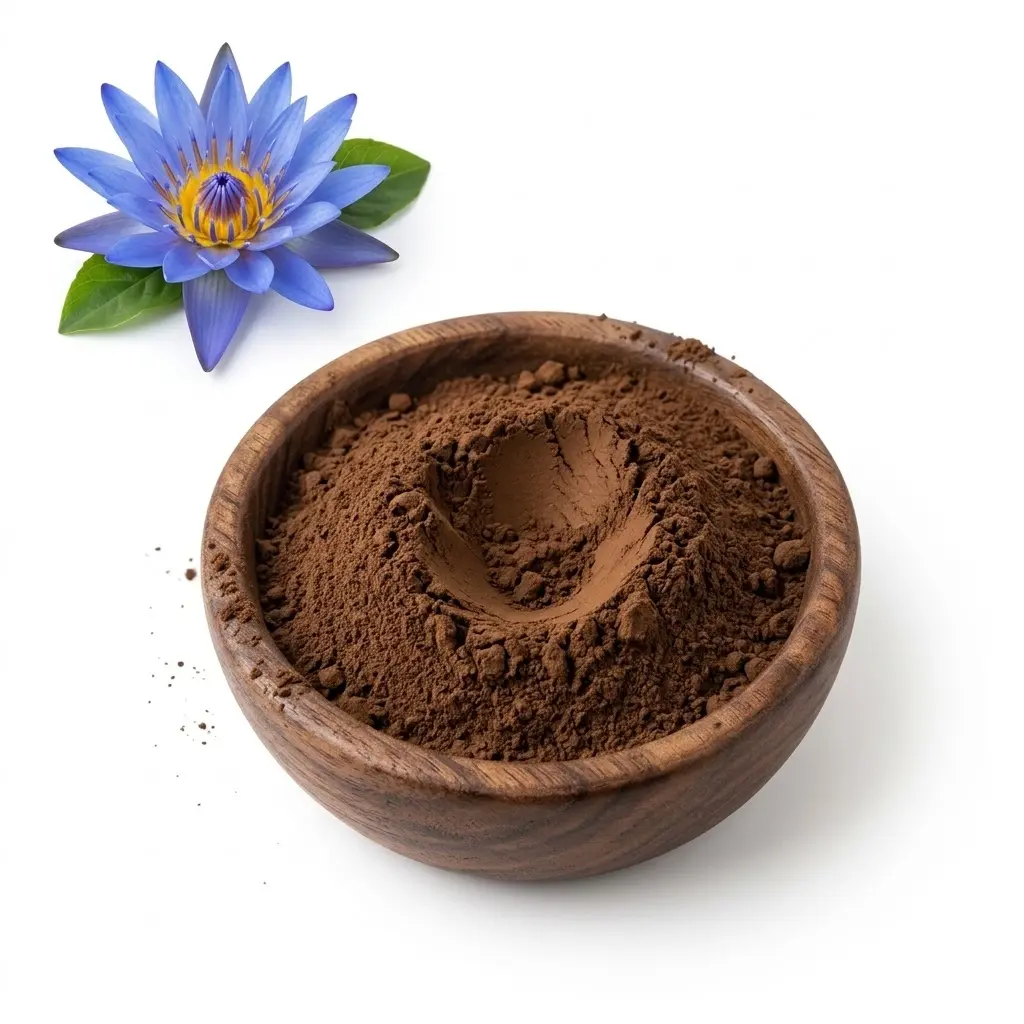
Nymphaea nouchali var. caerulea
Blue Lotus Extract
- Source
- Whole flower, Hainan, China
- Grades
- 10:1 · 30:1 · 50:1 · 100:1 · 200:1 (fresh flower)
- Extraction
- Water only, no carrier
- Testing
- Species ID · Synthetic cannabinoid screen
- Applications
- Cosmetics · Fragrance
- Documentation
- COA · Species ID · Heavy metals · Microbiology
MOQ
1 kg
Lead time
7–15 days
Quotation
Within 24 hours
Samples
Free of charge
Bulk Blue Lotus Extract Supplier: Whole Flower, Water Extracted, 10:1 to 200:1
Written by Flora · Reviewed by Prof. Bingji Ma · Updated September 2026
PhytoVale is a bulk supplier of Blue Lotus Extract produced from whole flowers of Nymphaea nouchali var. caerulea, extracted with water only. Five stock grades from 10:1 to 200:1, quoted on fresh flower weight, with no maltodextrin or other carrier in the finished powder. Supplied as a cosmetic and fragrance raw material. MOQ 1 kg, free samples, quotation within 24 hours.
Most blue lotus on the market is quoted against two alkaloids that published analysis cannot find in it, at a ratio whose calculation basis is never stated, from a plant that is often the wrong species. We do it the other way round: the ratio is stated on fresh flower weight, apomorphine and nuciferine are reported as not detected, and the species is authenticated on every lot. What we do not do is supply it as a food ingredient or into vaping, and section 03 explains why the first of those is not legally available to you in either the EU or the US.
01 · Product identity
What Is Blue Lotus Extract?
Blue Lotus Extract is produced from the flowers of Nymphaea nouchali var. caerulea, a day-blooming water lily native to the Nile basin and eastern Africa and cultivated for this product in Hainan, southern China. Whole fresh flowers are extracted in water, filtered, concentrated under vacuum and dried to a powder. No ethanol is used at any stage and no carrier is added, so the ratio describes the powder itself rather than the powder plus an excipient. The point at which concentration stops sets the ratio, and the ratio defines the grade.
The product name does a lot of work in this category, which is where most confusion starts. Dried blue lotus flower, meaning the whole flower milled with nothing removed, is routinely listed alongside extract at comparable prices, although the extract has had its insoluble plant tissue discarded and behaves quite differently in a formulation. Separately, N. caerulea, the name almost every quotation uses, is a recognised synonym of N. nouchali var. caerulea [1] — a plant that shares the English word lotus with a species from an entirely different botanical family. Section 04 covers which plant is actually in the drum, which in this category is not a rhetorical question.
02 · Product data
Blue Lotus Extract Grades: 10:1, 30:1, 50:1, 100:1 and 200:1
All five grades come from the same whole flowers and the same water process, and differ only in how far the extract is concentrated before drying. None contains a carrier.
| Grade | Ratio, fresh flower | ≈ dried flower | Typical inclusion | Where it is normally used |
|---|---|---|---|---|
| BL-200 | 200:1 | ≈ 20:1 | 0.1–0.5% | Fine fragrance, candles and diffusers; clear gels where the dose has to stay very low |
| BL-100 | 100:1 | ≈ 10:1 | 0.3–1% | Serums, ampoules, eye care, anything in a clear pack where colour load is the constraint |
| BL-50 | 50:1 | ≈ 5:1 | 0.5–2% | Creams, lotions, after-sun and soothing gels |
| BL-30 | 30:1 | ≈ 3:1 | 1–3% | Toners, essences, sheet mask essence, hair conditioners and masks |
| BL-10 | 10:1 | ≈ 1:1 | 2–5% | Bath soaks, cleansers, rinse-off formats and cost-led blends |
Across all grades: mesh [ ], loss on drying [ ], ash [ ], packed in [1 kg foil bag / 25 kg drum with double PE inner liner], shelf life [ ] in the unopened original packing stored cool, dry and out of direct light. Residual solvents do not apply, since water is the only solvent used. Heavy metals, microbiology and the adulteration panel are set out in section 08.
How to Read a Blue Lotus Ratio
A ratio only carries information when the basis is stated, and most blue lotus quotations do not state it. The same lot is honestly describable as 200:1 or as 20:1 depending on whether the input flowers were weighed fresh or dried, since water lily flowers lose roughly nine tenths of their weight on drying. A carrier such as maltodextrin moves the figure again in the same direction. Ours are quoted on fresh whole flower weight with no carrier in the powder, and the dried equivalents are published above so you can hold our numbers against a supplier quoting the other way.
Every other extract in the PhytoVale range carries a guaranteed assay. Blue lotus does not, and the reason is analytical rather than commercial. The two compounds normally quoted as markers, apomorphine and nuciferine, are not viable assay targets for this material. GC-MS analysis of six authentic N. caerulea extracts produced in industrial settings, alongside eleven commercial products, found both virtually absent from the authentic extract [1]. Independent UHPLC-QTOF-MS profiling of Egyptian material published in 2025 reported the same result, and identified the alkaloids actually present as spermidine conjugates rather than aporphines [2].
No industry-accepted marker assay exists for blue lotus flower extract. A supplier quoting a guaranteed apomorphine or nuciferine percentage is quoting a figure the published literature does not support, and no third-party laboratory will confirm it for you. We report both as not detected, and we would rather you hear that from us than find it during due diligence.
Total phenolic and total flavonoid content are run as internal batch parameters and will be published as guaranteed minima once we have the batch history to stand behind them. Until then, treat the ratio as a process description and not a potency statement.
For buyers comparing ratio extracts with alkaloid-standardized materials, our Blue Lotus Extract vs Nuciferine Extract guide explains why extract ratio, botanical identity and nuciferine assay answer different sourcing questions.
Not sure which of the five grades fits?
Send us your formula type, the target inclusion and whether the base is clear or opaque. We will tell you which two grades to trial and send both as free samples.
03 · Compliance
Regulatory Status: EU Novel Food, UK, US FDA and Where It May Be Used
This section sits early on the page deliberately. For blue lotus the first question is not what the ingredient does, it is whether it can be used at all, and the answer differs sharply between cosmetic and food applications. We supply this material for cosmetic and fragrance use. The reasoning follows.
European Union
| Intended use | Position |
|---|---|
| Cosmetic products | Available. INCI name Nymphaea Caerulea Flower Extract, listed with the function skin conditioning. No restriction applies under the cosmetics regulation |
| Food, beverages and food supplements | Not available. Nymphaea caerulea falls under Regulation (EU) 2015/2283 on novel foods. No authorisation is in place and none has been granted |
The novel food position follows from Article 3.2(iv) of the regulation, which treats a food produced from a plant as novel unless it has a history of safe food use in the Union. Blue lotus has no established record of significant consumption in the EU before 15 May 1997 and no dossier has been authorised since. A customer placing this material into an EU food or supplement is placing an unauthorised novel food on the market, whatever the supplier's paperwork says.
United Kingdom
Great Britain operates its own novel food regime under the Food Standards Agency, and its own cosmetics regulation, both separate from the EU since exit. The practical outcome at present mirrors the EU position — usable in cosmetics, no food authorisation in place — but it is a separate determination made by a different authority, so treat it as one and have it confirmed separately rather than assuming the EU answer carries across. Northern Ireland follows EU rules for goods.
United States
| Aspect | Position |
|---|---|
| DEA scheduling | Not a controlled substance. Nymphaea caerulea does not appear on the federal schedules |
| FDA, food and dietary supplements | No pathway. There is no GRAS notification and no new dietary ingredient notification for blue lotus. FDA has not accepted it as a food or dietary ingredient |
| Cosmetic use | Used in cosmetic products. This category of ingredient does not require FDA pre-market approval |
| Louisiana | Prohibited for human consumption. Nymphaea caerulea is named in La. R.S. 40:989.2. Ornamental, landscaping and decorative use is exempt |
| US Department of Defense | Listed on the Prohibited Dietary Supplement Ingredients list. Service members may not use it |
Other Markets
Blue lotus is prohibited outright in Russia, Poland, Latvia and Lithuania. Most other countries have no legislation naming the plant, which leaves it legal by default rather than positively approved. [Add China, Japan, Korea, Canada, Australia and New Zealand positions as they apply to your customer base.]
Our position, plainly
We supply Blue Lotus Extract for cosmetic and fragrance applications. We do not supply it for food, beverage, dietary supplement, vaping or inhalation use, and we ask for the intended end use at enquiry. Regulatory positions change, so confirm current status for your destination market at the point of registration rather than relying on any supplier web page, including this one.
For a more detailed market-by-market breakdown, see our Blue Lotus regulatory status guide , which covers US federal and state rules, the EU, UK and other international markets in greater detail.
04 · Identity
Three Different Plants Are Sold as Blue Lotus
Substitution is the largest quality problem in this category, and it is not always deliberate. The naming is genuinely ambiguous in both English and Chinese, and once flowers are dried and milled the three materials are hard to tell apart by eye.
| Sold as | Actual species | Family | Origin | Relationship to this product |
|---|---|---|---|---|
| Blue lotus, Egyptian blue lotus, blue water lily | Nymphaea nouchali var. caerulea | Nymphaeaceae | Nile basin and eastern Africa | This is the material on this page |
| Blue lotus, Thai blue lotus | Nymphaea nouchali Asian type and related Nymphaea cultivars | Nymphaeaceae | South and Southeast Asia | Same genus, different variety. Used as a substitute because supply is larger and cheaper |
| Sacred lotus, lotus | Nelumbo nucifera | Nelumbonaceae | Asia | A different family. Shares only the English word lotus and a superficial resemblance |
The English word lotus covers two unrelated families, which is where the Nelumbo confusion originates. In Chinese sourcing the term 蓝莲花 covers the first two rows without distinguishing them, so material can change identity in translation without anyone intending it to. Authentic Egyptian material is comparatively scarce, which applies steady commercial pressure toward the Asian substitute.
Where Ours Grows, and Why That Is a Separate Question
Our flowers are cultivated in Hainan, in tropical southern China, where the climate allows flowering across the year rather than in a single seasonal window. Anyone who has just read the second row of that table will reasonably ask whether Asian cultivation and Asian substitution amount to the same thing.
They do not. Origin is where a plant grew. Identity is which plant it is. N. nouchali var. caerulea has been cultivated as an ornamental far outside its native range for well over a century, and a var. caerulea plant grown in a Hainan pond is still var. caerulea — in the same way that vanilla grown in Madagascar is still Vanilla planifolia, a species native to Mexico. Substitution of one taxon for another is a different failure, and it is the one the table is about.
What Asian cultivation does change is where the burden of proof sits. Because the substitute in that second row is itself an Asian plant, an Asian-grown supplier should expect to be asked for identity evidence rather than assertion, and we would rather volunteer it than wait to be asked. The same scepticism is worth pointing the other way as well: wild Egyptian material has become genuinely scarce, so a competing offer of wild-harvested Egyptian flower at commercial tonnage deserves at least as much documentation as this one does.
Cultivation also buys three things wild collection cannot. A finished lot traces back to a pond, a planting and a harvest date. The water the crop grows in is a specified input rather than an inherited one, which matters more than it sounds for an aquatic plant and is covered in section 08. And year-round flowering shortens lead times and narrows the variation between batches.
How Identity Is Confirmed
- Macroscopic and microscopic examination of incoming flower before milling. The cheapest control and the one that catches most substitution, because whole flowers are far easier to judge than powder.
- HPTLC fingerprint against a reference sample, which also picks up gross adulteration with unrelated plant material.
- DNA barcoding of the chloroplast trnL intron, which separates the families and species reliably even in processed material. As an aside, this is the same marker used in the 2024 study that recovered N. nouchali var. caerulea from residue inside a Ptolemaic Egyptian ritual vessel [10], which gives some sense of how little intact material the method needs.
What travels with your lot
Identity is confirmed by [method] at [frequency], and the report [travels with each lot / is available on request]. If your own QC team wants to verify independently, we will release a retained sample to a laboratory of your choosing. Ask for that. On a material with this much substitution in circulation, you should be checking rather than taking anyone's word for it, including ours.
05 · Composition
Key Constituents: Flavonoids, Ellagitannins and Delphinidin Anthocyanins
Before the numbers, one caveat that determines how to read them. The most complete published profile of this plant was generated on air-dried flower extracted with 80% methanol [2]. A commercial water extract carries the water-soluble part of that profile and not the lipophilic part, so the lipid and fatty acid classes in the paper are largely absent from our powder. Read the table below as a description of the plant, not as a specification for the material in your drum. The certificate of analysis reports what was measured on your lot.
That study annotated 185 secondary metabolites across flower, leaf and stem, of which 72 were reported in the species for the first time, and the flower carried the highest content of every phenolic class measured. The classes that survive into a water extract are these.
| Class | Representative constituents | Behaviour in a water extract |
|---|---|---|
| Flavonoids | Myricetin, quercetin, kaempferol and isorhamnetin glycosides, often acetylated or galloylated; patuletin glycosides; naringenin and eriodictyol hexosides | Glycosides are water soluble. The dominant class by number of compounds annotated |
| Ellagitannins | Corilagin, geraniin, casuarictin, ellagic acid derivatives | Water soluble. Contributes astringency and colour depth |
| Phenolic acids | Gallic, caffeic and ferulic acids, mostly present as glycosides | Water soluble |
| Anthocyanins | Delphinidin glycosides, the pigments of the blue flower | Water soluble and strongly pH sensitive. See below |
| Alkaloids | Spermidine conjugates such as tricoumaroyl spermidine. Not aporphines | Present at low level |
| Apomorphine and nuciferine | — | Reported virtually absent in two independent studies [1][2]. We report both as not detected |
For reference only, the bulk phenolic figures published for flower material in that study were total phenolics 561.5 mg/g, total tannins 414.0 mg/g and total flavonoids 116.1 mg/g of extract [2]. Those are figures for a methanolic laboratory extract. They are not a specification we offer and not one we can be held to. Earlier isolation work on N. caerulea flowers characterised twenty constituents including acetylated myricetin, quercetin and kaempferol glycosides, naringenin and isosalipurposide [3], and the acylated delphinidin galloylgalactosides were first described in 1999 [4].
The Flower Is Blue. The Extract Is Not.
This catches out more first-time buyers than anything else about the material. The blue colour comes from delphinidin glycosides, and anthocyanins of that type are strongly pH sensitive [2]; they do not survive concentration and drying as a visible blue. A whole-flower water extract is amber to brown as a powder and amber in solution. It will not turn a formula blue, and at higher inclusion in a white base it tints the base beige.
If your product concept depends on a visible blue, this ingredient will not deliver it and a separate colourant is needed. Tell us at enquiry and we will say so before you order rather than after you open the drum.
06 · Evidence level
What the Research Actually Shows, and Where It Stops
The published science on blue lotus is thinner than its marketing suggests. The table states the species, the part and the model for each finding so your regulatory team can judge the distance between the evidence and your product. None of it is a claim for a PhytoVale product.
| Finding | Species and part | Model | Evidence level |
|---|---|---|---|
| Radical scavenging: DPPH IC50 45.15, ABTS 5.02, NO 54.07, H2O2 55.04 µg/ml. Flower outperformed vitamin C on DPPH and approached Trolox [2] | N. nouchali var. caerulea flower, methanol extract | In vitro | In vitro, single study, 2025 |
| Acetylcholinesterase inhibition, IC50 1.85 µg/ml. Flower more active than leaf or stem [2] | Same | In vitro | In vitro, single study, 2025 |
| Twenty antioxidant constituents isolated; ethyl acetate fraction active [3] | N. caerulea flower | In vitro | In vitro, 2008 |
| Topical or skin efficacy of any kind | — | — | No published data |
| Human efficacy of any kind | — | — | No published data. No clinical trials exist |
You will see other studies cited on blue lotus supplier pages: antihyperglycaemic work on N. nouchali rhizome [5], hepatoprotective and anti-inflammatory work on N. alba leaf [6]. Those are different plant parts and, in the second case, a different species. We have deliberately left them out of the table above, because a rhizome result is not evidence about a flower extract, and listing it with a disclaimer attached does not turn it into one.
Two Things to Carry into a Formulation Brief
There are no human studies. Not weak ones, not small ones, none. Every row above is a cell-free assay. Marketing copy implying a demonstrated human effect is running ahead of a literature that does not yet exist, and a reviewer at a retailer or a regulator will establish that faster than you would like.
If you want to separate the commonly reported effects from what has actually been demonstrated, our guide to Blue Lotus effects and active compounds looks at nuciferine, apomorphine, flavonoids and the available evidence without treating isolated-compound pharmacology as proof for the whole extract.
The published safety position is narrow and should be quoted as such. The 2023 assessment concluded that safety data on the plant and its extracts is limited, and that available information does not indicate major safety concerns for topical application of authentic blue lotus flower concrete or absolute when diluted as a fragrance ingredient [1]. That is a statement about diluted topical use of a specific fragrance material. It is not a general safety clearance and should not be presented as one.
Reported Adverse Events
Documented harm from blue lotus is associated with ingestion and inhalation, not topical use. A case series described five active-duty patients presenting to an emergency department with altered mental status after using blue lotus products, four after vaping and one after an infused beverage [8]. Analysis of a confiscated resin used in a rebuildable dripping atomiser reported nuciferine at 4,300 ng/g and no detectable apomorphine [9] — concentrations well below any plausible pharmacological dose by that route, which is itself a clue about what was really in those products. Section 08 covers what forensic laboratories found when they looked.
For readers evaluating Blue Lotus alongside another relaxation-positioned botanical ingredient, our Blue Lotus vs CBD comparison covers the differences in pharmacology, human evidence, safety, regulation, COA requirements and sourcing rather than treating the two ingredients as interchangeable.
07 · Handling
Handling and Formulation Notes
Five things worth knowing before a pilot batch. Grade-to-format guidance is in the table in section 02 rather than repeated here.
Colour. The powder is amber to brown, as covered in section 05. In a white emulsion at 2% it tints the base visibly. Evaluate the shade at your target inclusion in your own base, not in water, because water tells you very little about how it will read in an emulsion.
pH and shade stability. The anthocyanins present are delphinidin glycosides and are pH sensitive [2]. Expect the shade of the finished product to depend on formula pH and to drift over shelf life, most visibly in transparent packaging exposed to light. If your brand holds a tight colour tolerance, run accelerated stability in the actual pack before signing off the formula.
Water phase and heat. Water extracted and carrier-free, so it disperses into the water phase without a wetting aid. Add after the hot stage wherever your process allows; prolonged heating darkens the colour.
Preservation. A water-soluble botanical extract supplied with no added preservative raises the microbial load your preservative system has to carry. Confirm coverage at your intended inclusion before challenge testing the complete formula, not after.
Odour. [Describe the actual odour of your material at 1% in water and in a neutral cream base, and say whether it is detectable in a fragranced formula. This is the single most requested piece of information at sampling stage and almost no supplier publishes it.]
Requesting a sample
Lot-specific physicochemical data, including solubility, bulk and tapped density, pH in solution and particle size, is issued with the certificate of analysis rather than published here, because it varies by grade and lot. Ask for 100 g rather than 20 g if you intend to run a real trial, and tell us the base you will be testing in. Behaviour in a beaker of water rarely predicts behaviour in an emulsion, and a second sample request costs you another two weeks.
08 · Quality control
Batch Testing and Adulteration Screening
Most supplier pages leave this section out. For blue lotus it is the one that matters most, because the material has a documented adulteration problem that has nothing to do with the plant and everything to do with what has been sold under its name.
What Forensic Laboratories Have Been Finding
Between May 2020 and December 2023 the US Army Criminal Investigation Laboratory received 29 seized drug cases in which the case history mentioned blue lotus or valerian root. In 90% of those cases at least one exhibit contained one or more synthetic cannabinoids. Over the same period the Armed Forces Medical Examiner System handled 65 toxicology cases containing synthetic cannabinoids or their metabolites where blue lotus appeared in the case history. The compounds identified most often across both laboratories were 5F-MDMB-PICA, ADB-BUTINACA and MDMB-4en-PINACA. The authors noted that innocuous branding can lead investigators and clinicians to attribute sedation, slurred speech and hallucinations to the plant's own alkaloids when the cause is an undeclared synthetic [7].
That describes the finished-product market, vaping products in particular, rather than raw material supply. It is nonetheless why blue lotus attracts scrutiny that other botanical extracts do not, why we screen for these compounds on every lot, and why we do not supply this material for inhalation applications at all.
Testing Panel
| Test | Method | Frequency | Why it is on the list |
|---|---|---|---|
| Species identity | [DNA barcode / HPTLC] | Every lot | Substitution with Asian Nymphaea or Nelumbo is common. See section 04 |
| Synthetic cannabinoids | LC-MS/MS | Every lot | Documented adulteration in this product category. See above |
| Apomorphine and nuciferine | LC-MS/MS | Every lot | Reported as a negative result. Confirms the material is not a concentrated alkaloid preparation |
| Heavy metals, Pb / As / Cd / Hg | ICP-MS | Every lot, on the shipped lot | Aquatic crop. See the note below |
| Pesticide residues | GC-MS/MS and LC-MS/MS | [Frequency] | Surface water contamination rather than direct application |
| Microbiology: TPC, yeast and mould, E. coli, Salmonella, S. aureus | [Pharmacopoeial method] | Every lot | No preservative is added to the powder |
| Loss on drying, ash | [Methods] | Every lot | Standard |
| Residual solvents | — | Not applicable | Water extraction only. No ethanol at any stage |
Heavy Metals Matter More on an Aquatic Crop Than on a Field Crop
Water lilies are used in water purification and constructed wetland systems. That is a statement about what the plant does with its growing medium rather than a marketing point. The rhizome sits in pond sediment and the plant draws from the water column, so the heavy metal profile of a harvest is determined largely by the water body it grew in.
For wild-collected material that is largely uncontrollable. The variable sits upstream of anything the processor can influence, and a clean result from one harvest does not predict the next. Cultivation changes the picture, because the water becomes an input that can be specified rather than one that is inherited. Our flowers grow in managed ponds in Hainan (section 04), which is the main reason we can treat this as a control point instead of a lottery.
It does not remove the need to test. Ask any supplier, including us, for ICP-MS results on the lot being shipped rather than a historic certificate from a previous season. We test every lot [by third-party lab name].
Ask for the current lot's full test package
Send us your incoming specification and we will return a current certificate of analysis with species identity and synthetic cannabinoid screening reports attached, before you commit to a trial order.
09 · B2B qualification
Supplier Qualification: Eight Questions and Our Answers
Eight questions worth putting to any blue lotus supplier, including us. Our answers are in the right column so you can hold us to them in writing.
| Ask any supplier | PhytoVale |
|---|---|
| Which species, where was it harvested, and how is identity confirmed? | N. nouchali var. caerulea, cultivated in Hainan, China, confirmed by [method] on incoming flower |
| Is the ratio quoted on fresh or dried weight? | Fresh whole flower weight. Dried equivalents published in section 02 |
| Which part, which solvent, and is a carrier present? | Whole flower; water only, no ethanol; no carrier, no maltodextrin, no flow agent |
| Do you guarantee an apomorphine or nuciferine content? | No. Both are reported as not detected. No published analysis supports a guaranteed figure for either |
| Do you screen for synthetic cannabinoids? | Yes, LC-MS/MS on every lot |
| Heavy metals on the shipped lot or a historic sample? | The shipped lot, [by third-party lab name] |
| What is the EU, UK and US position for this exact material? | Supplied as a cosmetic and fragrance raw material. Full position in section 03 |
| Are retained samples held, and for how long? | Yes, [period], releasable to a laboratory of your choosing |
If a supplier will not answer the second and fourth questions in writing, the price comparison you are running is not like for like. Two powders both quoted at 200:1 can differ by an order of magnitude in how much flower is actually behind them.
Documentation Supplied With Every Shipment
Lot-specific certificate of analysis with the test method named against each result, species identity report, synthetic cannabinoid screening report, full specification sheet, safety data sheet, manufacturing flow chart with critical control points marked, signed allergen and GMO statements, and the traceability record linking the finished lot to its harvest batch. Samples ship with the same document set, so you can run your incoming specification against it before committing to an order.
10 · Questions
Ordering, Compliance and Customisation FAQ
Can I use this in a tea, beverage, gummy or capsule?
Not in the EU, the UK or the United States, and we do not supply it for those uses. In the EU Nymphaea caerulea is a novel food under Regulation (EU) 2015/2283 with no authorisation in place, and Great Britain runs an equivalent regime with the same outcome. In the US there is no GRAS notification and no new dietary ingredient notification, so it is not an accepted food or dietary ingredient, and Louisiana prohibits it for human consumption outright. We supply this material for cosmetic and fragrance applications. If your project is a consumable, tell us at enquiry and we will say so rather than take the order and leave the problem with you.
Do you supply blue lotus extract for vape or inhalation products?
No. This is a firm position rather than a negotiable one. Documented adverse events for blue lotus are concentrated in vaping, and forensic analysis found synthetic cannabinoids in 90% of seized cases where blue lotus was named [7]. Supplying into that format would place our material in a category under active scrutiny by several agencies, and a raw material supplier has no way to control what happens downstream of the drum. We ask for the intended end use at enquiry for exactly this reason.
Why is the powder brown when the flower is blue?
The blue comes from delphinidin anthocyanins, which are pH sensitive and do not survive concentration and drying as a visible blue [2]. A whole-flower water extract is amber to brown as a powder and amber in solution. This catches out a lot of first-time buyers who have seen photographs of the flower and expect the extract to match. If you need a blue finished product you will need a separate colourant, and it is better to know that before the sample arrives.
Can you supply a certificate showing apomorphine or nuciferine content?
We can supply an LC-MS/MS result showing both as not detected, which is what the material actually is. We cannot supply a certificate showing a guaranteed percentage, because published analysis of authentic blue lotus extract reports both compounds as virtually absent [1][2]. If a competing supplier is offering you a guaranteed figure, ask which laboratory produced it and whether they will repeat the analysis on the lot you are actually shipped.
What payment terms do you offer, and are they different for a first order?
Standard terms are [T/T, 30% deposit with the balance against a copy of the bill of lading]. For trial quantities at or near the 1 kg MOQ we also accept [PayPal / Western Union / credit card], since bank fees on a small T/T often exceed the value of the goods. Letters of credit are available from [value threshold] upward. If your procurement policy requires different terms, raise it at quotation rather than at order confirmation.
How do you ship, and what documents come with the shipment?
Small quantities go by express courier [DHL / FedEx / UPS], typically [transit time] door to door. Larger orders move by air or sea depending on volume. We quote EXW, FOB, CIF and DDP. Every shipment carries a commercial invoice, packing list, certificate of origin, certificate of analysis and the airway bill or bill of lading, plus a phytosanitary certificate and manufacturing flow chart on request. Tell us the destination country and the HS code your broker intends to use before we ship, because botanical extracts are classified inconsistently between markets and a mismatch is the most common cause of a hold.
Do you offer OEM, private label or custom ratios?
[Describe actual scope, for example: custom ratios between the stock grades, custom mesh, liquid extracts in glycerin or propanediol carriers, and bulk supply for your own packing.] Custom ratios normally carry a higher MOQ than the 1 kg stock minimum and a longer lead time, because they are produced against your order rather than drawn from stock. Send the target specification with its calculation basis stated and we will confirm plainly whether we can meet it.
What happens if the material fails our incoming inspection?
First we establish what was measured and against which basis, because with a ratio extract most disputes turn out to be a basis mismatch rather than a quality failure. We will send our retained sample of the same lot to a third-party laboratory of your choosing, with the cost carried by whichever party's result is not confirmed. If the material is genuinely out of specification we replace or refund it, your choice, including freight. Raise it with the lot number and your test report within [claim window] of arrival so the retained sample is still within its hold period.
11 · Evidence base
References
[1] Dosoky NS, Shah SA, Dawson JT, Sharma Banjara S, Poudel A, Bascoul C, Satyal P. Chemical composition, market survey, and safety assessment of blue lotus (Nymphaea caerulea Savigny) extracts. Molecules. 2023;28(20):7014. DOI: 10.3390/molecules28207014 →
[2] Younis IY, Essa AF, El-Newary SA, Elgamal AM, Farag MA, Mohsen E. Unravelling Egyptian blue lily (Nymphaea nouchali) organs' metabolome via UHPLC/PDA/ESI-QTOF-MS and in relation to their antioxidant and anti-cholinesterase effects. Scientific Reports. 2025;15:44136. DOI: 10.1038/s41598-025-30937-y →
[3] Agnihotri VK, ElSohly HN, Khan SI, Smillie TJ, Khan IA, Walker LA. Antioxidant constituents of Nymphaea caerulea flowers. Phytochemistry. 2008;69(10):2061–2066. DOI: 10.1016/j.phytochem.2008.04.009 →
[4] Fossen T, Andersen ØM. Flavonoids from blue flowers of Nymphaea caerulea. Phytochemistry. 1999;51(9):1133–1137. Companion paper on the acylated delphinidin galloylgalactosides: Phytochemistry. 1999;50(7):1185–1188.
[5] Anand A, Kumar V, Bora P, et al. Phytometabolomic analysis of boiled rhizome of Nymphaea nouchali (Burm. f.) using UPLC-Q-TOF-MSE, LC-QqQ-MS and GC–MS and evaluation of antihyperglycemic and antioxidant activities. Food Chemistry. 2021;342:128313. DOI: 10.1016/j.foodchem.2020.128313 →
[6] Bakr RO, El-Naa MM, Zaghloul SS, Omar MM. Profile of bioactive compounds in Nymphaea alba L. leaves growing in Egypt: hepatoprotective, antioxidant and anti-inflammatory activity. BMC Complementary and Alternative Medicine. 2017;17:52. DOI: 10.1186/s12906-017-1561-2 →
[7] Seither JZ, Karschner EL, Jackson KR, Deakin A, Roper SH, Walterscheid JP. Synthetic cannabinoid identification in cases associated with blue lotus and valerian root vaping products. Journal of Analytical Toxicology. 2024;48(8):557–565. DOI: 10.1093/jat/bkae065 →
[8] Schimpf M, Ulmer T, Hiller H, Barbuto AF. Toxicity from blue lotus (Nymphaea caerulea) after ingestion or inhalation: a case series. Military Medicine. 2023;188(7-8):e2689–e2692. DOI: 10.1093/milmed/usab328 →
[9] Poklis JL, Mulder HA, Halquist MS, Wolf CE, Poklis A, Peace MR. The blue lotus flower (Nymphea caerulea) resin used in a new type of electronic cigarette, the re-buildable dripping atomizer. Journal of Psychoactive Drugs. 2017;49(3):175–181. PMC5638439 →
[10] Tanasi D, van Oppen de Ruiter BF, Florian F, et al. Multianalytical investigation reveals psychotropic substances in a Ptolemaic Egyptian vase. Scientific Reports. 2024;14:27891. DOI: 10.1038/s41598-024-78721-8 →
Research is cited to describe the published science on Nymphaea nouchali var. caerulea and related Nymphaea species. It is not a claim about any PhytoVale product, and it does not constitute a cosmetic claim under Regulation (EC) No 655/2013, a health claim under Regulation (EC) No 1924/2006, or any equivalent national rule.
Reviewed by
Prof. Bingji MaScientific Advisor, PhytoVale · Professor & Medicinal Plant Science Expert. Research focus: Chinese medicinal materials, phytochemistry, natural products and medicinal plant quality.
Written by
FloraContent Editor, PhytoVale · Product Content & Editorial Specialist. Focuses on botanical ingredient specifications, sourcing information and B2B technical content.
B2B supply
Tell us the formula and the market it ships to
Send us your formula type, target inclusion, whether the base is clear or opaque, and the destination market. We will tell you which two grades to trial and at what loading, with the current lot's test package attached. Bulk Blue Lotus Extract from 1 kg MOQ, free samples, quotation within 24 hours.
Request a sample →Browse all products →Related Botanical Ingredients
 Butterbur ExtractKey specification: Total Petasins
CAS N/A
Total Petasins 10%, 15%, 20%, 30%
 Cinnamon Bark ExtractKey specification: Polyphenols
CAS 84649-98-9
total polyphenols 10%, 20%, 30%
 Citrus aurantium extractKey specification: Synephrine/Total Flavonoids
CAS 94-07-5
Synephrine 6%, 30%, 50%, 98% Total Flavonoids 30%, 60%, 98%
 Fisetin PowderKey specification: Fisetin
CAS 528-48-3
Fisetin 10%, 50%, 85%, 98%
 Custom Sweetener Blend OEM: The Buyer’s Process Guide→Custom Sweetener Blend OEM: The Buyer’s Process Guide WRITTEN BY Flora / OCTOBER 19, 2026 Written by Flora,…
 Types of Curcumin Extract: 7 Grades by Process, Assay and Use→Types of Curcumin Extract: 7 Grades by Process, Assay and Use WRITTEN BY Flora / OCTOBER 17, 2026…