Cinnamon Bark Extract for Blood Sugar — What 24 Trials Actually Show
Written by Flora, reviewed by Prof. Bingji Ma, updated October 2026
Cinnamon bark extract for blood sugar has been studied in 24 randomised controlled trials involving 1 815 patients. The meta-analysis says the effect is significant: fasting blood sugar down (p < 0.001), HbA1c down (p = 0.011), HOMA-IR down (p < 0.001). But if you stop at the summary statistic, you miss the most useful part of the data — because the individual trials underneath disagree with each other in ways that are not random. Some show 29 % fasting glucose reductions. Others show nothing. The disagreement follows three patterns, and those patterns tell you exactly when cinnamon will work in your formula and when it will not.
One disclosure. We supply cinnamon bark extract standardised to polyphenols at 10 %, 20 % and 30 %. We have a commercial interest in this ingredient. Every claim below is referenced against peer-reviewed literature, and you should read with that interest in mind.
This guide covers the full trial map from 2003 to 2025, three patterns that predict when cinnamon works and when it fails, a GLP-1 mechanism that nobody in the industry is talking about, the honest evidence gap between cinnamon powder and standardised extract, where cinnamon sits relative to berberine and chromium, and a dose-to-capsule conversion table you can hand to your formulator.
01 · Trial map
Cinnamon Bark Extract for Blood Sugar — Every Major Trial at a Glance
Before arguing about whether cinnamon "works," look at the data. The table below includes every key RCT from the founding 2003 Pakistan study through the 2025 Ceylon trial, plus the 2024 CGM crossover that changed how we interpret the earlier results. Read across, not down — the patterns emerge when you compare the rows.
| Trial | Year | n | Species / form | Dose | Duration | Population | FBG result | HbA1c result |
|---|---|---|---|---|---|---|---|---|
| Khan et al. | 2003 | 60 | Cassia powder | 1, 3, 6 g/day | 40 days | T2DM; diet-controlled, no meds | ↓ 18–29 % | Not measured |
| Mang et al. | 2006 | 79 | Cassia water extract | ~3 g equivalent | 4 months | T2DM; mixed medication | ↓ ~10 % | No change |
| Vanschoonbeek | 2006 | 25 | Cassia | 1.5 g/day | 6 weeks | Postmenopausal; well-controlled; all on meds | No change | No change |
| Suppapitiporn | 2006 | 60 | Cassia powder | 1.5 g/day | 3 months | T2DM; 75 % on insulin sensitisers | ↓ 11 % (NS) | No change |
| Blevins et al. | 2007 | 57 | Cassia powder | 1 g/day | 3 months | T2DM; well-controlled (HbA1c ~7 %) | No change | No change |
| Crawford | 2009 | 109 | Cassia powder | 1 g/day | 90 days | T2DM; poorly controlled (HbA1c > 7 %) | — | ↓ 0.83 % |
| AJCN CGM | 2024 | crossover | Cassia powder | 4 g/day | 4 weeks | Pre-diabetes; CGM-monitored | 24-h trajectory ↓ | — |
| Muthukuda / Ranasinghe | 2025 | 210 | Ceylon extract | 250 / 500 mg | 4 months | Adults; T2DM subgroup included | ↓ 8.59 mg/dL (overall); ↓ 78.6 mg/dL (T2DM subgroup) | No change |
| Berberine + cinnamon | 2025 | 44 | Cinnamon extract 600 mg + berberine 1 200 mg | TDS | 12 weeks | T2DM | ↓ significant (p = 0.031) | ↓ significant (p = 0.013) |
The Cochrane verdict is from 2012 — the evidence base has tripled since
If your regulatory team cites the 2012 Cochrane review as the last word on cinnamon and blood sugar, they are working from an obsolete document. That review included 10 RCTs with 577 participants. Half were flagged as high risk of bias. It mixed Type 1 and Type 2 diabetes in the same analysis — two completely different diseases with different insulin dynamics. Its conclusion — "insufficient evidence" — was reasonable given that dataset.[1]
Since 2012, the evidence base has tripled. The most recent dose-response meta-analysis (2024, Phytotherapy Research) pooled 24 RCTs with 1 815 participants and found statistically significant reductions in fasting blood sugar (p < 0.001), HbA1c (p = 0.011), and HOMA-IR (p < 0.001).[2] The 2013 Annals of Family Medicine meta-analysis (10 RCTs, 543 participants) had already found significant decreases in fasting glucose, total cholesterol, LDL and triglycerides.[3] Cochrane has not updated its cinnamon review. The evidence has moved on; its verdict has not.
02 · Pattern one
Pattern 1 — The Higher the Baseline Blood Sugar, the Bigger the Effect
This is the single most important pattern in the cinnamon evidence and the one that resolves most of the apparent contradictions between trials.
Compare three data points from the trial map:
- Crawford 2009 enrolled poorly controlled diabetics with HbA1c above 7 %. Result: HbA1c dropped 0.83 % — a clinically meaningful reduction, larger than some pharmaceutical add-on therapies.
- Vanschoonbeek 2006 enrolled well-controlled postmenopausal diabetics already on medication. Result: nothing moved.
- Muthukuda 2025 tested Ceylon extract in 210 adults. The overall cohort showed a modest FBS reduction of 8.59 mg/dL. But the T2DM subgroup — people with the highest baseline glucose — showed a fasting blood sugar drop of 78.6 mg/dL versus 11.2 mg/dL in the placebo group.[4]
The pattern is not subtle. Cinnamon polyphenols do not push normal blood sugar lower. They help elevated blood sugar come back down. The higher the starting point, the more room there is to move, and the larger the measured effect. In people with healthy baseline glucose, the effect approaches zero — which is exactly what the negative trials in healthy or well-controlled populations show.
Cinnamon is not a glucose-lowering agent. It is an insulin-sensitising agent. That distinction determines your target population, your claim language and your clinical-trial design.
What this means for formulators: if your product targets pre-diabetics or people with T2DM as a dietary adjunct, the evidence supports you. If you are positioning cinnamon as a general-wellness ingredient for people with normal blood sugar — "maintain healthy blood sugar levels already within normal range" — the clinical data offers almost nothing to cite. Choose your target population before you choose your ingredient.
The PCOS angle — a separate market with its own evidence
Polycystic ovary syndrome affects 6–12 % of women of reproductive age, and insulin resistance is a core pathological driver. Several RCTs have tested cinnamon specifically in PCOS populations, with positive results on HOMA-IR improvement, menstrual cycle regularity and androgen reduction.[5] This is not a secondary benefit of the blood-sugar effect — it is a distinct product category with distinct claim language. If you are formulating for women's metabolic health, PCOS-focused cinnamon evidence gives you a clinical story that does not depend on the T2DM trial data at all.
03 · Pattern two
Pattern 2 — Diabetes Medication Masks the Signal
Suppapitiporn 2006 is the trial that gets cited most often to argue cinnamon does not work. Sixty Thai patients with T2DM, 1.5 g cinnamon per day for three months, no significant change in anything. Case closed?
Read the methods section. Seventy-five percent of participants were already on insulin-sensitising medication — metformin, sulfonylureas, or both. Cinnamon's primary mechanism is insulin-receptor potentiation via A-type proanthocyanidins and PPARγ activation — the same pathway these drugs occupy. Adding cinnamon on top of a drug that already maximally stimulates that pathway is like turning on a lamp in a room where the ceiling lights are already at full brightness. The lamp works. You just cannot see it.[6]
Vanschoonbeek shows the same pattern: all 25 subjects were on oral hypoglycaemic medication. Blevins — all on medication, well-controlled. Compare with Khan 2003, where all 60 subjects controlled their diabetes with diet alone, no medication — and fasting glucose dropped 18–29 %.
The medication paradox
The trials most likely to be well-designed (double-blind, large-hospital recruitment, published in high-impact journals) are also the most likely to recruit patients on medication — because that is the standard of care. The trials with the largest effect sizes tend to use subjects who are not on medication — because that is where the insulin-sensitising pathway is unoccupied. This creates a systematic bias in the literature: the best-designed trials are the ones most likely to show null results, not because the compound is inactive but because the pathway is already taken.
What this means for label language: "use alongside diet and exercise" is a more evidence-aligned positioning than "use alongside your diabetes medication." The compound works best when it is the first insulin-sensitiser in the system, not the second.
04 · Pattern three
Pattern 3 — Cinnamon Moves Fasting Glucose but Struggles with HbA1c
This pattern is the most consistent finding across every meta-analysis published in the last decade:
- 2013, Annals of Family Medicine: fasting plasma glucose significantly reduced; HbA1c not significant (−0.16 %, 95 % CI crossing zero).[3]
- 2024, Phytotherapy Research: fasting blood sugar p < 0.001; HbA1c p = 0.011 — just barely significant, with high heterogeneity (I² = 66–95 %).[2]
- 2012, Cochrane: no significant effect on HbA1c or postprandial glucose.[1]
There are two explanations. First, HbA1c reflects three months of average blood sugar. Most cinnamon trials run 40 days to four months — barely long enough for HbA1c to catch up to a real change in glucose homeostasis. A trial that moves fasting glucose by day 20 might still show a non-significant HbA1c at day 90 because the first six weeks of pre-intervention glycation are still in the measurement window.
Second — and this is the more interesting explanation — cinnamon may primarily affect the fasting state (hepatic glucose output overnight) rather than the postprandial state (glucose clearance after a meal).
The 2024 CGM study settles this
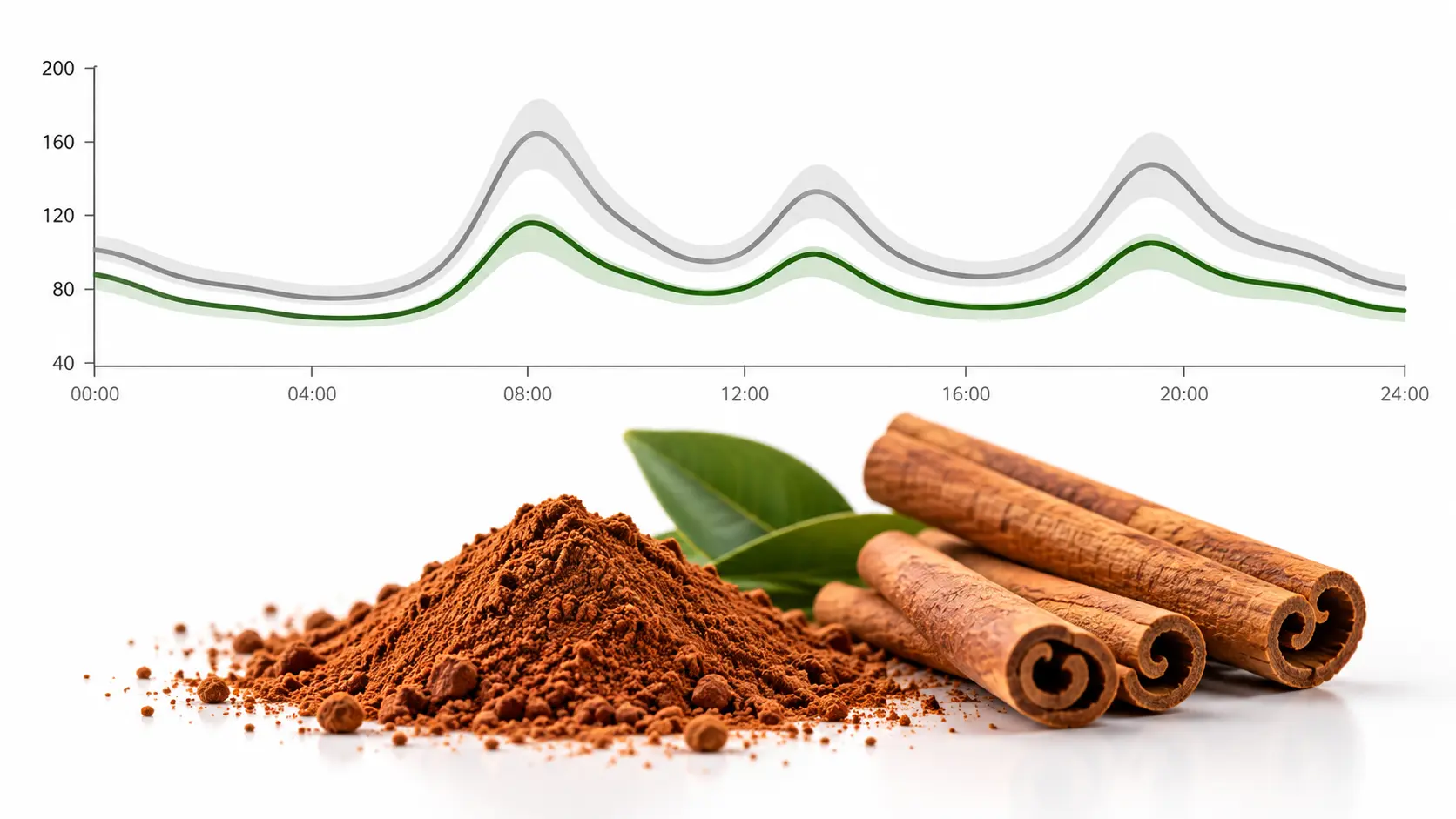
A 4-week randomised, double-blind, crossover trial published in the American Journal of Clinical Nutrition gave pre-diabetic adults 4 g of cinnamon per day and tracked their glucose with continuous glucose monitors. The result was striking: the 24-hour glucose trajectory was consistently and significantly lower during cinnamon supplementation (effect size 0.96, p < 0.001). Glucose peaks were 9.56 mg/dL lower. But a standard oral glucose tolerance test (OGTT) performed at the end of the 4 weeks showed no significant change.[7]
This means cinnamon is not an acute postprandial glucose-lowering agent — it does not work like acarbose or an α-glucosidase inhibitor that blunts a single meal spike. It works as a chronic, subtle, steady-state regulator — lowering the baseline around which glucose oscillates all day. CGM captures it. A single-time-point fasting draw captures part of it. An OGTT captures almost none of it.
What this means for claim language: "supports healthy fasting blood sugar" has three times the evidence depth of "supports healthy HbA1c." If your regulatory team asks for claim substantiation, build the file around fasting glucose, not glycated haemoglobin. This is where cinnamon bark extract for blood sugar shows its true character — not as an acute spike-blunter, but as a baseline-lowering agent that rewards consistent daily use.
05 · GLP-1
The Mechanism Nobody Is Talking About — Cinnamon and GLP-1
In 2024 and 2025, every supplement brand in the metabolic-health category is chasing the same narrative: GLP-1 support. Ozempic and Wegovy have made "GLP-1" a consumer keyword. Brands want natural ingredients that can credibly claim to support endogenous GLP-1 secretion.
Cinnamon has the data, and almost nobody knows it.
Hlebowicz and colleagues (2009, American Journal of Clinical Nutrition) gave healthy subjects 1 g and 3 g of cinnamon with a rice-pudding meal and measured incretin hormones. At the 3 g dose:[8]
- GLP-1 response increased significantly — both the change in AUC (p = 0.0082) and change in peak concentration (p = 0.0138).
- Postprandial insulin was reduced — AUC at 120 min was significantly lower (p = 0.036). The same blood glucose level required less insulin to maintain.
- The authors concluded the effect was likely mediated by "enhanced glucose uptake via stimulation of the insulin receptor" — cinnamon made insulin work more efficiently, so less was needed.
The 2024 CGM trial confirmed a related finding: cinnamon supplementation significantly increased GIP (glucose-dependent insulinotropic polypeptide) AUC — the other major incretin hormone.[7] An animal study published in the Chinese Journal of Experimental Traditional Medical Formulae demonstrated the mechanism: cinnamon bark extract downregulated DPP-4 protein and upregulated GLP-1 protein in the pancreas of diabetic rats — the same pathway targeted by sitagliptin and other DPP-4 inhibitors.[9]
Proportionality check
Cinnamon is not a GLP-1 receptor agonist. It does not produce the weight loss, nausea or appetite suppression of semaglutide or tirzepatide. The effect is orders of magnitude weaker than injectable GLP-1 drugs. But "supports natural GLP-1 secretion" is a structure/function claim direction with human data behind it — and it is a positioning space that no major cinnamon supplier or supplement brand has occupied yet.
Multiple targets, not one
The GLP-1 effect sits alongside at least two other documented mechanisms. A comparative study of all four commercial cinnamon species found that cinnamon extracts inhibit α-glucosidase more potently than acarbose — the prescription drug designed for exactly that purpose — and also strongly inhibit α-amylase, with Chinese cassia (C. cassia) showing the lowest IC₅₀ against α-amylase of all four species.[10] Meanwhile, the CGM trial detected a significant shift in gut microbiota alpha diversity (Shannon index) in the cinnamon group — an unexpected finding suggesting cinnamon may also influence glucose metabolism through microbiome remodelling.[7]
No single mechanism is strong enough to carry a product. But the combination — insulin-receptor potentiation, GLP-1 promotion, starch-digestion enzyme inhibition, and microbiome modulation — means cinnamon is hitting the glucose problem from four different angles at once. That multi-target profile is what makes it a valuable combination ingredient, not a standalone powerhouse.
06 · Extract vs powder
The Evidence Gap You Should Know About — Extract vs Whole Powder
Here is something we need to say plainly, because you will not find it in competitor articles. Most of the positive clinical trials on cinnamon and blood sugar used whole cinnamon powder — ground bark in capsules — not standardised polyphenol extract. Khan 2003 used powder. Crawford 2009 used powder. The 2024 CGM trial used 4 g of cinnamon powder. The GLP-1 data from Hlebowicz used powder.
We sell extract. So where is the evidence bridge?
It rests on two pillars.
Pillar 1: The active fraction is the water-soluble polyphenol
Richard Anderson at the USDA — the researcher whose work with Alam Khan produced the founding 2003 trial — identified the insulin-potentiating activity of cinnamon as residing in the water-soluble polyphenol fraction, specifically A-type proanthocyanidin oligomers, not in cinnamaldehyde or the lipophilic components. His group demonstrated that the water-soluble extract mimics insulin activity in adipocyte cell assays and increases insulin-receptor phosphorylation.[11] The commercial product Cinnulin PF — used in the CINNAMON trial (NCT01301521, the largest pre-diabetes prevention trial ever run with cinnamon, 229 patients, 1 year + 1 year follow-up) — is specifically a water-extracted, polyphenol-enriched product with the lipophilic fraction removed.
Pillar 2: Concentrated extract outperformed crude extract in head-to-head animal data
US Patent 9,861,610 describes a cinnamon polyphenol extraction process with selective coumarin elimination. The patent's efficacy data showed that a 75 % polyphenol extract with ≥ 8 % type-A procyanidin content outperformed cruder aqueous extracts of both C. zeylanicum and C. cassia in a streptozotocin-induced diabetic rat model.[12]
These two pillars support the position that a standardised polyphenol extract should deliver at least the same insulin-sensitising effect as whole powder at an equivalent polyphenol dose — and possibly a better effect per milligram because the inert fibre and volatile-oil fraction have been removed. But we do not yet have a human RCT that directly compares 500 mg of 30 % polyphenol extract against 3 g of whole powder in the same trial. That head-to-head study has not been done. Until it is, the extract-to-powder bridge is a mechanistic argument plus animal data, not a clinical proof. We think the argument is strong. You should know it is not yet conclusive.
Why this matters beyond science
Whole cinnamon powder at 3–6 g/day requires 4–8 capsules just for the cinnamon — before you add berberine, chromium, ALA or anything else. A 30 % polyphenol extract at 500 mg delivers the equivalent polyphenol load in a single capsule. The practical reason extract exists is not "more concentrated is more impressive." It is capsule-count compliance. The largest cinnamon trial ever run — NCT01301521, 229 patients — had a 60 % dropout rate, and the protocol team attributed it to adherence rather than adverse events. Daily pill burden is a real product-design constraint, and extract solves it. For a deeper comparison of what you get in an extract versus raw powder, see our guide on cinnamon bark extract vs cinnamon powder.
07 · Hierarchy
Where Cinnamon Sits in the Blood-Sugar Ingredient Hierarchy
If this article has done its job, you now understand cinnamon's evidence profile in detail. But you also need to know where it sits relative to the other ingredients competing for space in a blood-sugar formula. Here is our honest assessment.
| Ingredient | HbA1c effect size | Evidence volume | Primary mechanism | Safety profile | Best role |
|---|---|---|---|---|---|
| Berberine | ↓ 0.6–1.0 % | 3 000+ patients in meta-analyses | AMPK activation (metformin pathway) | GI side effects common (diarrhoea, cramping) | Standalone lead ingredient |
| Cinnamon polyphenols | ↓ 0.1–0.4 % | 1 815 patients (24 RCTs) | Insulin-receptor potentiation + GLP-1 + α-glucosidase | Excellent (Ceylon eliminates coumarin concern) | Combination base layer |
| Chromium picolinate | Inconsistent | Mixed; some positive in PCOS and insulin resistance | Insulin-signalling cofactor | Good at supplemental doses | Micronutrient top-up |
| α-lipoic acid | Weak for glucose; stronger for neuropathy | Moderate | Antioxidant; mitochondrial support | Good | Neuroprotection adjunct |
Cinnamon is not berberine. Its effect size on HbA1c is roughly one-third to one-half as large, and its evidence base, while substantial, is less consistent. If you want a single-ingredient blood-sugar supplement with maximum clinical firepower, berberine is the stronger choice — but it comes with GI tolerability concerns and an evolving FDA regulatory conversation about its classification.
Cinnamon's advantages are in a different dimension: excellent tolerability, low cost, a multi-target mechanism profile (insulin receptor + GLP-1 + enzyme inhibition + microbiome), and complementary pathway coverage with berberine. Berberine works through AMPK — the same master switch as metformin. Cinnamon works through insulin-receptor phosphorylation and PPARγ — a parallel but distinct pathway. In combination, they cover more metabolic ground than either does alone. A 2025 RCT testing 1 200 mg berberine + 600 mg cinnamon extract showed significant reductions in both fasting glucose (p = 0.031) and HbA1c (p = 0.013).[13]
In a three-ingredient blood-sugar formula — berberine as the lead, cinnamon polyphenols as the base, chromium picolinate as the micronutrient — cinnamon is doing the multi-target coverage and the GLP-1 narrative work, not carrying the HbA1c number on its own. That is a defensible and honest position. For guidance on choosing Cassia vs Ceylon for your cinnamon component, see our species-selection guide.
08 · Dosing
From Study Dose to Capsule Fill — the Conversion Table
When converting cinnamon bark extract for blood sugar doses from clinical literature to a capsule formula, the gap between "grams of whole powder" and "milligrams of standardised extract" trips up most procurement teams. This table bridges the two.
| Literature dose | Approx. polyphenol content | Equivalent 30 % extract | Equivalent 20 % extract | Capsule fit |
|---|---|---|---|---|
| 1 g cinnamon powder/day (Khan 2003) | ~30–50 mg polyphenols | 100–170 mg | 150–250 mg | Fits in 1 × size-1 |
| 3 g powder/day (GLP-1 data) | ~90–150 mg polyphenols | 300–500 mg | 450–750 mg | 1 × size-00 |
| 500 mg standardised extract (meta optimal range, lower end) | 150 mg (at 30 %) | 500 mg | 750 mg | 1 × size-00 |
| 250 mg Ceylon extract (Muthukuda 2025) | Varies by grade | ~250 mg | ~375 mg | 1 × size-1 |
The arithmetic makes the formulation trade-off visible. Two capsules of 500 mg 30 % extract per day deliver 300 mg polyphenols — covering the core effective range from the meta-analyses. The same polyphenol load from whole powder would require roughly 3 g — six to eight capsules — leaving no room for berberine, chromium or any other ingredient in the daily regimen.
When to take it — the timing data
A 2024 study in T2DM patients (doi:10.1371/journal.pone.0311501) tested raw cinnamon powder taken immediately before breakfast. The 1-hour postprandial glucose peak was significantly reduced. The researchers confirmed this was not caused by delayed gastric emptying — they measured it — but by enhanced peripheral glucose uptake.[14] An earlier study (Hlebowicz 2007) found that 6 g cinnamon taken with a meal delayed gastric emptying and reduced postprandial glucose in healthy subjects. Below 3 g, the gastric-emptying effect disappeared.[15]
The practical recommendation: for a polyphenol extract at supplement doses (250–500 mg), the insulin-sensitising mechanism does not depend on meal timing the way an enzyme inhibitor would. Advise before or with the first meal of the day for consistency and to capture whatever acute postprandial benefit exists, but do not overclaim the timing effect at extract doses — the acute data is from multi-gram whole-powder studies.
Drug interaction
Cinnamon polyphenols potentiate insulin sensitivity. In patients taking sulfonylureas, insulin or other hypoglycaemic agents, additive glucose-lowering is theoretically possible. The clinical trials that combined cinnamon with medication did not report hypoglycaemic events, but the sample sizes were small. Your label should carry a "consult your physician" advisory for anyone on diabetes medication. For full incoming-QC and documentation guidance, see our buying guide.
FAQ
Frequently Asked Questions
Does cinnamon bark extract actually lower blood sugar?
Yes, with conditions. Meta-analyses of 24 RCTs (1 815 patients) show significant fasting blood sugar reductions. But the effect depends heavily on who takes it: people with elevated baseline glucose (pre-diabetes, poorly controlled T2DM) see meaningful improvements; people with normal or well-controlled blood sugar see little to no change. The effect also weakens when patients are already on insulin-sensitising medication. Cinnamon is an insulin sensitiser — it works best when the insulin-sensitivity pathway is not already occupied by a drug.
How much cinnamon extract should I take for blood sugar?
The effective dose range in clinical trials translates to roughly 250–500 mg of standardised polyphenol extract per day. At 30 % polyphenol content, 500 mg delivers 150 mg of polyphenols — equivalent to the polyphenol content of approximately 1.5–3 g of whole cinnamon powder. Most positive trials used 1–3 g/day of whole powder or equivalent extract doses for 8–16 weeks.
Does cinnamon lower HbA1c?
The evidence for HbA1c is weaker than for fasting glucose. Most meta-analyses show a modest or borderline-significant effect on HbA1c (the 2024 meta found p = 0.011 with high heterogeneity). The strongest single-trial HbA1c result — a 0.83 % reduction — came from Crawford 2009 in poorly controlled diabetics with baseline HbA1c above 7 %. The 2024 CGM study helps explain why: cinnamon appears to lower the 24-hour glucose baseline chronically, which CGM captures but a single OGTT or short-duration HbA1c window may miss.
Can I take cinnamon extract with diabetes medication?
The clinical trials that gave cinnamon to patients already on diabetes medication did not report hypoglycaemic events. However, those trials were not designed or powered to detect additive glucose-lowering effects. Cinnamon works through insulin-receptor potentiation — a mechanism that overlaps with some oral hypoglycaemic drugs. There is a theoretical additive risk. Patients on sulfonylureas, insulin or other hypoglycaemic agents should consult a physician before adding cinnamon supplementation.
Does cinnamon increase GLP-1?
A 2009 human study found that 3 g of cinnamon significantly increased GLP-1 response (ΔAUC p = 0.0082) while reducing the insulin requirement for the same blood glucose level. The 2024 CGM trial found increased GIP — the other major incretin. Animal data suggests the mechanism involves DPP-4 downregulation and GLP-1 upregulation. The effect is real but orders of magnitude weaker than GLP-1 receptor agonist drugs like semaglutide. "Supports natural GLP-1 secretion" is a defensible structure/function claim direction, not a comparison with injectable medications.
Is berberine or cinnamon better for blood sugar?
Berberine has a larger effect size (HbA1c reduction of 0.6–1.0 % versus cinnamon's 0.1–0.4 %) and deeper meta-analytic evidence (3 000+ patients). Berberine works through AMPK activation; cinnamon through insulin-receptor potentiation and GLP-1 promotion — parallel pathways. A 2025 RCT testing their combination (1 200 mg berberine + 600 mg cinnamon) found significant reductions in both fasting glucose and HbA1c, supporting the multi-target approach. In a blood-sugar formula, berberine is the lead ingredient; cinnamon is the complementary base layer that adds pathway coverage, GLP-1 support and excellent tolerability at low cost.
Does cinnamon help with PCOS?
Multiple RCTs have tested cinnamon in women with polycystic ovary syndrome, with positive results on insulin resistance markers (HOMA-IR), menstrual regularity and androgen levels. Since insulin resistance is a core driver of PCOS pathology, the mechanism is consistent with cinnamon's insulin-sensitising activity. This is a distinct clinical application from general blood-sugar management, with its own evidence base and claim language.
References
References
Meta-analyses & systematic reviews
[1] Leach MJ, Kumar S. Cinnamon for diabetes mellitus. Cochrane Database Syst Rev. 2012;(9):CD007170. doi:10.1002/14651858.CD007170.pub2
[2] Asbaghi O et al. The effect of cinnamon supplementation on glycemic control in patients with type 2 diabetes mellitus: an updated systematic review and dose-response meta-analysis. Phytother Res. 2024;38(1):117–130. doi:10.1002/ptr.8026
[3] Allen RW et al. Cinnamon use in type 2 diabetes: an updated systematic review and meta-analysis. Ann Fam Med. 2013;11(5):452–459. doi:10.1370/afm.1517
Key clinical trials
[4] Muthukuda D, de Silva CK et al. Effects of Cinnamomum zeylanicum (Ceylon cinnamon) extract on lipid profile, glucose levels and its safety in adults. PLOS ONE. 2025;20(1):e0317904. doi:10.1371/journal.pone.0317904
[5] Ranasinghe P et al. The glycaemic outcomes of Cinnamon, a review of the experimental evidence and clinical trials. Nutr J. 2015;14:108. doi:10.1186/s12937-015-0098-9
[6] Suppapitiporn S et al. The effect of cinnamon cassia powder in type 2 diabetes mellitus. J Med Assoc Thai. 2006;89(Suppl 3):S200–S205.
[7] Gutierrez-Salmean G et al. Effect of cinnamon spice on continuously monitored glycemic response in adults with prediabetes: a 4-week randomized controlled crossover trial. Am J Clin Nutr. 2024;119(3):649–657. doi:10.1016/j.ajcnut.2024.01.008
GLP-1 & mechanism
[8] Hlebowicz J et al. Effects of 1 and 3 g cinnamon on gastric emptying, satiety, and postprandial blood glucose, insulin, glucose-dependent insulinotropic polypeptide, glucagon-like peptide 1, and ghrelin concentrations in healthy subjects. Am J Clin Nutr. 2009;89(3):815–821. doi:10.3945/ajcn.2008.26807
[9] Cinnamomi Cortex regulates incretin effect in diabetic rats. Chinese Journal of Experimental Traditional Medical Formulae. 2023. PMID via BVS
[10] Hartel S et al. Cinnamon shows antidiabetic properties that are species-specific: effects on enzyme activity inhibition and starch digestion. Plant Foods Hum Nutr. 2019;74:544–550. doi:10.1007/s11130-019-00760-8
Active fraction & extraction
[11] Anderson RA et al. Isolation and characterization of polyphenol type-A polymers from cinnamon with insulin-like biological activity. J Agric Food Chem. 2004;52(1):65–70. doi:10.1021/jf034916b
[12] US Patent 9,861,610. Process for selective extraction of bioactive and bioavailable cinnamon polyphenols and procyanidin oligomers and a stable composition thereof. USPTO
Combination & dosing
[13] Berberine and cinnamon in management of diabetes. ClinicalTrials.gov NCT05570357. Completed 2025. 44 T2DM patients; berberine 1 200 mg + cinnamon 600 mg for 12 weeks. clinicaltrials.gov
[14] Suppression of the postprandial hyperglycemia in patients with T2DM by raw cinnamon. PLOS ONE. 2024. doi:10.1371/journal.pone.0311501
[15] Hlebowicz J et al. Effect of cinnamon on postprandial blood glucose, gastric emptying, and satiety in healthy subjects. Am J Clin Nutr. 2007;85(6):1552–1556. doi:10.1093/ajcn/85.6.1552
[16] Crawford P. Effectiveness of cinnamon for lowering hemoglobin A1C in patients with type 2 diabetes: a randomized, controlled trial. J Am Board Fam Med. 2009;22(5):507–512. doi:10.3122/jabfm.2009.05.080093
Written by
FloraPhytoVale technical-content team. Flora writes product and ingredient guides for B2B buyers, drawing on published literature and supplier-side experience.
Reviewed by
Prof. Bingji MaProfessor of Pharmacognosy. Prof. Ma reviews botanical-extract content for scientific accuracy before publication.
Disclaimer — PhytoVale supplies the ingredient discussed in this article. This content is provided for informational purposes only and does not constitute medical, legal or regulatory advice. Always verify claims against the primary literature cited above and consult qualified professionals for product-specific decisions.

Need Cinnamon Bark Extract for Your Formulation?
Tell us your target application, preferred cinnamon species, extract ratio or polyphenol specification, and estimated quantity. We'll help you identify a suitable grade and provide COA, technical specifications, sample availability and bulk pricing.