

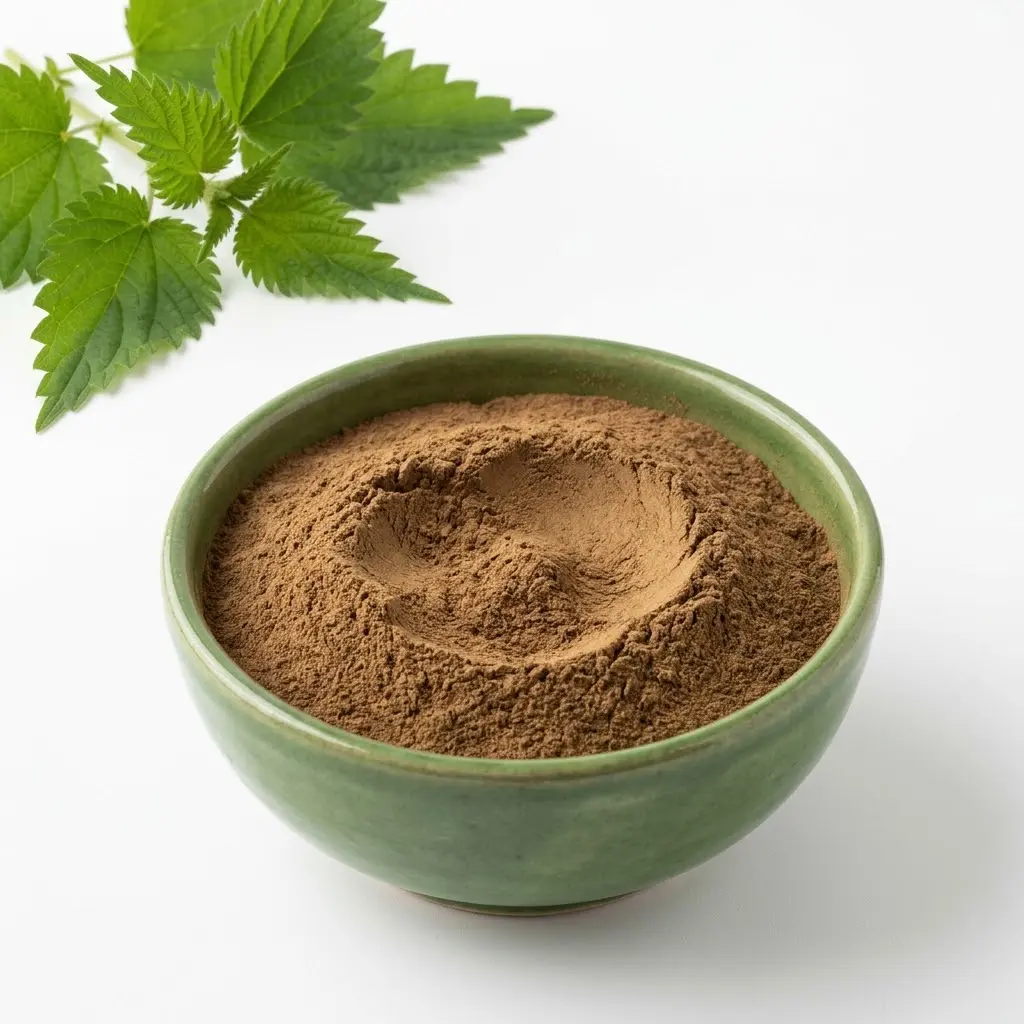
Nettle Leaf Extract Powder
- Source
- Urtica dioica L. (stinging nettle) · leaf
- Origin
- Cultivated crop from growers in Qinghai, China
- Extraction
- Ethanol
- Grades
- 10:1 · 30:1 · 50:1 · 0.8% β-sitosterol
- Assay
- β-Sitosterol by HPLC (standardized grade)
- Applications
- Capsules · tablets · powder blends · stick packs
- Documentation
- Batch COA, spec sheet, SDS and compliance statements on inquiry
MOQ
1 kg
Lead time
7–15 days
Quotation
Within 24 hours
Samples
Free of charge
Stinging Nettle Leaf Extract From Cultivated Urtica dioica
Written by Flora · Reviewed by Prof. Bingji Ma · Updated September 2026
PhytoVale supplies nettle leaf extract, a concentrated dry extract of stinging nettle leaves, in bulk to supplement brands, contract manufacturers and ingredient distributors in the EU and US. Every grade is made from the leaves of Urtica dioica L., the species and plant part the European Pharmacopoeia defines as nettle leaf (Urticae folium). The leaf is a cultivated crop bought from growers in Qinghai Province, China, not wild-collected material, and it is extracted with ethanol. We offer three ratio grades, 10:1, 30:1 and 50:1, for formulas specified by leaf input, and one standardized grade with 0.8% β-sitosterol by HPLC, for specifications that call for a measured constituent. A batch COA stating the Latin name and plant part is provided with every inquiry, so identity can be checked before the first order. Beyond the grades, this page explains why the Chinese name 荨麻 is not proof of Urtica dioica, how a leaf COA should read against a root one, what the research on nettle leaf supports, and how contaminants are kept in check.
01 · Raw material & grades
Nettle Leaf Extract Raw Material and Grades: Cultivated Qinghai Leaf, Ethanol-Extracted
Why cultivated leaf rather than wild nettle
Nettle leaf has traditionally been gathered mainly from wild stands. Researchers developing nettle as a field crop describe that material as often of questionable quality, because the species is highly variable and readily accumulates heavy metals and pesticides from where it grows, and they conclude that the herbal industry needs cultivated supply.[1] We buy nettle leaf as a farmed crop from growers in Qinghai, which narrows the sources of variation to one species, one growing region and one plant part, and makes the origin of each lot easier to trace.
Why the solvent is part of the specification
The dried leaf is extracted with ethanol, then concentrated and dried to a fine powder. The EU herbal monograph lists water extracts and a 50% ethanol extract of nettle leaf as separate preparations,[2] because the solvent changes what leaves the leaf: ethanol takes up more of the lipophilic fraction, where sterols such as β-sitosterol sit. Two extracts at the same ratio but made with different solvents are not equivalent.
Four grades, two ways of specifying
Three grades are defined by how much dried leaf goes into the extract; the fourth is defined by a constituent measured in the powder.
| Grade | Specified by | How it is confirmed | Choose it when |
|---|---|---|---|
| Nettle leaf extract 10:1 | 10 parts dried leaf to 1 part extract | From the quantities used in production; a ratio cannot be measured in the finished powder | Your specification is a ratio and you want a grade within the range the EU monograph describes for nettle leaf dry extracts[2] |
| Nettle leaf extract 30:1 | 30 parts dried leaf to 1 part extract | From the quantities used in production | You need three times the leaf input of 10:1 in the same weight |
| Nettle leaf extract 50:1 | 50 parts dried leaf to 1 part extract | From the quantities used in production | You need the highest leaf input per milligram |
| Nettle leaf extract, 0.8% β-sitosterol | β-Sitosterol content | HPLC assay on each batch | Your specification calls for a measured constituent and lot-to-lot control |
For a detailed explanation of what these ratio numbers mean in practice — including why a ratio cannot be verified by a third-party laboratory — see nettle leaf extract ratio grades explained.
02 · Botanical identity
Is It Really Urtica dioica? Nettle Species Identity in Chinese Supply
The European Pharmacopoeia defines nettle leaf as the dried leaf of U. dioica, U. urens or a mixture of the two, so leaf from any other nettle species fails a Ph. Eur.-based specification.[3] In China this is a practical risk: the everyday name 荨麻 belongs to a different species, and U. dioica itself is recorded mainly in Xizang (Tibet), Xinjiang and Qinghai.[4] Our Qinghai leaf falls inside that range, and the COA states the Latin name and plant part. The features in the table help at intake, while the leaf is still whole or coarsely cut; after extraction, identity rests on chemical and genetic methods.
| Name on a Chinese document | Species | How to tell the raw plant apart[4] | Meets the Ph. Eur. nettle leaf definition? |
|---|---|---|---|
| 异株荨麻 (yì zhū qián má) | Urtica dioica L. | Perennial. Stipules free and linear, up to about 8 mm. Leaf ovate, sometimes lanceolate, with 15–21 coarse teeth along the margin | Yes |
| 欧荨麻 (ōu qián má) | Urtica urens L. | Annual. Small leaves, 1.2–6 cm, with 6–11 teeth. Stipules free, narrowly triangular, 1–2.5 mm | Yes, on its own or mixed with U. dioica |
| 荨麻 (qián má), also 裂叶荨麻 or 白活麻 | Urtica fissa E. Pritz. | Stipules joined between the leaf stalks, 10–20 mm long. Leaf margin shallowly cut into 5–7 lobes, or palmately 3-lobed | No |
| 狭叶荨麻 (xiá yè qián má) | Urtica angustifolia, formerly treated as U. dioica var. angustifolia | Narrow leaves, as the name says | A separate species in Flora of China; agree its status with your customer |
| 荨麻叶, with no Latin name given | Not identified | Cannot be assessed from the name | Cannot be judged until the species is confirmed |
| 荨麻根 | Root of a nettle species | Root material, not leaf | No. Root is a separate herbal drug |
Identity needs care even within U. dioica, which botanists treat as a variable complex with many described subspecies, varieties and hybrids.[1] For US brands it is also a legal question. FDA's dietary supplement cGMP rule, 21 CFR Part 111, requires at least one appropriate test or examination to verify the identity of each dietary ingredient before use, and for this product that check has to confirm Urtica dioica leaf, not simply “nettle”.
03 · Leaf vs root
Nettle Leaf vs Nettle Root Extract: What the Marker on the COA Means
| Nettle leaf extract | Nettle root extract | |
|---|---|---|
| Pharmacopoeial drug | Urticae folium[3] | Urticae radix[1] |
| Constituents that define it | Phenolic acids and flavonol glycosides (§04) | Sterols, mainly β-sitosterol and stigmasterol, plus lignans, lecithin and polysaccharides[1] |
| Pharmacopoeial quality marker | Sum of caffeoylmalic and chlorogenic acids, at least 0.3% of the dried leaf, expressed as chlorogenic acid[3] | Set in the separate root monograph |
| Research focus | Allergies, joints, urinary flushing and blood sugar (§05) | Benign prostatic hyperplasia[1]; a widely quoted 2017 allergic rhinitis trial also used root extract[5] |
| Does its research apply to this product? | Yes | No |
For a full comparison of how leaf and root differ across pharmacopoeial standards, quality markers and procurement specifications, see nettle root extract vs nettle leaf extract.
What the 0.8% β-sitosterol grade tells you
β-Sitosterol is one of the most widespread plant sterols and, in nettle, best known from the root. In our leaf extract it plays an analytical role: a named constituent, measured by HPLC in each batch, that gives you a number to hold every lot against. It does not make the product a root extract.
Sterol figures are easy to compare badly. Sterols occur free and bound, as steryl esters and glycosides, so a method measuring free β-sitosterol and one measuring total sterol after hydrolysis give different numbers for the same powder, and HPLC and GC differ again. Before weighing two “0.8%” offers, ask what each figure measures and how; we send our HPLC method details with the COA.
The pharmacopoeial leaf marker is the phenolic acid sum shown in the table, not a sterol. If your specification is written around that marker, send it with your inquiry and we will check it against our grades before sampling.
For more on what β-sitosterol means as a quality marker versus a functional ingredient — and how our 0.8% HPLC specification compares across the supply chain — see β-sitosterol in nettle leaf extract.
04 · Composition
Key Compounds in Stinging Nettle Leaf
Phenolic acids
Caffeoylmalic acid, an ester of caffeic and malic acids, and chlorogenic acid dominate the leaf's phenolic acids, with neochlorogenic and cichoric acids in smaller amounts. In ten nettle populations grown side by side, caffeoylmalic acid ranged from about 570 to 1,370 mg and chlorogenic acid from about 350 to 1,070 mg per 100 g of dried leaf, and every population met the pharmacopoeial minimum.[1]
Flavonol glycosides
Rutoside (rutin) is the main flavonol glycoside, at about 920–1,940 mg per 100 g of dried leaf in the same study, with hyperoside a much smaller second. Kaempferol, quercetin, isorhamnetin and astragalin have also been reported in nettle.[1]
Vitamins and minerals
The leaf also carries carotenoids, vitamins C and K, B-group vitamins, and mineral salts, mainly of magnesium, potassium, calcium and iron, together with soluble silica.[1] How much of each passes into an ethanol extract depends on its solubility, so formulate with the extract as a phenolic botanical ingredient rather than as a vitamin or mineral source.
Why batches differ
Under identical field conditions, nettle chemistry varied more within populations than between them, largely for genetic reasons, and harvest time and heavy nitrogen fertilization shift the phenolic profile further.[1] Published values for the same compounds can differ several-fold between studies, so compare figures only when they come from the same method, and judge each lot by its batch COA rather than by a general specification sheet.
05 · Evidence & safety
Nettle Leaf Extract Benefits: What the Research Supports
For each benefit people search for, the table sets out the evidence behind it and the material that was actually tested. In the EU, nettle leaf is recognized for traditional use only.
| Benefit area | Evidence and material tested | What was found | Evidence level |
|---|---|---|---|
| Seasonal allergies | Mittman, 1990: a freeze-dried U. dioica preparation against placebo; 98 randomized, 69 completed, one week[6]. Roschek et al., 2009: a proprietary extract in laboratory assays, by authors from HerbalScience Group[7] | Rated better than placebo in the global assessment, only slightly better in symptom diaries. In vitro, the extract acted on the histamine H1 receptor and inhibited tryptase, COX-1, COX-2 and prostaglandin D2 synthase, at IC50 values of about 160–295 µg/mL | Low: one small, short trial and test-tube data |
| Joint comfort | EU herbal monograph, based on long-standing use[2]. Chrubasik et al., 1997: open randomized pilot, 40 people with acute arthritis, stewed nettle herb plus 50 mg diclofenac versus 200 mg diclofenac[8]. Riehemann et al., 1999: IDS23, a standardized leaf extract, in cultured cells[9] | Recognized for relief of minor articular pain. In the pilot, both groups improved by about 70%, and the authors suggested the herb may enhance the drug's effect. In cells, the extract blocked NF-κB activation by preventing breakdown of its inhibitor IκB-α | Traditional use, one small open pilot with cooked herb, and cell data |
| Urinary flushing | EU herbal monograph, based on long-standing use of leaf teas and dry extracts[2] | Recognized for increasing urine output to flush the urinary tract, as a supporting measure in minor urinary complaints | Traditional use only |
| Blood sugar | Tabrizi et al., 2022: meta-analysis of 13 clinical trials in people with type 2 diabetes[10] | Pooled reductions in fasting blood glucose (−17.17 mg/dL) and HbA1c (−0.93), with very high heterogeneity between trials (I² 93% and 75%) | A research area; no basis for claims |
The EU monograph lists mild stomach upset (nausea, vomiting, diarrhea) and skin reactions (itching, rash, hives) as possible side effects, with frequency unknown. It advises against use during pregnancy and breastfeeding and in children under 12, because safety data are lacking, and rules it out for anyone hypersensitive to nettle and in conditions where fluid intake must be restricted, such as severe heart or kidney disease. Tests on reproductive toxicity, genotoxicity and carcinogenicity have not been performed.[2] No interactions with medicines are listed, but the leaf naturally contains vitamin K,[1] so people taking anticoagulants should talk to their doctor first. Carry these points into the consumer advice on any finished product.
06 · Applications
Nettle Leaf Extract Applications in Supplement Formulas
Where nettle leaf extract fits in finished products, what to pair it with, and which grade usually works:
| Application | Formula partners to consider | Suggested grade | Formulation notes |
|---|---|---|---|
| Seasonal wellness capsules | Quercetin, bromelain, vitamin C | 30:1 or 50:1 | Several actives compete for fill weight, so a high ratio keeps the daily capsule count down |
| Joint and mobility blends | Turmeric, boswellia, glucosamine | 30:1, or 0.8% β-sitosterol where the finished-product specification needs an assay | Nettle usually plays a supporting role beside high-dose actives |
| Urinary and fluid-balance herbal blends | Dandelion leaf, birch leaf, cranberry | 10:1 | Closest to the leaf dry extracts described for traditional EU preparations; suits single-herb products and short ingredient lists |
| Hair, skin and nail supplements | Biotin, zinc, horsetail | 30:1 or 50:1 | Small inclusion beside vitamins and minerals in a single daily capsule or tablet |
| Greens powders and drink mixes | Spirulina, wheatgrass, moringa | 10:1 in scoop servings; 50:1 in stick packs | A traditional food leaf that sits naturally in a greens ingredient list; see §07 on PA limits for instant drinks |
Dry plant extracts are often hygroscopic, so keep drums sealed, cool and dry between uses. Pre-blend the extract with the other dry ingredients before encapsulation or tableting for an even distribution, and check flow at higher inclusion rates. In finished products, light-protective packaging helps the green pigments hold their shade over shelf life.
07 · Contaminant control
Nettle Leaf Extract Contaminants: PAs, Heavy Metals, Pesticides and Solvent
Pyrrolizidine alkaloids: a weed problem, not a nettle problem
Pyrrolizidine alkaloids (PAs) are now a standard question for leafy botanicals sold into Europe. Nettle is not among the plants known to produce them; the usual source is PA-producing weeds harvested with the crop, which is why EU rules treat PA contamination as something good agricultural and harvest practices can minimize or prevent (Regulation (EU) 2020/2040, now part of Regulation (EU) 2023/915). A managed field allows weed control that wild collection does not. Butterbur is the opposite case: it produces PAs itself and needs dedicated removal steps, as our butterbur extract page explains.
| Product in EU law | Maximum level, sum of PAs | What it means for nettle leaf extract |
|---|---|---|
| Food supplements containing herbal ingredients, including extracts | 400 µg/kg | Applies to the finished supplement as sold, not to the raw material |
| Herbal infusions (dried product) | 200 µg/kg | Relevant where the extract goes into herbal tea blends |
| Instant herbal teas | Covered by the dried-infusion category; for powdered extracts the regulation applies a concentration factor of 4 | Relevant for instant nettle drinks and drink mixes |
| Herbal infusions for infants and young children (dried) | 75 µg/kg | The strictest category; nettle leaf is not recommended for children under 12 in any case (§05) |
Heavy metals and pesticides
Regulation (EU) 2023/915 also sets lead, cadmium and mercury limits that, like the PA limits, apply to the supplement as sold; for lead the maximum in food supplements is 3.0 mg/kg. Read raw-material results against the inclusion rate: an extract making up one third of a capsule fill contributes one third of its own lead concentration. Pesticide limits under Regulation (EC) No 396/2005 are set for the plant and applied to extracts through processing factors. In California, Proposition 65 sets a lead safe-harbor level of 0.5 µg per day, so check the COA lead result at your daily serving.
Ethanol as an extraction solvent
Extraction solvents for food in the EU are governed by Directive 2009/32/EC. Ethanol sits in Part I of its Annex I, permitted for all uses under good manufacturing practice, meaning residues remain only in technically unavoidable quantities that pose no danger to health, and no specific residue limit is set. Other listed solvents carry conditions of use and maximum residue values, which makes ethanol one of the simplest choices for an extract sold into Europe.
08 · Compliance
Nettle Leaf Extract Regulatory Notes for EU and US Buyers
European Union
The EMA monograph governs traditional herbal medicinal products, so its indications cannot move onto a food supplement.[2] Health claims for botanicals under Regulation (EC) No 1924/2006 have been on hold since 2010. Claims submitted for botanicals and placed on hold may in the meantime still be used under the transitional provisions of Article 28(5) and (6), at the operator's own responsibility and subject to national enforcement. Separately, Article 7(3) of Regulation (EU) No 1169/2011 bars presenting any food as preventing, treating or curing disease.
Whether a concentrated extract may be used for a given purpose is for the food business operator to confirm. The Commission's Novel Food Status Catalogue is a non-binding orientation tool, and national authorities give the final answer.
United States
Under DSHEA, structure/function statements need FDA's standard disclaimer on the label and a notification to FDA within 30 days of first marketing. Statements about treating or preventing hay fever, arthritis, diabetes or prostate enlargement are disease claims and cannot appear on a supplement.
Batch COA, specification sheet, safety data sheet (SDS), allergen statement, non-GMO statement, residual solvent statement and California Proposition 65 statement. Tell us your destination market and we will send the set that matches it.
09 · Evidence base
References
[1] Koczkodaj S, Przybył JL, Kosakowska O, Węglarz Z, Bączek KB. Intraspecific variability of stinging nettle (Urtica dioica L.). Molecules. 2023;28(3):1505. DOI
[2] European Medicines Agency, Committee on Herbal Medicinal Products. Community herbal monograph on Urtica dioica L.; Urtica urens L., folium. EMA/HMPC/508015/2007. Final, 14 January 2010. EMA
[3] European Pharmacopoeia. Nettle leaf (Urticae folium), monograph 1897. European Directorate for the Quality of Medicines & HealthCare (EDQM), Council of Europe, Strasbourg.
[4] Chen J, Friis I, Wilmot-Dear CM. Urtica. In: Flora of China, vol. 5. Science Press, Beijing, and Missouri Botanical Garden Press, St. Louis; 2003. Entries for Urtica dioica and Urtica fissa on eFloras.
[5] Bakhshaee M, Mohammad Pour AH, Esmaeili M, Jabbari Azad F, Alipour Talesh G, Salehi M, Noorollahian Mohajer M. Efficacy of supportive therapy of allergic rhinitis by stinging nettle (Urtica dioica) root extract: a randomized, double-blind, placebo-controlled, clinical trial. Iranian Journal of Pharmaceutical Research. 2017;16(Suppl):112–118. PMC
[6] Mittman P. Randomized, double-blind study of freeze-dried Urtica dioica in the treatment of allergic rhinitis. Planta Medica. 1990;56(1):44–47. DOI
[7] Roschek B Jr, Fink RC, McMichael M, Alberte RS. Nettle extract (Urtica dioica) affects key receptors and enzymes associated with allergic rhinitis. Phytotherapy Research. 2009;23(7):920–926. DOI
[8] Chrubasik S, Enderlein W, Bauer R, Grabner W. Evidence for antirheumatic effectiveness of Herba Urticae dioicae in acute arthritis: a pilot study. Phytomedicine. 1997;4(2):105–108. DOI
[9] Riehemann K, Behnke B, Schulze-Osthoff K. Plant extracts from stinging nettle (Urtica dioica), an antirheumatic remedy, inhibit the proinflammatory transcription factor NF-κB. FEBS Letters. 1999;442(1):89–94. DOI
[10] Tabrizi R, Sekhavati E, Nowrouzi-Sohrabi P, Rezaei S, Tabari P, Ghoran SH, et al. Effects of Urtica dioica on metabolic profiles in type 2 diabetes: a systematic review and meta-analysis of clinical trials. Mini-Reviews in Medicinal Chemistry. 2022;22(3):550–563. DOI
Reviewed by
Prof. Bingji MaScientific Advisor, PhytoVale · Professor & Medicinal Plant Science Expert. Research focus: Chinese medicinal materials, phytochemistry, natural products and medicinal plant quality.
Written by
FloraContent Editor, PhytoVale · Product Content & Editorial Specialist. Focuses on botanical ingredient specifications, sourcing information and B2B technical content.
10 · Questions
Frequently Asked Questions
What is the difference between nettle leaf extract and nettle leaf powder?
Nettle leaf powder is dried leaf milled fine, so 1 g of powder is 1 g of leaf, fiber included. Nettle leaf extract keeps only what the solvent dissolves, concentrated so that 1 g stands for 10, 30 or 50 g of leaf depending on the grade. Powder suits teas, foods and greens blends where bulk is welcome; extract suits capsules and tablets where dose space is limited.
How much nettle leaf extract equals a cup of nettle tea?
The EU monograph uses 2–4 g of dried leaf per dose of tea. By leaf input, that corresponds to about 200–400 mg of 10:1 extract, 67–133 mg of 30:1 or 40–80 mg of 50:1. The match is by leaf only: tea is a hot-water infusion and our extract is made with ethanol, so the two do not carry an identical set of compounds.
Does nettle leaf extract help hair growth?
Nettle is popular in hair supplements and shampoos, but the published hair research on it is laboratory work, such as in vitro and ex vivo studies on human hair follicles. Registered clinical trials of nettle cover conditions such as joint pain, prostate symptoms, diabetes and allergic rhinitis, and we have not found a controlled trial of oral nettle leaf extract for hair growth. In hair formulas, position it as a botanical ingredient rather than a hair-growth active. For formulation guidance on shampoos, scalp serums and leave-on products, see nettle leaf extract in hair and scalp care formulations.
Can nettle leaf extract be used in cosmetics?
Yes. The EU cosmetic ingredient database, CosIng, lists it under the INCI name Urtica Dioica Leaf Extract, and US labels often write it as Urtica Dioica (Nettle) Leaf Extract. Whole-plant extracts carry a different INCI name, Urtica Dioica Extract, so match the name to the plant part. It is used mostly in hair care and cleansers; check solubility and color in your base before scaling up.
Why is nettle leaf extract dark green?
Nettle leaf is rich enough in chlorophyll to serve as a raw material for chlorophyllin, a green colorant for foods and cosmetics, and ethanol dissolves chlorophyll readily. Ethanol extracts of the leaf therefore tend toward dark green or olive-brown. The color shows in clear capsules, uncoated tablets and pale drink mixes, and disappears in opaque capsules and film-coated tablets.
Does nettle leaf extract powder sting?
No. The sting comes from fine hollow hairs on fresh leaves and stems, which release a fluid containing acetylcholine, formic acid, serotonin, histamine and other irritants when they break against the skin. Drying, milling and solvent extraction leave none of those hairs intact in the powder, so the usual dust precautions for botanical powders are enough.
How should nettle leaf extract be named on a supplement label?
In the US, the Supplement Facts panel must identify the part of the plant a botanical ingredient comes from (21 CFR 101.36), so name the leaf explicitly, for example “stinging nettle (Urtica dioica) leaf extract”. The EU sets no single naming format for botanical food supplements; giving the common name, Latin name, plant part and the word “extract” is the clearest route, and national rules may add requirements.
B2B supply
Tell us the grade and the market
Send us your target grade or specification, the finished-product format and where it will be sold. We will reply within 24 hours with a quotation, a free sample and the batch COA.
Request a quotation →Browse all products →Disclaimer: this page is intended for ingredient evaluation, formulation and B2B purchasing. PhytoVale supplies nettle leaf extract as a raw material and makes no health claims for it. Research is summarized as technical background, not as claim substantiation, and most of it used preparations other than this extract. These statements have not been evaluated by the U.S. Food and Drug Administration, and this ingredient is not intended to diagnose, treat, cure or prevent any disease. Regulatory positions and limits change and should be re-verified at launch. © 2026 PhytoVale.
Related Botanical Ingredients
 Blue Lotus ExtractKey specification: None
CAS N/A
10:1 · 30:1 · 50:1 · 100:1 · 200:1 (fresh flower basis)
 Butterbur ExtractKey specification: Total Petasins
CAS N/A
Total Petasins 10%, 15%, 20%, 30%
 Cinnamon Bark ExtractKey specification: Polyphenols
CAS 84649-98-9
total polyphenols 10%, 20%, 30%
 Citrus aurantium extractKey specification: Synephrine/Total Flavonoids
CAS 94-07-5
Synephrine 6%, 30%, 50%, 98% Total Flavonoids 30%, 60%, 98%
 Custom Sweetener Blend OEM: The Buyer’s Process Guide→Custom Sweetener Blend OEM: The Buyer’s Process Guide WRITTEN BY Flora / OCTOBER 19, 2026 Written by Flora,…
 Types of Curcumin Extract: 7 Grades by Process, Assay and Use→Types of Curcumin Extract: 7 Grades by Process, Assay and Use WRITTEN BY Flora / OCTOBER 17, 2026…
