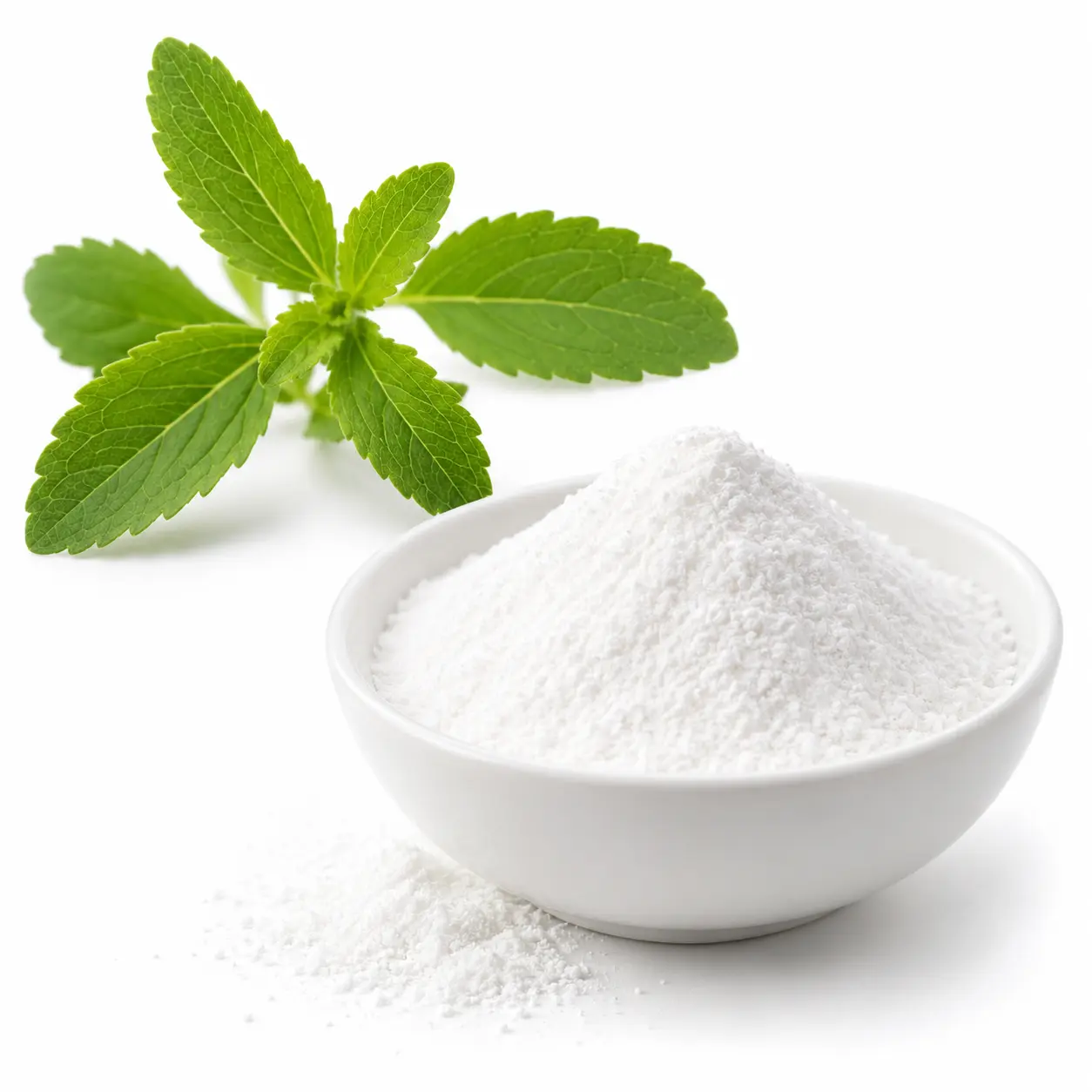
Stevia rebaudiana Bertoni
Reb M (Rebaudioside M)
- Grades
- RM95 · RM98
- Production
- Enzymatic conversion from our own Reb A
- EU additive
- E 960c(ii), not E 960a
- Certification
- EU 2018/848 · USDA NOP
- Batch testing
- Recombinant DNA · Residual protein · HPLC, every batch
- Solubility
- Approx. 0.26% in water at 25 °C
MOQ
1 kg
Lead time
7–15 days
Quotation
Within 24 hours
Samples
Free · freight credited
Bulk Rebaudioside M Supplier — RM95 and RM98 by Enzymatic Conversion, Conventional and Organic
Written by Flora · Reviewed by Xinjuan Xu, Associate Professor · Updated September 2026
PhytoVale manufactures RM95 and RM98 by enzymatic conversion from our own high-purity Rebaudioside A, using UDP-glucosyltransferase and sucrose synthase enzymes produced in house. Both grades are available as conventional or certified organic material under Regulation (EU) 2018/848 and USDA NOP. Every batch is tested for residual recombinant DNA and residual protein, not sampled periodically. MOQ 1 kg, free samples with freight credited to your first order, quotation within 24 hours.
Rebaudioside M is the steviol glycoside whose taste comes closest to sugar, and it is bought for that reason. What catches formulators out is what comes with it. Reb M is less soluble in water than Rebaudioside A, not more, and in crystalline form it often cannot reach the concentration a syrup or concentrate needs. Its regulatory identity is different from Reb A and turns on how it was made rather than on what it is. This page is written around both, because they are what decide whether a Reb M project works.
01 · Product identity
Why Rebaudioside M Is Made Rather Than Extracted
Rebaudioside M, sometimes still called Reb X in older literature, is a minor steviol glycoside of Stevia rebaudiana and the highest-specification product in our stevia extract range. Among all known steviol glycosides its sweetness profile is the one that most closely resembles sucrose, which is why it became the target of the whole next-generation stevia effort.
The problem is arithmetic. Reb M and Reb D together account for roughly 0.4% to 0.5% of total dry leaf weight, and Reb M alone is present in minute quantities, in the region of 0.05% to 0.5%. At that abundance, direct extraction and purification is not economically feasible at commercial scale. Enzymatic conversion is not a shortcut or a second-best route to Reb M. It is the only route that exists.
This matters commercially because buyers occasionally ask for leaf-extracted Reb M in the belief that it would be a cleaner-label option. No supplier can deliver it in volume, and any offer that claims to should be examined closely. What is real is the substrate: our conversion starts from stevia leaf, is purified to high-purity Rebaudioside A in our own facility, and is then converted enzymatically. The plant origin is intact; the last step is biocatalysis.
02 · Product data
Rebaudioside M Quick Reference: Grades, Properties, Storage and Shipping
| Property | Value | What it means in practice |
|---|---|---|
| Grades | RM95, not less than 95% Reb M. RM98, not less than 98% Reb M | The balance in RM95 is mostly Reb D with smaller amounts of Reb A and Reb B, which affects dissolution more than taste |
| Appearance | White to off-white crystalline powder | Both grades; purity does not change the visual |
| CAS number | 1220616-44-3 | Use alongside the E number on customs and QA paperwork |
| Molecular formula and weight | C56H90O33, 1291.3 g/mol | Six glucose units on the steviol backbone, against four for Reb A |
| Sweetness potency | Approx. 200 to 350 times sucrose | Overlaps Reb A rather than exceeding it dramatically. Reb M is bought for profile, not for potency |
| Solubility in water at 25 °C | Approx. 0.26% at thermodynamic equilibrium | Lower than Reb A, which sits near 0.8%. This is the single most important line on the page. See section 04 |
| Solubility in aqueous ethanol | Substantially higher than in water | Useful for premix and extract-based systems, not for finished beverages |
| Taste profile | Fast onset, rapid decay of aftertaste, essentially no bitterness | The reason to pay the premium over Reb A |
| Packaging | 25 kg fibre drum with double PE liner | Smaller trial packs supplied with samples |
| Shelf life and storage | 24 months, cool and dry, sealed, protected from light | Store the powder dry; the handling risk with Reb M is in solution, not in the drum |
Batch-specific release data sits on the COA, which we send with samples rather than only with orders. Section 03 lists the parameters specific to enzymatically produced material that a standard stevia COA does not cover.
03 · Production and testing
How We Make Rebaudioside M, and What We Test That Others Do Not
Production runs in two stages inside one facility. Leaf from our own 400 hectare cultivation base is extracted, decolourised, desalted and crystallised to high-purity Rebaudioside A, the same RA97 stream we sell. That Reb A is then converted enzymatically: UDP-glucosyltransferase transfers glucose onto the steviol backbone, with sucrose synthase regenerating UDP-glucose from sucrose so that the cascade runs economically. The converted product is then heat treated, carbon treated, resin purified, crystallised and filtered to remove the enzyme system.
Both enzymes are produced in house rather than bought in. Controlling both the substrate and the biocatalyst is unusual for a Reb M supplier and it is the reason we can hold the specification tightly from leaf to finished crystal.
The two parameters that separate an enzymatic product from a leaf extract
A standard steviol glycoside COA does not cover these. They exist because the additive is made with a biocatalyst produced by a genetically modified microorganism, and regulators assess exactly that.
| Parameter | Requirement | Why it exists | Our frequency |
|---|---|---|---|
| Residual recombinant DNA | Absence demonstrated by a method with a limit of detection not higher than 10 ng DNA per gram of product | Confirms that no DNA from the production strain carries through into the finished additive | Every batch |
| Residual protein | Absence demonstrated by a method with a limit of detection not higher than 5 mg/kg | Confirms that the processing enzymes have been removed from the finished additive | Every batch |
Why we do not write "Non-GMO" on this product
It would be inaccurate, and the customers who care most would catch it. The enzymes are produced by a genetically modified microorganism. They function as processing aids, are removed during purification, and their absence is demonstrated batch by batch against the two limits above. That is a stronger statement than a bare non-GMO claim, and the one your regulatory team can actually use. Why the specification is written this way.
04 · Solubility
The Rebaudioside M Solubility Problem, Stated Plainly
This is the section that decides whether your project works, so it comes before applications rather than after.
Reb M is less soluble than Reb A, not more
The thermodynamic equilibrium solubility of Reb M in water is approximately 0.26% at 25 °C. Reb A, which most formulators already consider difficult, sits near 0.8%. Buyers upgrading from Reb A for taste reasons routinely assume the newer glycoside will behave better in every respect. On this axis it behaves worse, by a factor of three.
Crystalline material often cannot reach the concentration a syrup needs
This is the failure that costs a development cycle. Published work on crystalline Reb M compositions, of the type that contain roughly 75% to 90% Reb M with 10% to 25% Reb D, found that they could not be dissolved above 0.1% to 0.15% at room temperature. Syrup and concentrate formulations frequently need at least 0.3%.
Read those two numbers together and the conclusion is uncomfortable but useful: a crystalline Reb M cannot, on its own, reach the concentration a typical beverage syrup is designed around. Amorphous forms show higher apparent solubility, which is why some suppliers quote figures that look much better than the equilibrium value. Ask which form the quoted number refers to before you build a process on it.
What this means for RM95 versus RM98
The Reb D fraction that makes up part of the balance in RM95 is itself poorly soluble. The purity difference between RM95 and RM98 is therefore not only a taste question, it is a dissolution question, and in a concentrate application it can be the deciding one. If you are working at the edge of what will dissolve, trial RM98 even if RM95 meets your sensory target. We break this down further in Reb M 95% vs 98%: Does the Extra Purity Actually Matter?
How to work with it
- Dissolve hot and dilute down. Prepare a dilute stock at elevated temperature and let it into the batch rather than trying to reach concentration cold.
- Do not design a high-concentration Reb M syrup. If the format demands a concentrate, carry part of the sweetness with a co-sweetener that dissolves freely, or use a solubilised or blended form rather than crystalline Reb M alone.
- Hold the trial for a week before you accept it. As with Reb A, apparent solubility on day one is not equilibrium solubility. If a solution looks fine at mixing, check it again after seven days at your real storage temperature before writing the specification.
- Aqueous ethanol is a different story. Reb M dissolves far more readily in ethanol-water systems, which helps for premixes and extract-based products but does not transfer to a finished aqueous beverage.
- Tell us the format before you order. Concentrate, RTD, powder sachet and dairy behave differently enough that the right answer changes. We would rather send the grade that works than the grade you asked for.
Why we lead with this
Every Reb M supplier knows these numbers and most leave them off the page. Finding out at pilot scale that the material will not dissolve is far more expensive than reading it here, and a supplier who lets you discover it later has not saved you anything. If solubility rules Reb M out for your format, Reb A or a blend may be the better answer and we will say so.
05 · Taste and applications
What Rebaudioside M Actually Buys You, and Where to Use It
The sensory case
In time-intensity sensory work across the steviol glycosides, Reb M and Reb D show faster onset of sweetness, quicker decay of aftertaste, and are nearly devoid of bitterness, while stevioside and rubusoside show an immediate distinct bitterness with a lingering aftertaste and Reb A sits between them. Reb M's organoleptic profile is the closest to sucrose of any known steviol glycoside.
The practical consequence is that Reb M lets you push sugar replacement further before the sweetener becomes audible. That headroom, rather than raw potency, is what the premium is for. At 200 to 350 times sucrose, Reb M is not meaningfully more potent than Reb A, and a supplier selling it on potency is selling the wrong attribute. For a full cost-and-performance comparison, see Reb A vs Reb M: Taste, Cost and When the Upgrade Is Worth It.
Where it fits
| Application | Fit | Starting Reb M range | What decides it |
|---|---|---|---|
| Premium RTD beverages, carbonated and still | Strong | 300 to 500 ppm for high replacement levels | Dilute enough that solubility is manageable; the taste headroom pays |
| Dairy and drinking yoghurt | Strong | 150 to 300 ppm for partial replacement | Clean finish matters most in low-acid matrices where off-notes are exposed |
| Table-top and sachet | Good | Set by spoon or sachet equivalence | Dissolution in a hot drink is easy; in a cold one, check it |
| Confectionery and desserts | Good | Format dependent | Bulking agent required, as with any high-intensity sweetener |
| Beverage concentrates and syrups | Check first | Often not achievable with crystalline Reb M alone | See section 04. This is where projects fail |
| High-dose nutraceutical premixes | Check first | Format dependent | If the premix must dissolve at high solids, solubility governs |
Coffee RTD is one of the fastest-growing segments in sugar reduction and one where Reb M's clean finish matters most, but a sweetener that tests well in water can still fail in the cup. See Reb M in Coffee: Why a Cleaner Sweetener Can Still Fail in the Cup for the formulation challenges specific to coffee matrices.
For process validation on whether Reb M holds up through pasteurisation, UHT and low-pH storage, see Does Reb M Survive Heat and Low pH? What Beverage Formulators Should Know.
How to read these levels
These are formulation starting points drawn from commercial practice, not validated or recommended doses. Sweetness potency per unit falls as concentration rises, so a level derived by scaling up from a low-concentration trial will under-dose. Confirm in your own matrix under your actual process, and taste again at four weeks rather than only at mixing.
06 · Compliance
Rebaudioside M Regulatory Status: Where It Differs From Reb A
Reb M's regulatory identity turns on how it was made, not on what the molecule is. That is the single most consequential difference from Reb A, and getting it wrong on a label is not a cosmetic error.
European Union
Steviol glycosides are authorised in Annex II to Regulation (EC) No 1333/2008 as the group E 960a to E 960d. In October 2022 Regulation (EU) No 231/2012 was amended to insert the entry E 960c(ii), rebaudioside M produced via enzymatic conversion of highly purified rebaudioside A stevia leaf extracts, which is the definition our process is made against. Enzymatically converted Reb M is not E 960a and must not be labelled as such.
Note also that Reb M made by fermentation rather than by enzymatic conversion sits under a different entry again, E 960b(i), covering rebaudioside M from fermentation produced by Yarrowia lipolytica, introduced by Commission Regulation (EU) 2025/652 in April 2025. When you compare Reb M offers, the E number tells you which production route you are being quoted.
Two points buyers should verify rather than assume. First, the EU specification requires not less than 95% Rebaudioside M for material produced via enzymatic modification. Second, and less widely understood, the specification defines the additive by its manufacturing process, including the production organism. Adding a new strain requires an amendment to the specification, which EFSA assesses case by case. When qualifying any enzymatically produced Reb M, ask the supplier which sub-entry of E 960c applies to their exact process and confirm it against the current consolidated Annex II. We will provide our process definition and the corresponding entry on request.
United States
Rebaudioside M produced by enzymatic conversion of high-purity Rebaudioside A has been the subject of GRAS notices to which FDA has responded with no-questions letters, and it is used as a general-purpose sweetener on that basis. Our RM95 and RM98 are manufactured to the specifications and by the production route described in that body of notified material.
PhytoVale does not hold its own GRN number. US customers relying on GRAS self-affirmation should confirm the basis with their own regulatory counsel, and we supply the full specification, process description and analytical package needed for that assessment. We state this plainly because "FDA approved" and "GRAS certified" are not things that exist for any steviol glycoside, from any supplier, and a page that implies otherwise is telling you something about the supplier rather than about the product.
China
China treats these as three separate additive categories. GB 1886.355-2022 covers glycosides obtained from stevia leaf by extraction and refining, which is our Reb A. Enzymatically converted glycosides sit outside that standard and are approved as a separate new food additive variety with their own production description, as are fermentation-derived glycosides. All three may be used alone or together under GB 2760, calculated as steviol equivalents. Quoting GB 1886.355-2022 on an enzymatic product is the wrong reference and tends to surface at customs rather than at purchase order. Confirm the applicable route for your intended use with your importer, and see our regulation guide for the comparison across markets.
Organic certification
RM95 and RM98 are both available as certified organic material under Regulation (EU) 2018/848 and USDA NOP. Certification has to cover the chain from field through processing, which is why we run it from our own 400 hectare cultivation base. Organic Reb M is chemically identical to conventional Reb M and performs identically. The certification governs the agricultural and processing inputs, and it is an access requirement rather than a performance upgrade: if your finished product carries an organic claim, organic raw material is the only route.
Intake and claims
The ADI of 4 mg/kg body weight per day as steviol equivalents, the conversion factors, the combined maximum levels across E 960a to E 960d and the sugar replacer claim rules apply to Reb M exactly as they do to Reb A. They are set out with a worked intake calculation in our steviol glycoside regulation and claim guide.
07 · Packaging and logistics
Bulk Packaging, Lead Time and Shipping
Standard packing is a 25 kg fibre drum with a double food-grade PE liner, palletised for container and air freight. Trial quantities from 1 kg are supplied in sealed foil bags inside a fibre drum or carton. Shelf life is 24 months from production when stored cool, dry, sealed and away from light.
Lead time is 7 to 15 days depending on grade and quantity. Organic grades sometimes run to the longer end because certified lots are produced in scheduled campaigns rather than continuously, and enzymatic conversion adds a batch step ahead of crystallisation. Air, sea and courier shipping are all supported, and the documentation set is confirmed against the specific grade at quotation.
08 · Questions
Rebaudioside M FAQ for Buyers and Formulators
Can I buy Rebaudioside M extracted directly from stevia leaf?
Not at commercial scale, from anyone. Reb M and Reb D together make up roughly 0.4% to 0.5% of dry leaf weight, and Reb M alone is present in minute quantities. Direct extraction is not economically feasible at that abundance, which is why every commercial Reb M is produced by enzymatic conversion or by fermentation. If an offer claims leaf-extracted Reb M in tonnage, ask for the mass balance from leaf to product and the numbers will not close.
Is Reb M easier to work with than Reb A?
On taste, yes. On solubility, no, and the gap runs the wrong way. Reb M sits at roughly 0.26% equilibrium solubility in water at 25 °C against about 0.8% for Reb A. Formulators upgrading for sensory reasons often assume the newer glycoside is better in every respect and discover this at pilot scale. Section 04 sets out what it means for concentrates, syrups and high-dose premixes, and how to work around it.
Why does my Reb M solution not reach the concentration my syrup needs?
Because crystalline Reb M frequently cannot get there. Published work on crystalline compositions containing roughly 75% to 90% Reb M with 10% to 25% Reb D found they would not dissolve above 0.1% to 0.15% at room temperature, while syrup formulations commonly need at least 0.3%. Amorphous material shows higher apparent solubility, so check which form any quoted figure refers to. In practice the fix is to carry part of the sweetness with a freely soluble co-sweetener, or to change the format.
Is your Reb M Non-GMO?
We do not make that claim, because it would not be accurate. The UGT and sucrose synthase enzymes used in the conversion are produced by a genetically modified microorganism. They act as processing aids, they are removed during heat treatment, carbon treatment, resin purification, crystallisation and filtration, and their absence in the finished product is demonstrated on every batch: recombinant DNA against a limit of detection no higher than 10 ng DNA per gram, and protein against a limit of detection no higher than 5 mg/kg. That is the statement your regulatory team can use, and we supply both reports.
Can I label your Reb M as E 960a?
No. Enzymatically converted Reb M falls under E 960c(ii), the entry inserted into Regulation (EU) No 231/2012 in October 2022 for rebaudioside M produced via enzymatic conversion of highly purified rebaudioside A stevia leaf extracts. E 960a is reserved for steviol glycosides obtained from stevia leaf by extraction. Moving between our Reb A and our Reb M therefore changes the regulatory section of your specification and your label, not just the sensory profile. One further point worth checking with any supplier: the EU specification defines the additive by its manufacturing process including the production organism, so ask which sub-entry of E 960c applies to their exact route.
Do you have a GRAS notification number for the US market?
No, and we would rather tell you here than at contract stage. Enzymatically converted Reb M has been the subject of GRAS notices that received no-questions letters from FDA, and our material is made to the specifications and by the production route described in that body of notified material, but we do not hold our own GRN. US customers relying on GRAS self-affirmation should confirm the basis with their own counsel. We provide the full specification, process description and analytical package for that assessment. Note also that "FDA approved" and "GRAS certified" do not exist for any steviol glycoside from any supplier.
Should I choose RM95 or RM98?
Decide on solubility rather than on taste. RM95 meets most sensory targets, and the balance is mostly Reb D, which is itself poorly soluble. In a concentrate or any application near the dissolution limit, that fraction works against you, and RM98 is worth trialling even where RM95 tastes acceptable. In a dilute RTD or a dairy application the two will usually perform the same and RM95 is the better economics. Tell us the format and we will send both. For a detailed breakdown, see Reb M 95% vs 98%: Does the Extra Purity Actually Matter?
Do you also supply Reb A and Reb D?
Yes. Rebaudioside A in RA60, RA80 and RA97, and Rebaudioside D in RD95 and RD98, alongside stevioside, total steviol glycosides and glucosylated steviol glycosides across the full stevia extract range. Our RA97 is the substrate for both our Reb M and our Reb D, so a customer moving across the range stays with one supplier and one substrate history. If you are deciding between Reb D and Reb M specifically, Reb D vs Reb M: Do You Actually Need the Premium Grade? works through the economics. If you are still choosing across all three, our Reb A, Reb D or Reb M guide works through it.
Can I get a sample before committing to a bulk order?
Yes. Samples are free of charge and the freight is credited against your first order, bulk orders start at 1 kg MOQ, quotations are returned within 24 hours and lead time is 7 to 15 days. Send us the finished-product format, the sweetness you need to replace and the destination market, and we will send RM95 and RM98 together with the batch COA and the recombinant DNA and protein reports for each, rather than a single sample and a specification sheet. If your format is a concentrate or a syrup, say so, because that changes what we recommend.
09 · Evidence base
References
[1] Okonkwo CE, et al. A review on rebaudioside M: The next generation steviol glycoside and noncaloric sweetener. Journal of Food Science. 2024. DOI: 10.1111/1750-3841.17401 →
[2] EFSA Panel on Food Additives and Flavourings. Safety of the proposed amendment of the specifications for steviol glycosides (E 960): Rebaudioside M produced via enzyme-catalysed bioconversion of purified stevia leaf extract. EFSA Journal. 2019. EFSA Journal 2019;17(10):5867 →
[3] EFSA Panel on Food Additives and Flavourings. Safety of the proposed amendment of the specifications of the food additive E 960c(i) or E 960c(ii). EFSA Journal. 2025;23:e9396. DOI: 10.2903/j.efsa.2025.9396 →
[4] Dual-Enzyme Biocatalytic Synthesis of Novel Rebaudioside M Analogs with Enhanced Aqueous Solubility, Physicochemical Stability, and Sensory Profiles. PubMed Central record →
[5] Compositions and methods for improving rebaudioside M solubility. United States Patent 11291233. USPTO full text →
[6] EFSA Panel on Food Additives and Flavourings. Scientific opinion on the extension of the authorisation of use of the food additive steviol glycosides (E 960a–d) and the modification of the acceptable daily intake (ADI) for steviol. EFSA Journal. 2024;22:e9045. DOI: 10.2903/j.efsa.2024.9045 →
[7] FAO/WHO JECFA. Steviol Glycosides: Chemical and Technical Assessment, 63rd JECFA. FAO/JECFA official document →
[8] Manoharan et al. Steviol Glycosides (E960) from Stevia rebaudiana: Technological Innovations, Safety Assessment, Regulatory Aspects and their Role in Sustainable Food Systems. Food Science & Nutrition. 2026. DOI: 10.1002/fsn3.71891 →
Reviewed by
Xinjuan XuScientific Advisor, PhytoVale · Associate Professor, Stevia Agronomy & Crop Physiology Expert. Research focus: stevia cultivation, crop physiology, glycoside accumulation and raw material quality.
Written by
FloraContent Editor, PhytoVale · Product Content & Editorial Specialist. Focuses on botanical ingredient specifications, sourcing information and B2B technical content.
B2B supply
Tell us the format before you tell us the grade
Reb M's fit is decided by whether your format can dissolve it. Send us the finished-product format, the sweetness you need to replace, whether you need conventional or organic material, and the destination market. We will tell you honestly whether Reb M is the right answer, and send RM95 and RM98 with full documentation if it is. From 1 kg MOQ, free samples with freight credited to your first order, quotation within 24 hours.
Request a sample →Browse all products →Related Botanical Ingredients
 Monk Fruit ExtractKey specification: Mogroside V
CAS 88901-36-4
Mogroside V 25–60%
 Rebaudioside AKey specification: Reb A
CAS 58543-16-1
Reb A 60% / 80% / 97%
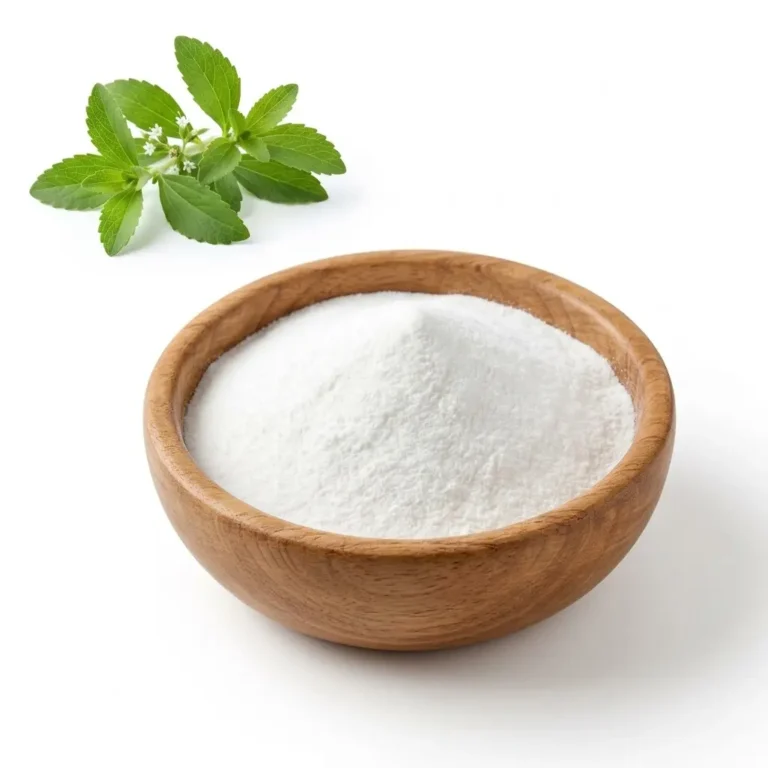 Rebaudioside DKey specification: Rebaudioside D (Reb D)
CAS 63279-13-0
Reb D 95%/98%
Stevia ExtractKey specification: Steviol GlycosidesCAS 57817-89-7
Reb A 80–98% ,Reb M 95–98% ,Reb D 95%
 Custom Sweetener Blend OEM: The Buyer’s Process Guide→Custom Sweetener Blend OEM: The Buyer’s Process Guide WRITTEN BY Flora / OCTOBER 19, 2026 Written by Flora,…
 Types of Curcumin Extract: 7 Grades by Process, Assay and Use→Types of Curcumin Extract: 7 Grades by Process, Assay and Use WRITTEN BY Flora / OCTOBER 17, 2026…