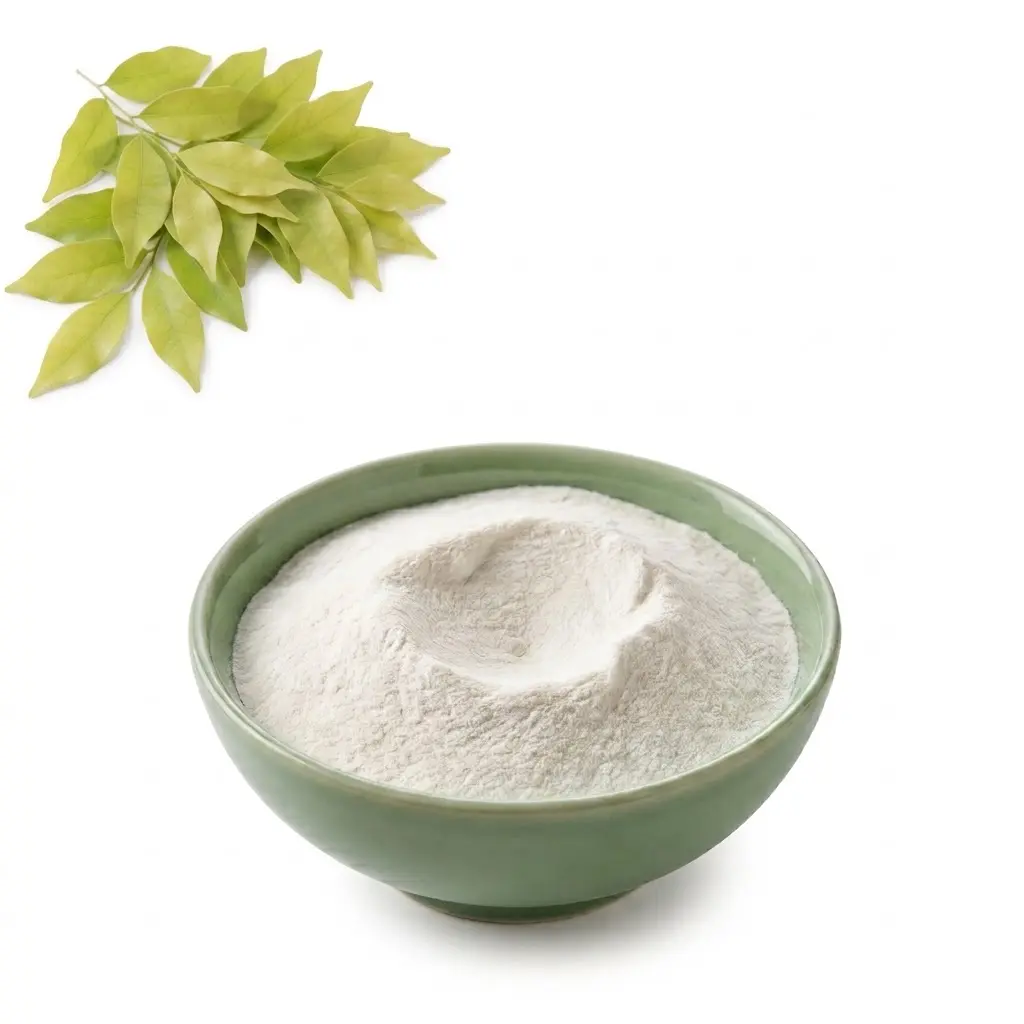
Lithocarpus polystachyus
Sweet Tea Extract
- Compounds
- Trilobatin · Phlorizin
- Grades
- 30% · 50% · 80% · 98% Trilobatin
- Method
- HPLC per lot — trilobatin assay and chromatographic profile
- Applications
- Beverages · Sweetener blends · Nutraceuticals · Research
- Documentation
- COA · HPLC chromatogram · Heavy metals · Microbiology
MOQ
1 kg
Lead time
7–15 days
Quotation
Within 24 hours
Samples
Free of charge
Bulk Trilobatin Sweet Tea Extract Supplier — Natural High-Intensity Sweetener, 30%–98% by HPLC
Written by Flora · Reviewed by Prof. Bingji Ma · Updated September 2026
PhytoVale is a bulk supplier of Sweet Tea Extract standardized for 30%–98% trilobatin by HPLC, in 30%, 50%, 80% and 98% grades for beverage formulation, natural sweetener systems, sugar-reduction and clean-label reformulation, nutraceutical premixes and research use. The material is produced from authenticated Lithocarpus polystachyus sweet tea leaf, with trilobatin as the primary standardized marker. MOQ 1 kg, free samples, quotation within 24 hours.
Trilobatin is a naturally occurring dihydrochalcone glycoside and one of the newer natural high-intensity sweeteners entering commercial sugar-reduction work. For formulators, the useful question is not simply whether the extract is “sweet.” Grade, botanical identity, co-occurring dihydrochalcones, solubility, use level and intended regulatory route all determine how the material behaves in a finished product. This page covers all six.
01 · Product identity
What Is Sweet Tea Extract? Botanical Identity and Trilobatin Standardization
Sweet Tea Extract is produced from the leaves of Chinese sweet tea, described in ingredient and research literature under Lithocarpus polystachyus and closely related taxonomic naming. Trilobatin is one of the plant’s characteristic dihydrochalcones and is the marker most often used to standardize commercial extracts sold as natural sweetener ingredients.
The common name “sweet tea” is not botanically unique. For procurement, the Latin name, plant part and HPLC assay matter more than the common name on a sales sheet. A 10:1 botanical extract, for example, does not tell a formulator how much trilobatin is present. A standardized assay does.
This distinction becomes more important as purity increases. A 30% trilobatin extract still contains a meaningful botanical matrix, while a 98% material is much closer to an isolated high-purity ingredient. They should not be treated as interchangeable simply because both can be sold as “Sweet Tea Extract.”
02 · Active marker
Trilobatin (CAS 4192-90-9): Dihydrochalcone Identity and Sweetness Potency
Trilobatin is a dihydrochalcone glycoside structurally related to phlorizin. It is one of the compounds responsible for the characteristic sweetness of Lithocarpus sweet tea, and it is the compound that gives a Sweet Tea Extract its value as a sweetener rather than as a generic botanical.
Published sources often describe trilobatin as roughly 300 times sweeter than sucrose, but that figure is a screening input, not a fixed formulation conversion. Perceived sweetness depends on concentration, reference sucrose level, sensory method and the surrounding food matrix. Section 08 gives starting use levels derived from it.
For buyers, trilobatin is also the quality marker. HPLC quantification gives a much clearer basis for comparing lots and grades than extract ratio alone. This is why a specification such as “50% trilobatin by HPLC” is materially more informative than “20:1 Sweet Tea Extract.”
03 · Sweetener comparison
Trilobatin vs Stevia vs Monk Fruit: Natural High-Intensity Sweetener Comparison
| Property | Trilobatin Sweet Tea Extract | Stevia, typically Reb A | Monk Fruit, typically Mogroside V |
|---|---|---|---|
| Main source | Lithocarpus sweet tea leaf | Stevia rebaudiana leaf | Siraitia grosvenorii fruit |
| Main sweet marker | Trilobatin | Steviol glycosides | Mogrosides |
| Sweetness | High-intensity; literature often reports around 300× sucrose | High-intensity | High-intensity |
| Typical beverage use level | 0.005%–0.02% on high-purity grades — see section 08 | Same order of magnitude; set by glycoside profile and sweetness target | Same order of magnitude; set by mogroside profile and sweetness target |
| Sensory profile | Often described as clean and sugar-like | Can develop bitter or licorice notes at higher use levels | Generally cleaner than many stevia systems but matrix-dependent |
| Water behavior | High-purity trilobatin is officially described by JECFA as slightly soluble in water | Grade-dependent | Grade-dependent |
| Formulation role | Sweetness contribution, taste modulation and botanical positioning in clean-label systems | Primary high-intensity sweetener | Primary high-intensity sweetener |
| Supply maturity | Emerging specialty ingredient | Mature global supply | Mature global supply |
| Regulatory treatment | Must be assessed by intended use and market | Established sweetener pathways in many markets | Established pathways in several major markets |
Trilobatin is therefore not simply “another stevia.” Its commercial interest lies in a different sensory profile and a different ingredient story, but it also comes with a less mature supply chain and a more use-specific regulatory picture. Its role in reducing undesirable bitter and lingering notes is discussed in more detail in our guide to trilobatin as a bitterness blocker. In practice most projects reach trilobatin as a second high-intensity sweetener in a blend before they reach it as a sole replacement.
04 · Evidence level
Trilobatin Research: Reading the Evidence at the Right Level
Trilobatin has attracted research interest beyond sensory use. The studies below are summarized for technical context only; none of them are claims for a PhytoVale product, and the material is supplied as a food and flavour ingredient.
Alpha-Glucosidase Research
A 2022 Food & Function study examined purified trilobatin in an in-vitro alpha-glucosidase system and reported reversible noncompetitive inhibition, supported by kinetic and molecular interaction analysis. This is mechanistic research on isolated trilobatin at millimolar concentrations; it is not clinical evidence that a commercial Sweet Tea Extract at beverage use levels affects blood glucose.
Hepatic Lipid and Metabolic Research
A 2022 European Journal of Pharmacology study investigated trilobatin in a diabetic mouse model with fatty-liver changes and examined pathways including NLRP3 inflammasome activation. The work is useful for understanding preclinical research interest, but it remains an animal study and should not be converted into a human liver-health claim.
Inflammatory-Pathway Research
In a 2015 Food Chemistry study, trilobatin was investigated in an LPS-mediated inflammatory model and was reported to influence NF-κB-related signaling and inflammatory markers. Again, the relevant distinction is the test material and model: isolated trilobatin in experimental research is not the same evidence level as a standardized 30% or 50% botanical extract used in people.
The broader literature on Lithocarpus dihydrochalcones is still dominated by cell and animal work. For product development, treat these studies as research context, not as finished-product efficacy evidence — and be cautious of supplier material that presents them the other way round.
05 · Raw material & standardization
Sweet Tea Extract Sourcing: What Trilobatin Standardization Actually Controls
Natural raw materials do not arrive with a fixed chemical profile. Research on Lithocarpus samples from multiple Chinese growing areas has shown substantial variation in trilobatin, phlorizin and other phenolic compounds. That means two leaf lots can come from the same species and still produce very different starting extracts.
Standardization reduces this variability at the finished-ingredient level. It does not erase the importance of the raw material. A supplier still needs to control botanical identity, plant part, incoming raw-material quality and extraction conditions before the final HPLC adjustment is made.
For procurement teams, this is why a harvest story should never replace analytical evidence. “Early harvest,” “mountain-grown” or “selected young leaves” may describe sourcing, but the batch-specific HPLC result is what confirms whether the commercial specification was actually achieved.
06 · HPLC interpretation
Trilobatin vs Phlorizin on the COA: Why One HPLC Number Is Not Enough
Trilobatin and phlorizin are structurally related dihydrochalcone glycosides that naturally occur in Lithocarpus sweet tea. A 2020 HPLC-DAD study of 26 batches from different Chinese areas measured both compounds and identified trilobatin and phlorizin as useful chemical markers for quality evaluation.
That matters commercially because “total dihydrochalcones,” “sweet tea polyphenols” and “trilobatin” are not equivalent specifications. If a buyer requires 50% trilobatin, the COA should state trilobatin specifically rather than reporting a broader combined value. This is also the most common way an attractive-looking assay turns out to be unusable once the sweetness target is set.
| COA Item | What It Tells the Buyer |
|---|---|
| Trilobatin assay | Confirms the declared standardized potency and sets your use-level conversion |
| Phlorizin or chromatographic profile | Helps characterize the co-occurring dihydrochalcone fraction |
| HPLC method | Shows how the active marker was quantified |
| Botanical source | Reduces common-name and raw-material ambiguity |
| Plant part | Confirms which botanical material entered production |
| Carrier or excipient | Important for lower-purity standardized extracts |
| Moisture, heavy metals and microbiology | Confirms basic release quality outside the active assay |
For high-purity material, an HPLC chromatogram or additional identity data can be more informative than a single headline purity number.
07 · Product data
Trilobatin Extract Grades: 30%, 50%, 80% and 98% Specifications
| Grade | Best Understood As | Practical Reason to Choose It |
|---|---|---|
| 30% Trilobatin | Standardized botanical extract | Herbal tea blends, instant powders and botanical-forward positioning where lower active density is acceptable |
| 50% Trilobatin | Enriched standardized extract | Balances active concentration with extract character; common starting point for functional beverage screening |
| 80% Trilobatin | High-active extract | Reduces ingredient loading where formulation space is limited, and reduces colour and off-note contribution from the matrix |
| 98% Trilobatin | Highly purified trilobatin-rich material | Precision sweetener blends, analytical reference work and applications requiring high active density with minimal matrix |
Higher purity is not automatically the better grade. A formulator choosing between 30% and 98% should consider target active load, sensory profile, colour, solubility, finished-product format and regulatory identity. A lower-purity extract may fit a botanical clean-label formulation better, while a high-purity grade makes more sense when the formula has very little room for non-active material.
08 · Formulation
Trilobatin Use Levels by Application: Beverage, Supplement and Blend Formulation
The levels below are quoted on an extract basis for 80%–98% grades. Because loading is set by trilobatin content rather than extract weight, roughly double it for a 50% grade and roughly triple it for 30%. Copying a use level across grades is the most common formulation error with this ingredient.
- Beverages: trilobatin performs cleanly at 0.005%–0.02% in water-based systems. Blending with erythritol carrying 50%–70% of the sweetness base improves mouthfeel and lowers total sweetener cost while keeping a clean flavour profile. JECFA describes high-purity trilobatin as slightly soluble in water, so check clarity after cooling and again at four weeks, not only at mixing.
- Supplement capsules and tablets: use 50% grades and above. Typical loading is 50–200 mg extract per serving depending on grade and formula. Priorities here are assay uniformity across the batch and compatibility with the rest of the premix.
- Baked goods and high-temperature processing: dihydrochalcone glycosides are reasonably heat-tolerant as a class, but stability depends on pH and hold time as much as on temperature. For retort, hot-fill acidic or long bake profiles, run a trilobatin HPLC assay on your own formula before and after process rather than relying on a blanket “stable above 120°C” claim.
- Synergistic blending: pairs well with monk fruit and erythritol. Trilobatin’s cleaner finish can cover monk fruit’s mild linger at low inclusion, which is how most cost-optimised clean-label sweetener systems get built. If taste masking is part of the formulation goal, see our technical guide on how trilobatin helps manage bitterness and aftertaste. Screen it at 10%–30% of total high-intensity sweetness before considering full replacement.
How to read these levels
These are formulation starting points derived from the reported ~300× sucrose potency, not validated doses or efficacy levels. Confirm the level in your target matrix under your actual process conditions before locking a specification, and confirm the regulatory route for your use category and destination market (section 11).
09 · Raw material variation
Why Sweet Tea Leaf Chemistry Varies by Region and Harvest
The chemistry of sweet tea leaf is not fixed by the species name alone. A multi-region study of 26 batches found clear differences among samples from different growing areas and between tender leaves and flower spikes. Trilobatin reached as high as 27.82% of dry weight in one tender-leaf sample, while phlorizin showed a different distribution pattern.
More recent work has reinforced the same point at a larger scale. A 2026 study analyzed 163 Lithocarpus litseifolius samples from seven major production regions and found enough chemical and elemental variation to model geographical origin and cultivation practice.
For buyers, the lesson is practical. Growing region, plant part, harvest stage, agricultural conditions and post-harvest handling all influence the raw material entering extraction. This is one reason a standardized finished extract is more reliable for formulation than unstandardized sweet tea powder bought on origin alone.
It also explains why two suppliers can both offer “Sweet Tea Extract” while delivering noticeably different colour, taste and minor-compound profiles even when the headline trilobatin assay is similar. The active assay is critical, but it is not the whole chemical fingerprint — which is why a retained sample from the qualification lot is worth asking for.
10 · B2B qualification
Sweet Tea Extract COA Review and Bulk Supplier Qualification
A useful Sweet Tea Extract specification connects botanical identity with analytical release testing. The minimum commercial discussion should cover the scientific name used by the supplier, leaf as the plant part, trilobatin assay by HPLC stated as trilobatin rather than as total dihydrochalcones, and the grade-specific composition.
For routine B2B qualification, COA review should also cover moisture, heavy metals and microbiological limits. Depending on destination market and extraction process, buyers may additionally request pesticide screening, residual-solvent data and an HPLC chromatogram.
For 30%–50% grades, ask whether the balance consists entirely of native extract solids or includes a carrier — this changes both your use-level conversion and your label declaration. For 98% material, focus more closely on identity, chromatographic purity and the processing route. Those are different procurement questions, even though both materials may appear under the same product name.
PhytoVale supplies bulk Sweet Tea Extract from 1 kg MOQ with free samples, quotation within 24 hours and a 7–15 day lead time depending on grade and quantity. Packaging, shelf life and the full documentation set are confirmed against the specific grade at quotation.
11 · Compliance
Trilobatin Regulatory Status: JECFA, FEMA, EU and China
Regulatory status depends on what the material is, how pure it is, how it is used and where the finished product will be sold. A single global answer does not exist for this ingredient, and any supplier offering one is oversimplifying.
JECFA evaluated trilobatin in 2012 at its 76th meeting as a flavouring agent. The JECFA specification lists CAS 4192-90-9, JECFA No. 2171, FEMA No. 4674, FLAVIS No. 16.112 and a minimum assay of 98%. Its conclusion was “no safety concern” at the estimated intake for the evaluated flavouring use. That should not be broadened into a general approval for every sweetener or supplement application.
In the European Union, trilobatin appears as FL No. 16.112 in the Union list of flavouring substances. A flavouring listing is not the same thing as authorisation as a food additive sweetener under Regulation (EC) No 1333/2008 — a distinction that matters directly for how a finished product can be positioned and labelled.
In China, a 2017 National Health authority announcement approved the tender leaves and buds of Lithocarpus litseifolius as a new food raw material, with specific labelling considerations. That botanical raw-material approval should not automatically be treated as identical to the regulatory status of a highly purified trilobatin ingredient.
Before launch, the finished-product manufacturer should confirm the regulatory route for the exact grade, use level, application category and destination market. PhytoVale can supply the specification and analytical documentation needed for that assessment; the assessment itself belongs with the manufacturer and its regulatory advisers.
12 · Questions
Sweet Tea Extract FAQ for Buyers and Formulators
Does trilobatin have the bitter or licorice aftertaste associated with stevia?
Trilobatin is generally described in the literature and in sensory work as cleaner and more sugar-like than steviol glycosides, without the licorice character that Reb A can develop at higher use levels. That said, “clean” is a comparison, not an absence. At higher inclusion rates trilobatin can show a slightly delayed onset and a lingering finish, and a 30% grade also carries botanical notes from the remaining leaf matrix that a 98% grade does not. If aftertaste is the reason you are trialling trilobatin, start at 80% or above and evaluate against a full-sugar control rather than against your current stevia formula.
What colour is Sweet Tea Extract powder, and will it affect my finished product?
Colour tracks purity. Lower-purity grades typically run light tan to brown because the botanical matrix is still present, while higher-purity material trends toward off-white. In a clear beverage at 100–200 ppm, a 30% grade can contribute a visible tint, whereas an 80% or 98% grade at the equivalent trilobatin level usually will not. If you are formulating a water-clear RTD or a white powder sachet, treat colour as a grade-selection criterion alongside assay, and confirm it against the actual lot rather than the specification range — colour is one of the properties that varies most between raw-material batches.
Is trilobatin stable enough for pasteurisation, retort or baking?
Dihydrochalcone glycosides are reasonably robust to heat as a class, but PhytoVale does not publish a blanket stability claim, because stability is a function of temperature, hold time, pH and matrix together rather than temperature alone. The condition set worth testing is combined low pH and prolonged heat, where sweetness can shift without any visible change to the product. The test is simple: run a trilobatin assay by HPLC on the finished product after your full thermal profile and compare it against the same formula pre-process. One trial settles it for your specific product.
Are Lithocarpus polystachyus and Lithocarpus litseifolius the same plant?
They are treated as the same species under different accepted names in different sources, with Lithocarpus litseifolius the name used in current Chinese regulatory documents and Lithocarpus polystachyus widely used in ingredient and research literature. This matters commercially rather than academically: your specification, COA and regulatory file should use consistent naming, and a mismatch between them is a common cause of customs and QA delays. If your destination market references one name, ask your supplier to state that name on the COA and note the synonym rather than leaving the two documents to disagree.
How should trilobatin Sweet Tea Extract be declared on a finished-product label?
The declaration follows the regulatory route you are using in that market, not the ingredient’s chemistry. Because trilobatin’s established international position is as a flavouring substance rather than an authorised food-additive sweetener in several major markets, the ingredient name, the functional category you declare it under, and any front-of-pack sweetness or clean-label positioning all need to be confirmed for your specific market before artwork is finalised. Settle this with your regulatory adviser before formulation is locked rather than after — the answer can change which grade and which use level are viable for you.
Can I get a sample before committing to a bulk order?
Yes. Samples are supplied free of charge, and bulk orders start at 1 kg MOQ with quotation returned within 24 hours and a 7–15 day lead time depending on grade and quantity. For a first evaluation we would usually suggest requesting more than one grade rather than only the highest purity, since the useful comparison is how each behaves at equal trilobatin loading in your matrix — dissolution, colour and sensory frequently separate the grades more than the assay does. Tell us the finished-product format and your sweetness target and we will suggest which two grades to trial.
13 · Evidence base
References
[1] Shang A, Liu H-Y, Luo M, et al. Sweet tea (Lithocarpus polystachyus Rehd.) as a new natural source of bioactive dihydrochalcones with multiple health benefits. Critical Reviews in Food Science and Nutrition. 2022;62(4):917–934. DOI: 10.1080/10408398.2020.1830363 →
[2] He M, Zhai Y, Zhang Y, et al. Inhibition of α-glucosidase by trilobatin and its mechanism: kinetics, interaction mechanism and molecular docking. Food & Function. 2022;13(2):857–866. DOI: 10.1039/D1FO03636J →
[3] Zhang Z-T, He W-J, Deng S-M, et al. Trilobatin alleviates non-alcoholic fatty liver disease in high-fat diet plus streptozotocin-induced diabetic mice by suppressing NLRP3 inflammasome activation. European Journal of Pharmacology. 2022;933:175291. DOI: 10.1016/j.ejphar.2022.175291 →
[4] Fan X, Zhang Y, Dong H, et al. Trilobatin attenuates the LPS-mediated inflammatory response by suppressing the NF-κB signaling pathway. Food Chemistry. 2015;166:609–615. DOI: 10.1016/j.foodchem.2014.06.022 →
[5] Wei M, Tuo Y, Zhang Y, et al. Evaluation of Two Parts of Lithocarpus polystachyus Rehd. from Different Chinese Areas by Multicomponent Content Determination and Pattern Recognition. Journal of Analytical Methods in Chemistry. 2020:8837526. DOI: 10.1155/2020/8837526 →
[6] FAO/JECFA. Trilobatin. Online Edition: Specifications for Flavourings. JECFA No. 2171. Latest evaluation: 2012, 76th meeting. FAO/JECFA official specification →
[7] European Union. Union List of Flavouring Substances under Regulation (EC) No. 1334/2008. Trilobatin, FL No. 16.112. EUR-Lex official text →
[8] National Health and Family Planning Commission of China. Announcement No. 7 of 2017 concerning new food raw materials, including Lithocarpus litseifolius tender leaves and buds. China NHC official page →
[9] Tang Y, Yu P, Xiong F, et al. Tracing origin and cultivation practice of Lithocarpus litseifolius via multi-data fusion and machine learning approaches. npj Science of Food. 2026;10:105. DOI: 10.1038/s41538-026-00748-0 →
Reviewed by
Prof. Bingji MaScientific Advisor, PhytoVale · Professor & Medicinal Plant Science Expert. Research focus: Chinese medicinal materials, phytochemistry, natural products and medicinal plant quality.
Written by
FloraContent Editor, PhytoVale · Product Content & Editorial Specialist. Focuses on botanical ingredient specifications, sourcing information and B2B technical content.
B2B supply
Tell us the grade and finished-product format
Send us the format, the sweetness you need to replace and the destination market, and we will suggest which two grades to trial and at what starting loading. Bulk Sweet Tea Extract from 1 kg MOQ, free samples, quotation within 24 hours.
Request a sample →Browse all products →Related Botanical Ingredients
 Monk Fruit ExtractKey specification: Mogroside V
CAS 88901-36-4
Mogroside V 25–60%
 Rebaudioside AKey specification: Reb A
CAS 58543-16-1
Reb A 60% / 80% / 97%
 Rebaudioside DKey specification: Rebaudioside D (Reb D)
CAS 63279-13-0
Reb D 95%/98%
 Rebaudioside MKey specification: Rebaudioside M (Reb M)
CAS 1220616-44-3
Reb M 95% / 98%
 Custom Sweetener Blend OEM: The Buyer’s Process Guide→Custom Sweetener Blend OEM: The Buyer’s Process Guide WRITTEN BY Flora / OCTOBER 19, 2026 Written by Flora,…
 Types of Curcumin Extract: 7 Grades by Process, Assay and Use→Types of Curcumin Extract: 7 Grades by Process, Assay and Use WRITTEN BY Flora / OCTOBER 17, 2026…