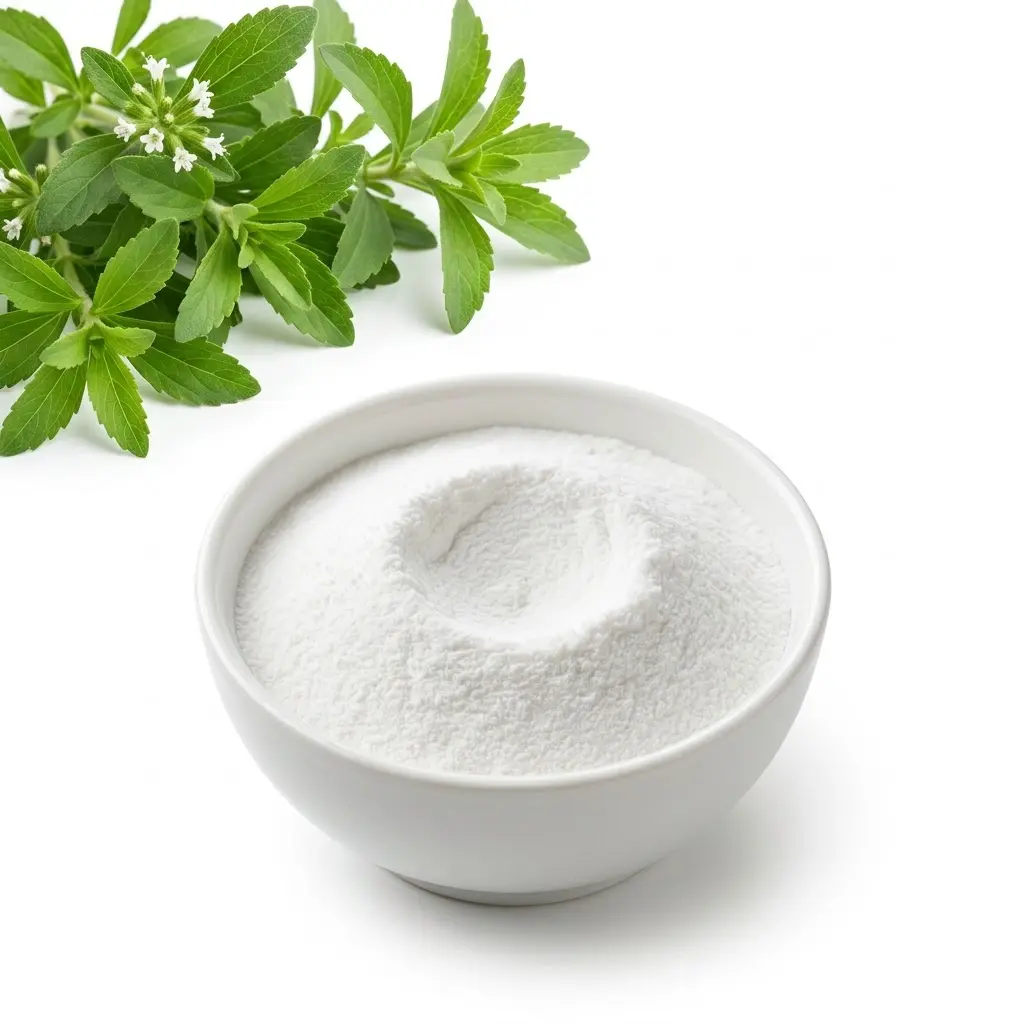
Stevia rebaudiana
Stevia rebaudiana
Written by Flora · Reviewed by Assoc. Prof. Xinjuan Xu · Updated September 2026
PhytoVale manufactures and wholesales stevia extract across the full purity range: total steviol glycosides from 80%, Rebaudioside A 80% to 98%, Rebaudioside M 95% and 98%, Rebaudioside D, and enzymatically glucosylated grades, in conventional and certified organic. Extracted from the dried leaf of Stevia rebaudiana Bertoni, steviol glycosides hold FDA GRAS status, EU authorisation as E960, and JECFA evaluation, with approvals in more than sixty markets. That makes stevia the most heavily documented natural high-intensity sweetener available, and the usual first move away from sucralose and aspartame.
Purity is where most specifications stop. It should not be. The ratio of Reb A to Reb M to the bitter minor glycosides is fixed by variety and harvest window, in the field, before the leaf reaches a column. Extraction separates what the crop already decided. A supplier buying leaf on the open market inherits that ratio. We farm 400 hectares ourselves, so we choose it.
Every lot is released against the individual glycoside by HPLC, with the full distribution and the chromatogram available.
01 · Glycoside selection
Most comparisons rank steviol glycosides on two axes: how sweet, and how bitter. Both are real. Neither is what decides whether a formulation ships. The two that do are the shape of the sweetness over time, and whether the compound stays in solution for the life of the pack.[1]
| Compound | Leaf level | Sweetness | Sweetness over time | Solubility | Specify it when |
|---|---|---|---|---|---|
| Stevioside | 5–10% of dried leaf | 150–300× | Slow to arrive, long bitter and liquorice finish | High | The flavour system does the masking: cocoa, coffee, spice, citrus. Baked goods, confectionery coatings, pharmaceutical syrups and chewables |
| Rebaudioside A | 2–4% | 200–250× | Moderate onset, sweetness lingers; bitterness emerges above roughly 4–5% sucrose equivalence | High | Partial reduction in mainstream products. Carbonates, still drinks, reduced-sugar dairy, table-top blends. The default until sensory says otherwise |
| Rebaudioside D | under 0.5% | 200–220× | Clean, but slow to arrive | Poor | As a blend component only, and only after a real-time cold trial at finished concentration |
| Rebaudioside M | under 1% | 200–350× | Closest to sucrose. Arrives quickly, clears quickly | Moderate | Deep reduction or full replacement, and anywhere the base has nothing to hide behind: plain dairy, water, unflavoured protein |
Why the time course decides more than the bitterness figure. Sucrose arrives fast and leaves clean. Every steviol glycoside is slower at both ends, and the gap at the back is what consumers report as stevia aftertaste. The part that matters for formulation: the lingering component scales faster than the peak. Raising the dose to chase sweetness makes the tail worse, not better. This is the most common failure in a stevia project, and no amount of extra material fixes it.
Reb D is specified on taste and fails on solubility. It reads well on a sensory panel, which is why it ends up in briefs. Its water solubility is far below Reb A, and in a chilled beverage held through shelf life it can drop out and haze or settle. A hot-fill sample that looked fine at week one is not evidence.
The decision is a fraction, not a choice. Almost nothing commercial runs on a single glycoside. Reb A carries the sweetness load economically; Reb M buys back the finish at several times the cost. So the useful question is not Reb A or Reb M, it is what proportion of the load moves to Reb M before the sensory gain stops paying for itself. That crossover sits in a different place for a citrus carbonate than for a plain dairy drink, because one has flavour to hide behind and the other does not.
The fastest way to find that crossover is not to model it. Send us the base and the reduction target, and we will run the ratio series on your matrix.
02 · What the assay hides
Two lots can both assay Rebaudioside A 97.0% by HPLC and taste different in the same base. The number describes one compound. It says nothing about the other three percent, and in stevia that remainder is not inert filler. It is other glycosides, and they do not all behave the same way on the palate.
| In the remainder | What it contributes | What its level tells you |
|---|---|---|
| Rebaudioside B | Bitter, astringent | Forms from Reb A when the C19 ester bond is cleaved under alkaline or thermal stress.[2] A Reb B figure that climbs across lots is a process signal, not a crop one |
| Rebaudioside C | Bitter, liquorice | Naturally present. Varietal and harvest dependent, so it moves with the field |
| Stevioside | Slow bitter tail | The residual most often carried through in 80 to 95% Reb A grades |
| Reb D and Reb M | Clean, sugar-like | A residual worth paying for. At identical assay, the lot carrying these will panel better |
Read that table backwards and it becomes a diagnostic. If the assay has not moved but sensory has, a rising Reb B points at processing or storage stress; Reb C rising with it points at the leaf.[5] Two different conversations with your supplier, and without the profile you cannot tell which one to have.
No regulatory standard caps Rebaudioside B. It counts toward the 95% total steviol glycosides required by JECFA and by EU Regulation (EU) No 1131/2011, and nothing constrains it individually. That is why most specifications leave it unconstrained, and why a supplier who does constrain it is telling you something about their process control.
Most purchase specifications stop at the headline assay, which leaves the remainder unconstrained. Two lines close that gap:
Glycoside profile. Rebaudioside B, C, D and M and stevioside each reported individually per lot. Rebaudioside B ≤ 1.0%..
Chromatogram. Supplied with each certificate of analysis.
We report all five on every lot.
03 · Product data
| Grade | Glycoside Content | Primary Compound | Typical Application |
|---|---|---|---|
| Stevioside 90–95% | 90–95% stevioside by HPLC | Stevioside dominant, with Reb A and Reb C in the remainder | Cost-led food formulation, blended sweetener bases, baked goods and heat-processed foods, confectionery coatings, pharmaceutical syrups and chewable tablets. The right call where cocoa, coffee, spice or citrus masks the tail |
| Total steviol glycosides 80–95% | 80–95% total glycosides by HPLC | Mixed profile, varies by lot. Specify a Reb A floor if sensory matters | Entry-level supplement bases, dry mixes, blended systems where another sweetener carries the profile and cost per unit sweetness drives the decision |
| Reb A 80% | ≥ 80% Rebaudioside A by HPLC | Reb A dominant, stevioside and Reb C in the remainder | Entry-grade beverage and dry-mix work, blended sweetener systems, table-top blends. The 20% it lacks is largely stevioside, so it is not simply a cheaper Reb A 97% |
| Reb A 95–98% | 95–98% Rebaudioside A by HPLC | Reb A dominant, Reb B and Reb D in the remainder | Mainstream to premium clean-label beverages, carbonates and still drinks, reduced-sugar dairy, confectionery, table-top sweetener. High-purity grades meet EU and FDA high-purity compliance |
| Reb D 95% | 95% Rebaudioside D by HPLC | Reb D dominant, Reb A and Reb M in the remainder | Blend component for sensory balancing rather than a standalone sweetener. Confirm solubility at finished concentration before committing to a pack |
| Reb M 95–98% | 95–98% Rebaudioside M by HPLC | Reb M dominant, Reb D and Reb A in the remainder | Premium beverages and dairy demanding the most sugar-like taste with virtually no aftertaste, deep sugar reduction and full sugar-replacement formulations, plain dairy, waters and unflavoured protein |
| GSG 80% | 80% glucosylated steviol glycosides by HPLC | Enzyme-modified glycosides, unconverted parent glycosides in the remainder | Rounder, more sugar-like mouthfeel with reduced bitter and liquorice aftertaste. Beverages, dairy and sweetener blends seeking improved body at lower cost than high-purity Reb M |
The third column is worth reading twice. It is why two grades at the same headline number quote differently, and it is the reason a specification that names only the assay leaves the part you can taste unconstrained. If you are still narrowing the specification, our guide to choosing the right stevia grade compares the main options by application, sensory profile and formulation constraints.
Organic
Our leaf-derived grades are available as conventional or certified-organic extract. Organic Rebaudioside A, organic Rebaudioside M, organic Rebaudioside D, organic stevioside and organic total steviol glycoside extracts are produced under USDA NOP and EU 2018/848 certification, from leaf grown on ground we farm and certify ourselves rather than sourced from certified third parties. Organic certificates list products by name rather than covering a catalogue, so ask for the certificate and confirm your grade appears in its scope before building it into an organic-positioned launch. For a deeper look at certificate scope, sourcing and documentation, see our guide to organic stevia certification and sourcing. GSG is enzymatically produced and sits outside organic scope.
04 · Technical
Two questions get answered as one here. Process heat is the easy one: all grades come through pasteurisation, retort and baking intact. Stevioside is the less robust of the common compounds in solution above roughly 120 °C, and degradation accelerates under acid.[6]
Storage heat is the one that catches people. Ambient sea freight through the tropics does slow work that a two-minute retort never gets to. If your route includes it, that exposure belongs in the stability model alongside the process step.
Steviol glycosides hold across pH 2 to 10, covering carbonates, functional waters and acidic dairy, where several alternatives degrade below pH 4.
The failure mode is not the process, it is the year that follows. At low pH over a long ambient shelf life, slow hydrolysis reduces sweetness gradually, and accelerated testing systematically under-predicts it because elevated temperature drives a partly different reaction path.[4] A product that passes a six-week accelerated study can still read flat at month ten. Run a real-time trial at your finished pH before setting a date on pack.
Solubility does not track sweetness or purity, and it decides whether a compound is usable at all. The difference in Reb A, Reb D and Reb M solubility becomes especially important in chilled beverages and concentrated premixes. Reb A and stevioside dissolve readily at beverage concentrations. Reb M is moderate. Reb D is the outlier, markedly less soluble, and capable of hazing or settling in a chilled product held through shelf life.[3]
It bites in three places: cold-chain beverages, concentrates sitting near the ceiling before dilution, and any formula where Reb D was specified on taste with no solubility check. Ask for solubility at your finished concentration and temperature, not a headline figure in warm water.
At 250 to 300 times sucrose, inclusion is very low. Replacing 10 g of sucrose takes roughly 35 to 40 mg of 90% stevioside, or 40 to 50 mg of 80% Reb A. The multiple compresses as sweetness equivalence rises, so a figure measured in water overstates a finished beverage.
Regulators work in steviol equivalents, converted by molecular weight ratio:
| Compound | Factor | 100 mg equals |
|---|---|---|
| Stevioside | 0.40 | 40 mg steviol |
| Rebaudioside A | 0.33 | 33 mg steviol |
| Rebaudioside D | 0.28 | 28 mg steviol |
| Rebaudioside M | 0.25 | 25 mg steviol |
The JECFA and EFSA ADI is 4 mg per kg body weight per day as steviol.[7] Reb M carries the lowest factor, so two formulas can taste equally sweet and sit a third apart on ADI headroom purely on glycoside choice. Model this against the whole portfolio, not one serving, if the same consumer meets your brand more than once. That is where Reb M often justifies its cost on regulatory grounds rather than sensory ones.
05 · Industry use
Buyers describe their project by industry. Formulators run into problems by format. A gummy has more in common with a jelly confection than with a tablet, whatever category the finished product is sold in.
| Format | What constrains the choice | Grade that fits |
|---|---|---|
| Carbonated and still beverages | Low pH over a long ambient shelf life. Sweetness has to survive months, not minutes. Cold-chain products additionally expose any solubility limit | Reb A 95–98% for partial reduction. Reb M 95% where the target is a fully sugar-like profile. Avoid Reb D as a standalone |
| Dairy and frozen | Nothing in the base to hide a tail behind. Removing sugar also removes solids and raises freezing point, so bulk has to come from somewhere | Reb M 95–98%, paired with erythritol or allulose for the body sugar was providing |
| Gummies and jellies | Heat during depositing, then months of moisture exchange with the gelling system. Flavour load is high, which helps mask | Reb A 95–98% is usually sufficient. GSG 80% where mouthfeel reads thin |
| Tablets and capsules | Sweetener has to flow, compress and not blow fill-weight tolerance. Taste is secondary to powder behaviour | Reb A 95–98% or total glycosides 80–95%. Specify particle size and bulk density, not just assay |
| Baked goods and confectionery coatings | Sugar is structure, colour and moisture retention as well as sweetness. Thermal exposure is short but intense, and the flavour matrix masks well | Stevioside 90–95% is the economic choice. A bulking agent is part of the answer, not an optional extra |
| Powders, sachets and table-top | Dispersion, caking and dosing accuracy at very low inclusion. One scoop has to be reproducible | Reb A 95–98% on a carrier. Blend uniformity matters more than glycoside choice here |
| Syrups, chewables and oral suspensions | Non-glycaemic requirement, documentation depth, and compatibility with actives that often taste worse than the base | Stevioside 90–95%. Specification and regulatory paperwork usually decide this before sensory does |
Blending. Stevia supplies sweetness, not bulk. Stevia and erythritol play different roles in formulation: erythritol helps replace some of the volume and mouthfeel removed with sugar, while stevia carries the high-intensity sweetness. Allulose serves a similar bulking role, while monk fruit extract fills the front of the sweetness curve where stevia alone reads thin. Published ratios are starting points only, since acid, flavour and temperature all shift sweetness equivalence. Send us the base and the reduction target and we will run the ratio series on your matrix.
06 · Compliance
High-purity steviol glycosides are marketed under the GRAS pathway, with multiple GRAS notices filed to FDA carrying no-questions letters. GRAS status attaches to a defined material at a defined purity, not to stevia in general, so confirm that the notice your supplier relies on covers your grade, your glycoside and your production route. Verify FDA facility registration separately if you supply into US food or supplement chains.
Steviol glycosides are authorised as sweetener E960 under Regulation (EC) No 1333/2008, with use levels set by food category in Annex II. The designation has been subdivided by production route as enzymatically produced and glucosylated grades entered the market, and leaf-derived and enzyme-modified material do not carry the same identifier. Confirm the current designation applicable to your grade before artwork, because the number on your label has to match the route.
Steviol glycosides are permitted as a food additive under GB 2760, with specifications under the corresponding national standard. Use levels are set by food category and revised periodically. Confirm the current category and limit for your application against the standard in force.
JECFA has evaluated steviol glycosides and set an ADI of 4 mg per kg body weight per day as steviol, and approvals exist in more than sixty countries. Category limits, permitted glycosides and labelling requirements differ substantially between them. A clearance obtained for one launch does not transfer.
Regulatory status for steviol glycosides differs by individual compound and by production route, and has been amended more than once in recent years. The formulator is responsible for confirming permitted categories, maximum use levels, ADI headroom across the finished portfolio and labelling requirements in each destination market before manufacture. Nothing on this page is a regulatory opinion. We supply the documentation your assessment needs and will tell you where our file does not reach.
07 · Questions
Stevia extract is the material; Rebaudioside A is one compound inside it. An extract sold as steviol glycosides 95% is 95% glycosides of mixed identity. An extract sold as Reb A 95% is 95% one compound. Both are stevia extract. They cost differently and taste differently, so the purchase specification has to name which one you mean.
Leaf-derived grades are extracted from Stevia rebaudiana leaf using water and food-grade solvent, with no synthesis step. Glucosylated grades are made by enzymatic modification of leaf-derived glycosides, which is a bioconversion rather than chemical synthesis, though it is classified separately from leaf extraction in some markets. If a label claim depends on the answer, confirm the wording permitted in your destination market rather than the production description.
Because the assay describes one compound and the remainder is unconstrained. In a 97% Reb A, the other three percent might be Reb B and stevioside, both bitter, or Reb D and Reb M, both clean. Ask for the glycoside profile per lot. Without it there is nothing to compare when sensory shifts.
Monk fruit is sweeter at the front of the curve and rounder in mouthfeel; stevia is more cost-efficient per unit sweetness and better documented across markets. Our detailed monk fruit vs stevia comparison looks more closely at their sensory profile, sweetness behaviour and formulation roles.They are frequently blended rather than chosen between, with stevia carrying the load and monk fruit filling the opening where stevia alone reads thin. Cost usually favours stevia; sensory usually favours the blend.
It depends entirely on which glycoside. Stevioside is noticeably bitter, Reb A becomes so above roughly 4 to 5% sucrose equivalence, and Reb M is close to clean. Raising the dose makes the tail worse rather than better, so the fix is glycoside selection and blending, not more material.
1 kg for standard grades. Samples are free and freight is credited against the first order. Tell us the base, the reduction target and the destination market and we will send the grade that fits with its specification sheet, rather than the one that is easiest to ship.
Certificate of analysis for the lot, specification sheet, safety data sheet, and allergen and non-GMO statements as standard. Glycoside profile with chromatogram, certificate of origin, organic certificate and market-specific documentation on request.
08 · Evidence base
Reviewed by
Scientific Advisor, PhytoVale · Associate Professor & Stevia Agronomy and Crop Physiology Expert. Research focus: stevia cultivation, varietal selection and the effect of harvest window on glycoside profile.
Written by
Content Editor, PhytoVale · Product Content & Editorial Specialist. Focuses on botanical ingredient specifications, sourcing information and B2B technical content.
B2B supply
Send your matrix, your target reduction and the destination market. We come back with a shortlist, samples, and sweetness equivalence measured on your own base rather than in water.
Request a sample → Browse all products → Monk Fruit ExtractKey specification: Mogroside V
 Rebaudioside AKey specification: Reb A
 Rebaudioside DKey specification: Rebaudioside D (Reb D)
 Rebaudioside MKey specification: Rebaudioside M (Reb M)
 Custom Sweetener Blend OEM: The Buyer’s Process Guide→Custom Sweetener Blend OEM: The Buyer’s Process Guide WRITTEN BY Flora / OCTOBER 19, 2026 Written by Flora,…
 Types of Curcumin Extract: 7 Grades by Process, Assay and Use→Types of Curcumin Extract: 7 Grades by Process, Assay and Use WRITTEN BY Flora / OCTOBER 17, 2026…