Glucoraphanin vs Sulforaphane: Which Form Does Your Supplement Formula Actually Need?
Written by Flora, reviewed by Prof. Bingji Ma, updated October 2026
Your supplement label says 50 mg glucoraphanin. A consumer swallows the capsule. How much sulforaphane does their body actually produce? Published human data put the answer anywhere from under 0.5 mg to over 8 mg — a spread of more than fifteen-fold from the same starting ingredient, depending on four formulation decisions you make before the product ships.
The short answer: if your label claims GR milligrams, use a glucoraphanin precursor grade; if it claims SF milligrams, use a preformed sulforaphane grade; if you want to maximise in-body SF generation from a GR ingredient, pair it with exogenous myrosinase, a vitamin C cofactor and an acid-protective capsule. Each route trades off stability, cost, regulatory complexity and the predictability of what actually reaches the consumer.
Below is the full technical breakdown: the chemistry behind the conversion, the human data that quantifies each route, the molar arithmetic most supplier articles get wrong, and the COA questions that separate a qualified ingredient from a number on a spec sheet. For grade-by-grade specifications, see our broccoli seed extract product page.
01 · The essential relationship
GR, SF and Myrosinase — and Why the Industry Exists in Two Halves
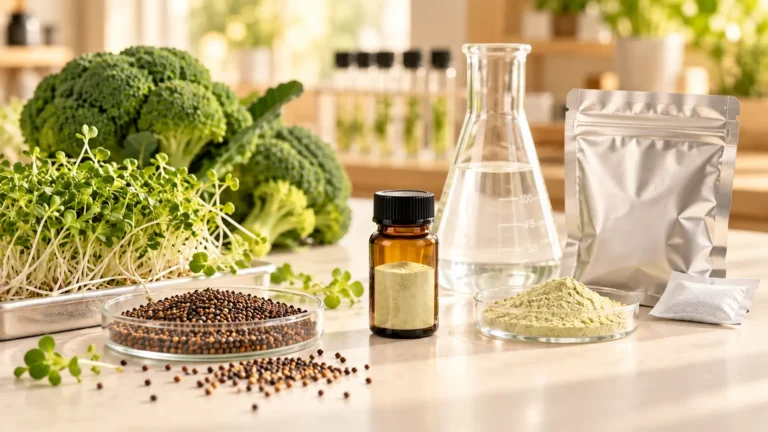
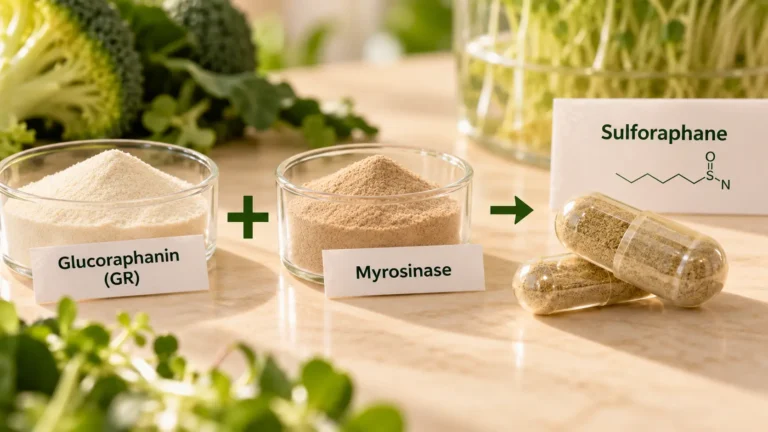
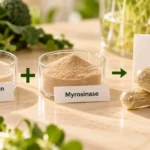
Glucoraphanin (GR) is a glucosinolate that sits in broccoli seeds, stable and inert. Sulforaphane (SF) is the isothiocyanate that the biological literature connects to KEAP1–NRF2 pathway activation. Myrosinase is the enzyme that converts the first into the second.
The reason the supplement industry splits into GR-based and SF-based products is physical chemistry. GR is a water-soluble thioglucoside; it tolerates dry storage, compression and room-temperature shipping. SF is an electrophilic isothiocyanate that degrades in the presence of heat, oxygen, water and alkaline pH. Pure SF at ambient temperature breaks down within days. That instability is why most finished products ship glucoraphanin and rely on conversion to happen later — either inside the consumer’s body or, with stabilisation technology, in a protected matrix.
But conversion is not a single pathway. When myrosinase hydrolyses GR, the unstable intermediate can proceed in two directions: toward sulforaphane (the desired product) or toward sulforaphane nitrile (biologically inactive). A protein called epithiospecifier protein (ESP) promotes the nitrile route[7]. ESP is more heat-sensitive than myrosinase — it denatures at roughly 60°C, while myrosinase survives to about 70°C — which is why mild heating can increase SF yield from fresh broccoli. For a formulator, the practical consequence is this: the source of your myrosinase matters. Mustard seed and red cabbage enzyme preparations carry minimal ESP activity compared to broccoli’s own endogenous enzyme, and that difference changes the ratio of SF to nitrile in the finished conversion[8].
One more detail that matters for every calculation in this article: GR (437.5 g/mol) and SF (177.3 g/mol) have different molecular weights. 1 mg of glucoraphanin cannot yield 1 mg of sulforaphane, even at 100% theoretical efficiency. The full arithmetic is in Section 07, but keep it in mind whenever you see a “sulforaphane equivalent” number on a competitor’s label.
02 · Three established routes, one emerging approach
Four Ways to Deliver Sulforaphane from a Broccoli Seed Extract
| Route | What the capsule contains | Where SF forms | Core risk | Market example |
|---|---|---|---|---|
| ① GR-only | Glucoraphanin, no active enzyme | Consumer’s colon, via gut bacteria | Conversion varies 1–40% across individuals | TrueBroc-based products, many private-label capsules |
| ② GR + Myrosinase | Glucoraphanin + exogenous enzyme ± vitamin C | Small intestine (if enzyme survives stomach acid) | Gastric acid inactivation; enzyme shelf-life decay | Avmacol, Life Extension, Thorne, Designs for Health |
| ③ Preformed SF | Stabilised sulforaphane (cyclodextrin complex or other carrier) | Already present in the ingredient | Cold-chain cost; carrier mass; limited suppliers | BrocElite, Prostaphane; PhytoVale β-CD and −4°C grades |
| ④ Pre-conversion (emerging) | GR + myrosinase powder, mixed in water before drinking | In the glass, before ingestion | Powder-only format; no long-term data | Nootropics Depot SulfoMax (launched Sep 2026) |
Routes ①–③ have multi-year commercial track records and published human data. Route ④ was introduced in September 2026 as a single commercial product; its 27 mg/serving claim comes from company-run UPLC testing and simulated gastric fluid dissolution, not from independent clinical trials[11]. It is included here as a formulation concept — converting GR outside the body to bypass gastric acid — rather than a validated delivery system. The remainder of this article focuses on the three established routes.
03 · Label strategy
What Are You Actually Claiming on the Supplement Facts Panel?
Before choosing a grade, decide what number goes on the label. This is not a formulation question — it is a regulatory and marketing question that determines everything downstream.
Option A: Declare glucoraphanin content. The label states the amount of GR per serving, measured by HPLC against a reference standard. The consumer receives a precursor, not the active compound. This is straightforward to substantiate: you test the powder, you report what is in it. Most GR-based products on the US market take this approach.
Option B: Declare “sulforaphane” or “sulforaphane potential.” Some labels convert GR milligrams into “sulforaphane equivalent” assuming complete conversion. This is misleading: 1 mg of GR cannot yield 1 mg of SF even at 100% theoretical efficiency (their molecular weights differ — see Section 07), and real conversion efficiencies range from 1% to 40%. A label that prints “30 mg sulforaphane” on a product containing only GR is overstating what the consumer receives by a large and variable margin.
Option C: Declare preformed SF content. A stabilised SF ingredient contains actual sulforaphane, assayed by HPLC or LC-MS. The label number represents what is in the capsule, not what might theoretically form later. This is the only route where the declared SF milligrams correspond directly to the ingredient.
Regulatory boundary
In the US, the Supplement Facts panel must accurately describe the ingredients present in the product. Declaring “sulforaphane” when the capsule contains glucoraphanin — a different compound — requires careful evaluation of whether the declared compound matches the ingredient identity under 21 CFR 101.36. In the EU, Novel Food authorisation and any permitted health claims must correspond to the specific substance and specification authorised; a concentrated broccoli seed extract is not automatically covered by the food history of the vegetable itself. TrueBroc’s GRAS notice (GRN 496) covers a specific broccoli-seed water extract at defined use levels in specified food categories; it does not extend GRAS status to all GR products or all applications[12]. Work with regulatory counsel before finalising label copy.
04 · Route ①
GR-Only: Predictable Content, Unpredictable Conversion
The simplest product: a capsule of standardised GR powder with no added enzyme. Stable, inexpensive, easy to manufacture. The problem is what happens after swallowing.
Without plant myrosinase, GR passes intact through the stomach and small intestine and reaches the colon, where gut bacteria with myrosinase-like activity hydrolyse it to SF. A human feeding study (Li et al., Cancer Prevention Research, 2011) gave 200 μmol purified GR to two populations (rural Chinese and urban American volunteers) and measured urinary SF metabolites over 24 hours. Conversion ranged from 1% to 40% of dose, with no demographic predictor — age, sex and body weight did not explain the variation[5]. The only observed pattern: daytime conversion exceeded nighttime conversion.
A 2024 study (n = 55) connected this variability to specific gut bacteria. Bifidobacterium, Dorea and Ruminococcus torques correlated positively with SF metabolite excretion; Alistipes and Blautia correlated negatively[6]. The same study was the first to track sulforaphane nitrile (the inactive product) in human plasma, urine and stool, confirming that the ESP-mediated competing pathway operates in vivo, not just in the lab.
A 2015 Johns Hopkins crossover trial added one useful data point for sourcing: GR from broccoli seed supplements was equally bioavailable to GR from broccoli sprout extracts when neither contained active myrosinase — both yielded roughly 10% urinary recovery[4]. Seed-derived and sprout-derived GR are interchangeable from a bioavailability standpoint in the GR-only route.
What this means for a brand owner: a GR-only capsule delivers a consistent amount of precursor but an inconsistent amount of active compound. A “high converter” and a “low converter” buying the same bottle receive different products.
Emerging research: microbiome-assisted conversion
A University of Exeter trial (PRO-BROC, NCT06561893) tested whether short-term Lactiplantibacillus plantarum supplementation could increase SF bioavailability from broccoli in healthy adults. The trial status is listed as completed (updated April 2026), but results have not been published as of October 2026[13]. If probiotic co-administration meaningfully narrows the conversion spread, it could reposition the GR-only route — but that is a future possibility, not a current formulation tool.
05 · Route ②
GR + Myrosinase: Five Variables That Determine Whether It Works
Adding exogenous myrosinase to a GR ingredient shifts conversion from the unpredictable colon to the upper GI tract. The strongest direct evidence comes from a single study with internal controls.
The Mastaloudis 2026 benchmark
A randomised, double-blind crossover trial gave 16 healthy adults 50 mg GR from an extract standardised to ≥13% GR. One arm received GR with vitamin C only; the other received GR with mustard-seed myrosinase plus vitamin C. Both were delivered in capsules[1].
| Measure | GR + vitamin C only | GR + mustard myrosinase + vitamin C |
|---|---|---|
| 24-hour urinary SF metabolite recovery | 18.6 ± 3.1% | 39.8 ± 3.1% |
| First 8 hours | 8.0 ± 2.7% | 25.4 ± 2.7% |
Two points. The 18.6% baseline in this study was higher than the ~10% historical average in other GR-only trials, possibly because the formulation included vitamin C. And the percentages are molar urinary recovery — the fraction of administered GR moles recovered as SF and metabolites in urine — not the fraction that reached every tissue. They are the standard comparison metric in the field, but they are not a direct measurement of what a consumer “absorbs.”
With that benchmark established, here are the five variables that control this route.
Variable 1: Enzyme source and ESP
Mustard-seed myrosinase is the most-used external enzyme in commercial supplements (Avmacol, Life Extension, SulfoMax all use Sinapis alba). Red-cabbage myrosinase is a second option — PhytoVale offers a preparation at ≥220 U/g from Brassica oleracea var. capitata f. rubra. Both sources are preferred over broccoli’s own endogenous enzyme because mustard and red cabbage carry little or no epithiospecifier protein, reducing competition from the nitrile pathway[7][8]. A transparency note: the published human bioavailability studies cited in this article (Mastaloudis 2026, Fahey 2019) used mustard-seed myrosinase specifically. PhytoVale’s enzyme option is from red cabbage. Both sources share the low-ESP rationale, but no published head-to-head trial compares their in-body conversion performance directly. Formulators should verify SF generation with whichever enzyme source they select. Allergen implication: mustard is listed in EU Regulation 1169/2011 Annex II; red cabbage is not a listed allergen, which can simplify labelling for EU-destined products. For details on enzyme formulation, see Formulating with Myrosinase.
Variable 2: Vitamin C as a myrosinase cofactor
Ascorbic acid accelerates the myrosinase reaction. A 2025 in vitro digestion study found that adding ascorbic acid to a GR + mustard-myrosinase formulation further enhanced SF formation in simulated small-intestinal conditions and improved SF bioavailability across Caco-2 cell monolayers[2]. Patent literature confirms near-complete GR-to-SF conversion within 30 minutes in the presence of 1 mmol/L ascorbic acid, versus slower conversion without it. Market validation: Life Extension, Thorne and Avmacol all include 100 mg vitamin C in their GR + myrosinase capsules.
Variable 3: Gastric acid
Myrosinase is a protein enzyme. Stomach acid denatures it. A pilot study of enteric-coated GR + myrosinase tablets found a mean conversion of ~36% regardless of whether participants took a proton-pump inhibitor, while uncoated delivery in subjects with high gastric acidity yielded 25.7%[9]. Nootropics Depot reported that in its own dissolution testing, myrosinase was “largely inactivated” in simulated gastric fluid at pH 1.2[11]. The practical implication: a standard capsule exposes the enzyme to stomach acid before it can act on GR. Delayed-release or enteric-coated capsules add a modest cost increment relative to the ingredient itself, but that increment buys a measurable improvement in conversion consistency.
Variable 4: Dosage form
Gummies and chewables involve heat, water activity and acidic flavouring — all enemies of enzyme activity. A GR + myrosinase formulation designed around dry capsules or tablets should not be assumed to work in a wet or heated format without finished-product stability testing. Powder sticks that mix into cool water could be viable if enzyme activity and SF generation are verified after reconstitution.
Variable 5: Shelf-life enzyme decay
A GR + myrosinase combination that generates adequate SF on the day of manufacture may not perform the same way 18 months later. Enzyme activity can decline with time, temperature and moisture exposure — enzymes are proteins, and protein denaturation is cumulative. High water activity and temperatures above 25°C accelerate the decay. The question a buyer should ask: is the sulforaphane-generating capacity verified at manufacture only, or also at the end of the stated shelf life? If the supplier can only show release-date conversion data, the product’s real-world performance at the point of consumer purchase is unknown. Request accelerated and real-time stability data for the enzyme component, not just for the GR assay.
06 · Route ③
Preformed Stabilised SF: No Conversion Needed, Different Trade-offs
A preformed SF ingredient delivers the active compound directly. No enzyme, no conversion variability, no dependence on gut bacteria. The trade-off is stability engineering and cost.
Stabilisation technologies
β-Cyclodextrin (β-CD) inclusion complexes are the most common approach in the nutritional supplement space. PhytoVale’s 5% SF grade uses β-CD stabilisation and ships at ambient temperature. A published study showed that HP-β-CD (hydroxypropyl-β-cyclodextrin) inclusion complexes significantly improved SF retention versus unprotected SF[3]. Note: HP-β-CD and unmodified β-CD are chemically distinct; performance data from one does not transfer directly to the other.
Maltodextrin spray-dried microcapsules are a third published approach. Wu et al. (2014) showed that spray-drying SF with maltodextrin improved encapsulation efficiency and retention compared to unprotected SF[15]. This route avoids cyclodextrin entirely but introduces its own carrier mass and process parameters.
α-Cyclodextrin (α-CD) complexes are used in pharmaceutical-grade preparations. SFX-01 (Sulforadex) is a synthetic racemic SF stabilised in a 1:1 α-CD complex, currently in clinical development. A 2025 Phase 1 study confirmed safety and tolerability of enteric-coated SFX-01 tablets in healthy men; an earlier α-CD formulation study reported mild stomach upset in 6 of 10 participants[10]. This is a drug-development programme, not a supplement ingredient, but the stabilisation chemistry is relevant.
pH behaviour: relevant for liquid and beverage formats
SF is relatively stable under acidic conditions but degrades faster at neutral and alkaline pH. This matters for formulators evaluating drinks, sachets or liquid shots: an acidic beverage base (pH 3–4) may be more compatible with preformed SF than a neutral-pH smoothie mix. In all liquid formats, oxygen exposure and temperature during processing and storage compound the degradation risk. Test SF retention in the actual finished matrix, not in the dry powder.
PhytoVale’s concentrated 10% SF grade specifies −4°C storage and requires cold-chain logistics. Higher SF concentration means less powder per serving, but the refrigeration and shipping costs alter the total landed cost per delivered mg of SF. For a deeper look at where SF losses occur in manufacturing, see Sulforaphane Stability in Manufacturing.
Cost per delivered mg SF: the real comparison
Comparing a GR ingredient and a preformed SF ingredient by price per kilogram of powder is meaningless. The unit that matters is cost per milligram of SF the consumer actually receives. For a GR ingredient, that calculation must factor in the molar conversion ratio (0.405), the expected conversion efficiency, and the added cost of enzyme, cofactor and enteric capsule. For a preformed SF ingredient, it includes the carrier dilution factor, cold-chain logistics (if applicable) and the testing cost to verify SF retention at end of shelf life. A preformed SF 5% grade at ambient storage and a GR 13% + enzyme combination may land closer in total cost-per-delivered-mg than their raw powder prices suggest.
The arithmetic for both routes is in Section 07 below.
07 · From target dose to bill of materials
The Molar Arithmetic Most Supplier Articles Get Wrong
GR and SF have different molecular weights. 1 mg of glucoraphanin cannot produce 1 mg of sulforaphane, even at 100% theoretical conversion. Many ingredient articles — and some product labels — ignore this, leading to inflated “sulforaphane equivalent” claims.
| Compound | Molecular weight | Source |
|---|---|---|
| Glucoraphanin (GR) | 437.5 g/mol | PubChem CID 9548634 |
| Sulforaphane (SF) | 177.3 g/mol | PubChem CID 5350 |
Theoretical maximum: 1 mg GR → 177.3 ÷ 437.5 = 0.405 mg SF (at 100% molar conversion, zero losses). This is the ceiling, never reached in practice.
Four measures that are not the same number
A responsible specification distinguishes these clearly:
| Measure | What it means | Typical range |
|---|---|---|
| Theoretical molar yield | Maximum SF mass from a given GR mass, assuming 1:1 molar conversion and zero side reactions | ×0.405 conversion factor |
| In vitro SF generation | SF actually formed when GR + enzyme are combined under controlled lab conditions | Up to ~75% molar yield in optimised Caco-2 models[2] |
| Urinary metabolite recovery (human) | SF + metabolites recovered in urine over 24 h, as a percentage of GR moles administered | 1–40% (GR alone); 18–40% (GR + myrosinase)[1][5] |
| Label declaration | What the Supplement Facts panel states per serving | Should match the compound actually present in the product |
Worked example: targeting 30 mg SF equivalent daily
30 mg SF is a commonly referenced research-relevant dose (derived from studies using 100–200 μmol SF). The table below shows the raw-material requirements for each route. These are formulation estimates, not guaranteed in-body delivery — the human conversion data in the right column is what the published studies measured, not a manufacturing specification.
| Route | Step-by-step calculation | Powder needed | Practical verdict |
|---|---|---|---|
| ① GR-only (assume ~10% recovery) | 30 mg SF ÷ 0.405 = 74 mg GR needed at 100%. At 10% efficiency: 740 mg GR. From GR 13%: 740 ÷ 0.13 | ~5,700 mg | Impractical — would require 8+ capsules per day |
| ② GR + myrosinase (assume ~35% recovery) | 74 mg GR at 100%. At 35% efficiency: 211 mg GR. From GR 13%: 211 ÷ 0.13 | ~1,625 mg (+ enzyme + VC) | Feasible in 3–4 capsules; needs enzyme + VC + acid protection |
| ③ Preformed SF 5% | 30 mg SF ÷ 0.05 | 600 mg | Fits in one large capsule; ambient storage |
| ③ Preformed SF 10% | 30 mg SF ÷ 0.10 | 300 mg | Fits easily; requires −4°C storage and cold chain |
Where the assumptions come from: The ~10% figure is the historical average from multiple GR-only human studies without active myrosinase (Fahey 2015 measured 8–10%; Li 2011 reported a 1–40% range with a central tendency near 10%)[4][5]. The ~35% is a conservative round-down from Mastaloudis 2026’s 39.8% mean with mustard-seed myrosinase[1], accounting for the fact that commercial capsules may not replicate a controlled clinical setting exactly. Neither number is a specification — they are planning estimates. Actual results depend on formulation, capsule type, enzyme activity and individual consumer biology.
If your product targets a specific SF milligram claim, the preformed SF route is the only one where the label number closely matches the ingredient content — though even here, verify SF retention at shelf-life end, because some degradation over 24 months is expected. The GR routes require a stated conversion assumption, and that assumption must survive regulatory scrutiny.
08 · Ingredient qualification
What the COA Should Actually Prove
Two suppliers both offer “broccoli seed extract, 13% glucoraphanin.” Their powders are not necessarily equivalent. A COA that reports only the headline assay leaves the most important questions unanswered.
| Check item | What to verify and why |
|---|---|
| GR content | HPLC method, reference standard identity, reporting basis (as-is or dried). Two labs using different methods on the same powder can return different numbers |
| SF content (if claimed) | Is the assay measuring preformed SF already in the powder, or SF generated by deliberate enzymatic activation during sample prep? These are different questions with different answers |
| Myrosinase activity (if separate enzyme) | U/g definition: substrate (sinigrin), temperature, pH, and whether the unit means μmol substrate consumed or μmol product formed per minute. A “220 U/g” figure from one assay is not comparable to “220 U/g” from a different assay[1] |
| Conversion capacity | When GR and myrosinase are combined under specified conditions, how much SF actually forms? This is the test that matters most for Route ② products — and it is rarely on a standard COA |
| Stability at end of shelf life | GR content at 24 months is straightforward. For GR + enzyme blends, ask: is the SF-generating capacity verified at end of shelf life, or only at release? Enzyme activity can decay with time and moisture |
| Carrier and excipients | β-cyclodextrin type and quantity; maltodextrin ratio; any other carrier. The non-active portion of a “5% SF” powder is not 95% SF — it is carrier, residual plant material and moisture |
| Heavy metals and microbiology | Pb, As, Cd, Hg within target-market limits. TPC, yeast/mould, E. coli, Salmonella. The testing standard matters: for arsenic, CP 2015 allows ≤2 ppm while China’s GB standard sets ≤0.30 mg/kg — nearly a 7-fold difference. A COA that says “conforms” without naming the standard tells you very little |
| Batch consistency | Request COAs from at least two production batches. A single cherry-picked batch COA proves nothing about ongoing supply quality |
One more trap: the analytical method itself can destroy what it is measuring. A 2026 study found that conventional high-temperature GC-MS sample injection caused over 60% SF degradation; an optimised protocol reduced that to below 1%[14]. If a lab uses an unvalidated SF method, the COA under-reports the actual SF content — or, worse, a supplier uses a harsh method to make a low result look like “no SF present” in a GR-only product. Ask which analytical method was used and whether it has been validated specifically for SF.
PhytoVale publishes typical specification data for its GR 13% grade, including heavy-metal limits tested to the stricter GB national standard. Grade-specific COAs with full test methods are available on request.
09 · Decision framework
Choosing Your Route: Start with the Label, Not the Ingredient
Most formulation projects start by choosing an ingredient and then figuring out the label. Reverse that. Start with what you intend to declare on the Supplement Facts panel, then select the route and grade that substantiates it.
| Your label declares | Route | Grade to evaluate | Must also address |
|---|---|---|---|
| GR milligrams | ① GR-only | GR 1%, 10% or 13% by fill weight | Consumer conversion variability (1–40%); cannot claim specific SF delivery |
| GR milligrams + “with myrosinase” | ② GR + enzyme | GR 10% or 13% + myrosinase + vitamin C | Enteric capsule; enzyme shelf-life stability; conversion testing; allergen declaration if mustard source. See Formulating with Myrosinase |
| SF milligrams | ③ Preformed SF | SF 5% (β-CD, ambient) or SF 10% (−4°C) | Cold-chain logistics for 10% grade; carrier declaration; shelf-life SF retention verification |
| Not decided yet | Evaluate all three | Request samples of GR 13%, SF 5% and myrosinase | Target market (US structure/function claims vs EU Novel Food); dosage form (gummy and liquid hostile to enzymes and concentrated SF); competitive positioning (SF claims are a clearer consumer story) |
10 · FAQ
Frequently Asked Questions
Is glucoraphanin the same as sulforaphane?
No. Glucoraphanin (GR) is a stable glucosinolate precursor with a molecular weight of 437.5 g/mol. Sulforaphane (SF) is the reactive isothiocyanate (177.3 g/mol) produced when myrosinase hydrolyses GR. They are different compounds with different stability profiles, different assay methods and different regulatory identities.
How much sulforaphane does glucoraphanin produce?
The theoretical maximum is 0.405 mg SF per 1 mg GR, based on their molecular-weight ratio. In practice, human urinary recovery ranges from 1–40% of the theoretical yield when GR is taken without myrosinase, and roughly 18–40% when taken with exogenous myrosinase. These are molar recovery percentages, not mass-conversion rates.
Why do most supplements use glucoraphanin instead of sulforaphane?
Stability. Pure sulforaphane degrades rapidly at ambient temperature in the presence of heat, moisture and oxygen. Glucoraphanin is a stable dry powder that survives manufacturing, compression and shelf storage. Stabilised SF formulations exist (using cyclodextrin complexes), but they add cost and, for concentrated grades, require cold-chain logistics.
Does a GR + myrosinase capsule work better than GR alone?
In the strongest direct comparison (Mastaloudis 2026), adding mustard-seed myrosinase approximately doubled urinary SF metabolite recovery from 18.6% to 39.8% of the GR dose. But the enzyme must survive stomach acid to function — delayed-release or enteric-coated capsules and a vitamin C cofactor improve the odds. A standard capsule in a highly acidic stomach may not deliver the same result.
How much glucoraphanin equals 30 mg sulforaphane?
At 100% theoretical molar conversion, 30 mg SF requires 74 mg GR (because 1 mg GR yields at most 0.405 mg SF based on their molecular-weight ratio). But human conversion is never 100%. At ~10% urinary recovery (GR-only route), you would need ~740 mg GR, or about 5,700 mg of GR 13% powder — impractical in capsules. At ~35% recovery (GR + myrosinase), you need ~211 mg GR, or about 1,625 mg of GR 13% powder — feasible in 3–4 capsules. A preformed SF 5% grade delivers 30 mg SF in 600 mg of powder. See Section 07 for the full arithmetic.
What is sulforaphane nitrile and why does it matter?
Sulforaphane nitrile (5-methylsulfinylpentane nitrile) is a biologically inactive by-product that forms when epithiospecifier protein (ESP) diverts the myrosinase-GR hydrolysis reaction away from sulforaphane. When broccoli tissue is crushed at room temperature, nitrile can be the primary hydrolysis product instead of SF. This is why the enzyme source matters: mustard seed and red cabbage myrosinase preparations carry minimal ESP, producing a higher SF-to-nitrile ratio than broccoli’s own endogenous enzyme.
What certifications should I look for in a broccoli seed extract supplier?
At minimum: GMP, food-safety management (ISO 22000 or FSSC 22000), HACCP. For export to regulated markets, Halal and Kosher certification expand your addressable market. PhytoVale holds all six (GMP, ISO 22000, FSSC 22000, HACCP, Halal, Kosher). Beyond certifications, ask for multi-batch COAs, the specific analytical methods used, and whether the supplier can provide conversion-capacity data for GR + enzyme combinations.
References
References
Human bioavailability
[1] Mastaloudis A et al. (2026). Exogenous myrosinase from mustard seed increases bioavailability of sulforaphane from a glucoraphanin-rich broccoli seed extract in a randomized clinical study. Scientific Reports. n=16, crossover; GR-only 18.6% vs GR+Myr 39.8% urinary recovery. DOI: 10.1038/s41598-026-39389-4
[2] Zhu et al. (2025). Optimization of sulforaphane bioavailability from a glucoraphanin-rich broccoli seed extract in a model of dynamic gastric digestion and absorption by Caco-2 cell monolayers. Food & Function. In vitro digestion + Caco-2 model; AA + MSP enhanced SF bioavailability. DOI: 10.1039/D4FO04561K
[3] Wu H et al. (2010). Preparation and stability investigation of the inclusion complex of sulforaphane with hydroxypropyl-β-cyclodextrin. Carbohydrate Polymers. DOI: 10.1016/j.carbpol.2010.05.020
[4] Fahey JW et al. (2015). Sulforaphane bioavailability from glucoraphanin-rich broccoli: control by active endogenous myrosinase. PLoS ONE. JHU crossover; GR supplements matched broccoli sprouts at ~10% conversion without myrosinase. DOI: 10.1371/journal.pone.0140963
Gut microbiome and individual variation
[5] Li F et al. (2011). Variation of glucosinolate hydrolysis products in vivo: a study on human volunteers consuming broccoli sprout extracts. Cancer Prevention Research. 200 μmol purified GR; conversion 1–40%; no demographic predictor. DOI: 10.1158/1940-6207.CAPR-10-0260
[6] Bouranis JA et al. (2024). Sulforaphane and sulforaphane-nitrile metabolism in humans following broccoli sprout consumption: inter-individual variation, association with gut microbiome composition, and differential bioactivity. Mol Nutr Food Res. n=55; Bifidobacterium/Dorea positively associated; first human SFN-nitrile tracking. DOI: 10.1002/mnfr.202300286
Epithiospecifier protein and conversion chemistry
[7] Matusheski NV et al. (2004). Heating decreases epithiospecifier protein activity and increases sulforaphane formation in broccoli. Phytochemistry. ESP denatured at ~60°C; myrosinase active to ~70°C; SF yield increased with mild heating. DOI: 10.1016/j.phytochem.2004.04.013
[8] Bones AM, Rossiter JT. (2006). The enzymic and chemically induced decomposition of glucosinolates. Phytochemistry. ESP directs myrosinase-catalysed hydrolysis toward nitrile; mustard seed myrosinase avoids ESP interference. DOI: 10.1016/j.phytochem.2006.02.024
Gastric acid and delivery format
[9] Fahey JW et al. (2019). Bioavailability of sulforaphane following ingestion of glucoraphanin-rich broccoli sprout and seed extracts with active myrosinase: a pilot study of the effects of proton pump inhibitor administration. Nutrients. Enteric-coated ~36% conversion; uncoated with high acidity 25.7%. DOI: 10.3390/nu11071489
Stabilised sulforaphane
[10] Clack G et al. (2025). A Phase 1 randomized, placebo-controlled study evaluating the safety, tolerability, and pharmacokinetics of enteric-coated stabilized sulforaphane (SFX-01) in male participants. Adv Ther. α-CD stabilised synthetic SF; Phase 1 safety confirmed. DOI: 10.1007/s12325-024-03018-1
Emerging approaches and market
[11] Nootropics Depot. (2026). SulfoMax launch. Press release, 8 Sep 2026. Pre-converted powder; 27 mg SF/serving by UPLC; company data, not independent clinical trial. PR Newswire
[12] US FDA. GRAS Notice GRN 496 — TrueBroc glucoraphanin from broccoli seeds (water extract). Specific use levels in specific food categories. FDA GRAS database
[13] University of Exeter. PRO-BROC trial (NCT06561893). Effect of L. plantarum probiotic supplementation on broccoli sulforaphane bioavailability. Status: completed (updated Apr 2026); results not yet published. ClinicalTrials.gov
[14] Melini V et al. (2026). Sulforaphane determination by GC-MS analysis: mitigation of thermal degradation and quality evaluation of two broccoli-based supplements. Molecules. >60% SF degradation from high-temperature GC-MS injection; optimised to <1%. DOI: 10.3390/molecules31152598
Stabilisation technology
[15] Wu Y et al. (2014). Stability and encapsulation efficiency of sulforaphane microencapsulated by spray drying. Carbohydrate Polymers. Maltodextrin spray-dried microcapsules improved SF retention vs unprotected SF. DOI: 10.1016/j.carbpol.2013.11.057
Reviewed by
Prof. Bingji MaScientific Advisor, PhytoVale · Professor & Medicinal Plant Science Expert. Research focus: Chinese medicinal materials, phytochemistry, natural products and medicinal plant quality.
Written by
FloraProduct content and editorial specialist, focused on botanical ingredient specifications, sourcing information and B2B technical content.
Disclaimer: PhytoVale supplies the broccoli seed extract grades and red-cabbage myrosinase discussed in this article. This content is provided for ingredient evaluation, formulation reference and B2B purchasing decisions. It does not constitute medical advice or a recommendation for treating any disease. Clinical data are summarised from published studies as of October 2026; evidence quality and study limitations are noted where applicable. Finished-product manufacturers are responsible for formulation, testing, labelling, claims substantiation and regulatory compliance in their target markets. © 2026 PhytoVale.
Find the Right Glucoraphanin or Sulforaphane Grade
Formulating with glucoraphanin, myrosinase or preformed sulforaphane? PhytoVale offers GR 13%, stabilised SF 5% and concentrated SF 10% grades, along with red-cabbage myrosinase. Tell us your target compound, dosage form and destination market. We can provide grade-specific specifications, COAs and sample options for your formulation evaluation.
Specify your target GR or SF content, dosage form and estimated order quantity.