

"Butterbur" names at least two species that share a genus and little else. Petasites hybridus is the European plant behind the clinical literature. Petasites japonicus is the East Asian plant eaten as fuki in Japan and meowi in Korea. They make different sesquiterpenes, carry different pyrrolizidine alkaloids, and have entirely separate bodies of evidence.
For a buyer, the species question has three layers. The first is the name on the documents. The second is the chemotype, the chemical variety within a species, which decides whether a standardised grade can be made at all. The third is processing. Purification removes the alkaloids that would otherwise identify the plant, and with them most of the chemical evidence of what the plant was.
A certificate of analysis for an extract answers only the first of these layers, and it is the layer most often wrong. Species cannot be read from an extract. It has to be established in the raw material and inherited by the lot.
This guide to Petasites japonicus vs Petasites hybridus covers why Chinese-origin material labelled P. hybridus needs explaining, which compounds separate the four plants sold under the name, how chemotype decides whether a Total Petasins grade is possible, where the alkaloids sit in the plant, what changes once they have been removed, and the questions to put to a supplier before quotes are compared.
01 Naming
Why a Chinese-Origin "Petasites hybridus" Deserves a Question
P. hybridus is the name buyers know because it is the species that reached the clinic. Europe's two approved butterbur medicines both came from it: a leaf extract made by patented sub-critical CO2 extraction for seasonal allergic rhinitis, and a root extract indicated for migraine.[1] Specifications, search terms and label copy default to P. hybridus accordingly.
Flora of China does not support that default for Chinese material. It records six Petasites species in China, namely P. tatewakianus, P. formosanus, P. tricholobus, P. rubellus, P. japonicus and P. versipilus, and P. hybridus is not among them. P. japonicus, by contrast, is recorded from ten provinces: Anhui, Fujian, Henan, Hubei, Jiangsu, Jiangxi, Shaanxi, Shandong, Sichuan and Zhejiang.[2]
A Chinese-origin extract whose COA names P. hybridus therefore has three possible explanations. The raw material may have been imported. It may have been grown from introduced stock. Or the name may have been chosen to match the buyer's specification rather than the plant. The first two leave a paper trail, in the form of import documents or a cultivation record. The third leaves nothing, which is why the question belongs before the sample is tested rather than after.
Labels in this category are known to drift. Bulk listings on a major marketplace have named P. japonicus, P. hybridus and "Petasites spp." in a single product title. In a US study of 21 dietary supplements labelled as P. hybridus, six contained no detectable petasins and seven contained pyrrolizidine alkaloids.[3]
Common names add a second layer of ambiguity, and it is an old one. In Japan the Chinese name 款冬 (kantō) was attached to fuki for centuries, until the botanist Makino Tomitarō published a paper in 1916 whose title states plainly that kantō is not fuki. The name properly belongs to coltsfoot, Tussilago farfara.[4] In China, 蜂斗菜 is P. japonicus and 毛裂蜂斗菜 is P. tricholobus, a separate species,[2] while the Chinese Pharmacopoeia reserves 款冬花 for the dried flower bud of T. farfara.[5] A raw-material document in Chinese or Japanese can point at the wrong plant even when every party to it is honest.
Latin is not safe without its author either. Tussilago petasites Thunberg is a synonym of P. japonicus,[2] while Tussilago petasites L. is a synonym of P. hybridus.[1] The minimum useful identification is the accepted binomial with its authority, Petasites japonicus (Siebold & Zucc.) Maxim., together with the plant part.
02 Identity
The Compounds That Tell the Four Plants Apart
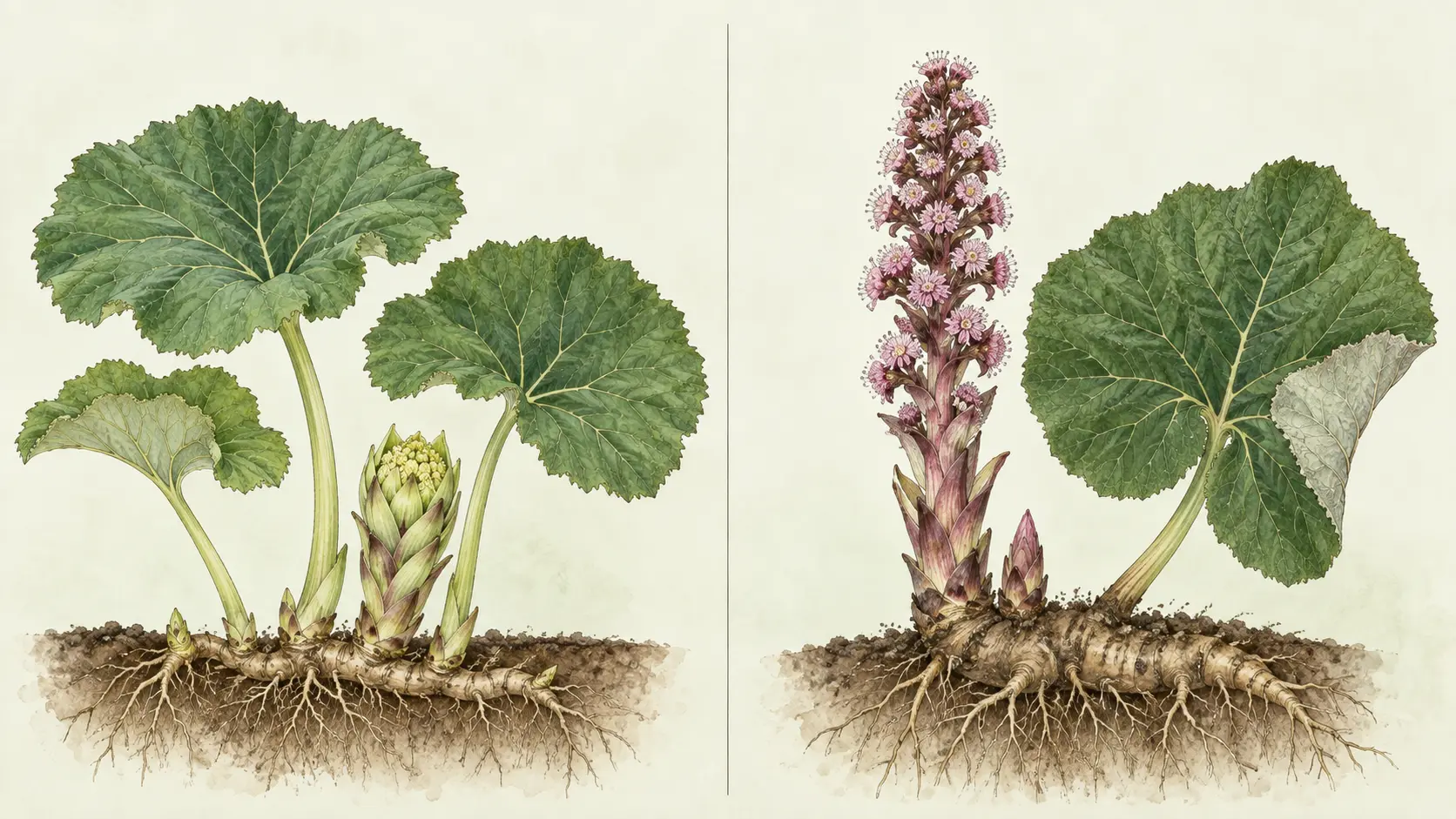
In a Chinese supply chain, four plants realistically compete for the name "butterbur". Identity testing between them comes down to which compounds each one makes.
| Plant | Sesquiterpene Signature | Alkaloid Signature | Other Characteristic Markers |
|---|---|---|---|
| Petasites japonicus | Bakkenolides as the predominant group; eremophilane sesquiterpenes, including the petasin series, in the rootstock[1] | Petasitenine, neopetasitenine and senkirkine, around 99% of total PAs; otonecine-type[6][7] | Fukiic and fukinolic acids in leaf and stem[1] |
| Petasites hybridus | Petasins in the petasin chemotype, or furanoeremophilanes such as furanopetasin in the furanopetasin chemotype; bakkenolide A in smaller amounts[1][8] | Mainly senecionine and integerrimine; retronecine-type[9] | Chemotype determined by TLC of a small piece of rhizome[10] |
| Petasites tricholobus | Bakkenolides, including the Ia to IVa series from the rhizome[11] | Not well characterised in the literature reviewed | Rhizome is the part studied |
| Tussilago farfara | Tussilagone (款冬酮), the reference compound for identification in the Chinese Pharmacopoeia[5] | Senkirkine and senecionine as major alkaloids, with integerrimine and seneciphylline as minor components[12] | Official drug is the flower bud, not the rhizome or leaf[5] |
The alkaloid column is the sharpest way to separate the two butterburs, because their dominant alkaloids belong to different necine classes. Senkirkine on its own is not diagnostic, since coltsfoot carries it as one of its two major alkaloids.[12] Petasitenine and neopetasitenine are what point to P. japonicus. But this is a raw-material test. The purification that makes an extract fit for sale is designed to remove exactly these compounds.
A clean PA result on a finished extract is good news about safety and no news about species.
Bakkenolides are more ambiguous than often claimed. The first bakkenolides, A to E, were isolated from the buds of P. japonicus subsp. giganteus, the Akita-buki of northern Japan.[13] Since then, bakkenolide A has been found in P. hybridus buds,[8] and in one Balkan subspecies of P. hybridus it was the single largest component of the leaf essential oil.[1]
The bakkenolide B-dominant profile of P. japonicus leaf separates it from European butterbur in most cases. It does not separate it from P. tricholobus, whose rhizome is itself a source of bakkenolides.[11] In China, where P. tricholobus is the substitute that matters, a bakkenolide assay narrows the field but does not close it.
DNA barcoding fills the gap only for raw material. In one validation dataset, the ITS2 region distinguished all 34 herbs tested from their 111 known adulterants.[14] It is not suitable for botanical extracts, because processing leaves DNA degraded into fragments shorter than a standard barcode region.[15]
Why identity has to be inherited
Every method that can actually establish species, whether morphology, DNA or alkaloid pattern, works on raw material. What an extract retains is its marker assay and chromatographic fingerprint, and these show consistency with the lot it came from, not which plant that lot was.
The buyer's evidence of species is therefore the raw-material identity record, together with the traceability of each extract lot back to it. A supplier that grows its own material can show where species was fixed. A supplier buying on the market can show its goods-in test. A supplier that can show neither is asking the buyer to trust the label.
03 Chemotype
Chemotype Decides Whether a Total Petasins Grade Can Be Made
Chemotype has shaped the European supply of butterbur for decades. P. hybridus occurs as a petasin chemotype and a furanopetasin chemotype, which cannot be told apart by morphology, and only the petasin chemotype is regarded as pharmaceutically useful.[9] Crossing experiments point to recessive genetic control of the furanopetasin chemotype,[10] and wild populations can contain plants of both chemotypes side by side.[1] Correctly identified P. hybridus can still be the wrong material.
P. japonicus has its own version of the problem. Three chemotypes have been proposed for it: an isopetasin-type, a fukinone-type and a bakkenolide A-type. Read literally, only the first is defined by the petasin series. Petasins are esters of petasol, isopetasol or neopetasol with angelic acid or a sulphur-containing acid, whereas fukinone is a non-esterified eremophilane and bakkenolides are built on a different skeleton altogether.[1]
A P. japonicus root extract that assays at 15–30% Total Petasins therefore implies something about its raw material: it came from plants rich in petasin-series esters. The reverse also holds. Wild material pooled from different populations can mix chemotypes, and petasin content will swing from lot to lot even if every lot is species-correct.
Species-correct, chemotype-wrong material does not fail an identity test. It fails the assay.
That is why a Total Petasins result is a chemotype check as much as a potency figure, and why consistent results across lots say more about a supply than any single COA. The petasin series is not just a convenient number, either. In a 2022 study, petasin was the compound responsible for most of the anti-adipogenic activity of P. japonicus flower-bud extract, with an IC50 of 0.95 μM.[16]
A stand propagated from the same rhizome stock and held on the same ground keeps its chemotype fixed, which a sequence of wild collections cannot do. How the Total Petasins figure is built, and why it is specified as a sum, is covered in Total Petasins explained: petasin, isopetasin and how to specify butterbur extract. The leaf line, which is specified on bakkenolides instead, is covered in Bakkenolide B and butterbur leaf extract.
04 Alkaloids
Where the Alkaloids Sit in the Plant
PA control starts before extraction, with which part of the plant is harvested and how it was grown. The published figures show how uneven the distribution is.
| Plant and Part | Reported Total PAs | Basis |
|---|---|---|
| P. hybridus rhizome, 77 Austrian populations | Below 2 to 500 mg/kg; population medians 2 to 191 mg/kg[9] | Dry material |
| P. hybridus rhizome against leaf, single study | 104.8 ppm against 3.86 ppm[1] | Dry material |
| P. japonicus flower buds | 2.1 to 330 mg/kg[17] | Fresh weight |
| P. japonicus young flower spikes | 8.4 to 23.3 mg/kg[6] | Wet basis |
| P. japonicus petioles, forced cultivation | 1.5 to 2.7 mg/kg[6] | Wet basis |
| P. japonicus petioles, suppressed cultivation | 6.4 to 7.9 mg/kg[6] | Wet basis |
On reading this table
The rows are not directly comparable across species, because the measurement bases differ between dry material, fresh weight and wet basis. Within each species the pattern is consistent, and that pattern is what the rest of this section works from.
In P. hybridus, alkaloids concentrate in the metabolically active thickenings of the rhizome just below the leaves. They are also present in flower stalks, but are almost absent from leaf buds, petioles and leaf blades.[9] In P. japonicus, the flower buds carry more than the stalk and leaf.[17] These are exactly the young shoots eaten as fukinoto, and the tissues a harvest needs to keep out of a leaf or stalk line.
Within one Japanese study, the method of cultivation alone produced roughly a threefold difference in petiole alkaloid levels.[6] PA load is partly a matter of agronomy, before it is a matter of processing.
What the food tradition actually shows
The same work explains why fuki can be eaten. The PAs in P. japonicus are water-soluble, and boiling followed by soaking cut them to under half their original level within one hour for petioles and six hours for young spikes. Peeling barely helps, because the peel held only about 2% of the petiole's alkaloids. Japan's agriculture ministry sees no known health concern from eating the plant, but only on condition that it is prepared in the traditional way and not overeaten.[6]
Fuki's food history is evidence that a boiled and soaked vegetable is acceptable at dietary intake. It is not evidence that the plant is low in alkaloids.
For an extract, the same logic runs in three layers. The first is harvest: which plant part, grown how, and kept separate from which other parts. The second is a removal step that exploits the alkaloids' water solubility, as an acid-water wash does. The third is testing of the finished lot. Root and leaf lines start from different alkaloid loads and should not share one PA assumption.
A direct rhizome-versus-leaf comparison for P. japonicus, equivalent to the P. hybridus data above, does not appear in the literature we reviewed. Why the standard EU testing panel is a poor fit for this species's alkaloids is covered in Pyrrolizidine alkaloids in butterbur: why the standard EU panel misses Petasites japonicus.
05 Safety
Once the Alkaloids Are Removed, the Question Becomes Petasin Dose
The regulatory history of butterbur is P. hybridus history. Germany's BfArM refused to reauthorise the root extract Petadolex after its extraction method changed, and it was withdrawn in 2009.[1] In January 2012 the UK MHRA advised the public not to take unlicensed butterbur products, following reports linking them to liver toxicity.[18] The American Academy of Neurology retired its 2012 migraine guideline on 16 September 2015, citing serious safety concerns with butterbur.[19]
P. japonicus has no comparable record. That is not because it was tested and cleared, but because it was never used as a medicine at that scale.
One detail in that history shifts the question. New Zealand's medicines regulator, summarising the UK alert, noted that liver toxicity had been reported with butterbur extracts from which the PAs had been removed and only small amounts remained.[18] That points away from the contaminant and towards the extract's own constituents, and the toxicology points the same way: hepatotoxic effects were observed only in extracts rich in petasins.[1] P. japonicus contains petasin.[16]
The history does not transfer between the species, but the chemistry does.
The scale of the signal matters as much as its existence. Those hepatotoxic effects appeared in a 28-day rat study only at around 200 times the therapeutic dose, and in vitro only above 170 times therapeutic peak plasma levels. In vitro toxicity of the leaf extract Ze 339 depended on the cytochrome activity of the test system, with rat cells more sensitive than dog or human cells.[1] This is not evidence of harm at normal intake. It is a reason to think in doses rather than in grades.
Grade concentration does not change exposure; milligrams of petasins per day do. A 30% grade in a 25 mg fill and a 10% grade in a 75 mg fill deliver the same 7.5 mg of petasins, and the same questions attach to both. For any petasin-standardised extract of either species, the safety conversation belongs at the level of petasins per serving, which is also the basis on which formulators should compare grades in the first place.
For the leaf line, the published data are short-term. An aqueous P. japonicus leaf extract showed no toxicity in single-dose and two-week repeated-dose studies in rats, with a NOAEL of 5000 mg/kg/day and no mutagenicity.[1] That is useful, but it is a two-week study, not a chronic one.
Efficacy evidence does not transfer either
The 202-patient migraine trial in which only the higher dose outperformed placebo used a P. hybridus rhizome extract. The hay fever study that found a leaf extract comparable to cetirizine used P. hybridus leaf.[1] We are not aware of any published controlled human trial on a P. japonicus preparation. A P. japonicus ingredient cannot borrow this evidence, and several regulators treat the attempt as misleading rather than as a grey area. Nor can it treat its own lack of a regulatory history as a safety record.
06 Sourcing
What to Ask Before Comparing Quotes
Five questions follow from all of this.
Which species, with its author, is on the COA, and is it consistent with where the raw material came from? A Chinese-origin P. hybridus needs an explanation.
Which plant part was used, and which marker matches it? Root and rhizome belong on Total Petasins, and leaf on Total Bakkenolides.
How was species established, and at what stage? The answer needs to name a raw-material record that each extract lot can be traced back to.
Which alkaloids does the PA panel cover? Ask whether they match the species' own alkaloid profile, at what limit of quantification they were measured, and whether the finished lot or the raw material was tested.
How is chemotype controlled? Consistent marker results across lots from a single stand answer it. A rotating supply of wild collections does not.
PhytoVale grows Petasites japonicus on its own cultivation base in Henan: approximately 33 hectares, in production since 2018 and harvested between March and June. Underground and aerial parts are separated at harvest, so species and plant part are fixed in the field before extraction begins. The root line is standardised on Total Petasins and the leaf line on Total Bakkenolides, and the two are run as separate products from separate raw material.
Grades, specifications and batch PA results are set out on the Petasites japonicus extract product page, and samples of both lines can be supplied together for evaluation on your own equipment. Samples are free, MOQ is 1 kg, and quotations are returned within 24 hours.
07 Questions
Petasites japonicus vs Petasites hybridus: Frequently Asked Questions
Is Japanese butterbur the same as butterbur?
No. Both are called butterbur, but Petasites japonicus and Petasites hybridus are different species. They differ in sesquiterpene chemistry and in their pyrrolizidine alkaloids, and they do not share clinical evidence.
Is fuki the plant used in butterbur supplements?
Fuki is P. japonicus. Most published butterbur research, and most Western label copy, refers to P. hybridus. Which plant a given supplement contains depends on its raw-material documentation, not its label name.
Is Petasites hybridus grown in China?
It is not among the six Petasites species recorded in Flora of China. Chinese-origin material labelled P. hybridus should come with evidence of where the raw material was sourced.
Does Petasites japonicus contain petasin?
Yes. Petasin occurs in P. japonicus and has been identified as the main anti-adipogenic compound in its flower buds. How much is present depends on plant part and chemotype, which is why root extracts are standardised on Total Petasins.
Is butterbur the same as coltsfoot?
No. Coltsfoot is Tussilago farfara, a different genus, and its official Chinese drug form is the flower bud. The confusion comes from names the plants have shared historically, both in Latin and in Chinese and Japanese.
Is Japanese butterbur safe because it is eaten as a vegetable?
Not on that basis alone. Fuki is eaten after boiling and prolonged soaking, which removes much of its water-soluble alkaloid content. An extract has to achieve that removal in its own process and demonstrate it by batch testing.
08 Evidence base
References
[1] Kulinowski, Ł., Luca, S. V., Minceva, M., Skalicka-Woźniak, K. (2022). A review on the ethnobotany, phytochemistry, pharmacology and toxicology of butterbur species (Petasites L.). Journal of Ethnopharmacology, 293, 115263. DOI: 10.1016/j.jep.2022.115263
[2] Chen, Y., Nordenstam, B. Petasites and Petasites japonicus. In Flora of China, Vol. 20–21. View source
[3] Avula, B., Wang, Y. H., Wang, M., Smillie, T. J., Khan, I. A. (2012). Simultaneous determination of sesquiterpenes and pyrrolizidine alkaloids from the rhizomes of Petasites hybridus (L.) G.M. et Sch. and dietary supplements using UPLC-UV and HPLC-TOF-MS methods. Journal of Pharmaceutical and Biomedical Analysis, 70, 53–63. DOI: 10.1016/j.jpba.2012.05.021
[4] Makino, T. (1916). 款冬ハふきニ非ズ [Kantō is not fuki]. Journal of Japanese Botany (植物研究雑誌), 1(1).
[5] Chinese Pharmacopoeia Commission (2020). 款冬花 Farfarae Flos. Pharmacopoeia of the People's Republic of China, Vol. I.
[6] Takenaka, M., Miyake, N., Kimura, T., Todoriki, S., Urushiyama, T. (2022). Reduction of pyrrolizidine alkaloids by cooking pre-treatment for the petioles and the young spikes of Petasites japonicus. Food Science and Technology Research, 28(3), 245–255. DOI: 10.3136/fstr.FSTR-D-21-00245
[7] Kitajima, M., Okabe, K., Yoshida, M., Nakabayashi, R., Saito, K., Kogure, N., Takayama, H. (2019). New otonecine-type pyrrolizidine alkaloid from Petasites japonicus. Journal of Natural Medicines, 73, 602–607. DOI: 10.1007/s11418-019-01285-9
[8] Jamieson, G. R., Reid, E. H., Turner, B. P., Jamieson, A. T. (1976). Bakkenolide-A: its distribution in Petasites species and cytotoxic properties. Phytochemistry, 15, 1713–1715. DOI: 10.1016/S0031-9422(00)97462-4
[9] Chizzola, R., Ozelsberger, B., Langer, T. (2000). Variability in chemical constituents in Petasites hybridus from Austria. Biochemical Systematics and Ecology, 28, 421–432. DOI: 10.1016/S0305-1978(99)00077-0
[10] Chizzola, R., Langer, T., Franz, C. (2006). An approach to the inheritance of the sesquiterpene chemotypes within Petasites hybridus. Planta Medica, 72(13), 1254–1256. DOI: 10.1055/s-2006-947226
[11] Wang, Y. L., Li, R. P., Guo, M. L., Zhang, G., Zhang, N., Ma, Y. L. (2009). Bakkenolides from Petasites tricholobus and their neuroprotective effects related to antioxidant activities. Planta Medica, 75(3), 230–235. DOI: 10.1055/s-0028-1088377
[12] Pyrrolizidine alkaloids in Tussilago farfara from Bulgaria. Biotechnology & Biotechnological Equipment (2015). DOI: 10.1080/13102818.2015.1047149
[13] Constituents of genus Petasites IV: bakkenolide-A, a sesquiterpene of novel carbon skeleton. Tetrahedron. View source
[14] Use of the potential DNA barcode ITS2 to identify herbal materials. Journal of Natural Medicines (2012). DOI: 10.1007/s11418-012-0715-2
[15] Derivative technology of DNA barcoding (nucleotide signature and SNP double peak methods) detects adulterants and substitution in Chinese patent medicines. Scientific Reports (2017). View source
[16] Uesugi, D., et al. (2022). Petasin is the main component responsible for the anti-adipogenic effect of Petasites japonicus. Fitoterapia. View source
[17] Hiemori-Kondo, M., Nii, M. (2020). In vitro and in vivo evaluation of antioxidant activity of Petasites japonicus Maxim. flower buds extracts. Bioscience, Biotechnology, and Biochemistry, 84, 621–632. DOI: 10.1080/09168451.2019.1691913
[18] Medsafe, New Zealand Medicines and Medical Devices Safety Authority (2012). Complementary corner: butterbur and liver toxicity. Prescriber Update, June 2012, summarising the MHRA safety alert of 27 January 2012 advising consumers not to take unlicensed butterbur (Petasites hybridus) herbal remedies. View source
[19] Holland, S., Silberstein, S. D., Freitag, F., Dodick, D. W., Argoff, C., Ashman, E. (2012). Evidence-based guideline update: NSAIDs and other complementary treatments for episodic migraine prevention in adults. Neurology. Retired by the AAN Board of Directors on 16 September 2015. DOI: 10.1212/WNL.0b013e3182535d0c
Reviewed by
Prof. Bingji MaScientific Advisor at PhytoVale. Professor and medicinal plant science expert. Research focus covers Chinese medicinal materials, phytochemistry, natural products and medicinal plant quality.
Written by
FloraContent Editor at PhytoVale. Product content and editorial specialist, focused on botanical ingredient specifications, sourcing information and B2B technical content.
This article is intended for ingredient sourcing, formulation and technical information only. It describes published research on Petasites and related species and is not medical advice or a claim for any PhytoVale product. Chemical composition and pyrrolizidine alkaloid content vary with species, chemotype, plant part, cultivation and processing, and several figures cited here come from single studies of specific plant material. Nothing here should be treated as a commercial specification. Species identity, marker content and alkaloid levels must be verified on the actual lot, and finished-product manufacturers remain responsible for regulatory status, permitted claims and labelling in their target markets.


