Reb M 95 vs 98 — the two most common commercial purity grades of rebaudioside M are RM95 (≥95 % Reb M) and RM98 (≥98 %). The price gap is real. The taste difference is not. The distinction that actually matters sits in a property most specification sheets leave out: practical dissolution in cold water.
The 2–5 % balance fraction in RM95 contains other steviol glycosides — most critically rebaudioside D, which is essentially insoluble in water. When Reb D co-crystallises with Reb M during manufacture, it drags total solubility below what pure Reb M achieves on its own. In clear, ambient-temperature beverages, that difference shows up as haze, sediment and inconsistent sweetness. In opaque or heated systems, it does not.
One disclosure. We supply rebaudioside M in both RM95 and RM98 grades. We sell more of whichever grade you order — we have no margin incentive to push one over the other. Every claim below is referenced against peer-reviewed literature, patents or regulatory filings, and you should read with that commercial context in mind.
This guide covers the minor-glycoside composition of each grade, why the taste difference is negligible, how Reb D co-crystallisation reduces practical solubility, which applications are affected and which are not, regulatory compliance across the EU, China and other major markets, a cost-in-use framework, and a bench-test protocol you can run in your own lab before committing to a grade.
01 · Short answer
The 3 % Gap Is Not About Reb M — It Is About What Replaces It
If you are making opaque dairy, baked goods, confectionery or sauces, RM95 and RM98 will behave identically in your product. The minor glycosides in the balance fraction dissolve, or they do not need to dissolve, because the matrix is thick enough to suspend any undissolved material. Buy RM95 and save the premium.
If you are making clear or lightly coloured beverages — carbonated soft drinks, flavoured water, ready-to-drink tea, zero-calorie mixers — the balance fraction matters. Reb D, the dominant impurity in many RM95 products, has a water solubility below 0.05 % at room temperature. When it co-crystallises with Reb M, the combined crystal dissolves more slowly and less completely than pure Reb M. The result is visible haze or settled particles at concentrations that pure Reb M or high-purity RM98 would dissolve cleanly.[1][2]
The rest of this Reb M 95 vs 98 comparison walks through the evidence behind that split. If you already know which application you are formulating for, skip to the application matrix or the decision framework.
02 · Composition
What Is in the Balance Fraction
The balance fraction — everything in the powder that is not Reb M — is not empty filler. It is a mixture of minor steviol glycosides whose identity and proportion depend on the production method. Two publicly available datasets illustrate the range.
Enzymatic / bioconversion products
The European Food Safety Authority evaluated 10 commercial batches of enzymatically produced Reb M as part of its 2020 safety assessment. Reb M content ranged from 95.1 % to 98.2 %. The principal impurities were structural isomers of Reb M itself, not Reb D:[3]
| Component | Range across 10 batches | Nature |
|---|---|---|
| Rebaudioside M | 95.1 – 98.2 % | Target glycoside |
| Reb M isomer | 0.5 – 1.5 % | Structural isomer |
| Reb V isomer | 0.8 – 1.3 % | Structural isomer |
| Reb V2 isomer | 0.3 – 0.5 % | Structural isomer |
| Reb N isomer | ~0.8 % | Structural isomer |
| Reb I / Reb D | ND – 0.2 % | Other steviol glycosides |
In these batches, the balance fraction is dominated by isomers — molecules structurally close to Reb M with broadly similar physical properties. Reb D is nearly absent.
Extraction-enriched products
A different picture emerges from FDA GRAS Notice GRN 744, which describes a Reb M product made by selective extraction and purification from stevia leaf. The Reb D content is dramatically higher:[4]
| Component | Typical value |
|---|---|
| Rebaudioside M | 89.53 % |
| Rebaudioside D | 7.33 % |
| Rebaudioside A | 0.30 % |
| Stevioside | 0.15 % |
| Other glycosides | ~2.7 % |
Why the composition varies
Enzymatic and bioconversion processes build Reb M from a precursor (typically Reb A) by attaching glucose units. Side reactions produce structural isomers of the target, so the balance fraction is mostly isomers. Extraction-based processes start with stevia leaf, which naturally contains Reb D alongside Reb M. The purification removes most but not all of the Reb D. Before comparing grades, ask your supplier which production method was used and request the full glycoside profile on the COA — not just the Reb M assay value.
The practical consequence: two RM95 products from different manufacturers can have fundamentally different balance fractions. One may contain 3 % isomers and almost no Reb D. Another may contain 2–4 % Reb D. The solubility behaviour of the two will differ sharply, as Section 04 explains.
03 · Taste
Taste Difference: Below the Threshold of Detection
Taste is usually the first question buyers ask about purity grades. The answer is short: at the concentrations used in finished products, the difference between RM95 and RM98 is not detectable by human panels.
Reb M sweetness profile
Prakash and colleagues at The Coca-Cola Company characterised Reb M in a 2014 sensory study. The sweetness potency is concentration-dependent — a common feature of high-intensity sweeteners:[1]
| Sucrose reference | Reb M potency (Pw) | Interpretation |
|---|---|---|
| 5 % sucrose | 347× | At low concentration, very high potency |
| 10 % sucrose | 159× | At mid concentration, moderate potency |
The same study reported that Reb M showed "no significant bitter or licorice off-taste" and outperformed Reb A in acidified water at pH 3.2 — a finding directly relevant to beverage applications.[1]
Minor glycoside taste contributions
The minor glycosides in the balance fraction are not off-flavour compounds. Rebaudioside D has its own favourable taste profile — lower bitterness than Reb A, good sugar-like character at moderate concentrations, and a sweetness potency of 250–350× sucrose, comparable to Reb M itself.[2] The structural isomers found in enzymatic products (Reb M isomer, Reb V isomer) are close enough in molecular structure that their individual taste contributions at sub-1 % levels are negligible.
Cross-glycoside sweetness comparison
To put the balance-fraction glycosides in context, the table below compares sweetness potency across the steviol glycosides most commonly encountered in commercial Reb M products:
| Steviol glycoside | Sweetness potency (× sucrose) | Taste notes |
|---|---|---|
| Rebaudioside A | 200 – 300× | Bitter / liquorice off-taste at high concentration |
| Rebaudioside D | 250 – 350× | Lower bitterness than Reb A; good sugar character |
| Rebaudioside M | 200 – 350× | Closest to sucrose; no significant off-taste |
| Enzyme-modified stevia | ~150× | Milder sweetness; good solubility; used in blends |
The problem with Reb D is not its taste — it is its solubility. A 3 % Reb D fraction in RM95 contributes no detectable off-flavour. But it can make the powder physically impossible to dissolve completely in cold water, as Section 04 details.
Sweetness-equivalent calculation
The dosage adjustment required to achieve equal sweetness from RM95 versus RM98 is trivially small. Consider a beverage targeting the sweetness of 10 % sucrose, using Reb M at 200× potency (a conservative mid-range estimate):
| Parameter | RM95 | RM98 |
|---|---|---|
| Reb M needed | 500 ppm | 500 ppm |
| Powder required | 526 ppm | 510 ppm |
| Difference | +16 ppm (3.1 % more RM95 powder) | |
Sixteen parts per million of additional powder has no measurable impact on taste, cost or label declaration. In the Reb M 95 vs 98 comparison, taste is not the axis on which these grades differ.
04 · Solubility
Solubility — The Real Differentiator
This is where the 3 % purity gap stops being a number on a COA and starts showing up in finished products. The evidence builds in three layers.
Layer 1 — Pure Reb M solubility
Reb M is sparingly soluble in water. Published and commercial data converge on a narrow range:[5][6]
| Form | Solubility at 25 °C | Source |
|---|---|---|
| Crystalline Reb M | ~0.1 % (1 000 ppm) | GLG Life Tech product data |
| Thermodynamic equilibrium | ~0.26 % (2 600 ppm) | Crystallisation literature |
| Amorphous Reb M | 1.1 – 1.3 % | Spray-dried form data |
For context, Reb A dissolves to roughly 0.8 % under the same conditions — about three times more soluble than crystalline Reb M. This already makes Reb M a challenging ingredient in cold-dilute systems.
Amorphous form: a 10× solubility gain
The amorphous (non-crystalline) form of Reb M dissolves to 1.1–1.3 % — roughly ten times the crystalline value. Some spray-dried stevia premix blends exploit this property to sidestep the crystalline solubility ceiling. The trade-off: amorphous Reb M is hygroscopic, prone to caking, and will eventually recrystallise on storage. If your Reb M arrives as a spray-dried premix rather than a crystalline powder, its initial dissolution may outperform its specification sheet — but shelf-life stability of the ingredient itself needs verification.
Layer 2 — Reb D is essentially insoluble
Rebaudioside D is among the least soluble of all steviol glycosides. PepsiCo's internal data reports a maximum aqueous solubility of 300–450 ppm (0.03–0.045 %) at 23 °C. Selleckchem's analytical-reagent listing describes Reb D flatly as "insoluble" in water.[2]
Layer 3 — Reb D co-crystallisation reduces Reb M solubility
Here is the mechanism that converts a compositional difference into a practical problem. Coca-Cola's crystallisation patents (US 11,291,233; US 12,408,689) describe what happens when Reb M and Reb D are present together in a crystalline matrix:[7]
Crystalline compositions containing 75–90 % Reb M and 10–25 % Reb D cannot dissolve above 0.10–0.15 % at room temperature — lower than pure Reb M alone.
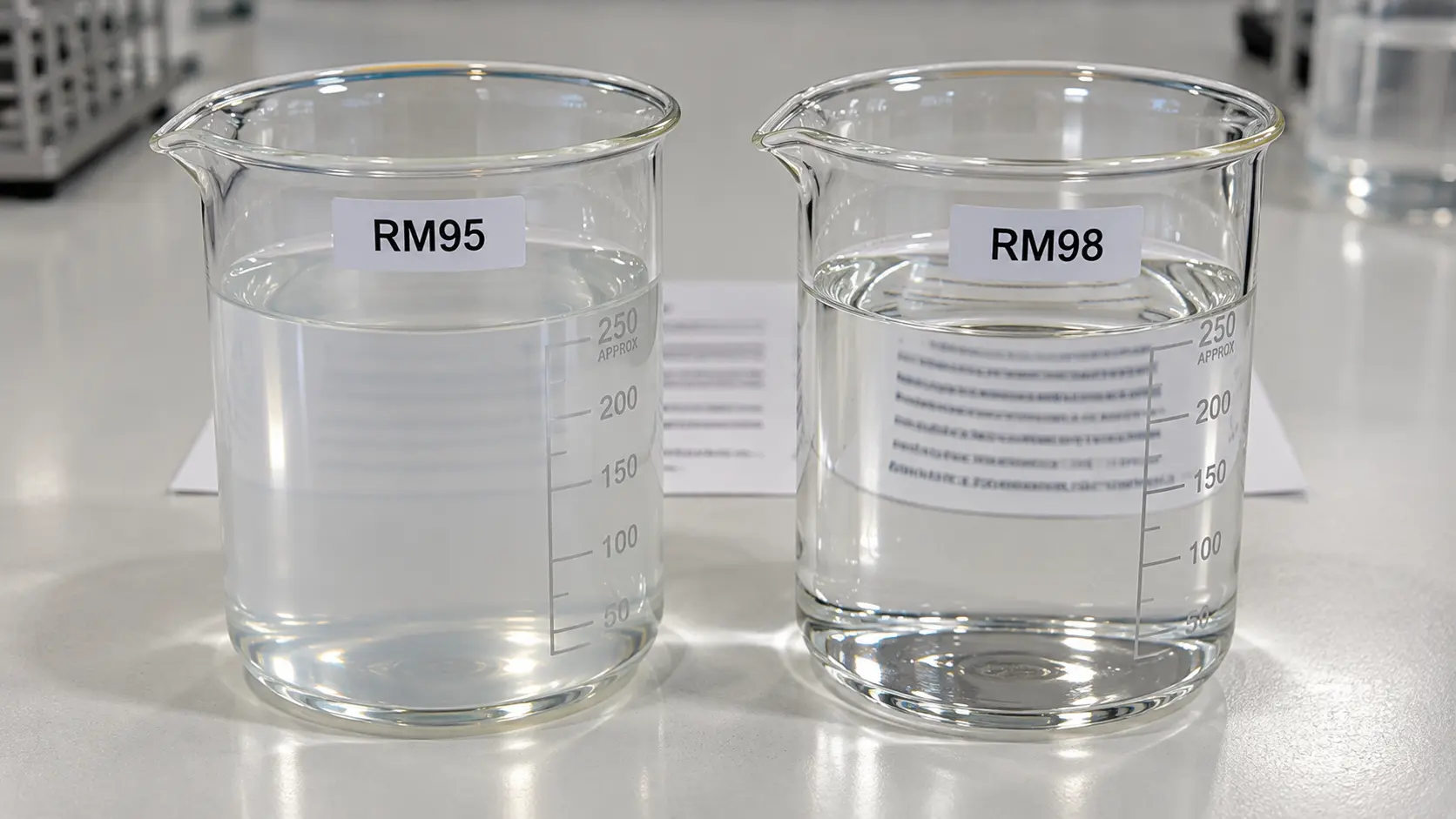
Reb D does not simply sit inert beside Reb M crystals. It co-crystallises into the same lattice, creating a mixed crystal that is harder to dissolve than either component on its own. This is not a theoretical concern — it is why Ingredion's commercial RM95 product (PureCircle Sigma-M) specifies a solubility of just 0.15 %, which is below the 0.26 % equilibrium solubility of pure Reb M.[6]
| Material | Solubility at 25 °C | Relative |
|---|---|---|
| Pure Reb M (equilibrium) | 0.26 % | Baseline |
| Commercial RM95 (Ingredion spec) | 0.15 % | 42 % lower |
| Reb M + 10–25 % Reb D crystal | 0.10 – 0.15 % | 46–62 % lower |
| Reb D alone | < 0.05 % | 81 % lower |
The paradox
Adding Reb D to Reb M reduces the solubility of the mixture below that of pure Reb M. A lower-purity product is not simply "slightly less Reb M" — it is a physically different crystal with worse dissolution behaviour. This is the single most important fact in the RM95-versus-RM98 decision, and it is absent from most supplier data sheets.
For enzymatic RM95 products where the balance fraction is dominated by isomers rather than Reb D, the co-crystallisation effect is milder. But any impurity incorporated into the crystal lattice can alter dissolution kinetics. RM98 minimises the balance fraction regardless of its composition, which is why it dissolves more predictably across suppliers and batches.
05 · Failure scenarios
What Goes Wrong When You Pick the Wrong Grade
The solubility gap described in Section 04 produces four failure modes, all of which appear specifically in clear, dilute, ambient-temperature systems.
Haze in clear beverages
At Reb M concentrations above 200–300 ppm in cold water, RM95 can produce a faint opalescence that is invisible in opaque products but immediately obvious in clear ones. The haze is caused by sub-micron Reb D particles (and co-crystal fragments) that remain suspended rather than settling. A 400 ppm Reb M solution made from RM95 at room temperature sits right at the solubility ceiling of the co-crystal and may fail a turbidity specification that RM98 passes.
Particle settling
In still beverages without agitation, the larger undissolved particles will settle over shelf life — producing a visible ring or sediment layer at the bottom of the bottle. This is a consumer-facing defect that triggers complaints and returns.
Batch-to-batch sweetness variation
If part of the Reb M is trapped in an undissolved co-crystal, the actual dissolved sweetener concentration varies with mixing time, temperature and water hardness. Two batches prepared identically can taste noticeably different — not because the Reb M changed, but because the fraction that dissolved changed.
Hot-fill crash-out
Reb M solubility increases with temperature. A hot-fill process at 85 °C may dissolve RM95 completely. But as the product cools to ambient temperature, the solution supersaturates and Reb D-rich crystals nucleate out of solution. The product leaves the filler clear and develops haze on the shelf. This is the most insidious failure mode because it passes QC at the filling line and fails in the distribution chain.
Stability note
In strongly acidic systems (pH ≤ 2.5) held at high temperature for extended periods, Reb M itself can degrade into isomers and isosteviol glycosides. This is a separate stability concern independent of purity grade — it affects RM95 and RM98 equally. The failure modes above are specific to the balance fraction, not to Reb M degradation.
06 · Application guide
Application Matrix — Where Each Grade Belongs
The decision is straightforward once you know two things about your product: is the matrix clear or opaque, and is the final product stored at ambient temperature or above?
| Application | RM95 | RM98 | Reason |
|---|---|---|---|
| Baked goods | Suitable | Suitable | Opaque matrix; solubility irrelevant |
| Dairy (yoghurt, ice cream) | Suitable | Suitable | Opaque; fat phase suspends particles |
| Confectionery | Suitable | Suitable | High sugar matrix; thermal processing dissolves fully |
| Sauces & dressings | Suitable | Suitable | Viscous / emulsified; particles invisible |
| Tabletop sachets | Suitable | Suitable | Dissolved into hot beverage by consumer |
| Flavoured water (still) | Caution | Recommended | Clear + ambient = haze risk from RM95 |
| Carbonated soft drinks | Caution | Recommended | Clear + CO2 nucleation on particles |
| RTD tea / coffee | Caution | Recommended | Clear or translucent; long ambient shelf life |
| Zero-calorie mixers | Caution | Recommended | Crystal-clear expectation; bar-light visibility |
| Sports / electrolyte drinks | Caution | Recommended | Clear; often low pH accelerates co-crystal visibility |
"Caution" does not mean RM95 cannot work in these applications — it means that dissolution must be verified in your specific formulation (see the bench-test protocol in Section 10). Some clear-beverage formulators use RM95 successfully by pre-dissolving at elevated temperature, by blending with co-sweeteners, or by specifying an enzymatic RM95 with minimal Reb D content.
07 · Workarounds
Making RM95 Work in Clear Beverages
If your procurement team has locked in RM95 pricing or your supply chain cannot source RM98, there are four workarounds that can mitigate the solubility gap. Each adds a step, a cost, or both.
Pre-dissolution at elevated temperature
Dissolving RM95 in water at 60–80 °C before blending into the final batch ensures complete dissolution. The catch: as the solution cools, it becomes supersaturated. If the Reb M concentration in the final product is above the room-temperature solubility ceiling (~0.15 % for high-Reb D RM95), crystals will nucleate over shelf life. Pre-dissolution buys you short-term clarity, not long-term stability.
Co-sweetener blending
Blending Reb M with a highly soluble co-sweetener — erythritol, allulose or a soluble Reb A fraction — reduces the required Reb M concentration below the co-crystal solubility ceiling. A 50:50 Reb M + erythritol blend, for example, halves the Reb M loading and brings dissolution into a safe range. This is already standard practice in many commercial stevia-erythritol blends.
Specify low-Reb-D RM95
Request your supplier's full glycoside profile and select an enzymatic RM95 with Reb D below 0.5 %. The balance fraction in these products is mostly isomers, which co-crystallise less aggressively than Reb D. Not all suppliers can provide this level of compositional detail, and it narrows your sourcing options.
Enzyme-modified stevia blends
Enzyme-modified stevia glycosides (α-glucosyl steviol glycosides) have lower sweetness potency (~150× sucrose) but substantially higher water solubility than native Reb M. A blend containing 70–80 % Reb M and 20–30 % enzyme-modified stevia can deliver adequate sweetness while keeping the total dissolved-glycoside load within the solubility window. This approach is already established in Japanese and Korean tabletop stevia products. The trade-off is a broader ingredient declaration and a slightly different temporal sweetness profile.
The real cost question
Each workaround adds either process complexity (pre-dissolution requires a heated premix tank), formulation constraints (co-sweetener blending limits your sweetener-system flexibility), supply-chain friction (specifying low-Reb-D RM95 locks you to fewer suppliers), or label complexity (enzyme-modified blends broaden the ingredient list). Before investing in a workaround, calculate whether the RM95-to-RM98 price premium is smaller than the cost of the workaround itself. In many cases, it is.
08 · Regulatory
Regulatory Landscape — Where Purity Specifications Bite
The EU is not the only market that sets a purity floor for steviol glycosides, but it is the only major market where that floor applies to individual Reb M content rather than total steviol glycosides. This distinction is critical when choosing between RM95 and RM98.
| Market / Framework | Regulation | Purity requirement | What it measures |
|---|---|---|---|
| European Union | E 960c(ii), Reg. (EU) 231/2012 | ≥ 95 % Reb M (dried basis) | Individual Reb M content |
| United States | GRAS (self-affirmed, e.g. GRN 744) | ≥ 95 % total steviol glycosides | Total glycosides, not individual Reb M |
| China | GB 8270-2014 (steviol glycosides) | ≥ 95 % total steviol glycosides | Total glycosides |
| JECFA / Codex | JECFA Monograph (2017 rev.) | ≥ 95 % total steviol glycosides | Total glycosides |
| Japan | JSFA (Specifications and Standards for Food Additives) | Steviol glycoside content requirement | Total glycosides |
In most markets outside the EU, an RM95 product with 95 % Reb M plus 3–5 % other steviol glycosides easily clears a “95 % total steviol glycosides” floor because the balance fraction is itself composed of glycosides. The EU is the exception: it looks at Reb M alone, so every percentage point of Reb D or isomer in the balance fraction works against you.[8][9]
The EU compliance problem
An RM95 product that assays at 95.0–95.5 % sits directly on the regulatory floor. Two factors conspire against it:
Batch variation
No manufacturing process delivers identical assay values batch after batch. The EFSA dataset (Section 02) shows a range of 95.1 – 98.2 % across 10 batches from a single producer. A supplier whose process centres on 95.5 % will occasionally ship batches at 94.8 % or 95.0 %. At the EU threshold, those batches either fail or require rework.[3]
Analytical uncertainty
HPLC assays carry measurement uncertainty, typically ± 0.5–1.0 % for steviol glycoside purity methods. A reported result of 95.2 % may have a true value anywhere between 94.2 % and 96.2 %. If an enforcement laboratory re-tests your ingredient at the lower end of that range, you have a non-compliant product on the EU market.
RM98 provides a 3-percentage-point buffer above the EU minimum. RM95 provides no buffer at all.
For markets that measure total steviol glycosides rather than individual Reb M — the US, China, Japan and JECFA-aligned countries — this regulatory argument carries less weight. But if any part of your product distribution touches the EU, the compliance margin alone can justify the RM98 premium. And if you sell globally, a single RM98 specification satisfies every framework listed above with margin to spare.
09 · Economics
Cost Comparison — Price per Kilogram vs. Cost per Litre
RM98 costs more per kilogram than RM95. That price gap is the reason this article exists. But the correct comparison is cost in use — the sweetener cost per litre of finished product — not price on the invoice.
Indicative price ranges
Market prices for food-grade Reb M fluctuate with stevia leaf supply, production method and order volume. The ranges below are representative of 2024–2025 contract pricing for kilogram-to-tonne quantities:
| Grade | Indicative price (USD/kg) | Notes |
|---|---|---|
| RM95 | $300 – $500 | Enzymatic and extraction grades; wide range reflects volume and origin |
| RM98 | $345 – $575 | Typically 15 – 20 % premium over equivalent RM95 |
Cost per litre in finished beverages
At typical beverage use levels (300–500 ppm Reb M in the finished drink), the absolute cost difference between grades is small. The table below uses a 400 ppm target and mid-range pricing:
| Parameter | RM95 ($400/kg) | RM98 ($460/kg) |
|---|---|---|
| Powder needed per litre | 421 mg | 408 mg |
| Sweetener cost per litre | $0.168 | $0.188 |
| Cost-in-use premium | ~$0.02 per litre (11.6 %) | |
Two cents per litre. In the Reb M 95 vs 98 cost comparison, the RM98 premium adds approximately one cent per 500 mL bottle to the ingredient cost. That is the number to weigh against the hidden costs below.
Hidden costs of RM95 in clear beverages
The one-cent-per-bottle premium for RM98 should be weighed against the costs that RM95 can add in sensitive applications:
- Heated premix step: Energy, equipment time and an additional CIP cycle for a pre-dissolution tank.
- Turbidity QC: Additional in-line or lab turbidity testing to catch haze before filling.
- Shelf-life claims: Accelerated stability testing to confirm no crystal crash-out over 12–18 months.
- Consumer complaints: A single visible-sediment complaint batch can cost more in returns and brand damage than a year of RM98 premium.
- Regulatory rework: An EU batch that fails the 95 % floor requires disposal or reprocessing — costs that dwarf the ingredient premium.
For opaque-matrix applications where none of these costs apply, the RM95 savings flow straight to margin. That is the correct choice.
10 · Bench test
A 30-Minute Lab Protocol to Test Your Own Application
Before committing to a grade for a new formulation, run this simple bench test. It requires no specialised equipment — a beaker, a magnetic stirrer, a turbidity tube or a spectrophotometer, and a refrigerator.
Protocol
- Step 1 — Prepare. Weigh out your target Reb M concentration (e.g. 400 ppm) in 500 mL of your product water (matching pH, mineral content and any co-ingredients). Prepare two samples: one with RM95, one with RM98.
- Step 2 — Dissolve at ambient. Stir both samples at 25 °C for 15 minutes at 300 rpm. Do not heat.
- Step 3 — Measure clarity. Measure turbidity (NTU) or absorbance at 600 nm. Photograph both samples against a printed-text background — the text-readability test is a fast visual proxy for clarity.
- Step 4 — Thermal cycle. Heat both samples to 85 °C, hold for 2 minutes, then cool to 5 °C and hold for 24 hours. This simulates hot-fill followed by refrigerated distribution.
- Step 5 — Re-measure. Bring samples to 25 °C, measure turbidity again. Look for sediment. Taste both.
Acceptance criteria
Target: < 1.0 NTU (or absorbance A600 < 0.005) at both Step 3 and Step 5. If both samples meet this threshold, RM95 works for your application. If RM95 exceeds 1.0 NTU at either step while RM98 stays below, RM98 is the safer grade. For carbonated products, add a visual CO2 nucleation check — bubbles preferentially nucleate on undissolved particles, producing excessive foam or streaming. The thermal cycle at Step 4 is critical — many co-crystal problems only appear after cooling from an elevated temperature.
We can supply bench-test quantities of both grades. Request samples through the link at the bottom of this page, and specify that you want matched lots for a dissolution comparison.
11 · Decision framework
Reb M 95 vs 98 — Which Grade Should You Specify?
Three questions resolve the decision for most applications:
Is your product clear? Is it stored at ambient temperature? Does your distribution include the EU?
- All three are no: Use RM95. It saves cost with no performance trade-off.
- Any one is yes: Run the bench test. If RM95 passes, use it. If not, switch to RM98.
- Two or three are yes: Default to RM98. The price premium is small relative to the risk of a shelf-stability or compliance failure.
Quick reference
| Your situation | Recommended grade |
|---|---|
| Opaque food (bakery, dairy, sauces, confectionery) | RM95 |
| Tabletop / sachets dissolved in hot liquid | RM95 |
| Clear beverage, ambient shelf life | RM98 |
| Carbonated or sparkling product | RM98 |
| EU-market product at ≥95 % spec floor | RM98 (compliance margin) |
| Multi-market product including EU | RM98 (simplifies global spec) |
| Unsure / new formulation | Request both; run bench test |
12 · Next step
Request Samples and Full Glycoside Profiles
We supply rebaudioside M in RM95 and RM98 grades. Every lot ships with a full HPLC glycoside profile — not just total Reb M, but individual quantification of Reb D, Reb A, stevioside and minor isomers. Ask for matched bench-test samples if you want to run the dissolution protocol above.
FAQ
Frequently Asked Questions
Reb M 95 vs 98 — is RM98 always better?
No. In opaque, viscous or thermally processed systems — bakery, dairy, confectionery, sauces — the balance fraction has no measurable effect on product quality. RM95 performs identically and costs less. RM98's advantages are specific to clear, ambient-temperature beverage applications and EU regulatory compliance.
What causes haze when I dissolve Reb M in cold water?
Haze is caused by sub-micron particles of undissolved steviol glycosides — primarily Reb D or Reb D–Reb M co-crystals — that remain suspended in solution. Reb D's aqueous solubility is below 0.05 % at 25 °C (roughly one-fifth of Reb M's own solubility), so even small amounts can produce visible turbidity in clear systems. Switching to RM98 reduces the Reb D fraction and usually eliminates the haze.
Does higher purity Reb M taste better?
Not detectably. The minor glycosides in the balance fraction (Reb D, Reb M isomers, Reb V isomers) have taste profiles comparable to or better than Reb M itself. At the 2–5 % levels present in RM95, their contribution to overall taste is below the threshold of detection in finished products. Sensory panels consistently report no significant difference between RM95 and RM98 at typical use concentrations.
Can I use RM95 in clear beverages if I pre-dissolve it in hot water?
Pre-dissolution at 60–80 °C can achieve initial clarity, but it does not guarantee long-term stability. As the solution cools, it becomes supersaturated with respect to the Reb D co-crystal. If your final Reb M concentration is above the room-temperature solubility ceiling (roughly 0.15 % for RM95 with significant Reb D content), crystals will nucleate over weeks to months. Run the thermal-cycle bench test in Section 10 before relying on pre-dissolution as a long-term solution.
Does Reb M purity affect regulatory approval outside the EU?
In the United States, Reb M is used under GRAS determinations that specify ≥ 95 % total steviol glycosides — not individual Reb M. China (GB 8270-2014), JECFA/Codex and Japan (JSFA) also set the floor at 95 % total glycosides. Because the balance fraction in RM95 is itself composed of steviol glycosides, an RM95 product typically meets all these frameworks easily. The EU is the only major market that measures individual Reb M content at 95 %, which is why the compliance risk is specific to EU-bound products. If you sell globally and want a single specification, RM98 satisfies every framework with margin.
What is Reb D and why does it affect Reb M purity grades?
Rebaudioside D is a steviol glycoside found naturally in stevia leaves alongside Reb M. It is the dominant impurity in extraction-based Reb M products (up to 7 % in lower-purity grades) and is nearly absent in enzymatic products. Reb D has a water solubility below 0.05 % at room temperature and co-crystallises with Reb M, reducing the solubility of the mixed crystal below that of pure Reb M. This is the primary mechanism by which lower-purity Reb M creates dissolution problems in clear beverage applications.
How do I test whether my application needs RM95 or RM98?
Run the bench-test protocol in Section 10. Prepare two identical samples of your formulation — one with RM95, one with RM98 — at your target Reb M concentration. Measure turbidity before and after a thermal cycle (heat to 85 °C, cool to 5 °C, hold 24 hours, return to 25 °C). If both samples are equally clear, RM95 works. If RM95 is hazier, use RM98. We supply bench-test quantities of both grades on request.
References
References
Sweetness & taste
[1] Prakash I, Dubois GE, Clos JF, Wilkens KL, Fosdick LE. Development of next generation stevia sweetener: rebaudioside M. Foods. 2014;3(1):162–175. doi:10.3390/foods3010162
[2] PepsiCo Inc. Internal sensory and solubility data on rebaudioside D. Cited in patent filings and technical literature. See also Selleckchem product listing S9498 (rebaudioside D analytical standard).
Composition & analytical
[3] EFSA Panel on Food Additives and Flavourings. Safety of a proposed amendment of the specifications for steviol glycosides (E 960) as a food additive: Reb M produced by enzymatic modification. EFSA J. 2020;18(4):6106. doi:10.2903/j.efsa.2020.6106
[4] FDA GRAS Notice GRN 744. Rebaudioside M from Stevia rebaudiana Bertoni leaf extract. Office of Food Additive Safety, 2018. FDA GRAS database
Solubility & crystallisation
[5] GLG Life Tech Corp. Rebaudioside M 95 % and 97 % product specifications. Technical data sheet. 80–100 mesh white powder, sparingly soluble in water.
[6] Ingredion Inc. (PureCircle). PureCircle Sigma-M Rebaudioside M 95 technical data sheet. Specified solubility: 0.15 % at 25 °C.
[7] Coca-Cola Company. Sweetener compositions containing rebaudioside M and rebaudioside D. US Patent 11,291,233 B2 (2022); continuation US Patent 12,408,689 (2024). Claims describe co-crystallisation of Reb M/D and solubility limits of mixed crystals.
Regulatory
[8] Commission Regulation (EU) No 231/2012 laying down specifications for food additives listed in Annexes II and III to Regulation (EC) No 1333/2008. As amended, steviol glycoside E 960c(ii) specification: rebaudioside M content not less than 95 % on a dried basis. EUR-Lex
[9] GB 8270-2014. National Food Safety Standard — Steviol Glycosides (食品安全国家标准 食品添加剂 甜菊糖苷). People’s Republic of China. Requires total steviol glycoside content ≥ 95 % on a dried basis.
Written by
FloraPhytoVale technical-content team. Flora writes product and ingredient guides for B2B buyers, drawing on published literature and supplier-side experience.
Reviewed by
Xinjuan XuAssociate Professor of Food Science. Xinjuan reviews stevia and steviol glycoside content for technical accuracy before publication.
Disclaimer — PhytoVale supplies the ingredient discussed in this article in both grades compared. This content is provided for informational purposes only and does not constitute medical, legal or regulatory advice. Always verify claims against the primary literature and regulatory texts cited above and consult qualified professionals for product-specific decisions.