What Is Lion's Mane Extract? Bioactive Compounds, Benefits & Quality Guide
Written by Flora, Content Editor · Updated October 2026
Two lion's mane extracts sit on a buyer's desk. One reads polysaccharides ≥ 50 %; the other, β-glucan ≥ 30 %. The price gap is threefold. Which one is actually better — and why does the label make it so hard to tell?
The answer lies in the biology of Hericium erinaceus, the extraction method used to concentrate its active compounds, and the difference between a number that sounds impressive and a number that reflects genuine bioactivity. This guide walks through all three.
Below we cover what lion's mane extract actually contains — hericenones, erinacines, β-glucans and the polysaccharide question — what clinical research has demonstrated so far, how extraction shapes the final product, and how to read a specification sheet without guessing.
View our Lion's Mane Extract Jump to spec-sheet guide01 Origin
A Culinary Mushroom with a Regulatory Head Start
Hericium erinaceus (Bull.) Pers. — lion's mane, yamabushitake in Japanese, 猴头菇 in Chinese — is a toothed fungus native to the hardwood forests of North America, Europe and East Asia. Its cascading white spines, resembling a frozen waterfall, make it one of the most visually distinctive edible mushrooms in the world.[1]
In traditional Chinese medicine the mushroom has been valued for centuries as both food and medicine — prescribed for strengthening the spleen and stomach, calming the mind, and treating chronic gastritis and duodenal ulcers.[2] Japanese yamabushi monks are said to have used it as a tonic during meditation retreats, lending the mushroom its Japanese name.
For B2B buyers, this centuries-long food-use history carries a practical advantage: lion's mane is one of the few nootropic-positioned ingredients that simultaneously holds clinical evidence for nerve growth factor stimulation and a documented culinary track record long enough to simplify regulatory filings in most major markets. Newer cognitive-health ingredients — synthetic nootropics, obscure adaptogens — rarely have both.
02 Compounds
Bioactive Compounds: What Makes One Extract Different from Another
Most "what is lion's mane" articles list hericenones and erinacines in the same sentence and move on. For anyone evaluating raw materials, that sentence hides a distinction that changes everything about sourcing.
Hericenones — the fruiting-body marker
Hericenones (C, D, E and others) are aromatic diterpenoids found exclusively in the fruiting body of H. erinaceus. They stimulate the biosynthesis of nerve growth factor (NGF) in astrocyte cells — a mechanism first documented by Kawagishi et al. in the early 1990s and confirmed repeatedly in vitro since.[3] A 2025 gene-expression study confirmed that hericenone-pathway genes are upregulated in fruiting-body tissue and downregulated in mycelium, reinforcing the compound's specificity to the mushroom itself rather than its vegetative stage.[4]
Erinacines — the mycelium marker
Erinacines are cyathane-type diterpenoids produced in the mycelium of H. erinaceus. Erinacine A, the most studied member, is a potent inducer of both NGF and BDNF (brain-derived neurotrophic factor) synthesis, and it has shown neuroprotective effects in animal models of Alzheimer's and Parkinson's disease.[5]
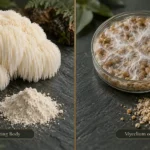
The critical sourcing implication: erinacine biosynthesis genes are consistently downregulated in the fruiting body.[4] A fruiting-body extract will not contain meaningful erinacines; a mycelium extract will not contain meaningful hericenones. This is not a defect in either product — it is a biological fact that should be reflected on the label and in the marketing claim. For a full comparison of what each source delivers and what to verify on the COA, see our guide to lion's mane fruiting body vs mycelium.
β-Glucans — the immune-active polysaccharide
β-Glucans are high-molecular-weight polysaccharides embedded in the fungal cell wall. In H. erinaceus, they activate macrophage phagocytosis, enhance NK-cell cytotoxicity, promote dendritic-cell maturation, and upregulate intestinal secretory IgA — effects mediated through the TLR4 / NF-κB and MAPK / AKT signalling pathways.[6][7]
Crucially, β-glucans must be extracted from the chitin cell wall to become bioavailable. Raw or lightly cooked mushroom powder delivers far less immunological activity than a hot-water extract standardised to β-glucan content — because the extraction process ruptures the chitin matrix and liberates the polysaccharides that chitin was protecting.
Why "polysaccharides" ≠ "β-glucan" — the spec-sheet distinction that saves buyers money
This is the point most competitor guides skip entirely, yet it is the one that prevents the most expensive sourcing mistakes.
Total polysaccharides is a broad analytical category that includes α-glucans (starch), β-glucans, mannans, xylans and other sugar polymers. When a product label reads polysaccharides ≥ 50 % without separately quantifying β-glucan, a significant fraction of that number may come from residual starch — especially if the source material is mycelium grown on a grain substrate, where the grain itself contributes α-glucans that inflate the total.
The table below puts the difference in concrete terms:
| Spec item | Product A | Product B |
|---|---|---|
| Label claim | Polysaccharides ≥ 50 % | β-Glucan ≥ 30 % |
| Source | Mycelium on grain | Fruiting body |
| Extraction | Not specified | Hot water |
| β-Glucan (Megazyme assay) | Likely 5–8 % (remainder is starch from grain substrate) | ≥ 30 % verified |
| Immune-active polysaccharide per gram | ~50–80 mg | ~300 mg |
| Typical price position | Lower | Higher — but 4–6× the functional payload |
The industry-standard method for distinguishing the two is the Megazyme enzymatic assay (K-YBGL), which hydrolyses starch before measuring remaining β-glucan. Any serious specification sheet should report β-glucan by this method — not by a generic phenol–sulphuric-acid total-polysaccharide assay that cannot tell starch from bioactive fungal glucan.
A product labelled "polysaccharides 50 %" from mycelium on grain may deliver only 50–80 mg of immune-active β-glucan per gram. A fruiting-body hot-water extract labelled "β-glucan 30 %" delivers roughly 300 mg per gram — four to six times the functional payload at a lower headline number.
03 Evidence
Research-Backed Benefits: What the Clinical Data Actually Shows
Rather than listing "10 health benefits" with a mix of test-tube and animal findings, the sections below are ranked by the strength of human clinical evidence — because for B2B buyers, the claims their customers can legally and credibly make depend on the quality of the studies behind them.
Cognitive function and neuroprotection — the strongest evidence
The landmark trial is Mori et al. (2009): a 16-week, double-blind, placebo-controlled study of 30 Japanese adults (aged 50–80) with mild cognitive impairment. Participants took four 250 mg tablets of lion's mane fruiting-body dry powder three times daily (3 g/day total). By weeks 8, 12 and 16, the lion's mane group scored significantly higher on the Hasegawa Dementia Scale than the placebo group. Notably, scores declined significantly within four weeks of cessation, suggesting the effect requires continued intake.[3]
Subsequent trials have extended the picture. Li et al. (2020) conducted a 49-week trial showing that erinacine-A-enriched mycelium significantly slowed cognitive decline in patients with mild Alzheimer's disease, with improvements in MMSE score and an increase in circulating BDNF.[5] Docherty et al. (2023) demonstrated that a single 3 g dose of 10:1 fruiting-body extract improved working-memory reaction time in healthy young adults (aged 18–35) within 60 minutes of ingestion, with chronic 28-day supplementation reducing subjective stress.[8]
A 2025 systematic review spanning literature from 2000 to 2024 concluded that H. erinaceus shows consistent promise for neuroprotection and cognitive enhancement across both impaired and healthy populations, with NGF and BDNF stimulation as the primary proposed mechanisms.[9]
What this means for sourcing
The landmark Mori trial used unextracted fruiting-body dry powder — meaning a fruiting-body extract with verified hericenone content sits closest to the clinical evidence base for cognitive claims. The Li trial, by contrast, used erinacine-A-enriched mycelium — relevant for buyers positioning a product specifically around Alzheimer's or neurodegenerative support. The choice of source material is not a quality judgement; it is a claim-strategy decision.
Mood, anxiety and stress — emerging clinical support
Nagano et al. (2010) gave 30 women four cookies per day containing 0.5 g of lion's mane powder each (2 g/day total) for four weeks. The lion's mane group showed significantly lower scores on the Centre for Epidemiologic Studies Depression Scale, particularly on the "irritating" and "anxious" subscales. The authors noted that the mood improvements appeared independent of NGF enhancement, suggesting additional mechanisms at play.[10]
These are encouraging results, but sample sizes remain small (30 participants in the Nagano study) and the populations studied have been narrow. Larger, more diverse trials are needed before mood-related claims can carry the same weight as cognitive ones.
What this means for sourcing
Mood and stress claims are commercially attractive, but the supporting clinical evidence is thinner than for cognitive function. Buyers targeting this positioning should frame products around "supports a positive mood" rather than making specific anti-anxiety or antidepressant claims, and should pair the ingredient with complementary adaptogens that have stronger mood-specific evidence.
Gut health and gastroprotection — tradition meets modern evidence
The traditional Chinese indication for lion's mane — strengthening the spleen and stomach — now has a growing body of preclinical support. Gravina et al. (2023) published a comprehensive review in the World Journal of Gastroenterology documenting anti-inflammatory and gastroprotective activity in models of chronic gastritis, inflammatory bowel disease and colorectal cancer.[2]
Roda et al. (2024) found that lion's mane supplementation promoted the growth of beneficial gut bacteria while suppressing pathogenic strains, exhibiting a prebiotic-like effect — and, intriguingly, the same study observed improvements in cognitive performance in aged mice, linking gut microbiota changes to brain function.[6]
What this means for sourcing
Hot-water extraction, which concentrates β-glucans and water-soluble polysaccharides, aligns most closely with the gut-health mechanism (prebiotic fibre → microbiota modulation). Buyers formulating a digestive-health product should prioritise β-glucan content over hericenone content, and can cite the centuries-old TCM indication as supporting traditional evidence.
The gut–brain axis: where the oldest claim meets the newest science
This is perhaps the most compelling narrative emerging from recent research — and one that no competitor guide has yet connected for buyers.
For centuries, lion's mane was prescribed to "nourish the stomach". In the 2020s, science is revealing that the stomach and the brain are not separate targets but connected endpoints on a single biological highway. The gut–brain axis — the bidirectional communication network linking the enteric nervous system to the central nervous system via the vagus nerve, immune signalling and microbial metabolites — means that a mushroom extract that improves gut microbial diversity may simultaneously support cognitive function.
Here is how the pathway works in practice: lion's mane β-glucans and polysaccharides reach the colon largely intact, where they are fermented by resident bacteria. This fermentation increases the abundance of short-chain-fatty-acid (SCFA)-producing species — primarily those generating butyrate, propionate and acetate. SCFAs are not merely gut-health markers; butyrate strengthens the intestinal barrier, reducing systemic inflammation, while also crossing the blood–brain barrier and modulating microglial activity in the brain, thereby reducing neuroinflammation. Menon et al. (2025) highlighted this SCFA-mediated pathway as a key mechanism connecting lion's mane's gut effects to its cognitive benefits.[9]
Lion's mane may be the rare ingredient where the traditional indication and the modern mechanism converge on the same biological pathway — the gut–brain axis — making it credible in both digestive-health and cognitive-health product lines, from a single raw material.
For brand owners, this dual positioning is commercially significant. A single SKU of lion's mane extract can serve two product categories — cognitive support and digestive wellness — with two distinct but scientifically connected stories. Few functional ingredients offer that flexibility without stretching the evidence.
Immune modulation — strong preclinical evidence
Shang et al. (2017) showed that lion's mane polysaccharides enhanced both cellular and humoral immunity in an immunosuppressed mouse model, boosting macrophage phagocytosis, NK-cell activity and intestinal SIgA secretion through the MAPK and AKT pathways.[7]
No published human clinical trial has yet tested immune endpoints specifically for lion's mane, so product claims in this area should cite the mechanism (β-glucan → macrophage activation) rather than asserting a direct clinical benefit.
04 Dosage
Clinical Dosage Summary: What the Trials Actually Used
Most guides omit this table — yet it is the single most useful reference for formulators deciding on a serving size. The rightmost column converts each trial's dose into an approximate equivalent for a 10:1 hot-water extract, which is the most common commercial format.
| Study | Population | Form used | Daily dose | Duration | ~10:1 extract equivalent |
|---|---|---|---|---|---|
| Mori 2009[3] | MCI, aged 50–80 | Fruiting-body dry powder | 3 g/day | 16 weeks | ~300 mg/day |
| Nagano 2010[10] | Women, mean age 41 | Fruiting-body powder (in cookies) | 2 g/day | 4 weeks | ~200 mg/day |
| Li 2020[5] | Mild AD, aged 50+ | Erinacine-A-enriched mycelium | ~1.35 g/day | 49 weeks | N/A (mycelium-specific) |
| Docherty 2023[8] | Healthy, aged 18–35 | 10:1 fruiting-body extract | 3 g extract | Acute + 28 days | 3 g/day (already 10:1) |
Formulation note
The Mori trial (3 g/day dry powder ≈ 300 mg of a 10:1 extract) sets a practical floor for cognitive-health capsule formulations — achievable in a single capsule. The Docherty trial used a much higher extract dose (3 g of a 10:1, equivalent to 30 g of raw material) and observed acute cognitive effects within 60 minutes, suggesting dose-response is not yet fully mapped and higher doses may offer faster onset. No trial to date has used an extract standardised to a specific β-glucan percentage, so correlating these dosages directly to a β-glucan-standardised product requires caution. For a detailed breakdown of grades and how they fit different dosage forms, see our bulk sourcing guide.
05 Safety
Safety, Side Effects and Regulatory Considerations
Lion's mane has a long history of culinary use and a generally favourable safety profile, but buyers formulating finished products need to know the regulatory landscape — not just the toxicology.
Known adverse reactions
Adverse events in clinical trials have been minimal. The most commonly reported side effects in post-market surveillance include mild gastrointestinal discomfort, skin rash and nausea. A single 2003 case report documented acute respiratory distress syndrome in one individual following ingestion, likely an allergic reaction. Anyone with a known mushroom allergy should avoid lion's mane products. No significant drug interactions have been reported in clinical trials to date, but buyers formulating products for populations on anticoagulant or immunosuppressant therapy should note that β-glucan-mediated immune activation is a theoretical interaction point — a precautionary line worth including in finished-product labelling.
Regulatory status by market
| Market | Status | What this means in practice |
|---|---|---|
| United States | Dietary supplement under DSHEA | No specific GRAS notification needed for supplement use. Structure/function claims require substantiation and an FDA notification letter within 30 days of first marketing. |
| European Union | Novel Food status varies by form | Whole dried mushroom has food-use history in some Member States. Concentrated extracts (high ratio, solvent-extracted) likely require Novel Food authorisation under Regulation 2015/2283 — check the Union Novel Food Catalogue for your specific extract form before shipping. |
| Canada | Licensed as NHP | Requires a Natural Product Number (NPN); monograph available for H. erinaceus fruiting body, which simplifies the application. |
| Australia / NZ | Complementary medicine | Must be listed on the ARTG. Low-risk (listed) pathway is available for traditional-use claims; evaluated pathway needed for higher-level claims. |
Regulatory status is not a fixed label — it depends on the extract form, the concentration, the part used and the intended claim. If you need regulatory documentation (COA, MSDS, TDS, allergen statement, origin statement) for a specific destination, our team can advise on what we supply alongside the raw material.
06 Extraction
How the Extraction Method Shapes What You Get
The extraction method is not a production detail to gloss over — it determines which compounds survive in the final powder, and therefore which health claims the finished product can credibly support.
Hot-water extraction
Hot water is the oldest and most widely used solvent for medicinal mushrooms. It excels at rupturing the chitin cell wall and liberating water-soluble β-glucans, heteropolysaccharides and certain glycoproteins. Because no organic solvent is involved, the finished extract carries no solvent-residue risk, simplifying regulatory documentation.
The trade-off: hericenones are partially lipophilic and not fully extracted by water alone. A hot-water-only extract will be strong in β-glucans and polysaccharides but lower in hericenones.
Best fit: immune-support formulations, gut-health products, functional foods and beverages where β-glucan content is the primary selling point.
Dual extraction (water + ethanol)
Adding an ethanol step after hot-water extraction captures additional alcohol-soluble compounds, including hericenones, certain triterpenoids and phenolic metabolites. In theory, dual extraction delivers the broadest compound spectrum.
In practice, however, ethanol can precipitate a portion of the β-glucans out of solution — meaning a dual extract sometimes contains less β-glucan than a pure hot-water extract from the same starting material. Laboratory comparisons by independent testing groups have confirmed this counter-intuitive result: a dual-extracted fruiting-body product tested at 15 % β-glucan while a hot-water-only extract from the same batch tested at 31 %.
Best fit: nootropic and cognitive-health formulations where hericenone content is a priority, and the buyer accepts a potentially lower β-glucan titre in exchange for a broader compound profile.
The extract-ratio question
Labels reading "10:1" or "20:1" indicate that 10 kg or 20 kg of raw mushroom yielded 1 kg of extract. A higher ratio implies greater concentration — but concentration of what?
Consider two real-world scenarios: a 20:1 extract with a COA showing β-glucan at 15 %, versus a 10:1 extract with β-glucan at 30 %. The 10:1 delivers twice the functional payload per gram, despite using half the raw material. The ratio tells you how much mushroom went in; the assay tells you how much active compound came out. When comparing suppliers, ignore the ratio and compare the COA.
07 Specifications
How to Read a Lion's Mane Extract Specification Sheet
No other "what is lion's mane extract" guide on the web includes this section — yet it is the one that translates everything above into a five-minute procurement decision. The "red flag" column highlights what should make you ask questions before placing an order.
| Spec item | What to look for | Why it matters | Red flag |
|---|---|---|---|
| Part used | "Fruiting body" or "Mycelium" stated clearly | Determines which bioactives are present | "Full spectrum" or "Whole mushroom" with no ratio or breakdown disclosed |
| β-Glucan | Separately quantified, ≥ 25 % for a quality fruiting-body extract | The immune-active polysaccharide | Only total polysaccharides reported; no separate β-glucan line |
| α-Glucan / starch | Below 5 % is ideal | High levels indicate grain-substrate residue | α-Glucan not tested or not reported |
| Test method | Megazyme enzymatic assay (K-YBGL) for β-glucan | Only method that distinguishes β-glucan from starch | Phenol–sulphuric acid used for "polysaccharides" without specifying what it measures |
| Extraction | Hot water / Ethanol / Dual — stated clearly | Affects compound profile | Not disclosed or listed as "proprietary" |
| Extract ratio | Compare the assay result, not the ratio number | Ratio ≠ potency | High ratio (e.g. 50:1) promoted without any active-compound assay on the COA |
| Heavy metals | Pb < 0.5 ppm, Cd < 0.5 ppm, As < 1 ppm, Hg < 0.1 ppm by ICP-MS | Compliance baseline for US, EU and most export markets | No heavy-metal panel on the COA at all |
| Microbiology | TPC < 1 000 cfu/g; yeast & mould < 100 cfu/g; E. coli and Salmonella absent | Safety baseline | Limits listed but no batch-specific test results provided |
If a supplier's COA does not separately report β-glucan by an enzymatic method and does not specify whether the source is fruiting body or mycelium, treat the omission as information in itself — it usually means the numbers would not be flattering.
08 What's Next
From Understanding the Extract to Choosing the Right Grade
This guide is designed to give you the biological and analytical foundation to evaluate lion's mane extract with confidence — whether you are a supplement-brand founder selecting your first nootropic ingredient, a procurement manager comparing three suppliers' COAs, or a distributor assessing which grades are worth stocking.
If you are formulating a finished product and need to decide between β-glucan grades, polysaccharide grades and extract ratios, our bulk lion's mane extract sourcing guide walks through the specifications, MOQ and application fit for each grade we supply.
If you are a distributor or trading company evaluating lion's mane as a category to carry, our guide to private-label and distribution opportunities covers which grades move, which markets are growing, and what documentation you need.
The supplement industry is full of ingredients that are popular for a season and forgotten the next. Lion's mane is different — not because the marketing is louder, but because the evidence base spans centuries of culinary tradition, a growing body of human clinical trials, and a biological mechanism (NGF/BDNF stimulation via the gut–brain axis) that is only becoming more relevant as the global population ages. The question is not whether lion's mane extract belongs in a product line. The question is whether the extract you source can survive a knowledgeable buyer reading the COA.
Lion's Mane Extract — PhytoVale Supply
Request a Sample & COA
Fruiting body, hot-water extracted. β-Glucan 10 % and 30 % grades, polysaccharide 10 %, 30 % and 50 % grades. Tell us your target specification and application — we'll match the right grade.
Typical reply within 24 hours · Lead time 7–15 days
FAQ
Frequently Asked Questions
What is lion's mane extract used for?
Lion's mane extract is used primarily as a raw material in dietary supplements and functional foods targeting cognitive health, immune support and gut health. Common finished-product formats include capsules, powder sachets, functional beverages, gummies and nootropic blends.
Is lion's mane extract the same as lion's mane powder?
No. Lion's mane powder is the dried, milled mushroom with no concentration step. Lion's mane extract is produced by dissolving the mushroom in a solvent (typically hot water), filtering and spray-drying the concentrate. An extract delivers a higher concentration of target compounds — such as β-glucans — per gram than raw powder.
What is a good β-glucan percentage for lion's mane extract?
For a quality fruiting-body hot-water extract, β-glucan content of 25–30 % (measured by the Megazyme enzymatic assay) is a strong benchmark. Products reporting only total polysaccharides without a separate β-glucan figure cannot be directly compared.
Does lion's mane extract contain both hericenones and erinacines?
Not typically. Hericenones are found in the fruiting body; erinacines are found in the mycelium. A single-source extract will contain one or the other. Any product claiming both should provide a certificate of analysis with quantified levels of each.
Is lion's mane safe? Are there any side effects?
Lion's mane has a long history of culinary use and clinical trials have reported minimal adverse effects. Rare reports include mild gastrointestinal discomfort and skin rash. Individuals with mushroom allergies should avoid it. One isolated case of acute respiratory distress syndrome has been documented.
Can lion's mane extract be used in food and beverages?
Yes. Hot-water-extracted lion's mane powder disperses well in dry-mix applications (mushroom coffee, protein blends, drink sachets) and can be incorporated into baked goods and soups. Regulatory status for food use varies by market — check Novel Food requirements in the EU and equivalent regulations in your target jurisdiction.
What is the difference between a 10:1 and a 30:1 lion's mane extract?
The ratio indicates how much raw mushroom was used to produce 1 kg of extract. A 10:1 means 10 kg yielded 1 kg. However, ratio alone does not determine potency — a 10:1 extract with 30 % β-glucan is functionally stronger than a 30:1 extract with 10 % β-glucan. Always compare the COA, not the ratio.
References
[1] Thongbai, B. et al. (2015). Hericium erinaceus, an amazing medicinal mushroom. Mycological Progress, 14(10), 91. Read paper →
[2] Gravina, A.G. et al. (2023). Hericium erinaceus, a medicinal fungus with a centuries-old tradition: evidence in gastrointestinal diseases. World Journal of Gastroenterology, 29(20), 3048–3065. Read paper →
[3] Mori, K. et al. (2009). Improving effects of the mushroom Yamabushitake on mild cognitive impairment: a double-blind placebo-controlled clinical trial. Phytotherapy Research, 23(3), 367–372. Read paper →
[4] Chen, C.C. et al. (2025). Gene expression profiling of hericenone and erinacine biosynthetic pathways in Hericium erinaceus. PMC11969743. Read paper →
[5] Li, I.C. et al. (2020). Prevention of early Alzheimer's disease by erinacine A-enriched Hericium erinaceus mycelia pilot double-blind placebo-controlled study. Frontiers in Aging Neuroscience, 12, 155. Read paper →
[6] Roda, E. et al. (2024). Hericium erinaceus supplementation modulates gut microbiota and cognitive function in aged mice. Biology, 13(1), 18. Read paper →
[7] Shang, H.M. et al. (2017). Immunomodulatory effects of insoluble polysaccharides from Hericium erinaceus. Food & Function, 8(3). Read paper →
[8] Docherty, S. et al. (2023). The acute and chronic effects of lion's mane mushroom supplementation on cognitive function, stress and mood in young adults. Nutrients, 15(22), 4825. Read paper →
[9] Menon, V. et al. (2025). Therapeutic potential of Hericium erinaceus: a systematic review (2000–2024). Frontiers in Nutrition, 12, 1641246. Read paper →
[10] Nagano, M. et al. (2010). Reduction of depression and anxiety by 4 weeks Hericium erinaceus intake. Biomedical Research, 31(4), 231–237. Read paper →
Reviewed by
Prof. Bingji MaScientific Adviser · Medicinal plant science, phytochemistry and natural products
This article is intended for informational and educational purposes only and does not constitute medical advice. The research cited reflects the current state of published literature and may evolve as new studies are conducted. Regulatory requirements vary by jurisdiction; consult qualified counsel before making health claims for finished products. PhytoVale supplies raw materials to qualified businesses and does not sell directly to consumers.
Sourcing Lion's Mane Extract?
Tell us your target specification and application. We can recommend the appropriate fruiting body extract and provide sample availability, COA, specification and bulk pricing.