A brief lands from a brand client: "We're developing an anti-hair-loss shampoo with nettle leaf extract. Please quote." Before you send a price, there are five questions the brief does not answer — and each one changes what you should supply.
Which INCI name goes on the label — URTICA DIOICA EXTRACT or URTICA DIOICA LEAF EXTRACT? Leaf or root? What ratio, and does the product format even work with a dry powder extract? Is the nettle there for the ingredient story or for a measurable functional contribution? And what can the brand legally say about it on the packaging?
This guide walks through each of those questions from the perspective of the ingredient supplier and the formulator's raw-material brief. It is the final article in a four-part cluster covering root vs leaf, β-sitosterol as a marker, ratio grades and — here — hair and scalp care formulation.
Request a Sample → Jump to Format Guide ↓01 INCI & Labelling
Check the INCI Name Before You Buy the Extract
CosIng — the EU cosmetic ingredient database — lists three separate INCI entries for nettle extract, each corresponding to a different plant part:[1]
| INCI name | CosIng Ref | Plant part | Registered functions |
|---|---|---|---|
| URTICA DIOICA EXTRACT | 80540 | Aerial parts (herb) | Anti-dandruff, Astringent, Hair conditioning, Skin conditioning, Soothing, Tonic |
| URTICA DIOICA LEAF EXTRACT | 59990 | Leaves only | Skin conditioning |
| URTICA DIOICA ROOT EXTRACT | 59992 | Root | Skin conditioning |
All three share the same CAS number (84012-40-8), but they are different entries with different function listings. If the brand's ingredient list says URTICA DIOICA LEAF EXTRACT and the supplier ships an extract made from the whole aerial part (leaves + stems), there is a mismatch between what the label says and what the product contains. In an EU cosmetic compliance audit, this matters.
The reverse is also true: if your extract is genuinely leaf-only, the correct INCI is URTICA DIOICA LEAF EXTRACT, not the broader URTICA DIOICA EXTRACT. Confirm with the brand which name their formulation dossier uses before shipping.
Regulatory note
The EMA herbal monograph on Urticae herba (the aerial part, not the leaf alone) lists seborrhoeic skin conditions as an external traditional-use indication. This means there is an EU traditional-use framework that supports nettle herb applied to the scalp for seborrhoeic conditions — but the indication is tied to herba (INCI: URTICA DIOICA EXTRACT), not folium (INCI: URTICA DIOICA LEAF EXTRACT). For personal-care products positioned around scalp health, this distinction may be relevant to the brand's regulatory strategy.[2]
02 Plant Part
Nettle Leaf Extract for Hair Care: Leaf or Root for Hair & Scalp Products?
The short answer: the commercial hair-care market overwhelmingly uses leaf. INCI Beauty data shows URTICA DIOICA LEAF EXTRACT and URTICA DIOICA EXTRACT (aerial parts) appearing in hair-care products at many times the frequency of URTICA DIOICA ROOT EXTRACT.[3] Root extract is far more common in dietary supplements for prostate health than in cosmetic formulations.
But the research picture is less clear-cut than the market would suggest. Some anti-androgen patent formulations specify root extract at 10–20 % for topical application, citing its lignan and sterol content.[4] And the most-cited clinical study in the hair-loss space used both leaf and root — in combination with four other herbs.
What the often-cited hair-loss study actually tested
Pekmezci & Türkoğlu (2018) is the study most frequently cited when brands or suppliers claim that "nettle reduces hair loss by 90 %." It was a 6-month, placebo-controlled, single-blind study on 120 subjects with androgenetic alopecia or telogen effluvium. Herbal formulations outperformed placebo at every assessment point, and anagen/telogen ratios improved significantly in the treatment group. Shampoo + leave-on solution used together was more effective than either product alone.[5]
Critical attribution
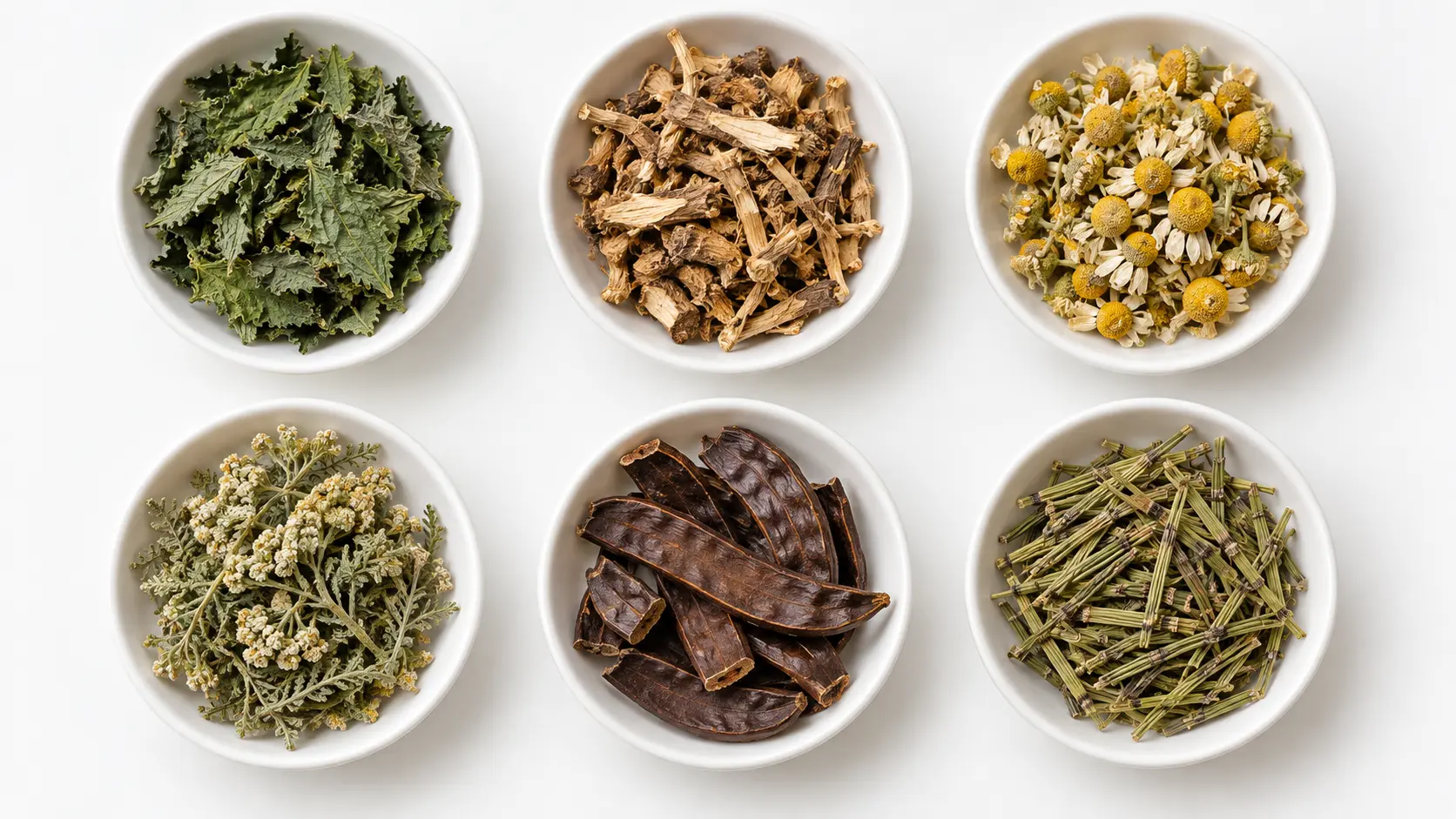
The formulation tested was not nettle leaf extract alone. It contained six herbal extracts: Urtica urens leaf extract, Urtica dioica root extract, Matricaria chamomilla flower extract, Achillea millefolium aerial part extract, Ceratonia siliqua fruit extract and Equisetum arvense leaf extract. The nettle component itself was a combination of U. urens leaf and U. dioica root — not U. dioica leaf. Attributing the study's outcome to "nettle leaf extract" alone is inaccurate, and multiple widely shared brand and supplier articles do exactly this.[5]
This does not mean nettle leaf extract has no relevance in hair care. A 2023 in-vitro study showed that U. dioica leaf extract downregulated 5α-reductase type II gene expression in HaCaT keratinocytes — a pathway directly relevant to DHT-mediated scalp biology.[6] And the INCI registration, established trade use and CosIng functional listing (hair conditioning, anti-dandruff, soothing) all support the ingredient's presence in cosmetic hair-care formulations.
For a detailed phytochemical and pharmacopoeial comparison of nettle root and leaf extracts, see Nettle Root Extract vs Nettle Leaf Extract.
03 Key Principle
Ratio Is Not the Same as Formulation Fit
A 50:1 extract sounds more potent than a 10:1. But for a cosmetic formulator, the ratio on the spec sheet is only one variable — and often not the most important one.
Whether an extract works in a given product format depends on its extraction solvent (which determines polarity and what was pulled out of the plant), its solubility or dispersibility (whether it dissolves in the product's base system), and its carrier content (how much of the powder is actual plant-derived material vs maltodextrin). A 50:1 water/ethanol-extracted dry powder will not dissolve in a carrier oil — it will suspend, clump or sediment, regardless of the ratio number.
A higher extract ratio does not automatically mean a better cosmetic active. For formulators, extract composition and vehicle compatibility matter more than the ratio printed on the specification sheet.
This is why the format-selection table below includes solubility and solvent columns alongside the ratio. For a detailed explanation of what 10:1, 30:1 and 50:1 actually represent and how carrier dilution affects the real concentration, see Nettle Leaf Extract Ratio Grades Explained.
04 Format Guide
Choosing a Nettle Leaf Extract Grade by Product Format
| Product format | Preferred extract type | Typical ratio | Solvent / polarity | Solubility requirement | Marker needed? |
|---|---|---|---|---|---|
| Anti-dandruff / oil-control shampoo | Full-spectrum leaf extract | 10:1 | Water or hydroethanolic | Water-dispersible preferred (rinse-off; short contact time) | Usually not — broad polyphenol profile is the goal |
| Anti-hair-loss shampoo | Full-spectrum or standardised leaf extract | 10:1 or β-sitosterol grade | Hydroethanolic | Water-dispersible | If the brand claims β-sitosterol on the label, yes |
| Scalp serum / leave-on tonic | Standardised leaf extract | β-sitosterol 0.8 % HPLC | Hydroethanolic | Must match serum base (aqueous, hydroalcoholic or gel) | Yes — leave-on products carry the ingredient story |
| Conditioner / hair mask | Full-spectrum leaf extract | 10:1–30:1 | Water or hydroethanolic | Dispersion test in conditioner base required | Usually not |
| Scalp oil / oil-based treatment | Oil-soluble extract or oil infusion | Ratio not applicable | Lipophilic extraction (CO&sub2;, oil maceration) | Must be oil-compatible — a standard water/ethanol dry powder will not dissolve in oil | Depends on claim |
The rinse-off washout factor
Shampoo stays on the scalp for 1–3 minutes before rinsing. Most of the extract washes off with the water. This is not a flaw — it is the nature of rinse-off products. But it means that a shampoo alone is a less efficient vehicle for delivering botanical actives to the scalp than a leave-on product.
Pekmezci’s 2018 study supports this directly: the combined use of herbal shampoo + herbal leave-on solution was more effective than using the shampoo alone.[5] For brand clients developing an "anti-hair-loss" line, the supplier-side recommendation should be to suggest a shampoo + serum pairing rather than a single shampoo SKU. The shampoo cleanses and pre-conditions the scalp; the serum is the primary active-delivery vehicle.
This has a procurement implication: the shampoo formulation can use a cost-effective 10:1 ratio extract (it will be rinsed away), while the serum justifies the premium for a standardised β-sitosterol 0.8 % grade (it stays on the scalp).
05 Supplier Checklist
What to Ask Your Extract Supplier Before Formulating
The formulator’s raw-material brief should confirm the following with the extract supplier. Most of these cannot be answered from the product name or ratio alone.
| # | Question | Why the formulator needs it |
|---|---|---|
| 1 | What is the exact INCI name for labelling? | LEAF EXTRACT, EXTRACT and ROOT EXTRACT are separate CosIng entries; must match the ingredient list |
| 2 | What is the extraction solvent? | Determines polarity, compound profile and compatibility with the product base |
| 3 | Is the powder water-dispersible, and has it been tested in a surfactant system? | Critical for shampoo and aqueous formulations; not all dry powders disperse cleanly |
| 4 | What is the native extract percentage vs carrier? | A 10:1 powder that is 50 % maltodextrin delivers half the botanical input per gram |
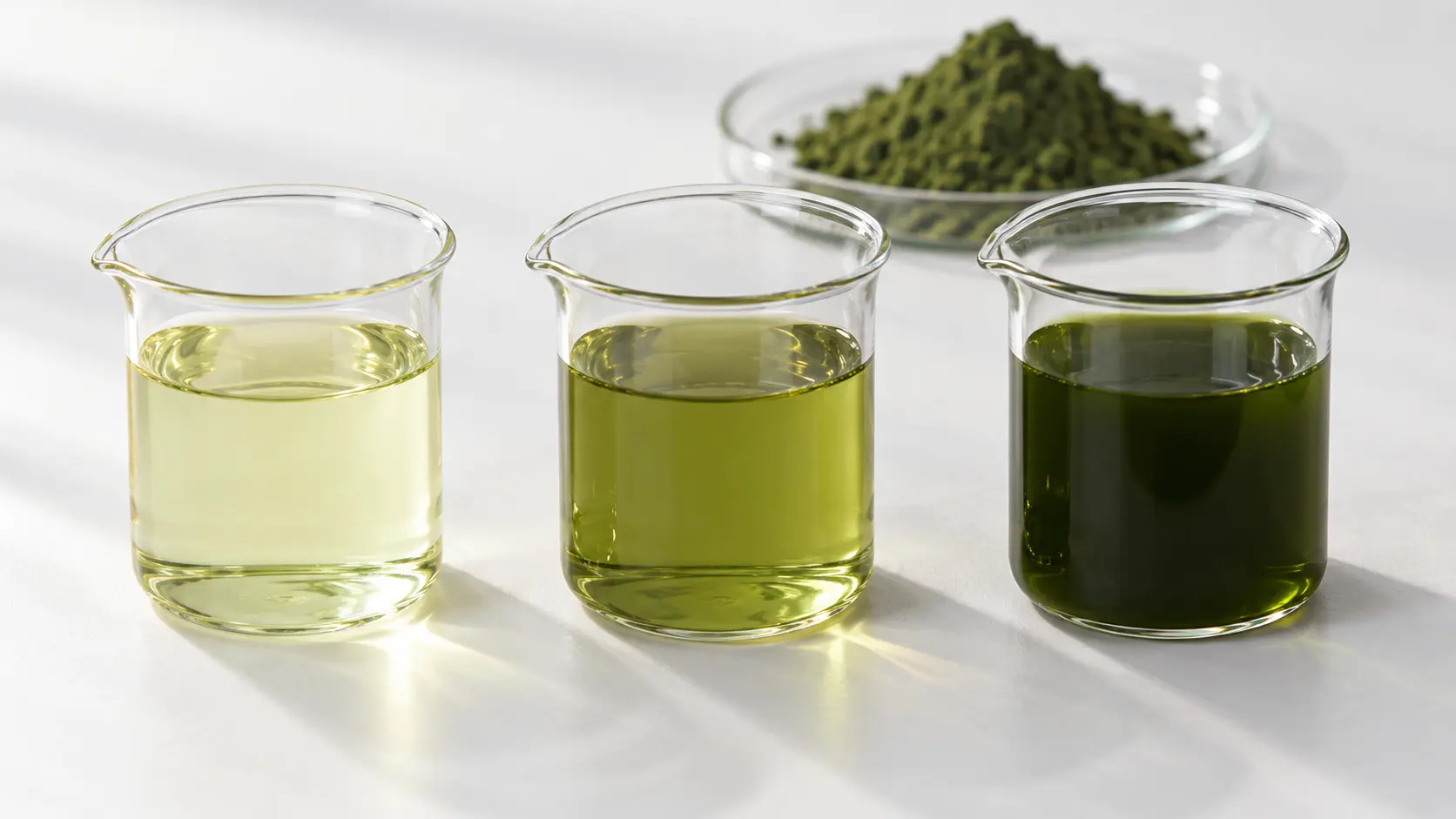
| 5 | What colour will 1 % addition impart to a clear formulation? | Nettle leaf ethanol extracts are deep green to brownish-green — even 0.5 % can visibly tint a transparent base |
| 6 | Is there a marker compound with an HPLC assay? | Needed if the product label declares β-sitosterol content or any quantified botanical active |
| 7 | What pH range is the extract stable in? | Scalp products typically target pH 4.5–6.0; confirm the extract does not degrade or discolour outside this range |
| 8 | Has the extract been tested for preservative compatibility? | Some botanical extracts interfere with preservative efficacy; the supplier should provide guidance or test data |
Label ingredient or functional active?
In many finished products, botanical extracts appear at relatively low inclusion levels. An INCI list alone does not normally reveal the exact concentration — it only indicates the order by weight.
This creates a question the procurement team should ask the brand client early: is the nettle extract being added primarily for label appeal, or is the formulation being designed around a meaningful botanical input?
If the answer is label appeal, the minimum effective inclusion level and the cheapest ratio grade (10:1, no marker) will do. If the answer is functional contribution — the brand wants to build its product story around nettle’s scalp-care properties — then the extract needs to be present at a concentration where its phytochemistry can plausibly contribute, and a marker spec helps substantiate the claim. These are two different procurement briefs with different cost structures.
Common formulation pairings
Nettle leaf extract is rarely the sole botanical active in a hair-care product. The following pairings reflect common market formulation logic — they describe how product development teams typically position multi-botanical hair-care formulas, not demonstrated synergistic effects.
| Pairing | Why formulators combine them |
|---|---|
| Nettle + rosemary | Botanical scalp-care positioning — two traditional herbs with established trade use in hair products |
| Nettle + caffeine | Common in "energising scalp" product concepts; caffeine is a well-known marketing anchor in hair-loss products |
| Nettle + horsetail (Equisetum) | Botanical hair-strength positioning — horsetail contributes silica; Pekmezci 2018 used both |
| Nettle + saw palmetto | DHT-focused product concepts — both ingredients are associated with 5α-reductase-related pathways |
| Nettle + biotin | Botanical + nutritional hair-care positioning — biotin is one of the most widely recognised "hair vitamin" ingredients |
As a supplier, having samples available for the common pairings — nettle leaf extract alongside saw palmetto, rosemary or horsetail — can shorten the formulator’s evaluation cycle.
06 Evidence & Claims
What the Evidence Can Support — and How to Say It on the Label
Evidence boundaries
The published evidence for nettle leaf extract in hair and scalp care includes one multi-herb clinical study (Pekmezci 2018, positive outcome but not attributable to nettle alone), one in-vitro study directly linking U. dioica leaf extract to 5αR-II downregulation (Aydın Köse 2023), a mechanistic rationale around β-sitosterol and VEGF, and a long tradition of use in European scalp-care products.[5][6][7]
This is enough to support a well-positioned cosmetic ingredient with a credible story. It is not enough to call nettle leaf extract a "clinically proven anti-hair-loss active" — that claim would require dedicated human efficacy trials on the specific extract at the specific use level in the specific product format. For a full review of the evidence base behind β-sitosterol and nettle leaf extract, see β-Sitosterol in Nettle Leaf Extract.
Cosmetic-style claims vs drug-like claims
Under EU Regulation (EC) No 1223/2009 and the common criteria for cosmetic claims (EC 655/2013), a cosmetic product cannot claim to treat, cure or prevent a disease or medical condition. The language below illustrates the boundary — final wording should always be reviewed by the brand’s regulatory team for the target market.
| Cosmetic-style positioning | Drug-like claims — use with caution or avoid |
|---|---|
| Helps condition the scalp | Treats hair loss |
| Supports the appearance of healthy-looking hair | Blocks DHT |
| Helps maintain a balanced-feeling scalp | Regrows hair |
| Formulated with nettle leaf extract, traditionally used in scalp care | Treats seborrheic dermatitis |
| Contains β-sitosterol from nettle leaf | Clinically proven to stop hair loss |
The left column describes the product’s cosmetic effect or the ingredient’s heritage. The right column implies therapeutic action or clinical efficacy that a cosmetic product cannot substantiate under most regulatory frameworks. When in doubt, keep the claim about the product experience (“how it feels”) rather than a biological outcome (“what it treats”).
07 FAQ
Frequently Asked Questions
Is the correct INCI name URTICA DIOICA EXTRACT or URTICA DIOICA LEAF EXTRACT?
They are separate CosIng entries. URTICA DIOICA EXTRACT (Ref 80540) refers to an extract of the aerial parts. URTICA DIOICA LEAF EXTRACT (Ref 59990) refers to an extract of the leaves only. The INCI name on the finished product label must match the plant part actually used in the extract. If you supply a leaf-only extract, the correct name is URTICA DIOICA LEAF EXTRACT.
Can I put a standard nettle leaf extract powder into an oil-based scalp product?
A standard water- or ethanol-extracted dry powder is not oil-soluble. Adding it to a carrier oil will result in suspension or sedimentation, not a clear solution. For oil-based formats, request an oil-soluble extract (e.g. CO&sub2; extracted) or an oil-infused preparation from the supplier. Alternatively, the formulator can incorporate the extract into the aqueous phase of an emulsion-based scalp product.
Does the "90 % hair-loss reduction" claim come from a nettle leaf extract study?
The commonly cited figure comes from Pekmezci & Türkoğlu (2018), a 6-month clinical study on 120 subjects. However, the formulation tested contained six herbal extracts — including U. urens leaf and U. dioica root, alongside chamomile, yarrow, carob and horsetail. The result cannot be attributed to nettle leaf extract alone, and the nettle component used was not U. dioica leaf.
Should I recommend a shampoo or a serum to a brand client asking about nettle for hair loss?
Ideally, both. A shampoo is a rinse-off product with 1–3 minutes of scalp contact — most of the extract washes away. A leave-on serum or tonic keeps the botanical actives on the scalp for hours. Pekmezci’s study confirmed that shampoo + leave-on solution outperformed shampoo alone. Suggest a paired SKU approach: shampoo for cleansing and pre-conditioning (10:1 ratio grade), serum for active delivery (β-sitosterol 0.8 % HPLC grade).
What concentration of nettle leaf extract is typically used in a shampoo?
Published patent formulations and formulation guides indicate a range of roughly 0.5–2 % for rinse-off products and 1–5 % for leave-on products. These are reference ranges from patent and formulation literature, not universal standards — the appropriate level depends on the extract type, the product format, the desired colour impact and the brand’s cost structure. The formulator should conduct their own stability and efficacy assessment at the intended use level.
Will nettle leaf extract change the colour of my product?
Yes, almost certainly. Ethanol-extracted nettle leaf powder is deep green to brownish-green. Even at 0.5–1 % in a transparent or light-coloured base, the tint will be visible. Some brands want this — it signals "natural herbal" to the consumer. Others do not. Higher-ratio extracts (30:1, 50:1) tend to be darker due to concentrated chlorophyll-derived pigments. Discuss colour expectations with the formulator before selecting a grade.
What grade does PhytoVale offer for hair-care formulations?
PhytoVale’s nettle leaf extract is available as ratio grades (10:1, 30:1, 50:1) and a standardised β-sitosterol 0.8 % grade (HPLC). All grades are ethanol-extracted from cultivated Urtica dioica L. leaf. The 10:1 is typically recommended for rinse-off shampoo formulations; the β-sitosterol 0.8 % grade for leave-on scalp serums and tonics where a quantified marker supports the product story. Samples and COA are available on request.
References
[1] European Commission CosIng database. INCI entries: URTICA DIOICA EXTRACT (Ref 80540), URTICA DIOICA LEAF EXTRACT (Ref 59990), URTICA DIOICA ROOT EXTRACT (Ref 59992). CAS 84012-40-8. CosIng Database →
[2] EMA/HMPC. European Union herbal monograph on Urtica dioica L.; Urtica urens L., herba. Traditional-use indication: seborrhoeic skin conditions (external).
[3] INCI Beauty. Ingredient frequency data: URTICA DIOICA LEAF EXTRACT (present in 0.41 % of indexed cosmetics); URTICA DIOICA ROOT EXTRACT (present in 0.02 % of indexed cosmetics). View Data →
[4] US Patent 6,113,926. Composition and topical formulation of antiandrogens of natural (plant) origin. Glycolic nettle root extract 10–20 % for topical application. View Patent →
[5] Pekmezci E, Türkoğlu M. A proprietary herbal extract against hair loss in androgenetic alopecia and telogen effluvium: a placebo-controlled, single-blind, clinical-instrumental study. Acta Dermatovenerol Alp Pannonica Adriat. 2018;27(2):51–56. Read Paper →
[6] Aydın Köse A, Demonstir Gürsel G, Akalın Çiftçi G. Urtica dioica extract downregulates the gene expression of 5α-RII in HaCaT cells: possible implications against androgenic skin diseases. Clin Exp Health Sci. 2023;13:116–121. Read Paper →
[7] Baştürk A, Gürsel G, Akalın Çiftçi G, et al. Proprietary Herbal Extract Downregulates the Gene Expression of IL-1α in HaCaT Cells (β-sitosterol and VEGF synthesis). Skin Pharmacol Physiol. 2018;31(5):268–276. Read Paper →
[8] US Patent 11,324,311. Composition and uses for influencing hair growth. Formulation example containing Urtica Dioica (Nettle) Extract at 1 %. View Patent →
[9] Regulation (EC) No 1223/2009 of the European Parliament and of the Council on cosmetic products. Common criteria for the justification of claims (Commission Regulation EU No 655/2013).
Reviewed by
Prof. Bingji MaScientific Adviser — medicinal plant science, phytochemistry, natural products quality
This article is provided for informational purposes for ingredient buyers and cosmetic formulators. It does not constitute regulatory advice, health-claim guidance or formulation instruction. Cosmetic claims, ingredient labelling and product safety assessments should be reviewed by qualified professionals in the target market. Information is current as of October 2026; regulatory standards and pharmacopoeial monographs may be updated — always consult the latest edition.